
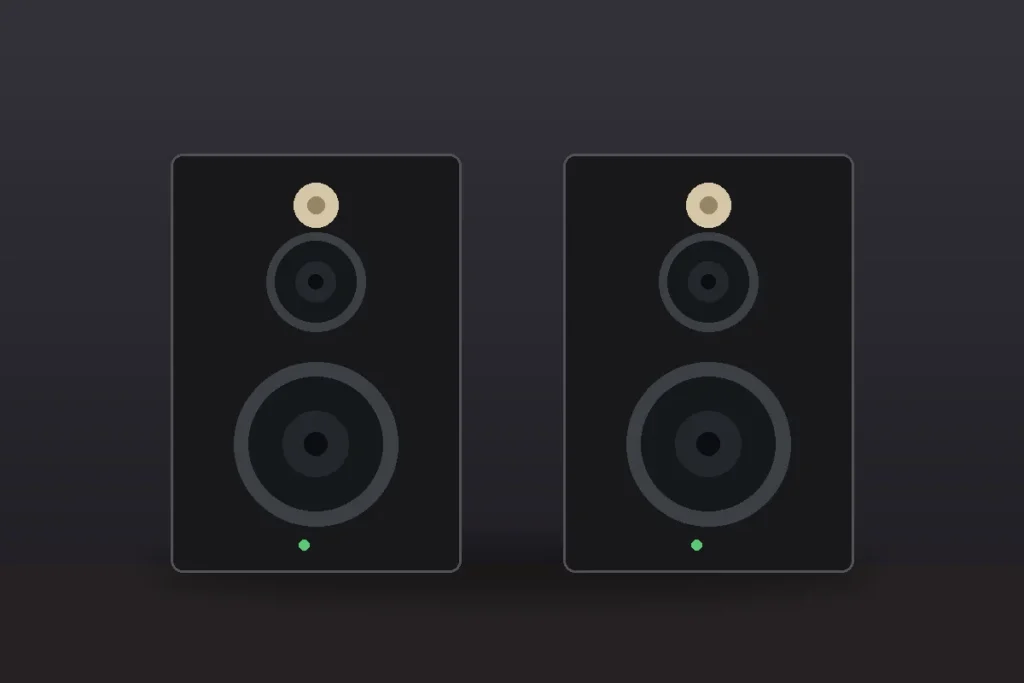
This Edifier MR5 review covers a speaker pair that makes a different promise from the lifestyle bookshelf crowd. The MR5 is a nearfield studio monitor set: a 3-way, tri-amped design with a 5-inch woofer, a dedicated 3.75-inch midrange driver and a 1-inch silk dome tweeter per cabinet, 110 watts RMS in total, and a flat response rated from 46 Hz to 40 kHz. Then, unusually for the category, Bluetooth 6.0 with LDAC lets it stream from a phone like a normal speaker. This review covers the Black pair, listed on Amazon US under ASIN B0F5B73RGT.
A note on method. This is a research review, built from Edifier’s published specifications and the verified Amazon US listing for this exact model. We have not had a pair on the desk, so nothing here claims hands-on testing, and speaker products on this site carry no scores.
Buy the Edifier MR5 if you make music, edit video or mix audio at a desk and want monitors that tell the truth, with Bluetooth streaming for after hours. The tri-amped 3-way layout is a genuine step beyond the 2-way pairs that dominate this tier, the balanced inputs connect to a proper interface without adapters, and the room trims fix the boundary problems most desks create. The sound is flat rather than flattering, there is no remote and no HDMI, and the pair is a fixed desk installation, not a portable anything. Casual listeners who want their speakers to add excitement should compare the entertainment-tuned options in our best powered speakers guide instead. Check Price on Amazon

Why you: A true 3-way, tri-amped monitor pair: 5-inch woofer, a dedicated 3.75-inch midrange and a silk dome tweeter, each with its own amplifier, a flat 46 Hz to 40 kHz response, balanced inputs and room-compensation trims. Bluetooth 6.0 with LDAC covers the casual listening most monitors refuse to do.
Trade-off: The tuning is flat on purpose, so it flatters nothing and fills a desk rather than a party. The pair weighs 10.38 kg and needs mains power and desk space, with no battery or weatherproofing anywhere in the design.
Edifier MR5 specifications
| Spec | Edifier MR5 (pair) |
|---|---|
| Model | Edifier MR5 2.0 studio monitor pair (Black) |
| Design | 3-way, tri-amped active crossover at 155 Hz and 2600 Hz |
| Drivers (per cabinet) | 5-inch woofer, 3.75-inch midrange, 1-inch silk dome tweeter |
| Amplification | 110W RMS total (30W + 30W bass, 15W + 15W mid, 10W + 10W treble) |
| Frequency response | 46 Hz to 40 kHz, flat target, Hi-Res Audio certified |
| Maximum SPL | 101 dB at 1 m |
| Inputs | Balanced XLR, balanced 1/4-inch TRS, unbalanced RCA, 3.5mm AUX |
| Wireless | Bluetooth 6.0 with LDAC and SBC, multipoint |
| Outputs | Front 3.5mm headphone output |
| Controls | Rear high and low frequency trim knobs, EQ via Edifier ConneX app, full DSP |
| Power | AC mains; active master speaker plus passive slave, sold as a pair |
| Dimensions (per speaker) | Active 159 x 264 x 280 mm; passive 159 x 264 x 257 mm |
| Weight | 10.38 kg per pair |
The 3-way, tri-amped design is the story
Most speakers at this level are 2-way designs: a woofer handles bass and midrange together, a tweeter handles the top, and the midrange, where voices and most instruments live, is a compromise shared by a driver busy doing something else. The MR5 gives the midrange its own 3.75-inch driver and its own 15-watt amplifier per side, with active crossovers at 155 Hz and 2600 Hz handing each band to the driver built for it. The woofer gets 30 watts a side, the tweeter 10 watts a side, and the total reaches 110 watts RMS across the pair.
The practical payoff is clarity at desk distance. Vocals, dialogue and acoustic instruments sit in the midrange, and a dedicated driver presents them without the woofer’s bass duties muddying the same cone. Maximum output is 101 dB at a metre, which is far more than nearfield listening needs and enough for a small room. Our explainer on 2-way vs 3-way speakers walks through why the extra driver changes what you hear.
A flat response, and what that means at your desk
Edifier rates the response at 46 Hz to 40 kHz with a flat target and Hi-Res Audio certification. Flat means the speaker adds no signature of its own: bass is present at the level the recording carries, treble is detailed without being pushed, and a bad mix sounds bad on purpose, because finding that out is the job. For producers and editors this honesty is the entire point. A mix that translates well from the MR5 will sound right on earbuds, car systems and club rigs alike.
For pure entertainment the same honesty cuts both ways. Films will not rumble the desk, and bass-led music arrives accurately rather than generously. The low end reaches 46 Hz, respectable for a 5-inch woofer, but there is no subwoofer output theatrics here. Buyers who mostly watch and play should weigh that before choosing a monitor over an entertainment speaker.
Inputs: a proper studio connection set
The rear panel covers the full working set. Balanced XLR and balanced 1/4-inch TRS inputs take an audio interface, a mixer or a controller with the noise rejection long cable runs need. Unbalanced RCA and a 3.5mm AUX input handle consumer sources, and a front-panel 3.5mm headphone output lets you switch to silent monitoring without reaching behind anything. The active speaker carries the electronics, the passive slave links by a multi-pin cable, and one mains lead powers the pair.
Bluetooth 6.0 is the surprise entry. LDAC support means a phone or laptop streams at high bitrates, multipoint keeps two devices connected, and the monitors double as genuinely good desk speakers for everything that is not work. Many monitors at this level omit wireless completely on principle. Edifier’s position, that a desk speaker should also play your phone, is the more useful one.
Room trims and DSP: tuning for real desks
Monitors live against walls, on desks, in corners, and every one of those placements bends the bass. The MR5 answers with rear-panel high and low frequency trim knobs for room compensation, so a pair pushed against a wall can have its boundary bass lift trimmed back instead of booming through every mix. Full DSP with dynamic range control runs underneath, and the Edifier ConneX app adds EQ adjustment from the listening position rather than from behind the speaker.
These are working features, not decoration. Placement flexibility is what separates a monitor that performs in a brochure room from one that performs in yours, and small rooms are exactly where this pair will spend its life.
MR5 vs MR4: where the step up goes
Against the MR4 it succeeds, the MR5 changes the architecture rather than the styling. The 2-way, 42-watt design becomes a 3-way, tri-amped 110-watt system with the dedicated midrange driver, and Bluetooth with LDAC arrives where the MR4 had no wireless at all. An MR4 owner gains midrange clarity and streaming. A first-time buyer skips a generation of compromise. Edifier’s own entertainment bookshelf line sits on the other side of the fence: our Edifier R1280DB review covers the pair built for listeners who want the brand’s sound with a warmer, friendlier tuning.
Placement notes
Each cabinet is about 159mm wide and 264mm tall, with the active speaker 280mm deep. On a desk they want stands or isolation pads that lift the tweeters to ear height and decouple them from the desk surface, angled in toward the listening position in the usual nearfield triangle. The pair weighs 10.38 kg in total, so this is furniture, installed once and left alone. There is no battery, no weatherproofing and no carry handle, by design.
Setup is a one-time job of about fifteen minutes. Connect the interface or source to the active speaker, run the link cable to the slave, set both cabinets at an equal distance from your seat, then work through the trims with a recording you know well. Most desks need a small low-frequency cut, because a cabinet placed close to a wall gets a bass lift from the boundary behind it. Once set, the pair asks for nothing: volume lives on your interface or in the app, and the Bluetooth source reconnects on its own.
Who should buy the Edifier MR5
Buy it if you record, produce, mix, edit or stream at a desk and need monitoring that translates, or if you are a listener who has discovered they prefer accuracy to excitement. The input set connects to a real studio chain today and the Bluetooth covers everything else tonight.
Skip it if you want a living-room speaker, a remote-controlled TV setup or added bass weight for films. Those needs belong to entertainment speakers, and no amount of monitor accuracy will substitute for them.
Frequently asked questions
Are the Edifier MR5 sold as a pair?
Yes. The MR5 is a 2.0 system: one active master speaker with the amplifiers and inputs, and one passive slave linked by a multi-pin cable. Both cabinets are included, and the pair runs from a single mains connection to the active speaker.
Does the Edifier MR5 have Bluetooth?
Yes. Bluetooth 6.0 with LDAC and SBC, plus multipoint, so a phone or laptop connects wirelessly at high quality alongside the wired studio inputs. That is unusual at this level, where many monitors are wired only.
What can you connect to the MR5?
Almost any source. Balanced XLR and 1/4-inch TRS take an audio interface or mixer, RCA and 3.5mm AUX take consumer gear, and Bluetooth covers phones and laptops. A front 3.5mm headphone output handles silent monitoring.
Is the MR5 good for casual listening and TV?
It works well if you like an honest sound. The flat tuning does not add bass weight or sparkle, so films and games sound clear rather than cinematic, and there is no remote control or HDMI input. Listeners who want excitement added should look at entertainment speakers instead.
What is the difference between the Edifier MR5 and MR4?
The MR5 moves from the MR4’s 2-way design and 42W total to a 3-way tri-amped system at 110W RMS with a dedicated midrange driver, and it adds Bluetooth 6.0 streaming with LDAC, which the MR4 lacked entirely.

I am the founder of Sound Mavericks, where I provide the polite truth about audio equipment. I started this site because consumer electronics reviews are often too technical. Instead of using a silent lab, I test headphones, earbuds, and Bluetooth speakers in the real world – like on a noisy subway or in a busy coffee shop.
To stay independent, I buy my own review units (mostly from the United States) rather than accepting free gifts from brands. Once I finish testing a product, I sell it locally to our community. My goal is to help you understand sound quality, active noise cancellation (ANC), and battery life without the marketing hype.

