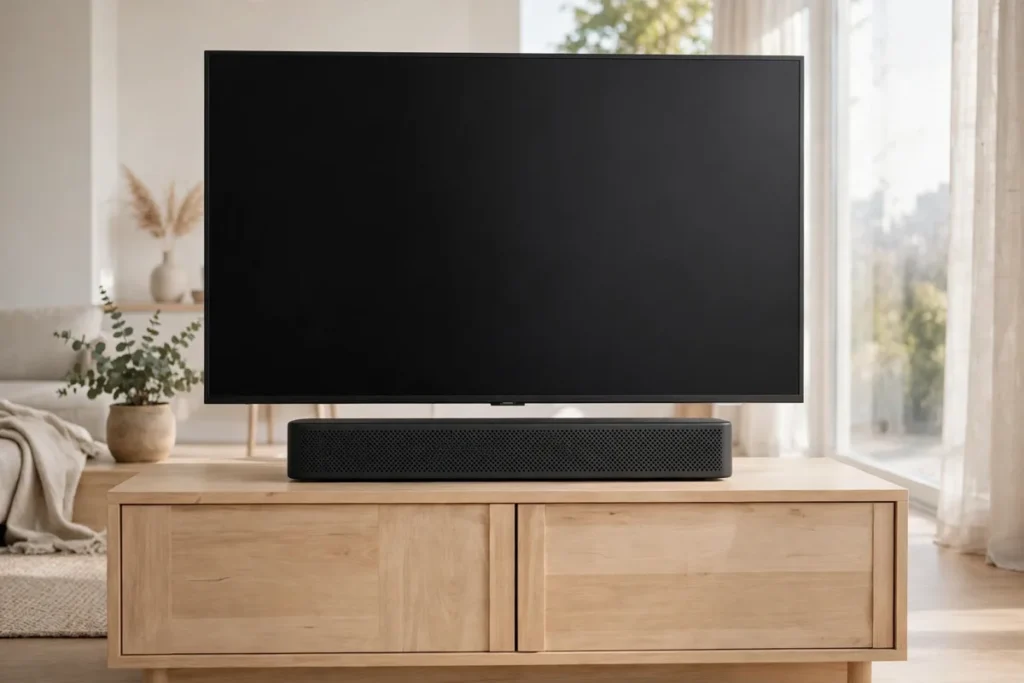
This Sony BRAVIA Theater Bar 7 review covers Sony’s HT-A7100, a single soundbar with nine speaker units, dedicated up-firing drivers for height effects, and 360 Spatial Sound Mapping to widen the stage beyond the cabinet. It decodes Dolby Atmos and DTS:X, carries IMAX Enhanced certification, and passes modern gaming video through its HDMI connection. It also needs clear positioning before anything else. The Bar 7 sits below the BRAVIA Theater Bar 8 and Bar 9 in Sony’s line, with fewer speaker units than either, and it is not their replacement. It is the smaller, simpler step into the same system, built for rooms and screens where the wider flagship bars are too much.
A note on method. This is a research review, built from Sony’s published specifications, the verified Amazon US listing for this exact model, and independent coverage of the bar. We have not had a unit in the room, so nothing here claims hands-on testing, and speaker products on this site carry no scores. The verdict is in prose: what the hardware does, where it is strong, and where a buyer should spend more or look elsewhere.
Buy the Sony BRAVIA Theater Bar 7 if you want real height channels and room-mapped surround from one bar under your TV, without a separate subwoofer box in the corner on day one. Nine speaker units, two of them firing at the ceiling, give Atmos and DTS:X content a physical start that virtual processing bars cannot copy, and Sound Field Optimization tunes the result to your room. The honest limits are bass weight and scale. No subwoofer is included, so deep low end stays polite until you add one of Sony’s optional subs, and buyers who want the widest stage in the family should look at the Bar 8 and Bar 9 above it. For a mid-size room and a BRAVIA TV in particular, this is the balanced point in the line. Check Price on Amazon
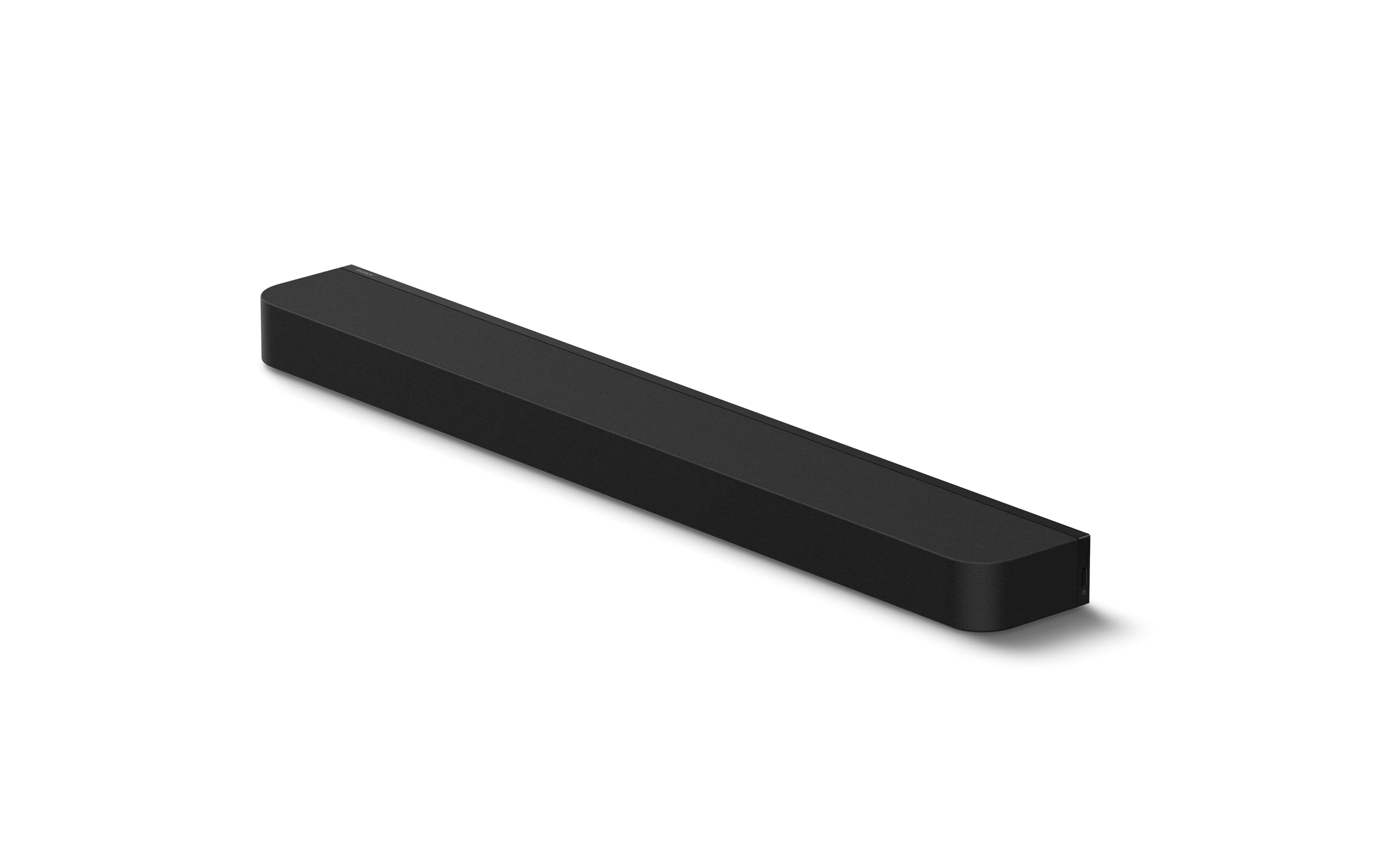
Why you: It packs nine speaker units into a bar under 38 inches wide, with dedicated up-firing and side-firing drivers, 360 Spatial Sound Mapping that adds five phantom speakers, and room calibration that sets the sound field for your seating position.
Trade-off: No subwoofer is in the box. Bass is handled inside the bar until you add an optional Sony sub, and the Bar 8 and Bar 9 above it carry more speaker units for larger rooms.
Sony BRAVIA Theater Bar 7 specifications
| Spec | Sony BRAVIA Theater Bar 7 |
|---|---|
| Model | HT-A7100 (HTA7100.UC2) |
| Speaker units | 9 units, including dedicated up-firing and side-firing drivers and a center channel |
| Channels | 5.0.2 with 360 Spatial Sound Mapping adding five phantom speakers |
| Total output | 405W |
| Formats | Dolby Atmos, DTS:X, IMAX Enhanced |
| Room calibration | Sound Field Optimization |
| Dialogue | Voice Zoom 3 with a compatible BRAVIA TV |
| TV connection | HDMI 2.1 eARC with 4K/120, VRR and ALLM passthrough |
| Streaming | Bluetooth, AirPlay 2, Spotify Connect, BRAVIA Connect app control |
| Subwoofer | None included. Dual subwoofer capability with optional BRAVIA Theater Sub 7, Sub 8 or Sub 9, plus optional Rear 9 surrounds |
| Size and weight | 37.5 in wide x 2.6 in high x 5 in deep, 10.2 lb |
Where the Bar 7 sits in Sony’s line
Sony sells three bars in this family, and the numbers in the names describe the order. The Bar 7 carries nine speaker units. The Bar 8 above it carries eleven, and the Bar 9 at the top carries thirteen, in wider cabinets built for larger screens and larger rooms. The Bar 7 is a newer mid-tier addition below both, not a replacement for either, and a Bar 8 or Bar 9 owner gains nothing by switching to it. What the smaller bar keeps from its siblings is the important part: the same format support, the same 360 Spatial Sound Mapping system, the same room calibration, and the same path to add Sony subs and rears later. What it gives up is driver count, cabinet width and the sheer scale that comes with them.
That trade suits a lot of living rooms. At 37.5 inches wide, the Bar 7 sits comfortably under mid-size TVs without hanging past the edges of the stand, and its 2.6-inch height keeps it below most screens. In a small or medium room, nine well-placed units with calibration will usually beat a wider bar whose side drivers fire straight into nearby walls and furniture.
Nine speaker units, and why the layout matters
Count matters less than placement, and placement is the Bar 7’s argument. Alongside the front drivers and a dedicated center channel for dialogue, Sony fits up-firing drivers that bounce height effects off the ceiling and side-firing drivers that push the stage wider than the cabinet. Many bars at this level simulate height with processing alone. Here the height channels are physical speakers, so an Atmos mix has real drivers to work with when a scene puts rain overhead or a helicopter above the front wall.
The center channel deserves its own mention. Dialogue anchored to a dedicated center driver stays put when effects get busy at the sides, which is the failure mode of stereo bars that split speech between left and right. Sony rates the system at 405W of total output. Treat that figure as a ceiling rather than a description of daily listening, but it does signal headroom: the bar should stay composed at the volumes a mid-size room actually asks for, instead of thinning out when a film gets loud.
360 Spatial Sound Mapping and room calibration
360 Spatial Sound Mapping is Sony’s processing layer on top of the physical drivers. It creates five phantom speakers in front of the listener, positions that behave like extra speakers placed around the room, and uses reflections from the ceiling and walls to build a surround field from the single bar. It works alongside Dolby Atmos and DTS:X decoding rather than replacing it, widening what the nine units can present.
Sound Field Optimization is the setup step that makes the mapping honest. The calibration measures your room and seating position, then adjusts the sound field to match, so the phantom positions land where your walls actually are instead of where a test lab’s walls were. Single-bar surround lives or dies on this kind of correction, because every room reflects differently. Run the calibration after any furniture move, not just on the first day. Readers comparing TV-first audio routes can also see our guide to speakers for TV sound for the simpler end of the same problem.
Formats, dialogue and the BRAVIA TV pairing
The format list is complete for current streaming and disc content: Dolby Atmos, DTS:X and IMAX Enhanced certification, the last of those applying to compatible titles played with compatible gear. Between Atmos and DTS:X, the major streaming services and game consoles are covered, so format support should not be the reason a buyer steps up to a bigger bar.
Voice Zoom 3 handles the most common soundbar complaint, speech buried under effects and music. It lifts dialogue independently of the rest of the mix, and it needs a compatible BRAVIA TV to do it. Owners of other TV brands still get the center channel and the bar’s own sound modes, but the tightest integration in this product, Voice Zoom 3, Acoustic Center Sync (which lets a compatible BRAVIA TV’s speakers work as part of the center channel), and control through the TV’s own menus, is reserved for Sony screens. That is the clearest fork in this review. With a BRAVIA TV, the Bar 7 is a matched component. Without one, it is a strong general-purpose Atmos bar competing on driver layout and calibration alone.
HDMI, gaming and everyday connections
One HDMI 2.1 connection with eARC carries audio from the TV and passes video through with support for 4K at 120Hz, variable refresh rate and auto low latency mode. For players, that means a current console can run through the bar without giving up the high-refresh and low-lag features the TV was bought for, and Dolby Vision and HDR formats pass through as well. Setup is the standard modern pattern: one cable to the TV’s eARC port, the BRAVIA Connect app for calibration and settings, and the TV remote for daily volume.
When the screen is off, the bar works as a music speaker. Bluetooth takes direct playback from a phone or laptop, AirPlay 2 covers Apple devices, and Spotify Connect hands playback to the bar from the Spotify app. The BRAVIA Connect app is also where firmware updates and the optional speaker pairing live, so it is worth installing even if you prefer the remote for volume. For headphone-based Atmos listening instead of a room system, our guide to headphones for Dolby Atmos covers that route.
Bass, and growing the system later
Start with the plain fact: no subwoofer is included with the Bar 7. Bass comes from the woofers inside the bar itself. For news, drama, sport and most streaming series, that is enough, and the clean single-box setup is part of the appeal. For action films and games with real low-frequency content, a compact cabinet has a physical ceiling, and no processing setting changes it. Judge the bar on that basis rather than expecting cinema low end from a 10.2 lb box.
The expansion path is where Sony’s system design earns its keep. The Bar 7 has dual subwoofer capability, meaning it can run a pair of Sony’s optional subs, and it pairs with the BRAVIA Theater Sub 7, Sub 8 or Sub 9 depending on how much low end the room needs. BRAVIA Theater Rear 9 speakers add genuine rear channels for listeners who later want sound behind the sofa instead of a mapped front field. None of this is required at purchase, and that sequencing is the sensible way to buy into the line: bar first, sub when bass is the complaint, rears last. Our guide to the best Sony headphones covers the personal-audio side of the same brand for readers splitting time between the TV and a desk.
Who should buy it, and who should skip it
Buy it if you own or plan to buy a compatible BRAVIA TV, your room is small to medium sized, and you want physical height drivers, room calibration and a clear upgrade path in one bar. It also suits gamers who need 4K at 120Hz passthrough with VRR and ALLM, and anyone who wants to start with a single box and add a sub or rears only if a real gap shows up.
Skip it if deep bass from day one is non-negotiable and you have no plan to add a sub, because a bar-only setup will leave big scenes sounding polite. Skip it if your room is large and your screen is wide, where the Bar 8 and Bar 9 above it in Sony’s line carry the driver counts built for that space. And skip it if dialogue tools are your main reason to buy but your TV is not a compatible BRAVIA model, since Voice Zoom 3 will not be available to you.
Frequently asked questions
Is the Sony BRAVIA Theater Bar 7 a replacement for the Bar 8 or Bar 9?
No. The Bar 7 sits below both in Sony’s line. It carries nine speaker units against eleven in the Bar 8 and thirteen in the Bar 9, in a narrower cabinet, and it keeps the same format support, 360 Spatial Sound Mapping and expansion options at a smaller scale.
Does the Sony BRAVIA Theater Bar 7 include a subwoofer?
No. No subwoofer is included, and bass is handled by the woofers inside the bar. It has dual subwoofer capability and pairs with the optional BRAVIA Theater Sub 7, Sub 8 or Sub 9, sold separately, plus optional Rear 9 surround speakers.
Does the Sony BRAVIA Theater Bar 7 support Dolby Atmos and DTS:X?
Yes. It decodes Dolby Atmos and DTS:X and carries IMAX Enhanced certification for compatible content and gear. Dedicated up-firing drivers handle height effects, and 360 Spatial Sound Mapping adds five phantom speakers to widen the surround field.
Does the Sony BRAVIA Theater Bar 7 work with a non-Sony TV?
Yes. It connects to any TV over HDMI eARC and plays Atmos and DTS:X content the same way. Some features need a compatible BRAVIA TV, including Voice Zoom 3 and Acoustic Center Sync, so Sony TV owners get the full feature set.
Can the Sony BRAVIA Theater Bar 7 pass 4K at 120Hz for gaming?
Yes. Its HDMI 2.1 connection passes 4K video at 120Hz with variable refresh rate and auto low latency mode, so a current console keeps its high-refresh and low-lag modes when it runs through the bar.

I am the founder of Sound Mavericks, where I provide the polite truth about audio equipment. I started this site because consumer electronics reviews are often too technical. Instead of using a silent lab, I test headphones, earbuds, and Bluetooth speakers in the real world – like on a noisy subway or in a busy coffee shop.
To stay independent, I buy my own review units (mostly from the United States) rather than accepting free gifts from brands. Once I finish testing a product, I sell it locally to our community. My goal is to help you understand sound quality, active noise cancellation (ANC), and battery life without the marketing hype.