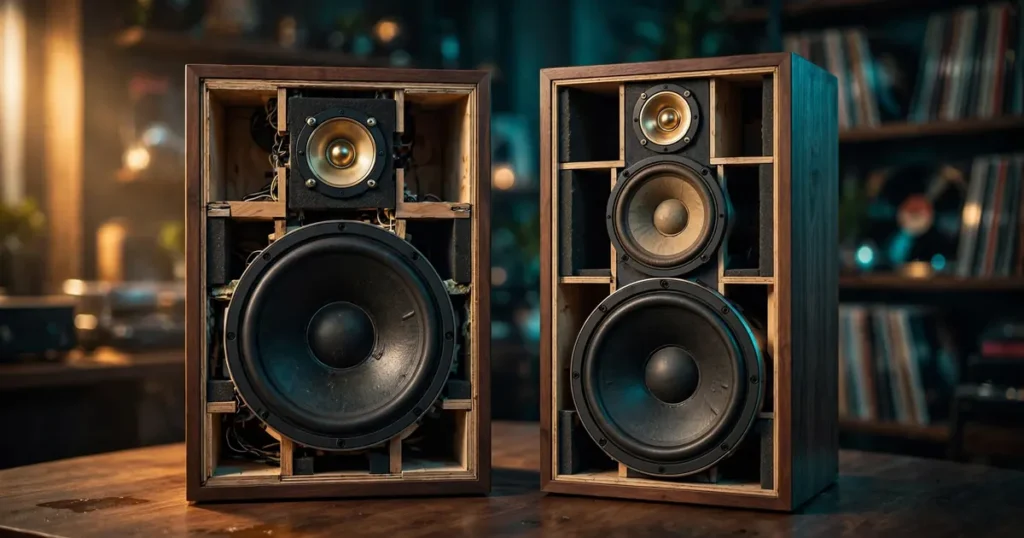
Shopping for speakers, you’ve probably run into the terms 2-way and 3-way — on bookshelf speakers, floorstanding towers, even car door speakers. The numbers aren’t marketing fluff: they describe how many driver sections split up the sound. The difference matters more than most people expect, because the critical midrange — vocals, guitars, snare drums — is where these two designs diverge most. Here’s how they work, where each one wins, and which one makes sense for your room.
What Does “2-Way” Mean?
A 2-way speaker divides the audio signal into two frequency bands and assigns each to a dedicated driver:
- Tweeter: handles the highs (roughly 2,000 Hz and up) — cymbals, vocal sibilance, detail and air.
- Woofer: handles everything below that — bass and, critically, the midrange (roughly 200 Hz to 2,000 Hz), where vocals and most instruments live.
A crossover is the circuit that splits the signal at a chosen crossover point (often around 2–3 kHz) and sends each band to the right driver. With only one crossover point to get right, 2-way speakers are simpler to engineer well. That simplicity is why some of the most beloved bookshelf monitors ever made are 2-way designs — done properly, they image with a wide, precise soundstage, with vocals that hang in a precise spot between the speakers.
The tradeoff is workload. The woofer covers roughly two octaves more ground than its counterpart: it’s reproducing deep bass and the full midrange at the same time. Ask it to play loud, and midrange detail can smear as the driver excursion climbs.
What Does “3-Way” Mean?
A 3-way speaker splits the signal into three bands, adding a dedicated driver:
- Tweeter: highs (roughly 3,000–5,000 Hz and up).
- Midrange driver: the middle band (roughly 300 Hz to 3–5 kHz) — the zone where nearly all vocals, guitars, and piano live.
- Woofer: freed from midrange duty, it focuses on bass alone (below roughly 300 Hz).
Each driver handles a narrower slice, so each can be optimized for its job. The midrange driver — the star of the show — can be sized and tuned specifically for the frequencies our ears are most sensitive to. The practical result is usually cleaner, more effortless mids at higher volumes, and better dynamic headroom overall.
The cost of that specialization is complexity: two crossover points instead of one, which have to be blended so the handoff between drivers sounds seamless. It’s harder to design well, and bad 3-way crossovers can sound worse than a well-tuned 2-way — more drivers is not automatically more quality.
Crossovers: The Traffic Cops of Your Speaker
Drivers can’t read sheet music — they need instructions. That’s the crossover’s job: it’s an electronic circuit inside the speaker that splits the incoming signal by frequency and routes each slice to the right driver. A 2-way crossover has one handoff (lows to highs); a 3-way has two (lows to mids, mids to highs).
Here’s why that matters more than the driver count: a bad crossover ruins good drivers. If the handoff between woofer and tweeter is sloppy, you get audible gaps or peaks in the frequency response — vocals can sound hollow or nasally around the crossover point. A 3-way gives engineers finer control (three optimized zones), but it also gives them twice as many handoffs to get wrong. This is why experienced listeners always say to audition specific models: two speakers with identical driver counts can sound worlds apart based purely on crossover tuning.
A related truth worth knowing: crossover complexity is also why a budget 3-way often loses to a mid-tier 2-way. The parts and engineering time to nail two crossovers cost real money, and cheap 3-ways are where corners get cut first.
Common Myths About 2-Way and 3-Way Speakers
Myth: more drivers always sound better. Quality of the drivers, cabinet, and crossover matters far more than the count. Plenty of legendary studio monitors are 2-way.
Myth: 3-way speakers are always louder. Loudness depends on sensitivity and power handling of the specific design, not driver count. A sensitive 2-way on a modest amp can outplay a power-hungry 3-way that’s starved for juice.
Myth: you need a 3-way if you have a subwoofer. Actually, adding a subwoofer reduces the case for a 3-way: the sub takes over bass duties, freeing a 2-way’s woofer to focus on the mids — the exact workload problem a 3-way solves. A 2-way bookshelf paired with a good sub is one of the best-value setups in audio.
Myth: a “3-way” car speaker with two tiny tweeters is a true 3-way. Many budget coaxial car speakers labeled 3-way are really a woofer, tweeter, and “super tweeter” — an extra high-frequency driver, not a real midrange. It adds sparkle on a spec sheet, not midrange authority.
Key Differences Compared
Here’s the head-to-head breakdown:
| Factor | 2-Way Speakers | 3-Way Speakers |
|---|---|---|
| Driver layout | Woofer + tweeter | Woofer + midrange + tweeter |
| Midrange clarity | Good, but woofer does double duty on mids and bass | Excellent — dedicated driver for the critical mid band |
| Crossover | Simpler single crossover point, fewer blending risks | Two crossover points; harder to design, more seamless when done right |
| Output & dynamics | More limited at high volumes | Typically higher power handling and dynamic headroom |
| Size | Compact — easy to place as bookshelves or desktop monitors | Larger cabinets — mostly floorstanding towers |
| Room fit | Suits small to medium rooms, nearfield listening | Fills large rooms; needs distance from walls and a proper listening position |
| Budget | Generally more affordable | Generally costs more — extra driver, crossover, cabinet |
| Best for | Desks, bedrooms, casual listening, first serious setup | Large living rooms, home theater, critical listening |
The Midrange Is Where the Decision Lives
If there’s one thing to take away, it’s this: the midrange carries roughly 70% of musical information. A 2-way speaker reproduces it through the same cone that’s pumping bass. At moderate volumes in a small room, that’s fine — great, even. But push the volume and the woofer’s cone motion starts to modulate the midrange, adding a subtle roughness that audiophiles call intermodulation distortion.
A 3-way’s dedicated midrange driver stays calm while the woofer does the heavy lifting. The result is vocals and instruments that stay composed and separated at realistic listening levels — the reason 3-way designs dominate serious home theater front stages and high-end listening rooms.
When 3-Way Matters Most (and When It Doesn’t)
3-way earns its keep when: your room is large (open-plan living rooms, dedicated theater spaces), you listen at theater-like volumes, or your main use is music with rich midrange content — jazz, classical, vocal-heavy genres — where small distortions in the mids are most audible.
2-way is honestly the smarter buy when: the speakers will sit on a desk or in a bedroom, you’re listening nearfield, or your budget is limited. A well-engineered 2-way bookshelf will outperform a cheap, poorly crossed-over 3-way tower every time. This is the honest truth most comparison articles bury: design quality beats driver count. A great 2-way beats a mediocre 3-way.
What About 2-Way vs 3-Way in Car Speakers?
The same terms show up in car audio, with one twist: car speakers are often coaxial (all drivers mounted on one axis in a single speaker) rather than separate components. A 2-way coaxial car speaker stacks a tweeter on the woofer; a 3-way (triaxial) adds a small midrange or, on cheaper models, a second small “super tweeter” for the top end rather than a true midrange driver.
The general logic holds: a genuine midrange driver helps, but in a noisy car cabin the gains are subtler than in a quiet living room. For most commuters, a quality 2-way set from a reputable brand is the sweet spot; consider 3-way components if you’re building a serious system with a subwoofer and proper amplification.
Which Should You Buy? Our Verdict
Here’s how we’d call it, based on the room and the use case:
- Small room, desk, or bedroom → 2-way. Simpler, cheaper, easier to place, and a quality pair images beautifully nearfield.
- Medium room, mixed music and movies → either works. Buy on quality of design, not driver count — compare specific models head to head.
- Large room, home theater, or critical listening → 3-way. The dedicated midrange and extra dynamic headroom genuinely pay off once the room and volume grow.
One last practical note: whichever you choose, placement does more for sound quality than the driver count ever will. Getting your speakers off the wall, toed in toward your listening seat, and decoupled from the surface they sit on is free and audible. If your speakers sit on a desk, foam pads under your speakers tighten up the bass noticeably.
Frequently Asked Questions
Is a 3-way speaker always better than a 2-way?
No. A well-engineered 2-way outperforms a poorly designed 3-way every time. More drivers only help when the crossover design is good enough to blend them seamlessly. Judge specific models, not the driver count on the spec sheet.
Do 3-way speakers need more amplifier power?
Often, yes — the extra driver and more complex crossover can make them slightly less efficient, and they’re designed for bigger rooms and louder listening. Check the speaker’s sensitivity rating and match your amplifier accordingly; an underpowered amp driven into clipping is what damages speakers, not the speaker’s wattage rating.
What’s the difference between coaxial and component 2-way speakers?
In a coaxial speaker, the tweeter sits on the same axis as the woofer (common in car audio and some bookshelf speakers), while component speakers separate them into individual units you place independently. Component placement gives you more control over imaging; coaxial keeps things compact and simple.
Can 2-way speakers produce deep bass?
Yes, if the woofer and cabinet are designed for it — many 2-way bookshelves reach surprisingly deep. But the woofer is doing double duty on bass and midrange, so the loudest, cleanest bass usually comes from larger 3-way towers or from adding a dedicated subwoofer. That’s also why speaker driver design — like the dynamic vs planar magnetic driver debate in headphones — shapes what a speaker can do more than the driver count alone.
Are 3-way speakers good for nearfield desktop listening?
Generally not the ideal pick. The multiple drivers of a 3-way need distance to blend into a coherent soundstage, and the large cabinets dominate a desk. A quality 2-way bookshelf or nearfield monitor is the better desktop choice — you’ll get a tighter stereo image at arm’s length.

I am the founder of Sound Mavericks, where I provide the polite truth about audio equipment. I started this site because consumer electronics reviews are often too technical. Instead of using a silent lab, I test headphones, earbuds, and Bluetooth speakers in the real world – like on a noisy subway or in a busy coffee shop.
To stay independent, I buy my own review units (mostly from the United States) rather than accepting free gifts from brands. Once I finish testing a product, I sell it locally to our community. My goal is to help you understand sound quality, active noise cancellation (ANC), and battery life without the marketing hype.