The Edifier R1280DB has been a fixture on budget-bookshelf-speaker recommendation lists for years, and for good reason: it’s a powered 2.0 speaker pair that blends old-school hi-fi looks with modern connectivity — Bluetooth 5.0, optical and coaxial digital inputs, dual RCA line-ins, a wireless remote, and physical bass/treble knobs. Our verdict after digging through the specs, published reviews and owner feedback: it’s one of the most versatile entry-level powered speakers you can buy, especially if your setup mixes a TV, a turntable and a phone. It’s not perfect — there’s no phono preamp, no USB input and Bluetooth codec support is basic — but the sound, build and input flexibility punch well above the price class.
A quick note on how this review is built: SoundMavericks scores are based on our analysis of manufacturer specs, published third-party reviews and long-term owner feedback — not on a test bench of our own. The verdict below is our own; outside reviewers are credited only where their reporting adds something specific.
The Verdict Up Front
SoundMavericks verdict: Buy it if you want flexible, great-sounding powered speakers for a desk, bedroom or starter vinyl/TV setup. The R1280DB’s 42W RMS of built-in amplification, warm and engaging tuning, and unusually complete input panel make it a rare “connect everything” speaker at this price. Skip it if you need a built-in phono stage for a turntable, USB audio from a PC, deep home-theater bass without a subwoofer, or hi-res Bluetooth codecs.
| Sound Quality | 8.8 |
| Build Quality | 8.7 |
| Connectivity | 9.0 |
| Ease of Use | 8.9 |
| Value | 9.2 |
Edifier R1280DB Specifications
All specs below are from Edifier’s official listings and published spec sheets — verified against multiple sources rather than marketing blurbs.
| Configuration | Powered 2.0 bookshelf pair (one active, one passive speaker) |
| Power output | 42W RMS total (21W per channel) |
| Drivers (per speaker) | 4-inch (116mm) woofer + 13mm silk dome tweeter |
| Enclosure | MDF cabinet, front-firing bass reflex port |
| Frequency response | 55Hz – 20kHz |
| Signal-to-noise ratio | ≥85dBA |
| Bluetooth | Bluetooth 5.0, SBC codec, ~10m range |
| Wired inputs | Optical TOSLINK, coaxial digital, dual RCA (Line-in 1 / Line-in 2) |
| Controls | Side-panel bass, treble and volume knobs + wireless remote |
| Finishes | Wood grain (brown/black) and white |
| Dimensions (per speaker) | 146 × 234 × 196 mm (5.7 × 9.5 × 7.7 in) |
| In the box | Speaker connecting cable, RCA-to-RCA cable, 3.5mm-to-RCA cable, fiber optic cable, remote control, user manual |
Design and Build Quality
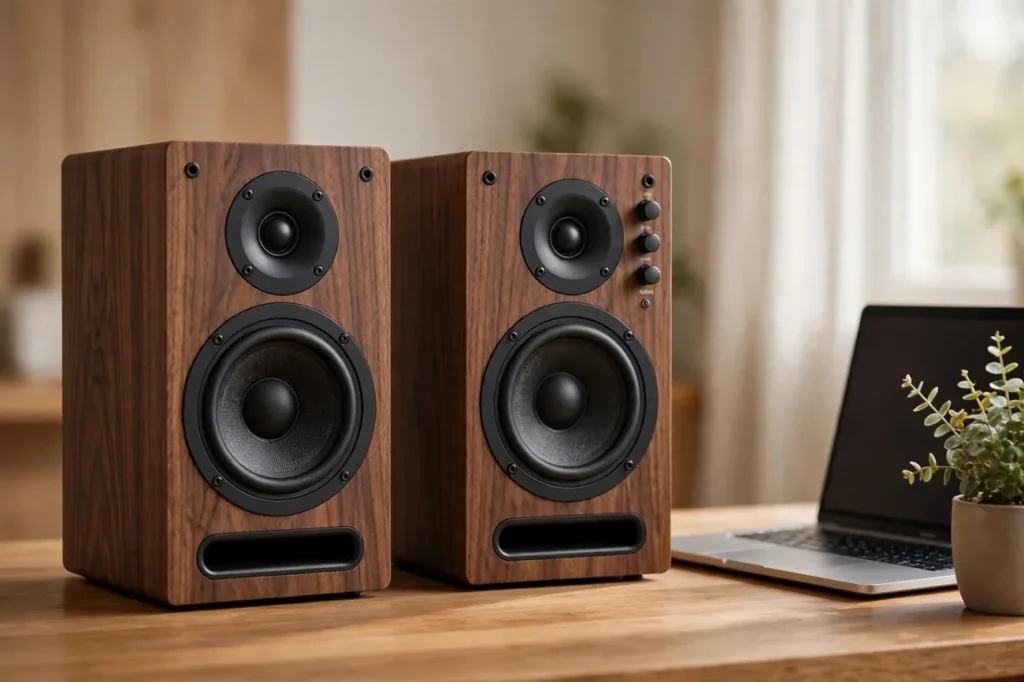
The R1280DB leans into classic hi-fi aesthetics: MDF cabinets with a wood-grain finish, black front baffles and visible driver surrounds. It’s a 2-way speaker design — one 4-inch woofer and one 13mm silk dome tweeter per cabinet, with a front-firing bass reflex port. The MDF construction matters: it’s dense and low-resonance, so the cabinet doesn’t add its own coloration the way thin plastic shells do.
The three small knobs for bass, treble and volume sit on the right side of the active (powered) speaker rather than the front — a cleaner look that keeps the baffle uncluttered. A handful of reviewers note the side placement is awkward if the speakers sit deep in a bookshelf, but that’s what the included wireless remote is for. The remote handles volume, mute, input switching and power, so you rarely need to touch the knobs after the initial setup.

Connectivity: Bluetooth, Optical, Coaxial and Dual RCA
Connectivity is where the R1280DB earns its keep. Most budget powered speakers give you one analog input and Bluetooth; the R1280DB gives you five ways in:
- Bluetooth 5.0 — pair a phone, tablet or laptop for wireless music.
- Optical TOSLINK — a clean digital connection from a TV or computer, which reviewers consistently praise for TV/movie use.
- Coaxial digital — a second digital option for DVD players, streamers or DACs.
- Dual RCA line-ins — connect a turntable (with line output or an external phono preamp), a CD player or a gaming console, and keep two of them hooked up at once.
That input list is why this speaker keeps showing up in “TV + turntable + phone” starter setups: you can leave everything connected and switch sources from the remote.
Bluetooth Pairing and Codec Support
Pairing is the standard procedure — select the R1280DB’s Bluetooth input with the remote, then choose the speakers from your device’s Bluetooth list. Connection range is roughly 10 meters, typical for Bluetooth 5.0 desktop gear. One honest caveat: codec support is basic SBC, not aptX or LDAC, so wired optical or coaxial will sound better than Bluetooth for critical listening. If Bluetooth audio quality matters to you, our Bluetooth codec explainer breaks down what the different codecs actually change.
A related note: the newer R1280DBs variant adds aptX support and a subwoofer output — see the comparison section below, because Amazon listings sometimes mix the two models.
Wired Inputs for TV, Turntable and PC
The optical input is the standout for TV duty: one cable from your TV’s optical-out gives you a big stereo upgrade over built-in TV speakers, and the Soundfield Spatializer mode (toggled from the remote) widens the soundstage for movies. For late-night viewing where speakers aren’t practical, see our headphones-for-TV guide. For turntables, remember the R1280DB has no built-in phono stage — you’ll need a turntable with a switchable line output or an external phono preamp (our preamp vs amp guide explains the difference). Digital inputs decode standard PCM, and there is no USB audio input, so a PC connects via 3.5mm-to-RCA or optical.
Sound Quality
Across published reviews, the consensus on the R1280DB’s sound is remarkably consistent: warm, balanced and engaging, with mids that flatter vocals and acoustic instruments, a smooth (non-fatiguing) treble from the silk dome tweeters, and bass that’s present and tuneful without trying to be a subwoofer. Multiple reviewers describe the sound as “bigger than the price suggests” and well-suited to small-to-medium rooms.
The side-panel EQ knobs are genuinely useful here. If the out-of-the-box tuning feels bass-heavy on your desk, dialing the bass knob back a notch cleans it up; a touch of treble lift adds air for classical or acoustic tracks. The 42W RMS of built-in amplification is plenty for desktop, bedroom and study use — these speakers fill a small-to-medium room comfortably, though they’re not party speakers and won’t pressurize a large living room. Bass extension stops at 55Hz, so deep sub-bass in movies and electronic music is the one real sonic limitation of the 2.0 format.
Setup and Ease of Use
Setup takes minutes: place the active speaker (the one with the knobs and inputs) where it’s reachable, connect the passive speaker with the included speaker wire, plug in power, and connect your sources. The front-facing bass port is a thoughtful touch for real-world placement — unlike rear-ported speakers, these don’t need breathing room behind them, so they work pushed back on a desk or tucked into a bookshelf.
For best results, give the speakers some separation (a meter or more apart works well on a desk), angle them slightly toward your listening position, and consider foam pads under the speakers to decouple them from a resonant desktop. The remote covers day-to-day control — volume, mute, input switching — so the side knobs become set-and-forget tone controls.
Edifier R1280DB vs R1280T vs R1280DBs
The Edifier R1280 family is confusing, so here’s the honest breakdown:
- R1280T — the analog-only sibling. Same 42W power, same drivers, dual RCA inputs, Bluetooth-free. If you’ll only ever use analog connections, it’s the same core sound with fewer inputs.
- R1280DB (this review) — adds Bluetooth 5.0, optical and coaxial digital inputs, and a redesigned remote over the R1280T.
- R1280DBs — a newer refresh that adds a subwoofer output with automatic crossover detection and aptX Bluetooth support. If subwoofer expansion or better Bluetooth codecs matter to you, it’s the one to compare against.
Practical advice: buy the DB if you want wireless plus digital TV connectivity. Buy the DBs only if the sub-out or aptX specifically matter to you — and double-check the model letter on the Amazon listing before ordering, since the two are easy to confuse.
Who Should Buy the R1280DB
- Desk and home-office listeners upgrading from laptop speakers or a single Bluetooth cylinder.
- Starter vinyl setups — pairs well with a turntable that has line-level output, no separate amp needed.
- TV sound upgrades — the optical input is a simple, big-sounding step up from TV speakers.
- Multi-source users who want a TV, console and phone all connected at once without an amp or receiver.
Look elsewhere if you need deep bass for movies (add a subwoofer-capable model or the DBs instead), a built-in phono stage, USB audio, or hi-res Bluetooth codecs.
Pros and Cons
| Pros |
| ✓ Unusually complete input panel: Bluetooth 5.0, optical, coaxial, dual RCA |
| ✓ Warm, engaging sound that flatters most music genres |
| ✓ Physical bass/treble knobs plus a genuinely useful wireless remote |
| ✓ Solid MDF cabinets; front bass port suits desk and shelf placement |
| ✓ No separate amplifier needed — setup takes minutes |
| Cons |
| ✗ No built-in phono stage — turntables need line-out or an external preamp |
| ✗ Basic SBC Bluetooth only; no aptX/LDAC (the DBs variant adds aptX) |
| ✗ No USB audio input and no dedicated subwoofer output on the original DB |
| ✗ Bass rolls off at 55Hz — fine for music, limited for home theater |
Frequently Asked Questions
Are the Edifier R1280DB speakers good for a turntable?
Yes, with one condition: the R1280DB has no built-in phono stage, so your turntable needs a switchable line-level output, or you need an external phono preamp between the turntable and the speakers’ RCA inputs. Many entry-level turntables (like the Audio-Technica AT-LP60X) have a built-in preamp, which works perfectly.
How do you pair the Edifier R1280DB via Bluetooth?
Use the remote to select the Bluetooth input, then choose the speakers from your phone, tablet or laptop’s Bluetooth device list. Range is about 10 meters. If a device refuses to pair — something at least one reviewer hit with a PC — try the wired 3.5mm-to-RCA connection instead.
What is the difference between the R1280DB and R1280DBs?
The R1280DBs is a refresh that adds a subwoofer output (with automatic crossover detection) and aptX Bluetooth codec support. Core power (42W RMS), drivers and cabinet design are otherwise the same. Check the exact model letter on the listing before buying.
Do the Edifier R1280DB speakers need an amplifier?
No. They’re powered (active) speakers with a 42W RMS amplifier built into the left speaker, which also powers the right passive speaker via the included speaker wire. You connect sources directly — no receiver or amp required.
Can I connect the R1280DB to my TV?
Yes — the optical TOSLINK input is the best route: one cable from your TV’s optical-out. Coaxial works too if your TV has it, and the dual RCA inputs accept a headphone-jack or line-out connection.
Do the Edifier R1280DB have a subwoofer output?
The original R1280DB does not have a dedicated subwoofer output. The newer R1280DBs variant adds one. If subwoofer expansion is a priority, buy the DBs or plan your setup around a different model.
Are the R1280DB still worth buying?
For a budget powered speaker with this combination of inputs, warm sound and build quality, yes — it remains one of the most-recommended entry-level bookshelf speakers. The main reasons to look elsewhere are the lack of a phono stage, USB input and hi-res Bluetooth codecs.

I am the founder of Sound Mavericks, where I provide the polite truth about audio equipment. I started this site because consumer electronics reviews are often too technical. Instead of using a silent lab, I test headphones, earbuds, and Bluetooth speakers in the real world – like on a noisy subway or in a busy coffee shop.
To stay independent, I buy my own review units (mostly from the United States) rather than accepting free gifts from brands. Once I finish testing a product, I sell it locally to our community. My goal is to help you understand sound quality, active noise cancellation (ANC), and battery life without the marketing hype.