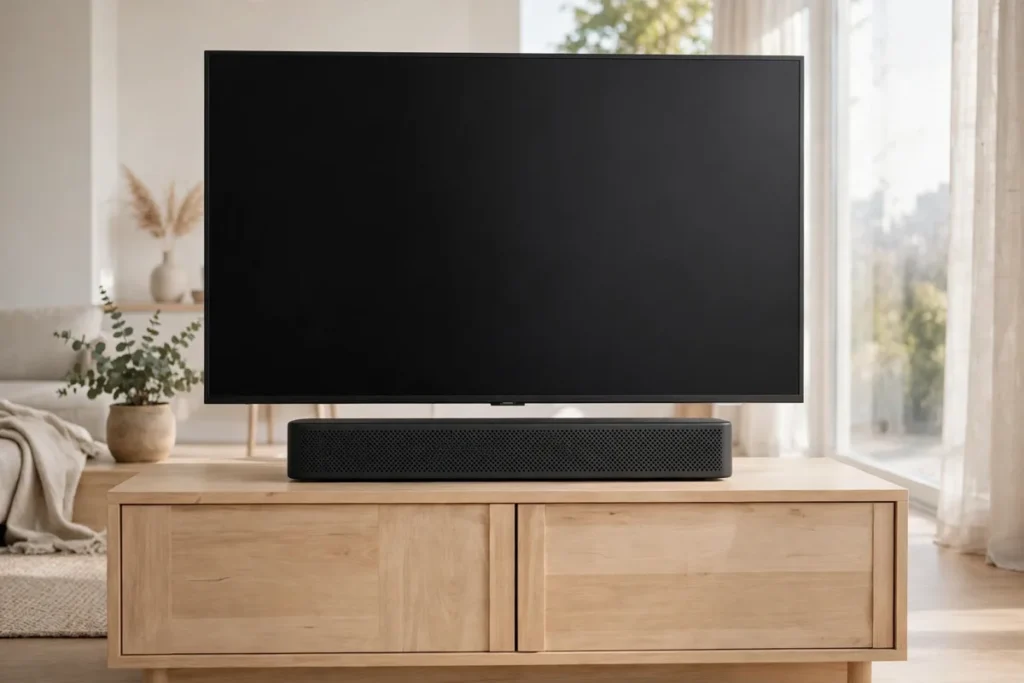
This Sonos Arc Ultra review covers the flagship soundbar in the Sonos TV range: a single wide cabinet that produces a 9.1.4 Dolby Atmos presentation from 14 drivers, built around a flat woofer design Sonos calls Sound Motion, with AI Speech Enhancement for dialogue and Trueplay room tuning. It is a research-based review. We have not tested this soundbar hands-on, so the verdict rests on the published specifications, the listing details, and measured coverage from outlets that have run the bar in a room. Where a claim comes from Sonos rather than from a measurement, we say so.
The short version is this. The Arc Ultra is the bar to buy if you want the widest and tallest sound Sonos can get out of one cabinet, with no subwoofer box on the floor and no rear speakers to place. It asks flagship money for that simplicity, and the deepest bass still needs the optional Sonos Sub.
The Sonos Arc Ultra is the strongest single-bar option Sonos sells. Fourteen drivers and the Sound Motion woofer give it a wide stage, real height effects on Atmos content and more bass than a cabinet this slim has any right to produce, and Speech Enhancement fixes the buried-dialogue problem that sends most people shopping for a soundbar. Buy it for a clean one-box setup under a large TV, especially if your home already runs Sonos speakers. Skip it if you want physical rear speakers and a subwoofer on day one, because rival packages bundle both for less than the expanded Sonos system costs.

Why you: A 9.1.4 Atmos presentation from one cabinet, with 14 drivers, a Sound Motion woofer for real low end, Trueplay room tuning, and speech processing that keeps dialogue clear at low volume.
Trade-off: No subwoofer in the box and no HDMI passthrough, so consoles connect to the TV, and the Sub and Era surrounds are separate purchases.
What the Arc Ultra is, and where it sits
The Arc Ultra is the top soundbar Sonos sells for TV use, and it replaced the original Sonos Arc at the head of the range. The original Arc is no longer sold directly by Sonos. Below the Ultra sit the smaller Beam soundbars for mid-size TVs and the compact Ray. The Ultra is built for large screens: at 46.18 inches wide it spans most of a big TV’s width, and at under three inches tall it sits low on a media console without blocking the bottom of the picture on most stands.
Inside the cabinet are 14 Sonos-engineered drivers driven by 15 Class-D amplifiers. Nine are silk-dome tweeters, angled to spread sound across the front and sides, and two of those tweeters fire upward to carry the height channels. The rest of the array handles the midrange, and one part of the design matters more than the count suggests: the Sound Motion woofer, covered below. There is no subwoofer and no rear speakers in the box, which is both its appeal and its limit.
Sonos Arc Ultra specifications
| Product | Sonos Arc Ultra (model ARCG2US1BLK, Black) |
| Channels | 9.1.4 spatial audio with Dolby Atmos |
| Drivers | 14 drivers: nine silk-dome tweeters (two up-firing), midrange drivers, Sound Motion woofer |
| Amplification | 15 Class-D digital amplifiers |
| Dialogue | AI Speech Enhancement with four selectable levels; Night Sound for late viewing |
| Calibration | Trueplay room tuning (iOS and Android) |
| TV connection | HDMI eARC (single input, no passthrough) |
| Streaming | Wi-Fi with AirPlay 2; Bluetooth for direct playback |
| Voice control | Amazon Alexa built in; Sonos Voice Control |
| Expansion | Pairs with Sonos Sub or Sub Mini and Era speakers as surrounds (all sold separately) |
| Dimensions | 46.18 in W x 2.95 in H x 4.35 in D |
| Weight | 12.7 lb |
Sound Motion, and the bass question
Every slim soundbar fights the same physics: deep bass needs air movement, and a cabinet under three inches tall has little room for a conventional woofer. Sound Motion is Sonos’s answer. It is a flat woofer that uses four motors and two membranes working against each other, so it moves more air than its size suggests while cancelling much of its own vibration. Because the woofer takes up so little depth, Sonos could fit more tweeters and midrange drivers into the same cabinet, which is where the wider stage comes from.
Published coverage agrees the result is the strongest bass a Sonos bar has produced on its own, with low end that gives film effects real weight. Keep the claim in proportion. The Arc Ultra goes deeper than the original Arc, and for most living rooms it removes the urgency of buying a subwoofer. It does not repeal physics: the lowest effects in an action film, the ones you feel through the sofa, still belong to the Sonos Sub.
Atmos and the height effect
The 9.1.4 figure describes how the bar renders a Dolby Atmos mix: nine ear-level channels, one low-frequency channel and four height channels, all produced by the driver array and its processing rather than by separate speakers around the room. The two up-firing tweeters bounce height cues off the ceiling, and the side-firing drivers push effects wider than the cabinet.
In practice, per the published coverage, overhead effects register clearly on native Atmos content, and the presentation holds together from seats off to the side better than narrower bars manage. The ceiling bounce depends on the room: a flat ceiling at a standard height reflects well, a vaulted or beamed ceiling scatters the effect. Our guide to the best headphones for Dolby Atmos makes the same point from the personal-audio side. Rendered height can be convincing, and it is never identical to speakers mounted above you.
Dialogue: Speech Enhancement and Night Sound
Buried dialogue is the complaint that sells soundbars, and Sonos built two tools against it. Speech Enhancement uses AI processing to detect the human voice in the mix and clarify it, with four levels selectable in the Sonos app. The middle levels suit most viewers: voices come forward and stay intelligible at modest volume, without the rest of the mix turning harsh. The top level is best kept for genuinely difficult mixes.
Night Sound works the other side of the problem. It pulls down loud effects and lifts quiet detail, so a late film session keeps its dialogue without waking the house at every explosion. Used together, the two features cover the most common reason people reach for subtitles.
Trueplay tuning, now on Android too
A soundbar’s output changes with the room it lands in. A bar close to a wall gains bass, a bar in an open-plan space loses it, and the factory tuning cannot know which room you own. Trueplay measures the acoustics of your room with your phone’s microphone and adjusts the bar’s EQ to suit. On the Arc Ultra, Trueplay works with both iOS and Android phones, which removes the old Sonos frustration where Android households were locked out of the full tuning.
Run it after the bar is in its final position, and again if you move the bar or rearrange the room. Room correction improves every source you play, because it fixes the room rather than the content.
Music, streaming and the Sonos system
As a music speaker the Arc Ultra covers the routes a household actually uses. Wi-Fi streaming through the Sonos app reaches the major services, AirPlay 2 lets Apple devices send audio directly, and Bluetooth is there for guests. Stereo music gets the same wide presentation as film sound, and the bar groups with other Sonos speakers for multi-room playback.
One feature is specific to this ecosystem. TV Audio Swap moves the TV sound from the bar to a pair of Sonos Ace headphones at a button press, for private late-night viewing with spatial audio. We covered the headphones in our Sonos Ace review. Households without other Sonos gear should weigh the ecosystem honestly: the bar works well on its own, and its best tricks multiply once other Sonos speakers are in the house.
Setup and connections
Setup is short. One HDMI cable runs to the TV’s eARC port, and that connection is the one to use, because eARC carries the full Atmos signal and lets the TV remote control the bar’s volume. The Sonos app then walks through Wi-Fi, Trueplay and voice setup in order.
Three connection notes deserve attention before you buy. There is no HDMI passthrough input, so consoles and media players connect to the TV and the TV feeds the bar. There is no optical input, so a very old TV without eARC or ARC is a poor match. And the bar does not decode DTS:X, so discs and files in that format need the player or the TV to convert them first. All three points are cheaper to learn now than after the box is open.
Growing the system later
The Arc Ultra is a starting point as much as a finished system. The Sonos Sub and the smaller Sub Mini both pair wirelessly and take over the low end. A pair of Era speakers behind the sofa adds true rear channels, which no processing fully replaces. Each step is a separate purchase, and the expanded system costs substantially more than the bar alone.
Our advice is to buy the bar on its own merits and judge it as it sounds out of the box. The Sound Motion woofer makes the one-box version more complete than the original Arc ever was. If that sound satisfies you, the expansion money stays in your pocket.
Arc Ultra vs the original Arc
Owners of the original Arc ask the fair question: what actually changed? The driver count rose from eleven to fourteen, and the layout was rebuilt around the Sound Motion woofer, so bass reaches deeper from the bar alone. Speech Enhancement gained selectable levels instead of a single on or off setting. Trueplay opened up to Android phones. The cabinet kept the same basic idea, a long low bar in black or white, at a similar width.
The upgrade case is strongest for original Arc owners who felt the bass was thin and never bought the Sub. For owners already running an Arc with a Sub and surrounds, the Ultra is a refinement rather than a transformation.
Who should buy it, and who should skip it
Buy the Arc Ultra if you want one clean cabinet under a large TV, you watch a mix of film and dialogue-heavy TV, and you value speech clarity and a wide stage over maximum bass output. It also suits households already invested in Sonos, where multi-room grouping and TV Audio Swap make the bar part of a system.
Skip it if you want physical rear speakers and a subwoofer on day one, because rival packages bundle them for less than the expanded Sonos system costs. Skip it too if your TV lacks an ARC or eARC port, or if your library leans heavily on DTS:X discs.
Frequently asked questions
Does the Sonos Arc Ultra include a subwoofer?
No. The bar is a single cabinet with 14 drivers and no separate subwoofer in the box. Its Sound Motion woofer covers the low end on its own, and it pairs wirelessly with the optional Sonos Sub or Sub Mini for deeper bass later.
Does the Arc Ultra support Dolby Atmos?
Yes. It renders a 9.1.4 spatial audio presentation from Dolby Atmos content, using two up-firing tweeters to bounce height effects off the ceiling. Feed it over HDMI eARC from the TV to get the full Atmos signal.
What is Sound Motion?
Sound Motion is Sonos’s flat woofer design. Four motors drive two membranes that work against each other, moving more air than a conventional woofer of the same size while cancelling much of the vibration. It is the reason the Arc Ultra produces deeper bass from a slim cabinet.
Can the Arc Ultra be expanded into a surround system?
Yes. A Sonos Sub or Sub Mini adds a dedicated low-frequency channel, and a pair of Sonos Era speakers can be added as true rear surrounds. Each addition is sold separately, so price the full system before choosing this route over a bundled rival package.
Does Trueplay work with Android phones on the Arc Ultra?
Yes. Trueplay room tuning on the Arc Ultra supports both iOS and Android devices, so Android households get the full measured tuning rather than the basic quick tune older Sonos bars offered them.
Final verdict
The Sonos Arc Ultra is a confident flagship: the widest and clearest sound Sonos has taken from a single bar, dialogue tools that solve the most common TV sound complaint, and room tuning that finally treats Android owners as equals. Its limits are the honest ones for the format. One cabinet cannot match a separate subwoofer for the deepest effects, the full system costs real money once expanded, and DTS:X support is absent. Judged as the one-box product it is sold as, it is the strongest soundbar Sonos makes.

I am the founder of Sound Mavericks, where I provide the polite truth about audio equipment. I started this site because consumer electronics reviews are often too technical. Instead of using a silent lab, I test headphones, earbuds, and Bluetooth speakers in the real world – like on a noisy subway or in a busy coffee shop.
To stay independent, I buy my own review units (mostly from the United States) rather than accepting free gifts from brands. Once I finish testing a product, I sell it locally to our community. My goal is to help you understand sound quality, active noise cancellation (ANC), and battery life without the marketing hype.