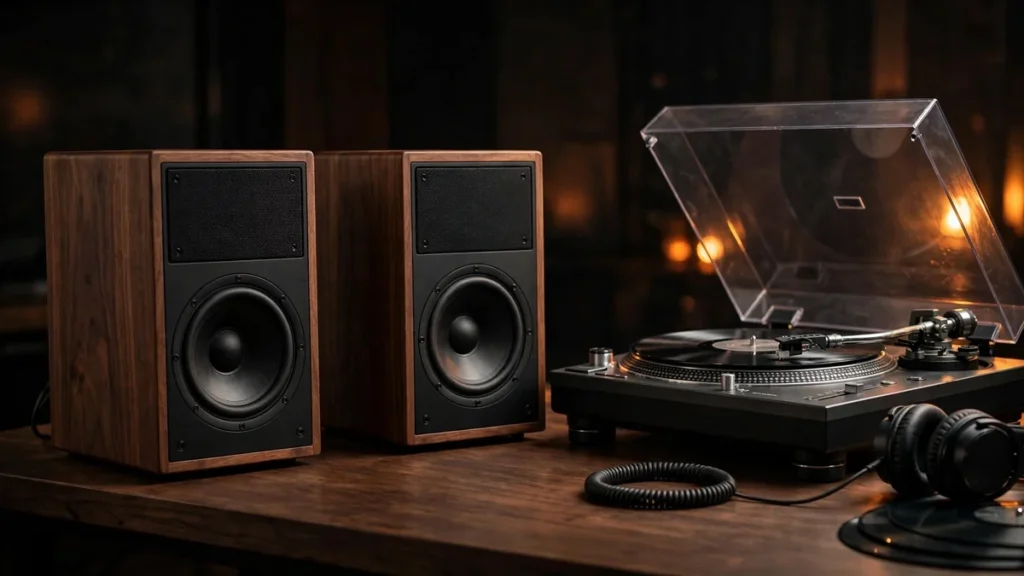
If you’re shopping for the best powered speakers, you’re already on the fastest path to great sound with minimum fuss. Powered speakers — also called active speakers — have their amplification built right into the cabinet, so there’s no receiver or separate amplifier to buy, wire up, and find shelf space for. Plug them into the wall, connect your turntable, TV, or laptop, and you’re listening.
Our team at SoundMavericks checked manufacturer spec sheets and what’s actually listed on Amazon right now to rank the 8 best powered speakers you can buy in 2026 — from the budget Edifier R1280DBs to the wireless KEF LSX II. Every pick below is a real, currently listed product: no discontinued models, no placeholder listings.
Quick Picks: The Best Powered Speakers at a Glance
| Pick | Best For | Standout Feature |
|---|---|---|
| KEF LSX II | Best overall | AirPlay 2, Chromecast, HDMI ARC, Uni-Q drivers |
| Audioengine A5+ Wireless | Best for turntables | 150W power, RCA inputs, wood cabinets |
| Klipsch The Fives II | Best for TV | Dolby Atmos, HDMI 2.1 eARC |
| Fluance Ai61 | Best mid-range all-rounder | 120W amp, 6.5″ drivers, USB + sub out |
| Kanto YU6 | Best feature-packed | Phono preamp, aptX Bluetooth, remote |
| Edifier R1280DBs | Best budget | 42W RMS, optical input, sub out |
| Audioengine A2 GEN3 | Best compact desktop | Bluetooth 5.4 aptX-HD, USB-C 24-bit DAC |
| PreSonus Eris 5 BT | Best for creators | 100W, room-tuning controls, Bluetooth 5.0 |
The 8 Best Powered Speakers of 2026
1. KEF LSX II — Best Overall Powered Speakers

The KEF LSX II takes our top spot because it does what most powered speakers can’t: it replaces your entire front end. These compact wireless active bookshelf speakers stream over AirPlay 2, Google Chromecast, Spotify Connect, and Bluetooth — no source component required — and connect straight to a TV via HDMI ARC or to a laptop via USB-C. KEF’s 11th-generation Uni-Q driver array widens the sweet spot so imaging stays precise even off-center, and the KEF Connect app adds room EQ tuned to your space. For a desk, bookshelf, or TV console, it’s the closest thing to a one-box hi-fi system at this size.
- Key specs: wireless active bookshelf pair; AirPlay 2, Chromecast, Spotify Connect, Bluetooth; HDMI ARC + USB-C inputs; 11th-gen Uni-Q drivers; KEF Connect app with room EQ
- Best for: anyone who wants one premium pair for music, TV, and desktop
- Keep in mind: premium pricing; full EQ and setup features live in the app
2. Audioengine A5+ Wireless — Best Powered Speakers for Turntables

Vinyl listeners have kept the Audioengine A5+ on best-of lists for years, and the wireless version earns its place here because it makes a turntable setup effortless. With 150 watts of built-in power, simple RCA and 3.5mm AUX inputs, and Bluetooth for everything else, you connect a record player with a built-in preamp and you’re done — no amp, no receiver, no cable tangle. The handcrafted wood cabinets damp resonance that cheaper plastic boxes let through, and Audioengine backs the pair with a 3-year warranty. For music-first listening with a turntable at the center, this is the most satisfying plug-and-play route in the guide.
- Key specs: 150W built-in power; RCA + 3.5mm AUX inputs; Bluetooth; handcrafted wood cabinets; 3-year warranty
- Best for: vinyl setups and music-first listening rooms
- Keep in mind: analog inputs only — no optical or HDMI for TV use
3. Klipsch The Fives II — Best Powered Speakers for TV

If your powered speakers are going to pull double duty as your TV sound system, the Klipsch The Fives II is the pick. The headline features are built for the living room: Dolby Atmos processing for a more immersive soundstage, and HDMI 2.1 with eARC so a single cable from your TV handles audio — including volume control from your TV remote. Built-in streaming covers your music platforms too, developed in collaboration with Onkyo, and the 5.25-inch drivers plus the new one-piece BMC baffle (denser and more rigid, to kill unwanted resonance) give dialogue and music genuine authority. These are happiest on a TV console or sturdy shelf — as a soundbar-killer with real stereo separation, they’re in a class of their own.
- Key specs: 5.25″ drivers; Dolby Atmos; HDMI 2.1 with eARC; built-in music streaming; one-piece BMC baffle
- Best for: living-room TV + music duty, soundbar upgrades
- Keep in mind: larger footprint — plan for a TV console or shelf, not a small desk
4. Fluance Ai61 — Best Mid-Range All-Rounder

The Fluance Ai61 is our pick for buyers who want one pair that genuinely does everything. A 120-watt built-in amplifier drives 6.5-inch woven glass fiber woofers and neodymium tweeters — a bigger, more capable driver complement than most speakers at this tier. The input list is equally generous: RCA, optical, and USB for wired sources, Bluetooth 5 for wireless, plus a subwoofer output for adding bass later. That means the Ai61 can anchor a vinyl setup today and a TV setup tomorrow, and our analysis puts it at the top of the mid-range for sheer versatility.
- Key specs: 120W built-in amplifier; 6.5″ woven glass fiber drivers; neodymium tweeters; RCA, optical, USB inputs; Bluetooth 5; subwoofer output
- Best for: buyers who want maximum inputs and upgrade headroom
- Keep in mind: 6.5-inch drivers mean bigger cabinets — measure your shelf first
5. Kanto YU6 — Best Feature-Packed Powered Speakers

The Kanto YU6 is the Swiss-army knife of this list. Its standout trick is a built-in phono preamp, so you can plug any turntable — vintage or modern — straight in with no extra box. Add Bluetooth with Qualcomm aptX for higher-quality wireless streaming, a full-function remote (volume, input, tone, balance, plus Bluetooth playback controls), and automatic standby and power-up so the speakers sleep when you leave and wake when the music starts. A 5.25-inch woofer and 200 watts of power give the YU6 real punch for rooms that smaller desktop speakers can’t fill — if your wishlist is “vinyl-ready, remote-controlled, and ready for anything,” start here.
- Key specs: 5.25″ woofer, 200W; built-in phono preamp; Bluetooth with Qualcomm aptX; full remote; auto standby/power-up
- Best for: vinyl lovers who want a remote and maximum input flexibility
- Keep in mind: mid-size cabinets — a step up from compact desktop speakers
6. Edifier R1280DBs — Best Budget Powered Speakers
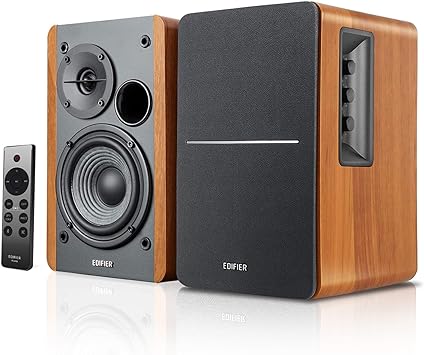
The Edifier R1280DBs has been the default budget recommendation for years because it gets the fundamentals right at a price that invites zero agonizing. You get 42 watts RMS, Bluetooth 5.0, and — unusually for the price — optical and coaxial digital inputs for clean TV audio. A subwoofer output with automatic detection and a built-in crossover lets you add bass later without guesswork, Edifier includes the cables that matter (including a fiber optic cable), and the wood-grain cabinets look far better than the price suggests. For a bedroom, dorm, or first real audio upgrade, this is the easiest recommendation in the guide.
- Key specs: 42W RMS; Bluetooth 5.0; optical + coaxial inputs; subwoofer output with auto detection and crossover; wood-grain finish
- Best for: first setups, bedrooms, and anyone testing the waters
- Keep in mind: modest power — ideal for small rooms, not house parties; no phono input for turntables without a preamp
7. Audioengine A2 GEN3 — Best Compact Desktop Powered Speakers

Desk space is precious, and the Audioengine A2 GEN3 — the latest generation of the beloved A2 line — is engineered specifically for it. These compact powered speakers are tuned for nearfield listening: music streaming, gaming, video calls, and late-night sessions where the speakers sit an arm’s length away. A built-in 24-bit DAC connects straight to your computer over USB-C, bypassing noisy onboard audio, while Bluetooth 5.4 Adaptive with aptX-HD handles high-quality wireless streaming. The hand-finished real wood cabinets keep resonance in check, and a 3-year warranty backs the pair — the best desktop audio upgrade that won’t eat half your desk.
- Key specs: nearfield desktop design; 24-bit DAC via USB-C; Bluetooth 5.4 Adaptive with aptX-HD; real wood cabinets; 3-year warranty
- Best for: desks, dorm rooms, and small spaces
- Keep in mind: compact drivers mean limited deep bass — perfect for a desk, not for filling a living room
8. PreSonus Eris 5 BT — Best Powered Speakers for Creators

Creators, editors, and home-studio dabblers should look at the PreSonus Eris 5 BT. This is a proper studio monitor pair — 100 watts driving 5.25-inch woven-composite woofers and 1-inch silk-dome tweeters — with the accurate, unhyped voicing you want for editing video, mixing a podcast, or hearing what’s actually in a recording. High and low acoustic tuning controls dial the response to your room, a companion 8-inch subwoofer is available if you need to feel the low end, and the Bluetooth 5.0 input makes it a dual citizen: a trustworthy monitor when you’re working, an easy wireless speaker when you’re not.
- Key specs: 100W; 5.25″ woven-composite woofers, 1″ silk-dome tweeters; Bluetooth 5.0; high/low acoustic tuning; optional companion subwoofer
- Best for: home studios, video/podcast editing, analytical listening
- Keep in mind: studio-flat tuning — exciting for work, more honest than hyped for casual listening
Powered Speakers Buying Guide: How to Choose
What exactly are powered speakers?
Powered speakers — usually called active speakers — have their amplifier built into the cabinet. One speaker typically houses the amp and powers both, and all you add is a source: a turntable, a TV, a computer, or your phone over Bluetooth. That single difference eliminates the receiver, the speaker-wire runs, and the impedance-matching homework that passive speakers demand.
Powered vs. passive speakers: which should you buy?
Choose powered speakers for the simplest path to good sound: fewer boxes, fewer cables, and a system the manufacturer already tuned as a matched pair — ideal for desks, bedrooms, and apartments. Choose passive speakers if you enjoy building a separates system, plan to upgrade your amplifier later, or already own one: passive setups offer more long-term flexibility, at the cost of complexity.
Match power and size to your room
For a desk or bedroom, 20–50 watts and 4-inch drivers are plenty. For a living room, look for 100 watts or more and 5.25-inch (or larger) woofers — bigger drivers move more air, which is what you feel as bass and presence. The KEF LSX II covers small-to-medium rooms beautifully; the Fluance Ai61 and Klipsch The Fives II have the muscle for larger spaces.
Checklist: the inputs that matter
- Bluetooth — table stakes for phone streaming; newer versions (5.x) and codecs like aptX/aptX-HD sound better.
- Optical/coaxial — the cleanest way to connect a TV: digital all the way to the speaker.
- USB / USB-C — turns the speaker into your computer’s DAC; the Audioengine A2 GEN3‘s 24-bit USB-C input is the gold standard here.
- HDMI ARC / eARC — one cable from TV to speaker, with volume control from your TV remote. The Klipsch The Fives II and KEF LSX II both offer it.
- Phono input — only needed if your turntable lacks a built-in preamp; the Kanto YU6 includes one.
- Subwoofer output — nice insurance for future bass upgrades; both the Edifier R1280DBs and Fluance Ai61 include one.
Driver configuration: 2-way is the sweet spot
Nearly every speaker here is a 2-way design — a woofer for mids and bass plus a tweeter for highs — the proven bookshelf formula. If you’re curious how 2-way and 3-way designs differ, our 2-way vs 3-way speakers explainer breaks it down.
Placement matters more than you think
Tweeters at ear height, breathing room from the back wall, and the pair angled toward your listening spot. On a desk, isolation makes an outsized difference — our guide to foam pads under speakers explains why decoupling from the surface tightens up the bass.
Frequently Asked Questions
What’s the difference between powered and passive speakers?
Powered (active) speakers have a built-in amplifier — plug them into the wall and connect a source directly. Passive speakers have no amp and must be driven by a separate amplifier or receiver. Powered is simpler and cheaper to get running; passive offers more upgrade flexibility over time.
Do powered speakers need a separate amplifier or receiver?
No — that’s the whole point. The amplification is built in and already matched to the drivers. Just match the speaker’s inputs to your sources.
Can I connect a turntable directly to powered speakers?
Yes, if the speakers have a built-in phono preamp (like the Kanto YU6) or your turntable has its own preamp (connect to the RCA line input, as with the Audioengine A5+). Otherwise, add an inexpensive external phono preamp between them.
Can I connect powered speakers to my TV?
Yes. The most common route is an optical cable (supported by the Edifier R1280DBs, Fluance Ai61, and others). For the simplest setup, choose speakers with HDMI ARC or eARC — like the KEF LSX II or Klipsch The Fives II — so one cable carries audio and your TV remote controls the volume.
Do I need a subwoofer with powered bookshelf speakers?
Not to start — most produce satisfying bass on their own, especially models with 5.25-inch or larger woofers. If you later want deeper low end, several picks in this guide (Edifier R1280DBs, Fluance Ai61) include a subwoofer output for easy expansion.
Are powered speakers good for a desktop computer?
They’re ideal for it. Nearfield-tuned models like the Audioengine A2 GEN3 sound their best at arm’s length, and a USB or USB-C input lets the speaker act as your computer’s DAC, bypassing noisy onboard audio.
The Verdict
The best powered speakers overall are the KEF LSX II — wireless streaming for everything, HDMI ARC and USB-C for TV and desktop, and KEF’s Uni-Q drivers in a compact box. It’s the closest thing to a one-box hi-fi system in this guide.
On a budget, the Edifier R1280DBs remains the no-brainer starter pick; vinyl-first buyers should get the Audioengine A5+ Wireless, TV-first buyers the Klipsch The Fives II. Match the inputs to your sources and the size to your room — and you’ll be listening within minutes of unboxing.

I am the founder of Sound Mavericks, where I provide the polite truth about audio equipment. I started this site because consumer electronics reviews are often too technical. Instead of using a silent lab, I test headphones, earbuds, and Bluetooth speakers in the real world – like on a noisy subway or in a busy coffee shop.
To stay independent, I buy my own review units (mostly from the United States) rather than accepting free gifts from brands. Once I finish testing a product, I sell it locally to our community. My goal is to help you understand sound quality, active noise cancellation (ANC), and battery life without the marketing hype.