
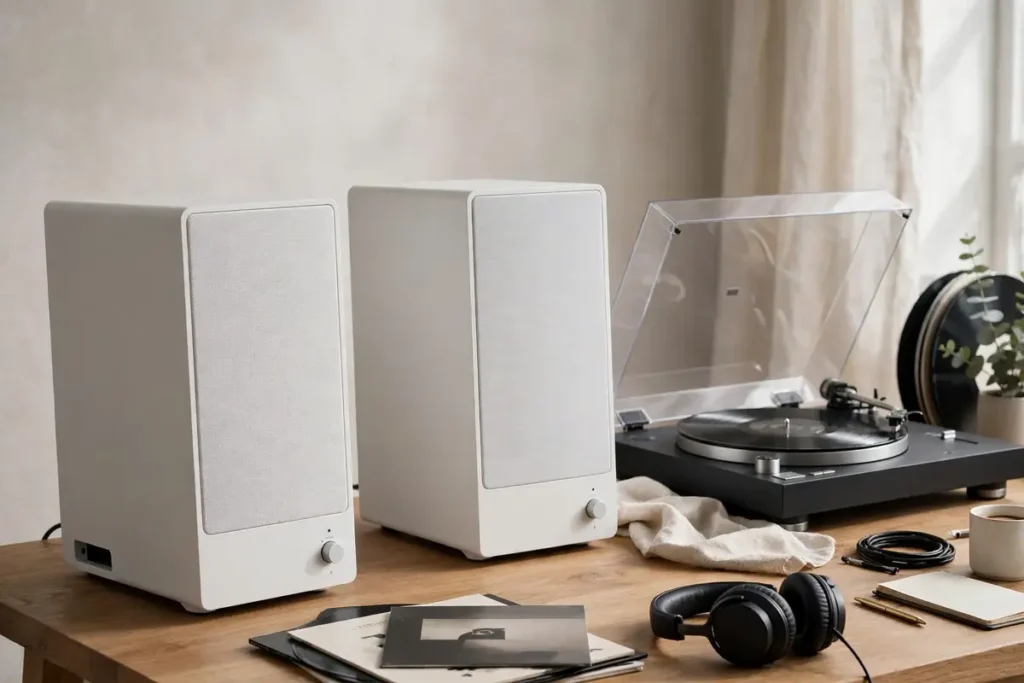
This Kanto REN review covers Kanto’s powered bookshelf speakers, sold as a pair, and built around two inputs most powered speakers still skip: HDMI ARC for the TV and USB-C for the computer. Each speaker in the pair carries a 1-inch silk dome tweeter and a 5.25-inch aluminium concave cone woofer, driven by a Class D amplifier rated at 100 watts RMS total, housed in the active cabinet. There is no receiver and no separate amplifier to buy. You place the pair either side of a screen or across a desk, plug in the active speaker, run the included cable to the passive speaker, and the system is complete. This review judges the REN on sound, on its TV manners, and on how complete that simple promise really is.
A note on method. This is a research review, built from Kanto’s published specifications, the verified Amazon US listing for this exact model, and independent coverage. We have not had a unit on the desk, so nothing here claims hands-on testing, and speaker products on this site carry no scores.
The REN is the powered pair for buyers who want one system to handle the TV, the laptop and the phone without a receiver in the middle. HDMI ARC with CEC means the TV remote controls the volume and the speakers wake with the screen. USB-C takes digital audio straight from a computer at up to 24-bit/96kHz, optical covers a games console or disc player, and Bluetooth 5.3 handles the phone. Sound is balanced and composed, with clean imaging from the waveguide tweeter. The honest limit is bass: a 5.25-inch woofer in a cabinet this size gives tidy low end rather than deep low end, and the REN is at its best with a subwoofer added through its filtered output. As a complete pair in our best powered speakers coverage, it is one of the most complete TV-and-desk packages at its size. Check Price on Amazon

Why you: A powered pair with HDMI ARC, USB-C, optical, RCA and Bluetooth 5.3, a filtered subwoofer output and a proper remote, so one system covers TV, desk and phone.
Trade-off: Bass is tidy rather than deep from the 5.25-inch woofers alone, there is no built-in phono stage for a turntable, and the amplifier lives in one cabinet only.
Kanto REN specifications
| Spec | Kanto REN |
|---|---|
| Product | Kanto REN, powered speaker system sold as a pair; linked listing is the Matte Blue finish, hardware is identical across finishes |
| Drivers (each speaker) | 1-inch silk dome tweeter in a waveguide, 5.25-inch aluminium concave cone woofer |
| Amplifier | Class D with DSP, 100W RMS total (200W peak), housed in the active speaker |
| Frequency response | 50 Hz to 22 kHz (manufacturer rated) |
| Inputs | HDMI ARC with CEC, USB-C (24-bit/96kHz), optical TOSLINK, RCA line-in, 3.5mm AUX, Bluetooth 5.3 with AAC |
| Outputs | Subwoofer out with automatic 80 Hz high-pass/low-pass filter, USB charge port (5V 1A) |
| Sound modes | Vocal Boost, Night Mode |
| Size and weight (each) | 7 x 8.5 x 10.9 inches; active 9.9 lb, passive 8.6 lb; remote control included |
Sound: balanced, composed, and honest about bass
The REN uses a proven two-way layout and spends its effort on control rather than colour. The silk dome tweeter sits in a small waveguide, which helps dispersion and keeps dialogue and stereo imaging stable when you are off to one side of the pair, the normal position on a sofa or at a desk. Independent coverage describes the same character from different rooms: a clean, broadly neutral balance, strong imaging for the size, and a presentation that stays composed when the volume climbs.
Bass is where the cabinet size sets the terms. The 5.25-inch woofer reaches down tidily and the rated response starts at 50 Hz, but small ported cabinets give up output at the very bottom, and reviewers who measured or pushed the REN note the low end rolling away and the ports working hard when the pair is driven loud on its own. For films and bass-heavy music, the REN is designed to hand that work to a subwoofer, and with one connected the midrange clears up further because the woofers stop chasing the deepest notes. Judged as a standalone pair for a desk or a small room, the bass is well judged. Judged as a full-range film system on its own, it is a pair waiting for its sub.
HDMI ARC is the headline, and it earns it
Plenty of powered speakers can be connected to a TV. Few behave like part of the TV. HDMI ARC with CEC means one cable carries the sound, the TV remote controls the REN’s volume, and the speakers wake and sleep with the screen. There is no second remote on the sofa and no input to select after the first setup. That is the experience a soundbar sells, delivered here by a proper stereo pair with real separation between channels, which is the comparison our best soundbars coverage keeps coming back to: a pair of speakers either side of the screen images better than a single bar under it.
Two DSP modes support the TV role directly. Vocal Boost lifts the midrange region where dialogue sits, for the common problem of speech buried under effects and music. Night Mode pulls the low end back and applies a high-pass filter, and mutes a connected subwoofer, so late viewing keeps its clarity without sending bass through the floor. Both are the kind of feature buyers use weekly rather than once, and both are controlled from the included remote.
Desk duty and the wired inputs
USB-C is the second signature input. A laptop or desktop sends digital audio straight into the REN’s own conversion at up to 24-bit/96kHz, which removes the noisy headphone output of a computer from the chain and gives the pair a clean, fixed-level source. Optical covers a console, a disc player or an older TV. RCA and 3.5mm analogue inputs take everything else, and Bluetooth 5.3 with AAC covers phones and tablets without a cable. A USB charge port on the back panel can power a small streamer or top up a phone.
One gap to plan around: there is no built-in phono stage. A turntable with its own phono preamp, which many current models include, connects to the RCA input without trouble. A turntable without one needs a separate phono preamp between it and the REN. Buyers building a vinyl-first system around powered speakers should weigh that against rivals in our best Bluetooth bookshelf speakers coverage, some of which build the phono stage in and skip the HDMI input the REN leads with.
The subwoofer output, done properly
Many powered speakers offer a subwoofer output that simply duplicates the full-range signal and leaves the crossover to luck. The REN applies an automatic 80 Hz filter when a subwoofer is connected: low bass goes to the sub, and the speakers are relieved of everything below the crossover. That is the correct way to integrate a sub. A compact sealed sub under the desk or beside the TV stand turns this into a genuine full-range system while the speakers stay small enough for a shelf. Buyers comparing simpler desktop pairs, such as the one in our Edifier R1280DB review, will find the REN a clear step up in inputs, power and sub integration, at a matching step up in size.
Who should buy the Kanto REN
Buy the REN if you want one powered pair to serve a TV and a desk or media room, with TV-remote volume control, a clean USB path from a computer, and a proper route to a subwoofer later. It suits small and mid-sized rooms, nearfield desks with room for a 10.9-inch tall cabinet, and anyone replacing a soundbar who wants real stereo separation.
Skip it if deep bass from the speakers alone is the priority, because no pair this size delivers that and a larger system or a sub budget belongs in the plan from the start.
Frequently asked questions
Are the Kanto REN sold as a pair?
Yes. The REN is a powered speaker system sold as a pair: one active speaker housing the amplifier and inputs, and one passive speaker connected by the included speaker cable. The price of a listing is for both speakers.
Can a TV remote control the Kanto REN volume?
Yes, over HDMI ARC with CEC. Connect the TV’s ARC port to the REN, enable CEC on the TV, and the TV remote controls volume while the speakers wake and sleep with the screen.
Can you add a subwoofer to the Kanto REN?
Yes. The REN has a subwoofer output with an automatic 80 Hz filter, so low bass is handed to the sub and the speakers focus on the range above the crossover. It is the recommended upgrade for film use.
Does the Kanto REN have a phono input for a turntable?
No. There is no built-in phono stage. A turntable with its own phono preamp connects to the RCA line input directly; a turntable without one needs a separate phono preamp in between.
Can the Kanto REN play audio from a computer over USB?
Yes. The USB-C input accepts digital audio at up to 24-bit/96kHz, so a laptop or desktop feeds the REN directly and bypasses the computer’s headphone output.

I am the founder of Sound Mavericks, where I provide the polite truth about audio equipment. I started this site because consumer electronics reviews are often too technical. Instead of using a silent lab, I test headphones, earbuds, and Bluetooth speakers in the real world – like on a noisy subway or in a busy coffee shop.
To stay independent, I buy my own review units (mostly from the United States) rather than accepting free gifts from brands. Once I finish testing a product, I sell it locally to our community. My goal is to help you understand sound quality, active noise cancellation (ANC), and battery life without the marketing hype.

