
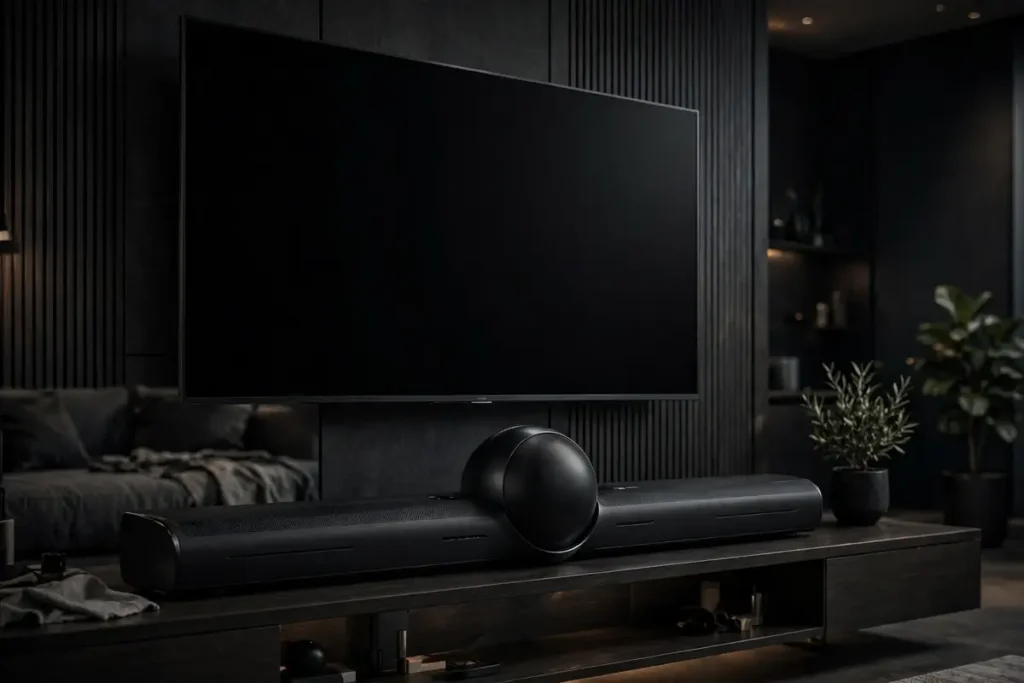
This devialet dione soundbar review covers Devialet’s Dione, a premium all-in-one Dolby Atmos soundbar built around 17 drivers, 950W RMS of amplification and a rotating centre sphere Devialet calls the ORB. The Amazon US listing linked here is ASIN B09VYHX3CZ, verified as the Dione in its standard matte black finish. The bar runs a 5.1.2 layout with no external subwoofer and no rear speakers, and it is not expandable later. Everything the Dione does, it does from the one cabinet: eight long-throw woofers handle the bass that most rival bars hand off to a separate box. This review judges it on those terms, against the other flagship one-box bars in our best Dolby Atmos soundbar coverage.
A note on method. This is a research review, built from Devialet’s published specifications, the verified Amazon US listing for this exact model, and independent coverage. We have not had a unit on the desk, so nothing here claims hands-on testing, and speaker products on this site carry no scores.
The Dione is the strongest argument yet for the one-box flagship bar. Its eight built-in woofers produce bass with real depth and control, so films get the low-end weight that usually demands a separate subwoofer, and the cabinet stays a single clean line under the TV. Dialogue stays clear, music holds together in plain stereo, and the build quality is a step above the plastic norm at this level. The limits are structural. There is no DTS:X decoding, no way to add a subwoofer or rears later, no remote in the box, and the price sits at the top of the soundbar market. Buy it if you want the best single-box sound and accept a closed system. Look elsewhere if you plan to grow a system piece by piece. Check Price on Amazon

Why you: A 5.1.2 Atmos bar with 17 drivers and eight built-in woofers, so deep bass arrives without a separate subwoofer box in the room.
Trade-off: A closed system with no subwoofer or rear-speaker expansion, no DTS:X decoding and no remote control in the box.
Devialet Dione specifications
| Spec | Devialet Dione |
|---|---|
| Product | Devialet Dione, all-in-one Dolby Atmos soundbar, matte black finish linked here, model LH929 |
| Channels | 5.1.2 with Dolby Atmos; SPACE processing upmixes stereo and mono content to 5.1.2 |
| Drivers | 17 total: 9 full-range aluminium drivers and 8 long-throw aluminium woofers, including the rotating ORB centre sphere |
| Power and output | 950W RMS total; 101 dB SPL maximum at 1 metre; frequency response 24Hz to 21kHz |
| Connections | HDMI 2.1 eARC, optical TOSLINK, Ethernet; no HDMI input for source passthrough |
| Wireless and streaming | Wi-Fi, Bluetooth 5.0, AirPlay 2, Spotify Connect, UPnP; Devialet app control on the DOS2 platform |
| Formats | Dolby Atmos and Dolby multichannel; no DTS:X decoding, DTS arrives as PCM |
| Size and weight | 1200 x 77 x 165 mm (88 mm tall with the sphere); 12 kg; wall mountable |
Sound: bass is the headline
Most one-box bars fake the low end with processing and hope the room forgives them. The Dione takes the harder route: eight long-throw woofers in a push-push layout, driven hard by Devialet’s ADH amplification, with a claimed response down to 24Hz. Independent coverage is unusually consistent here. Reviewers who measure and reviewers who listen both put the Dione’s bass at the top of the single-bar class, with the weight for action films and the control to keep bass lines in music distinct rather than boomy. That matters because there is no subwoofer output to fix weak bass later. What the cabinet does is the whole story, and on bass the cabinet delivers.
The rest of the range holds up. The nine full-range drivers include the ORB centre sphere, which handles dialogue and rotates to face the listener when the bar is wall-mounted flat. Voices stay anchored to the screen and remain intelligible at low volume, helped by a dedicated Voice mode. Height and surround effects are virtual, produced by angled drivers and the SPACE processing rather than by speakers behind you, so the Atmos bubble is convincing from the main seat and less precise from the edges of the sofa. That is the honest ceiling of any one-box design, and the Dione reaches it about as well as the format allows. Buyers who want real rear channels should compare it with the multi-box systems in our best soundbars guide instead.
The ORB, placement and daily use
The sphere in the middle is not decoration. On a stand it faces forward as the centre channel. Mount the bar flat on a wall and it turns through 90 degrees so the centre driver still fires at the seating position, while the internal layout adjusts to the new orientation. It is a neat answer to a real problem, and it makes the Dione one of the few flagship bars that wall-mounts without an acoustic compromise.
Daily control is the weaker side. There is no remote in the box. Volume runs through your TV remote over HDMI-CEC, through touch controls on the bar, or through the Devialet app, which also handles setup, room calibration and the sound modes: Movie, Music, Voice, Spatial and a Night mode that trims the bass for late listening. The app route works, but owners who like a physical remote and deep equaliser control will find the Dione restrictive. Devialet keeps the controls deliberately simple, and the trade is less fine-tuning than rivals offer.
Connections and the closed-system question
The Dione connects to the TV with a single HDMI eARC cable, with an optical input as backup. There is no HDMI input, so games consoles and disc players plug into the TV and pass audio back over eARC. Streaming is well covered for music: AirPlay 2, Spotify Connect, Bluetooth 5.0 and UPnP, with the bar able to join a Devialet multiroom setup over AirPlay 2.
The bigger decision is expansion, or the lack of it. You cannot add a wireless subwoofer, and you cannot add rear speakers. The rival approach, seen in our Sonos Arc Ultra review, lets owners start with a bar and build out over time. The Dione asks for the full commitment on day one and repays it with stronger built-in bass than expandable bars manage alone. Judge your room honestly: if a separate subwoofer box is a non-starter for space or looks, the closed system is a feature. If you like upgrading in stages, it is a dead end.
Dione or the Ambeo Max?
The closest rival in spirit is the Sennheiser Ambeo Soundbar Max, covered in our Sennheiser Ambeo Soundbar Max review. Both are heavyweight one-box Atmos bars at flagship money. The Max is the larger cabinet with a subwoofer output for owners who want the option, and it decodes DTS:X. The Dione is slimmer, wall-mounts more gracefully thanks to the rotating sphere, and produces deeper bass from the bar alone. Film collectors with big DTS:X libraries lean Max. Buyers who want the cleanest installation and the strongest built-in low end lean Dione.
Who should buy the Devialet Dione
Buy it if you want flagship film and music sound from a single cabinet, you have no place or patience for a separate subwoofer, and your viewing is mostly Dolby Atmos and standard Dolby or PCM sources. It also suits design-led rooms where a wall-mounted bar needs to look deliberate rather than attached.
Skip it if you need DTS:X decoding, plan to add rear speakers later, want a supplied remote and detailed EQ controls, or need an HDMI input for a console. Each of those points to a rival flagship or a component system.
Frequently asked questions
Does the Devialet Dione need a subwoofer?
No. Eight long-throw woofers are built into the cabinet, and Devialet rates the response down to 24Hz. There is also no subwoofer output, so an external sub cannot be added later.
What does the rotating sphere on the Dione do?
The ORB is the centre channel. It faces forward when the bar sits on a stand and rotates 90 degrees when the bar is wall-mounted, so dialogue still fires at the listening position in both setups.
Does the Dione support DTS:X?
No. The Dione decodes Dolby Atmos and Dolby multichannel formats. DTS content is taken in as PCM and then processed by the bar’s SPACE upmixing.
Can you add rear speakers to the Dione?
No. The Dione is a closed all-in-one system. Surround and height effects are virtual, created by its angled drivers and processing from the single cabinet.
How is the Dione controlled without a remote?
There is no remote in the box. Use your TV remote over HDMI-CEC, the touch controls on the bar, or the Devialet app, which also runs setup and room calibration.

I am the founder of Sound Mavericks, where I provide the polite truth about audio equipment. I started this site because consumer electronics reviews are often too technical. Instead of using a silent lab, I test headphones, earbuds, and Bluetooth speakers in the real world – like on a noisy subway or in a busy coffee shop.
To stay independent, I buy my own review units (mostly from the United States) rather than accepting free gifts from brands. Once I finish testing a product, I sell it locally to our community. My goal is to help you understand sound quality, active noise cancellation (ANC), and battery life without the marketing hype.

