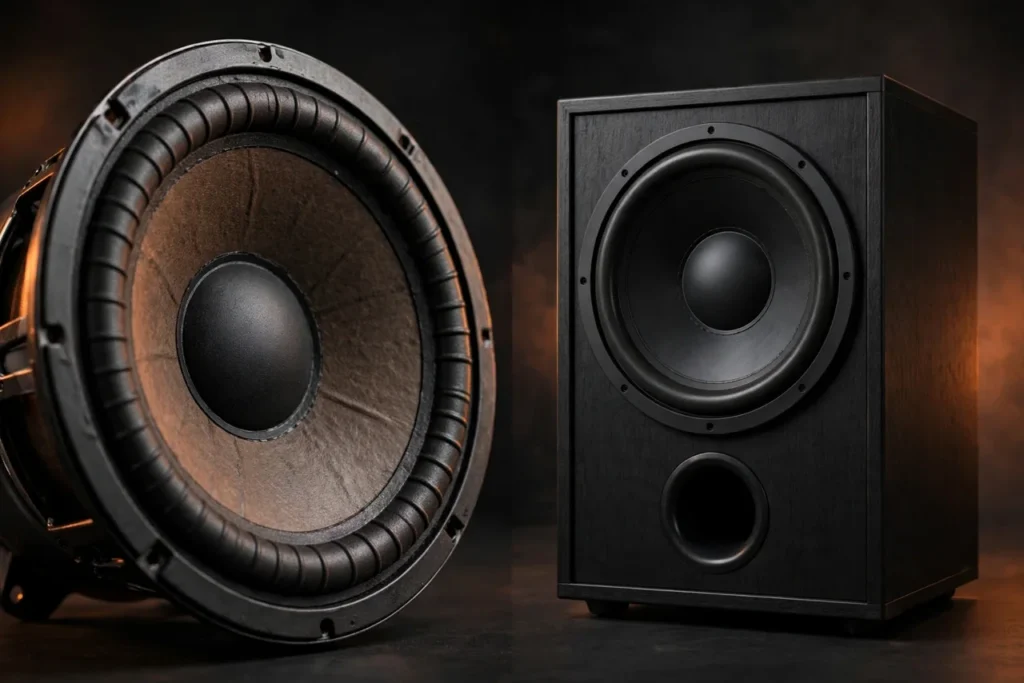
The woofer vs subwoofer debate trips up a lot of buyers: both make bass, both sit in big boxes, and sellers use the words almost interchangeably. But they do different jobs. A woofer is the low-frequency driver inside your speakers, covering bass and low midrange. A subwoofer is a dedicated system built for one thing only — the deepest bass your main speakers can’t reach.
In this guide, SoundMavericks breaks down the real differences between a woofer and a subwoofer — frequency range, power, enclosures — plus powered vs passive designs, when a woofer is enough on its own, and the room-size guidance we give readers before they buy a sub.
SoundMavericks verdict: You don’t choose between a woofer and a subwoofer — you decide whether your system needs both. Woofers handle the bass inside your speakers; a subwoofer takes over only the lowest octave your speakers can’t reproduce cleanly. Music-first setups with solid speakers can stop at woofers. Home theater and bass-heavy genres genuinely benefit from a sub.
What Is a Woofer?
A woofer is a speaker driver — the large cone you see in bookshelf speakers, floor-standers, soundbars, and car door speakers — designed to reproduce low-to-mid frequencies, roughly 40 Hz to 2,000 Hz. The name comes from “woof,” the onomatopoeia for a dog’s bark, which sits right in that range.
Inside a multi-driver speaker, the woofer is a team player, not a solo act. In a 2-way speaker it shares duties with a tweeter (the woofer takes everything below the crossover point); in a 3-way design it hands the midrange to a dedicated midrange driver and focuses more on bass. Our 2-way vs 3-way speaker comparison explains exactly how those driver lineups split the work.
Key points about woofers:
- Part of the speaker, not a separate unit. The woofer lives inside the speaker cabinet and shares the speaker’s amplifier and crossover network.
- Wide frequency job. It covers bass notes and the low midrange — bass guitar, kick drums, the body of male vocals.
- Size varies by speaker. A bookshelf speaker might use a 5.25- or 6.5-inch woofer; floor-standers often use several larger ones.
- Deep bass is its weak spot. A woofer physically runs out of steam below its tuning point. Pushing it into sub-bass territory raises distortion and eats amplifier headroom — which is exactly the problem subwoofers exist to solve.
What Is a Subwoofer?
A subwoofer is a specialist: a complete, self-contained speaker system dedicated exclusively to the lowest frequencies, typically 20 Hz to 120 Hz. If a woofer is the bass player in the band, the subwoofer is the guy who only plays the deepest notes — and plays them louder and cleaner than anyone else could.
Every subwoofer has three things a woofer doesn’t:
- Its own dedicated enclosure — a purpose-built sealed or ported box tuned for deep bass extension (not shared with tweeters or midrange drivers).
- Its own amplifier (in powered models) — high-powered, built into the cabinet, and matched to the driver. Our ported vs sealed subwoofer guide breaks down how enclosure design changes the bass you hear.
- A built-in crossover — so it only plays the low end and hands everything above the crossover point back to your main speakers.
Sub-bass is partly felt rather than heard — the rumble of a movie explosion, the pressure wave of a kick drum, the low synth in electronic music. That’s the territory no ordinary woofer covers well.
Woofer vs Subwoofer: Key Differences
Here’s the side-by-side comparison we give readers who want the decision at a glance:
| Feature | Woofer | Subwoofer |
|---|---|---|
| What it is | A driver inside a speaker | A complete, separate speaker system |
| Frequency range | ~40 Hz – 2,000 Hz (bass + low midrange) | ~20 Hz – 120 Hz (deep bass / sub-bass only) |
| Amplifier | Shares the speaker’s amp | Usually built-in (powered) or matched external amp |
| Enclosure | Part of the main speaker cabinet | Dedicated, purpose-tuned box |
| Deep bass | Limited — distorts when pushed low | Its entire purpose; clean output at low frequencies |
| Placement | Wherever your speakers sit | Needs its own spot; room position matters a lot |
| Space needed | None extra — it’s in your speakers | An extra box in the room |
| Best for | Everyday music, general listening | Home theater, EDM, hip-hop, gaming |
Are Woofer and Subwoofer the Same?
No — and this is the most common mix-up we see. A subwoofer is technically a type of woofer in the broad engineering sense (it’s a driver that reproduces low frequencies), but in practice the two words describe completely different things:
- A woofer is one component of a speaker, handling a wide band from bass to low midrange.
- A subwoofer is a standalone system that handles only the narrow sub-bass band, with its own enclosure and amplification.
Think of it this way: every subwoofer contains a woofer (a very specialized one), but a woofer inside your bookshelf speaker is not a subwoofer. When someone says “my speakers have plenty of woofers,” they still may be missing everything below 40 Hz — that’s the gap a sub fills.
Powered vs Passive Subwoofers
Subwoofers come in two flavors, and the difference matters when you’re shopping:
- Powered (active) subwoofers have the amplifier built into the cabinet. You plug them into power, connect a line-level cable from your receiver, and set the crossover. This is the most common type for home use — simple, matched amp-to-driver, and the only choice most buyers should consider.
- Passive subwoofers have no built-in amp. They need an external amplifier or a receiver with enough spare power, plus you handle the crossover yourself. They’re more common in car audio and custom installs where the amp is part of a larger system.
Our take: for home theater and music rooms, go powered — the built-in amp is already matched to the driver, and setup is dramatically simpler. If you’re curious about the broader powered-speaker landscape, our best powered speakers roundup covers systems where amplification is built in.
Which Is Better: Woofer or Subwoofer?
Neither — they answer different questions. The real question is do you need a subwoofer on top of the woofers you already have? Here’s how we frame it for readers:
When a Woofer Is Enough
- Music-first listening with good speakers. Quality bookshelf or floor-standing speakers with healthy woofers cover the vast majority of recorded music. Most instruments barely dip below 40 Hz.
- Small rooms and nearfield setups. Desks, bedrooms, and apartments often get plenty of satisfying bass from speakers alone — and a sub can overwhelm a small space.
- Budget or simplicity priorities. No extra box, no extra cable, no crossover to dial in, no neighbor complaints.
If your listening is mostly headphones rather than speakers, the question barely applies — headphone drivers handle the full range in one tiny package, and our best bass noise cancelling headphones picks cover listeners who want their low end portable.
When You Need a Subwoofer
- Home theater. Movie soundtracks put real content — explosions, score swells, LFE channel effects — below what most speakers reach. A subwoofer is the single biggest upgrade a home theater can get. If movies matter, also see our best wireless headphones for TV watching for late-night viewing that won’t shake the house.
- Bass-heavy music. EDM, hip-hop, and modern pop production lives in the sub-bass. If that’s your diet, your woofers are only telling half the story.
- Large or open rooms. Bass dissipates fast in big spaces; a subwoofer’s dedicated power and enclosure move the air that small woofers can’t.
- Small satellite speakers. Tiny speakers with tiny woofers physically cannot produce real bass — a sub isn’t optional here, it’s the other half of the system.
Subwoofer Room-Size Guidance
Room size decides how much subwoofer you actually need. Our general guidance:
- Small rooms (bedrooms, offices, under ~150 sq ft): A compact 8-inch powered sub is plenty. Corner placement boosts output for free, so start with the gain low and creep up.
- Medium rooms (living rooms, ~150–300 sq ft): This is the sweet spot for a 10-inch sub. Most buyers land here — enough authority for movies without taking over the room.
- Large or open-plan rooms (over ~300 sq ft): Consider a 12-inch sub, or two smaller subs placed asymmetrically. Dual subs smooth out room modes (dead spots and boomy spots) better than one big sub in most real rooms.
One hard rule: a subwoofer that’s too big for the room, played too loud, sounds worse than no subwoofer at all. Boomy, one-note bass is a setup problem, not a driver problem — proper placement and crossover settings fix most of it.
Can a Woofer Be Used as a Subwoofer?
Technically a large woofer in the right enclosure can play low frequencies — but it’s a compromise, not a substitute. A woofer asked to do a subwoofer’s job runs into three problems:
- Excursion limits. Subwoofers are built with long cone travel (excursion) to move lots of air at low frequencies. Ordinary woofers bottom out or distort when pushed the same way.
- No dedicated power. Deep bass demands serious amplifier power. A woofer sharing its speaker’s amp can’t draw what a sub’s dedicated amp delivers.
- Wrong enclosure. Sub-bass needs a box tuned for it. Dropping a standard woofer in a random cabinet gives you neither the extension nor the control of a real sub.
Bottom line: a big woofer gives you more bass, not deeper bass. If the lowest octave is what you’re missing, no woofer upgrade replaces a subwoofer.
Using a Woofer and Subwoofer Together
The best systems use both — and this is how most good setups actually work. Your speakers’ woofers handle everything from the crossover point up; the subwoofer handles everything below it. The crossover (usually set around 80 Hz for home theater) is the handoff point, and getting it right is what makes the system sound like one coherent whole instead of “speakers plus a boom box.”
Three setup tips that matter more than which sub you buy:
- Let the sub take the deep bass off your speakers’ plate. High-passing your main speakers at the crossover point frees their woofers to play louder and cleaner in the range they handle best.
- Placement is half the battle. Bass interacts with room walls dramatically. The classic trick: put the sub at your listening seat, crawl around the room, and place it where the bass sounds most even.
- Match levels, don’t max them. A properly integrated subwoofer should be felt more than noticed — if you can always tell exactly where the bass is coming from, the level or crossover is off.
Frequently Asked Questions
Are woofer and subwoofer the same?
No. A woofer is a driver inside a speaker covering roughly 40 Hz–2,000 Hz (bass plus low midrange). A subwoofer is a separate, self-contained system dedicated to roughly 20 Hz–120 Hz, with its own enclosure and amplifier.
Which is better, a woofer or a subwoofer?
Neither — they do different jobs. Woofers cover the bass inside your speakers and suit everyday music listening. A subwoofer adds the deepest bass for home theater, EDM, and hip-hop. Most full systems use both.
Can a woofer be used as a subwoofer?
Not effectively. Ordinary woofers lack the cone excursion, dedicated amplification, and tuned enclosure needed for clean deep bass. A large woofer gives you more bass, not deeper bass.
Do I need a subwoofer if my speakers have woofers?
For music, often not — good speakers cover most of what you’ll hear. For home theater, bass-heavy genres, large rooms, or tiny satellite speakers, a subwoofer makes a dramatic difference.
What’s the difference between a powered and a passive subwoofer?
A powered (active) subwoofer has a built-in amplifier matched to its driver — plug in power and a signal cable and you’re done. A passive subwoofer needs an external amplifier and manual crossover setup, common in car audio and custom installs.

I am the founder of Sound Mavericks, where I provide the polite truth about audio equipment. I started this site because consumer electronics reviews are often too technical. Instead of using a silent lab, I test headphones, earbuds, and Bluetooth speakers in the real world – like on a noisy subway or in a busy coffee shop.
To stay independent, I buy my own review units (mostly from the United States) rather than accepting free gifts from brands. Once I finish testing a product, I sell it locally to our community. My goal is to help you understand sound quality, active noise cancellation (ANC), and battery life without the marketing hype.