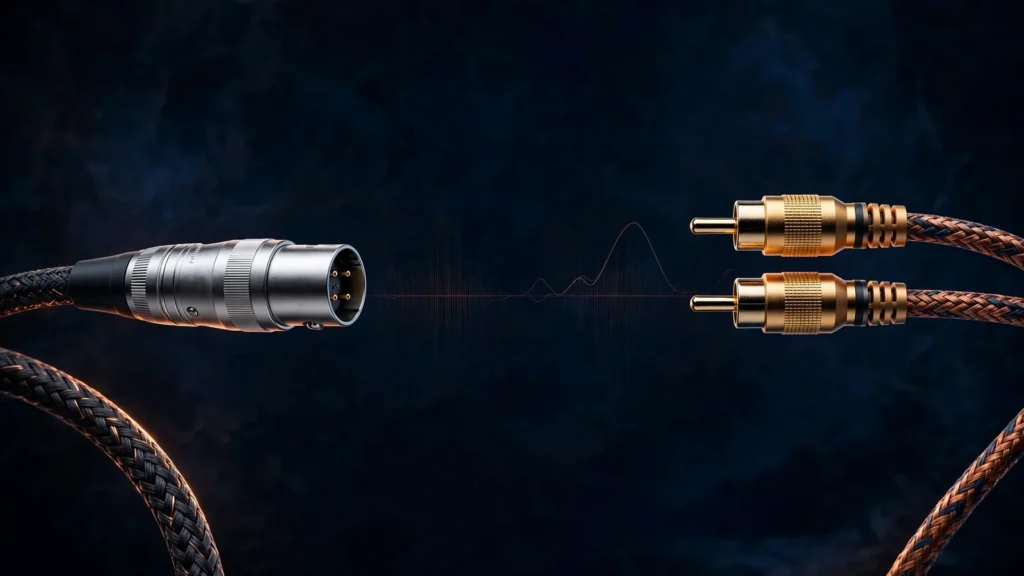
SoundMavericks’ verdict: Symmetry and Pulsar are both audiophile interconnects from the same one-man operation (Chris VenHaus), but they solve different problems. Pick the Symmetry if your system runs balanced XLR — preamp to amp, DAC to preamp — and you want a minimalist twisted-pair design. Pick the Pulsar if you need RCA coaxial: 75-ohm SPDIF digital or a shielded analog run. Both come in copper (Cu) and silver (Ag) conductor versions, and neither is “better” in the abstract — the right one is the one that matches your connectors and signal type.
Symmetry vs Pulsar: Quick Comparison
| Feature | VH Audio Symmetry | VH Audio Pulsar |
|---|---|---|
| Cable geometry | Minimalist twisted pair | Miniature coaxial |
| Primary use | Balanced analog (XLR); Cu version also rated for 110-ohm AES/EBU digital | 75-ohm SPDIF digital or shielded analog (RCA) |
| Conductor options | Symmetry Cu: 24 AWG solid OCC copper, deep cryo-treated; Symmetry Ag: 28 AWG solid pure silver | Pulsar Cu II: 24 AWG solid UniCrystal OCC copper; Pulsar Ag: 24 AWG solid pure OCC silver |
| Dielectric | AirLok foamed fluoropolymer (Cu); natural cotton + AirLok (Ag) | AirLok foamed fluoropolymer; thin clear FEP jacket |
| Shielding | Unshielded twisted-pair design (relies on balanced noise rejection) | Double-shielded: foil plus silver-plated copper braid |
| Termination | XLR (balanced); Cu version uses Furutech FP-601M / FP-602F Gold XLR connectors | RCA; sold as single (digital SPDIF) or stereo pair (analog) |
| Series / positioning | Gold Label series — VH Audio’s balanced flagship | Core lineup — the do-everything 75-ohm digital/analog cable |
| DIY availability | Finished interconnects focus | Also sold as bulk cable for DIY builders |
What the VH Audio Symmetry Is
The Symmetry is VH Audio’s Gold Label series balanced interconnect, built around a deliberately minimalist twisted-pair design. Each leg uses a single fine-gauge solid-core conductor: 24 AWG solid OCC copper (deep cryogenically treated) in the Symmetry Cu, or 28 AWG solid .9999 pure silver in the Symmetry Ag. Signal and return/ground conductors use the same wire, and the Ag version pairs natural unbleached cotton with VH Audio’s proprietary AirLok foamed fluoropolymer dielectric.
Where it goes in your system: the Symmetry is first and foremost a balanced XLR analog interconnect — DAC-to-preamp or preamp-to-power-amp runs where both ends offer XLR. The copper version is additionally specified at 110 ohms for AES/EBU digital, so it can double as a pro-style digital interconnect. Termination uses Furutech hardware (the Cu version ships with Furutech FP-601M/FP-602F Gold XLR connectors). This is SoundMavericks’ pick for the balanced-system listener: if your gear has XLR throughout, the Symmetry is the cable VH Audio designed for exactly that job.
What the VH Audio Pulsar Is
The Pulsar is VH Audio’s miniature coaxial interconnect designed for 75-ohm SPDIF digital connections as well as shielded analog runs — all terminated in RCA. Its defining trait is the double shield: foil plus a silver-plated copper braid, which gives a low-impedance path to ground and solid RFI rejection. The thin jacket is a clear solid FEP dielectric.
It comes in two conductor variants: the Pulsar Cu II, built around a 24 AWG solid UniCrystal OCC copper center conductor, and the Pulsar Ag, with a 24 AWG solid pure OCC silver center conductor. Both use VH Audio’s AirLok dielectric applied tightly enough to hold the consistent 75-ohm impedance SPDIF requires. Finished Pulsar interconnects are sold as singles for digital SPDIF use or pairs for analog stereo — and unlike the Symmetry, the Pulsar is also sold as bulk cable, making it the go-to for DIY builders who terminate their own RCA interconnects.
Where it goes in your system: transport-to-DAC digital links, streamer-to-DAC runs, or any RCA analog pair where you want coaxial shielding rather than a twisted pair. If your components speak RCA only, the Pulsar is the natural fit from this lineup.
The Key Differences, Side by Side
Topology first. The Symmetry is a twisted pair for balanced XLR; the Pulsar is a coaxial for RCA. This is the whole decision: your components’ connectors determine which cable can even be used where. A balanced system gets the Symmetry; an RCA system gets the Pulsar.
Shielding philosophy. The Pulsar is double-shielded (foil + silver-plated copper braid) because coaxial single-ended runs need it. The Symmetry is an unshielded twisted-pair design — balanced connections reject common-mode noise by design, so the cable doesn’t carry its own shield.
Digital duties differ. Both can run digital, but different standards: the Symmetry Cu is rated at 110 ohms for AES/EBU (XLR), while the Pulsar is a true 75-ohm SPDIF coaxial (RCA). If you’re wiring a DAC over AES/EBU XLR, it’s Symmetry; over coaxial SPDIF RCA, it’s Pulsar. Our R2R DAC review covers where digital interconnect choice matters in a source-first chain.
Conductor menus overlap. Both lines offer copper and silver versions — 24 AWG solid OCC copper on both Cu variants (the Symmetry Cu adds deep cryogenic treatment), and fine solid OCC silver on the Ag versions. The copper variants are the entry point; the silver versions sit above them in VH Audio’s own hierarchy.
DIY friendliness. The Pulsar wins here: VH Audio sells it as bulk cable, and it’s a long-standing DIY favorite. The Symmetry is primarily a finished-interconnect product.
Who Should Pick Which
Choose the Symmetry if: your DAC, preamp, and amp all have balanced XLR connections; you want one cable family for analog and 110-ohm AES/EBU digital duties; or you’re buying within VH Audio’s Gold Label tier. This is the endgame balanced interconnect in the lineup.
Choose the Pulsar if: your system is RCA-based; you need a 75-ohm SPDIF digital cable for a transport or streamer; you want a shielded analog pair; or you’re a DIY builder who wants bulk cable. It’s the more versatile everyday cable of the two.
Choose copper (Cu) if you want the baseline of each design at the lowest entry point; choose silver (Ag) if you’re chasing the upper tier of the same geometry — both cables’ Ag versions use solid pure OCC silver conductors.
One honest caveat from SoundMavericks: we don’t do cable “shootouts” by ear, and neither should your buying decision. Owner reports in the forums — including one AudioCircle member who ran both the balanced Symmetry and balanced Pulsar in the same system — describe the Symmetry as smoother and more resolving in that rig. That’s one listener’s system, not a universal ranking. Match the cable to your connectors and topology first; conductor metal is a secondary, personal call.
Where to Buy (Honest Note)
VH Audio is Chris VenHaus’s own operation, and these cables are sold directly through vhaudio.com — we found no official Amazon listings for either the Symmetry or the Pulsar. The Amazon buttons below lead to tagged Amazon search pages (not confirmed listings); if Amazon doesn’t stock them, order direct from the manufacturer link above. For broader signal-chain context, see our preamp vs amp and best headphone amps guides.
Frequently Asked Questions
Are the VH Audio Symmetry and Pulsar for headphones or IEMs?
No — despite the similar naming, both are component interconnects, not headphone or IEM cables. The Symmetry is a balanced XLR interconnect; the Pulsar is an RCA coaxial interconnect. They run between components like DACs, preamps, streamers, and amplifiers.
What is the difference between Symmetry Cu and Symmetry Ag?
The conductor metal and gauge. Symmetry Cu uses 24 AWG solid OCC copper (deep cryogenically treated) and is also rated for 110-ohm AES/EBU digital use; Symmetry Ag uses 28 AWG solid .9999 pure silver with cotton and AirLok dielectrics. Same twisted-pair geometry, different conductor.
Can the Pulsar be used for analog audio, or is it digital-only?
Both. The Pulsar is designed for 75-ohm SPDIF digital and shielded analog use. VH Audio sells it as a single cable for digital SPDIF duty or as a stereo pair for analog interconnects.
Which is better: Symmetry or Pulsar?
They’re not directly comparable — the Symmetry is an XLR balanced cable and the Pulsar is an RCA coaxial cable, so your components decide which one fits. The shared variable is conductor metal: both come in copper (Cu) and silver (Ag) versions, with silver positioned as the higher tier in each line.
Does VH Audio sell on Amazon?
Not that we could verify. VH Audio sells directly through its own site (vhaudio.com), where finished interconnects and — for the Pulsar — bulk DIY cable are available. We could not find official Amazon listings for either cable.

I am the founder of Sound Mavericks, where I provide the polite truth about audio equipment. I started this site because consumer electronics reviews are often too technical. Instead of using a silent lab, I test headphones, earbuds, and Bluetooth speakers in the real world – like on a noisy subway or in a busy coffee shop.
To stay independent, I buy my own review units (mostly from the United States) rather than accepting free gifts from brands. Once I finish testing a product, I sell it locally to our community. My goal is to help you understand sound quality, active noise cancellation (ANC), and battery life without the marketing hype.