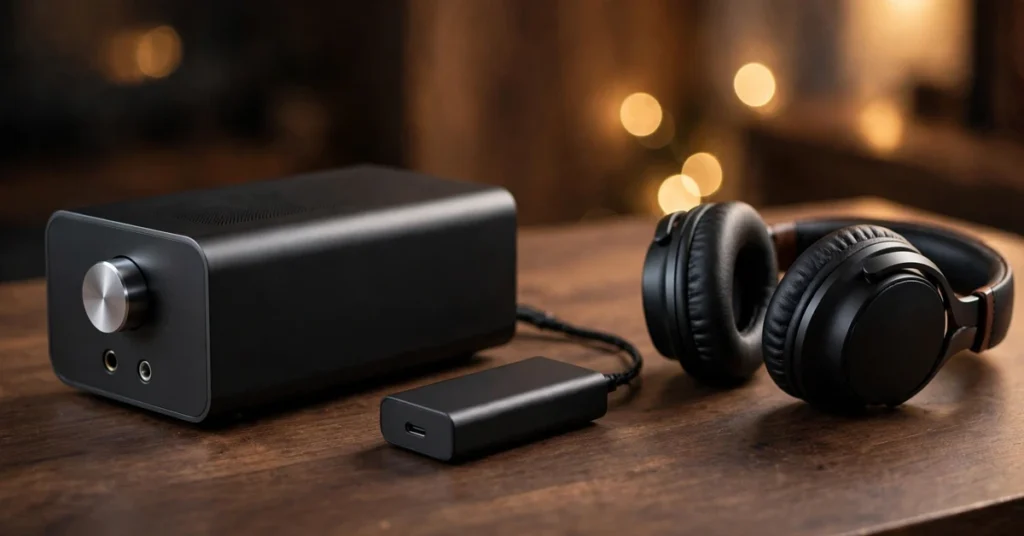
Shopping for the best headphone amps in 2026 is simpler than it looks: you want a clean, powerful source that lets demanding headphones sound the way their designers intended. Phones and laptops get louder, not better, and many high-impedance or planar-magnetic models never reach their potential without dedicated amplification. We compared the specs, Amazon listing data, and third-party reviews of the market’s most popular desktop and portable models to find the six worth your money.
Updated October 2026 — our #1 pick is the FiiO K11.
Quick Navigation
- FiiO K11 — Best Overall
- TOPPING DX5 II — Best Feature-Rich Upgrade
- TOPPING L30 II — Best Pure Headphone Amp
- FiiO BTR13 — Best Portable Bluetooth DAC/Amp
- xDuoo XD05 Plus2 — Best Portable for Hard-to-Drive Headphones
- Douk Audio P1 — Best Tube Pick
- Comparison Table
- How to Choose a Headphone Amp
- FAQ
Comparison Table
| Product | DAC chip | Power output | Headphone outputs | Rating |
|---|---|---|---|---|
| FiiO K11 | CS43198 | 1400mW @ 32Ω | 6.35mm + 4.4mm balanced | 9.2/10 |
| TOPPING DX5 II | Dual ES9039Q2M | 7600mW × 2 (balanced) | 4.4mm balanced + 6.35mm | 9.0/10 |
| TOPPING L30 II | None (amp only) | 2700mW × 2 @ 32Ω | 6.35mm + 3.5mm (adapter) | 8.8/10 |
| FiiO BTR13 | Dual CS43131 | 220mW (balanced) | 3.5mm + 4.4mm balanced | 8.6/10 |
| xDuoo XD05 Plus2 | AK4493SEQ | 1200mW @ 32Ω | Balanced + 6.35mm | 8.7/10 |
| Douk Audio P1 | CM6642 USB DAC | 160mW @ 32Ω | 3.5mm headphone out | 8.0/10 |
1. FiiO K11 — Best Overall

Key specs: Cirrus Logic CS43198 DAC · 1400mW balanced @ 32Ω (520mW single-ended) · USB-C / optical / coaxial inputs · 4.4mm balanced + 6.35mm + RCA outputs · 384kHz/32-bit, DSD256
The FiiO K11 is the easiest recommendation on this list. It is a complete front-end for a desktop rig — DAC, headphone amp, and preamp — in a compact aluminum box with a small status display, for the price of most bare DACs alone. The CS43198 chip handles PCM up to 384kHz/32-bit and DSD256, and the amp section delivers a genuine 1400mW per channel into 32 ohms on the balanced 4.4mm output — enough headroom for high-impedance studio cans and most planars.
Connectivity is where the K11 embarrasses rivals: USB-C for your PC, plus optical and coaxial SPDIF inputs (handy for a console or TV — see our guide to wireless headphones for TV watching for the other side of that setup), and RCA plus coax outputs for powered speakers. Independent reviews consistently praise its neutral, clean presentation and the sheer value of bundling this much in one unit.
- Pros: Complete DAC/amp/preamp in one box; 1400mW balanced power; three digital inputs; neutral measured performance; excellent value
- Cons: No Bluetooth; no EQ or app control; display is basic status-only
Our verdict: The default pick for anyone building a desktop listening setup — nothing else combines this much power and connectivity at this level.
| Sound Quality | 9.2 |
| Power Output | 9.0 |
| Features & Connectivity | 9.3 |
| Build & Design | 9.0 |
| Value | 9.6 |
2. TOPPING DX5 II — Best Feature-Rich Upgrade

Key specs: Dual ESS ES9039Q2M DACs · 7600mW × 2 balanced output · 10-band parametric EQ · Bluetooth 5.1 with LDAC/aptX Adaptive · 4.4mm balanced + 6.35mm outputs · Preamp mode · 12V trigger
The DX5 II is what you buy when the K11’s feature set runs out of runway. It is a flagship-tier DAC/amp built around dual ESS ES9039Q2M chips and an X-Hybrid amp circuit pushing up to 7600mW per channel balanced — comfortably more than any headphone you are likely to own. But the real reason to step up is the feature list: a 10-band parametric EQ for dialing in your headphones’ tuning, Bluetooth 5.1 with LDAC and aptX Adaptive (see our Bluetooth codec explainer for what those actually buy you), preamp mode for active speakers, and a 12V trigger for automated Hi-Fi stacks.
The 2-inch full-color Aurora UI display and pressable knob make it genuinely pleasant to operate, which matters more than reviewers admit on a device you will touch daily. The trade-off against the K11 is cost and complexity — you pay noticeably more for power and features most casual listeners will never touch.
- Pros: Huge balanced output power; 10-band PEQ; LDAC Bluetooth; preamp + 12V trigger; excellent full-color display
- Cons: Overkill for easy-to-drive headphones; costs much more than the K11; larger footprint
Our verdict: The enthusiast’s all-in-one — if you want EQ, Bluetooth, and power to spare in a single desktop unit, this is it.
| Sound Quality | 9.3 |
| Power Output | 9.5 |
| Features & Connectivity | 9.6 |
| Build & Design | 9.0 |
| Value | 8.2 |
3. TOPPING L30 II — Best Pure Headphone Amp

Key specs: Pure analog headphone amp (no DAC) · 2700mW × 2 @ 32Ω · THD+N below 0.00006% · 144dB SNR · Three gain settings · RCA in/out (preamp function)
The L30 II is the purist’s choice: no DAC, no Bluetooth, no display — just one of the cleanest-measuring headphone amplifiers ever made, built on TOPPING’s NFCA (Nested Feedback Composite Amplifier) architecture. Third-party lab measurements put distortion below 0.00006% with a 144dB signal-to-noise ratio, numbers that embarrassed units costing many times more when it launched.
With 2700mW per channel into 32 ohms and three gain settings (-14 / 0 / 16.5 dB), it drives everything from sensitive IEMs to 600-ohm studio cans without audible noise or channel imbalance. Pair it with your existing DAC — or the K11 above as a DAC feeding the L30 II’s RCA inputs — and you have a two-box stack that punches far above its weight. The RCA pass-through even doubles as a preamp for powered speakers.
- Pros: Reference-class measured transparency; huge power; three gain settings suit IEMs to high-impedance cans; doubles as a preamp
- Cons: No DAC — needs a separate digital source; single-ended outputs only; no Bluetooth or EQ
Our verdict: If you already own a DAC and just want the cleanest amplification per dollar, buy this and stop reading.
| Sound Quality | 9.2 |
| Power Output | 8.8 |
| Features & Connectivity | 7.8 |
| Build & Design | 8.8 |
| Value | 9.0 |
4. FiiO BTR13 — Best Portable Bluetooth DAC/Amp

Key specs: Bluetooth 5.1 with LDAC/aptX Adaptive/aptX HD/AAC · Dual CS43131 DACs · 220mW balanced @ 32Ω · 3.5mm + 4.4mm balanced outputs · PC/BT/PHONE mode switch · ~28.6g · ~8h battery
The BTR13 is the Swiss Army knife of this list: a Bluetooth receiver, USB DAC dongle, and pocket headphone amp in a 28.6-gram package. A three-position PC/BT/PHONE switch flips it between computer sound card, Bluetooth decoder, and phone DAC dongle — one device covering your desk, commute, and travel bag. It is a natural companion for travel headphones when you want wired-level quality from your phone.
The Qualcomm QCC5125 chip supports the full codec roster — LDAC, aptX Adaptive, aptX HD, aptX LL, AAC, SBC — and dual Cirrus CS43131 DACs (one per channel) deliver 220mW balanced into 32 ohms, a big jump over its BTR3K predecessor. The color IPS display and app-based parametric EQ round out a package that has no business being this capable at this size.
- Pros: Three devices in one (BT receiver / USB DAC / dongle); full hi-res codec support; 4.4mm balanced output; parametric EQ via app; featherweight
- Cons: 220mW won’t drive the hungriest planars; USB DAC tops out at 96kHz; ~8h battery is modest for long trips
Our verdict: The no-brainer portable upgrade — clip it on and everything from your phone sounds better, wired or wireless.
| Sound Quality | 8.6 |
| Power Output | 8.0 |
| Features & Connectivity | 8.8 |
| Portability & Design | 9.0 |
| Value | 9.2 |
5. xDuoo XD05 Plus2 — Best Portable for Hard-to-Drive Headphones

Key specs: AK4493SEQ DAC · 1200mW @ 32Ω · Bluetooth 5.1 · USB / coaxial / optical inputs · PCM 384kHz, DSD256, MQA rendering · EQ adjustment · 5000mAh battery
Where the BTR13 is a featherweight, the XD05 Plus2 is a pocket brick — and it earns the bulk. At 1200mW into 32 ohms it delivers genuinely desktop-class drive from a battery, enough to make planar-magnetic headphones sing on the go. The AK4493SEQ DAC decodes PCM up to 384kHz and DSD256 with MQA rendering, and inputs cover USB, coaxial, and optical plus Bluetooth 5.1, so it can also serve as a compact desktop DAC/amp.
The 5000mAh battery stretches past 9 hours on USB input (longer on SPDIF/Bluetooth), and built-in EQ lets you tune the sound without an app. It is bigger and heavier than clip-on rivals, but that is the price of real power: if your headphones laugh at dongles, this is the portable that finally shuts them up.
- Pros: Desktop-level 1200mW output; drives planars and high-impedance cans; USB/coax/optical inputs; long battery life; works as a mini desktop unit
- Cons: Bulky next to clip-style portables; no LDAC (aptX HD is the ceiling); utilitarian looks
Our verdict: The portable power pick — maximum drive in minimum size for demanding headphones.
| Sound Quality | 8.8 |
| Power Output | 9.2 |
| Features & Connectivity | 8.8 |
| Portability & Design | 8.4 |
| Value | 8.4 |
6. Douk Audio P1 — Best Tube Pick

Key specs: GE5654 vacuum tube stage · Bluetooth 5.0 with aptX-HD · USB DAC · 160mW @ 32Ω · 32–300Ω headphone range · Bass/treble tone controls (±6dB) · RCA preamp output
Every roundup needs a tube pick, and the Douk P1 is the affordable gateway: a GE5654 tube preamp with a headphone output, Bluetooth 5.0 with aptX-HD, and a USB DAC input, all in one compact box. The tube stage adds the warm, slightly rounded character tube fans love, and the tubes are swappable if you catch the rolling bug. Bass and treble knobs (±6dB) give you analog tone control no app can quite replicate.
Be realistic about its limits: 160mW into 32 ohms suits efficient headphones and IEMs, not planars, and the RCA outputs make it arguably a better preamp-for-powered-speakers than a pure headphone amp. Think of it as a flavor box for a secondary setup — for a dedicated study desk rig, the warm presentation is easy listening for hours.
- Pros: Genuine tube warmth on a budget; Bluetooth + USB DAC + preamp in one box; analog tone controls; swappable tubes
- Cons: 160mW won’t drive demanding cans; tube adds distortion by design; best as a flavor/preamp box rather than a primary amp
Our verdict: The fun pick — affordable tube character for easy-to-drive headphones and powered-speaker setups.
| Sound Quality | 8.2 |
| Power Output | 7.2 |
| Features & Connectivity | 8.6 |
| Build & Design | 7.8 |
| Value | 9.0 |
Notable Mentions
The FiiO Q1 Mark II remains a classic portable DAC/amp, but the BTR13’s Bluetooth versatility beat it. The Schiit Magni is a beloved pure desktop amp that sells mainly direct rather than through Amazon. The FiiO BTR15 is the BTR13’s bigger sibling, but its listing is inconsistent. The S.M.S.L SP200 is a fine THX-based desktop amp — the L30 II won on measurements-per-dollar.
How to Choose a Headphone Amp
Do you need a DAC, an amp, or both?
A DAC converts digital audio to analog; an amp makes that analog signal powerful enough to drive your headphones. Your phone and laptop have both built in — just weak ones. If you mostly stream from a computer, a DAC/amp combo (K11, DX5 II) replaces the whole chain. If you already own a decent DAC, a pure amp like the L30 II slots in downstream.
Match power to your headphones
Easy-to-drive earbuds and portable headphones need little power; high-impedance studio cans (250–600Ω) and planar magnetics need a lot. Check the manufacturer’s recommended range: anything rated 32–300Ω covers most consumer and studio headphones, while planars want the high output of the DX5 II or XD05 Plus2. Balanced outputs (4.4mm, XLR) generally deliver more power than single-ended 3.5mm/6.35mm.
Desktop vs portable
Desktop units (K11, DX5 II, L30 II, P1) run on wall power and always win on raw output. Portable units (BTR13, XD05 Plus2) run on batteries and add Bluetooth — pick one if you listen from a phone or travel. The BTR13’s three-mode switch makes it the most flexible of the two.
Solid-state vs tube
Solid-state amps (everything on this list except the P1) aim for transparency: what goes in is what comes out. Tube amps like the Douk P1 deliberately add harmonic warmth — a flavor choice, not a fidelity one. Try solid-state first; add tubes when you know what sound you want to season.
Frequently Asked Questions
Are headphone amps worth it?
Yes — if your headphones need one. High-impedance headphones (above roughly 100 ohms), planar magnetics, and low-sensitivity models sound noticeably louder, cleaner, and more dynamic with dedicated amplification. If your current headphones already get plenty loud and sound clean from your phone or laptop, an amp is unlikely to add much.
What is the best headphone amp in 2026?
For most people, the FiiO K11: it is a complete DAC/amp/preamp with 1400mW of balanced power, three digital inputs, and broad format support at an entry-level price. Step up to the TOPPING DX5 II for parametric EQ, Bluetooth, and 7600mW of headroom, or go portable with the FiiO BTR13.
Do I need both a DAC and a headphone amp?
Not necessarily as separate boxes. Most modern picks — the K11, DX5 II, BTR13, XD05 Plus2, and even the Douk P1 — combine a DAC and amp in one unit. You only need a standalone amp like the TOPPING L30 II if you already have a DAC you like or want a dedicated upgrade path for each half of the chain.
What does a balanced headphone output do?
Balanced outputs (4.4mm Pentaconn, XLR) drive the left and right channels with separate ground paths, which reduces crosstalk and allows more output power. In practice, the biggest benefit is power: the FiiO K11’s 1400mW balanced output dwarfs its 520mW single-ended rating. You need a balanced cable for your headphones to use one, though.
Will a headphone amp work with my phone or laptop?
Yes. USB DAC/amps connect to phones (via USB-C or a camera adapter on iPhones) and laptops as external sound cards — the BTR13 even has a dedicated PHONE mode so it runs on its own battery instead of draining yours. Bluetooth models like the BTR13 and DX5 II skip the cable entirely.
Tube vs solid-state — which sounds better?
Neither is objectively better; they sound different. Solid-state amps aim for transparency, reproducing the signal as accurately as possible. Tube amps add subtle harmonic distortion that many listeners describe as warmth or smoothness. Start with solid-state, and treat tubes like the Douk P1 as a flavor option once you know what you like.
How we ranked: SoundMavericks scores are editorial rankings based on manufacturer specifications, Amazon listing data, and third-party reviews and lab measurements. We did not conduct hands-on lab testing of these units.

I am the founder of Sound Mavericks, where I provide the polite truth about audio equipment. I started this site because consumer electronics reviews are often too technical. Instead of using a silent lab, I test headphones, earbuds, and Bluetooth speakers in the real world – like on a noisy subway or in a busy coffee shop.
To stay independent, I buy my own review units (mostly from the United States) rather than accepting free gifts from brands. Once I finish testing a product, I sell it locally to our community. My goal is to help you understand sound quality, active noise cancellation (ANC), and battery life without the marketing hype.