
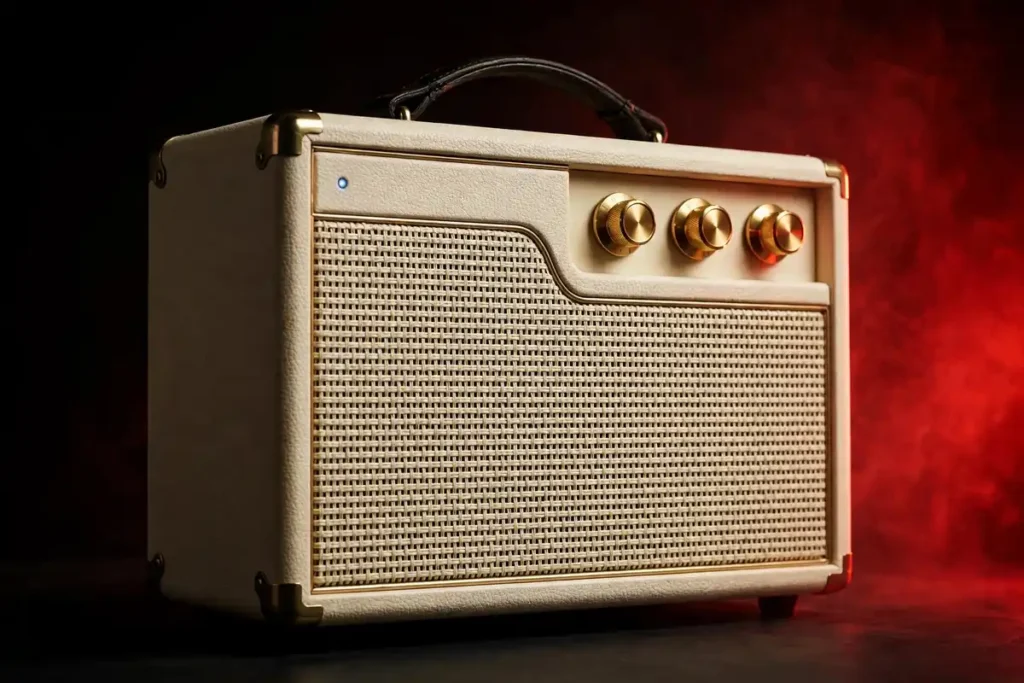
This Marshall Stanmore IV review covers Marshall’s flagship home Bluetooth speaker in its Cream listing on Amazon US, ASIN B0H5CQP7L9: a mains-powered stereo speaker with 110W of Class D amplification across a 5-inch woofer and two tweeters, Bluetooth with LDAC, and RCA and 3.5mm analogue inputs for wired sources. It is a living-room speaker in the classic Marshall cabinet, not a portable, and this review judges it on room-filling sound, wired flexibility and the streaming features it still leaves out.
A note on method. This is a research review, built from the manufacturer’s published specifications, the verified Amazon US listing for this exact model, and independent coverage. We have not had a unit on the desk, so nothing here claims hands-on testing, and speaker products on this site carry no scores.
The Stanmore IV is the strongest Stanmore yet on paper and in the room. Output climbs to 110W, the tweeters and their waveguides give it real stereo width for a one-box speaker, the bass port now vents through the base for cleaner low end near walls, and LDAC plus a proper RCA input make it a better hi-fi citizen than its predecessors. The ceiling is the same as before: no Wi-Fi, so no AirPlay or Cast without Marshall’s separate streaming hub, no pairing two units in stereo, and no battery. As a single-room speaker for Bluetooth and vinyl it is a confident pick in our best powered speakers coverage. Check Price on Amazon

Why you: A 110W three-driver stereo system with a 5-inch woofer, LDAC high-resolution Bluetooth, and RCA plus 3.5mm inputs underneath for a turntable or CD player.
Trade-off: It stays a Bluetooth speaker at heart: no Wi-Fi streaming, no stereo pairing with a second unit, no battery and no microphone.
Marshall Stanmore IV specifications
| Spec | Marshall Stanmore IV |
|---|---|
| Product | Marshall Stanmore IV, Cream finish, mains powered |
| Amplification | 110W total Class D: 60W woofer amplifier, 2 x 25W tweeter amplifiers |
| Drivers | One 5-inch woofer and two 0.75-inch tweeters with waveguides |
| Frequency response | 36Hz to 38kHz as published by Marshall (measurement conditions vary; treat the top figure with care) |
| Connectivity | Bluetooth 5.3 generation platform with LDAC and Auracast receive support; Marshall app with EQ and placement compensation |
| Wired inputs | RCA and 3.5mm inputs, both on the underside of the cabinet |
| Power | Mains only; no battery |
| Controls | Top-panel knobs for volume, bass and treble, source and playback controls, customisable M-button |
Sound: wide for one box, tuned for rock and pop
The Stanmore layout is a proper stereo system in a single cabinet: a central woofer for the lows and a tweeter at each side for width. In this generation the tweeters sit behind redesigned waveguides, and reviewers who compared generations side by side heard the result as a stereo image that finally escapes the box, with instruments placed a little outside the cabinet edges. That width is the upgrade owners will notice first.
Tone is classic Marshall: present mids, lively treble and bass with weight when the music asks for it. The 5-inch woofer and the extra amplifier headroom give the Stanmore a fuller, more projecting sound than the smaller Acton in our Marshall Acton IV review, and it fills a living room at low volume as happily as it plays loud. On default settings some reviewers found the top end a touch bright; the app graphic EQ and the top-panel bass and treble knobs tame it in seconds, and placement compensation adjusts for a corner or a wall behind the speaker.
Dynamic subtlety is the relative weakness. Quiet detail and the softest passages are handled a little more gracefully by the smaller Acton, and hi-fi separates at this money resolve more. Judged as a one-box living-room speaker for everyday listening, the Stanmore IV sounds big, confident and fun, which is the brief it was built to.
Inputs, LDAC and the streaming question
Wired sources are the Stanmore IV’s quiet strength. The RCA input, new to this generation alongside the 3.5mm aux, sits on the underside of the cabinet with the aux socket, so a turntable with a built-in phono stage or a CD player plugs straight in and the cables drop out of sight. Few Bluetooth speakers at any price still offer that, and for vinyl listeners it removes a whole preamp-and-receiver chain.
Wireless is Bluetooth only, but the Bluetooth is current: LDAC support allows higher-bitrate streaming from compatible Android phones and players, a step the previous generation lacked, and the speaker can receive Auracast broadcasts. Marshall sells that ecosystem around its Heddon hub, which feeds Wi-Fi streaming services to Auracast speakers. Without the hub there is no AirPlay, no Cast and no multiroom grouping, and two Stanmore IV units cannot form a stereo pair. Buyers who stream from a phone over Bluetooth all day will never miss it. Buyers building a whole-home system should look at Wi-Fi speakers instead.
The Marshall app covers EQ, placement compensation, the customisable M-button and firmware. Everyday control stays on the cabinet: brass-feel knobs for volume, bass and treble, and buttons for source and playback, in the amp-style layout the brand is known for.
Living with it: size, finish and reliability notes
The Stanmore IV is furniture first. The vinyl wrap, fret grille and brass details are the point of the product as much as the sound, and the Cream finish of the listing covered here lightens the classic black-and-gold look. It needs a shelf or a sideboard and a mains socket, and at living-room scale it is a two-hand lift, so measure the shelf before ordering.
One honest caution from owner feedback: a run of early reviews across retailers reports units failing to power on, alongside many more reporting trouble-free use and easy warranty replacements. We cannot verify a failure rate from reviews, and Marshall’s warranty handled the cases owners described. Buy from a seller with a straightforward returns route, register the product, and keep the packaging until it has run for a few weeks.
Who should buy the Marshall Stanmore IV
Buy it if you want one handsome speaker for a living room that plays Bluetooth all day and takes a turntable or CD player by cable, with room-filling volume in reserve. The LDAC support and the RCA input make it the most flexible Stanmore so far.
Skip it if you need Wi-Fi multiroom, voice control, stereo pairing or portable use. Each is a different speaker category, and no setting on this one adds them later.
Set against the wider home-speaker market, the Stanmore IV’s pitch is focus. Wi-Fi speakers at similar money add streaming platforms, voice assistants and multiroom grouping, then ask you to live inside an app. The Stanmore asks for a Bluetooth connection or a cable and gives back physical knobs, instant start-up and a cabinet guests recognise. For a main listening room where one person chooses the music and a turntable sits nearby, that focus is a feature, and the LDAC support means phone streaming no longer means the lowest-quality codec in the chain. Buyers who cast whole-home audio from streaming apps should count the missing radios as the deciding factor and shop the Wi-Fi category instead.
Frequently asked questions
Does the Marshall Stanmore IV have a battery?
No. The Stanmore IV is mains powered only, with no battery playback. Marshall’s portable models, such as the Kilburn line, cover battery use.
Can you connect a turntable to the Stanmore IV?
Yes. It has an RCA input (and a 3.5mm aux input) on the underside of the cabinet. Your turntable needs a built-in or external phono stage, since the speaker has no phono preamp of its own.
Does the Stanmore IV support Wi-Fi streaming?
No. It is a Bluetooth speaker with LDAC and Auracast receive support. Wi-Fi services reach it through Marshall’s separate Heddon streaming hub, sold separately.
Can two Stanmore IV speakers play in stereo?
No. The Stanmore IV does not offer stereo pairing with a second unit. Its own two tweeters produce the stereo image from the single cabinet.
What is new compared with the Stanmore III?
More power (110W total), an added RCA input, LDAC Bluetooth, redesigned tweeters and waveguides for wider stereo, a downward-venting bass port, and placement compensation in the app.

I am the founder of Sound Mavericks, where I provide the polite truth about audio equipment. I started this site because consumer electronics reviews are often too technical. Instead of using a silent lab, I test headphones, earbuds, and Bluetooth speakers in the real world – like on a noisy subway or in a busy coffee shop.
To stay independent, I buy my own review units (mostly from the United States) rather than accepting free gifts from brands. Once I finish testing a product, I sell it locally to our community. My goal is to help you understand sound quality, active noise cancellation (ANC), and battery life without the marketing hype.

