
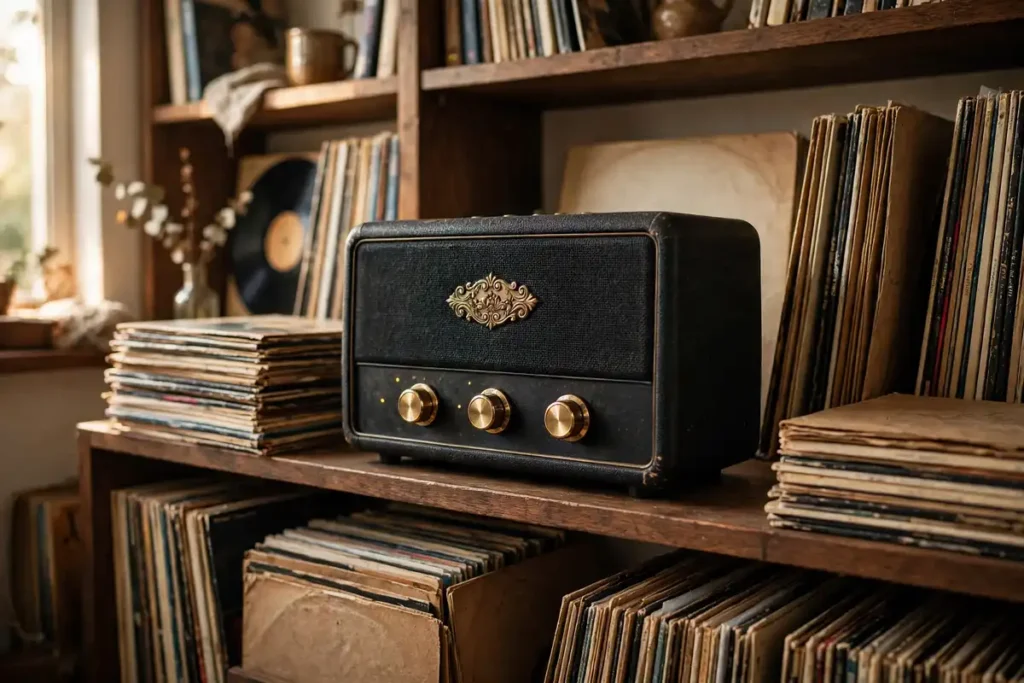
This marshall acton iv review covers the fourth generation of Marshall’s smallest home speaker. The Acton IV keeps the formula the line is known for, a compact guitar-amp-styled cabinet with brass-effect knobs and a three-driver layout rated at 110W, and changes the part owners asked about: inputs. RCA and 3.5mm analogue inputs join Bluetooth 5.3, so a turntable or CD player can finally plug into the little Marshall instead of streaming or nothing. This review judges whether that change, plus new LDAC and LC3 codec support, makes the Acton IV the small home speaker to buy.
A note on method. This is a research review, built from the manufacturer’s published specifications, the verified Amazon US listing for this exact model, and independent coverage. We have not had a unit on the desk, so nothing here claims hands-on testing, and speaker products on this site carry no scores.
The Acton IV is the Marshall for people who actually own records. The RCA input transforms it from a Bluetooth ornament into the end of a small hi-fi chain, the codec list (SBC, AAC, LDAC and LC3) is the most complete in its class, and the sound keeps the Marshall character: warm, forward and louder than the cabinet suggests, with 95dB of maximum output. TechRadar and Pickr both frame it the same way, the small Marshall grew up. It has no battery and no Wi-Fi, and it never pretends otherwise, which keeps it a focused pick in our best Bluetooth speaker home coverage. Marshall also kept the price of entry to its home line the lowest here, which matters: this is the Marshall badge, the knobs and the sound in the smallest and most affordable cabinet the company sells for the home. Check Price on Amazon
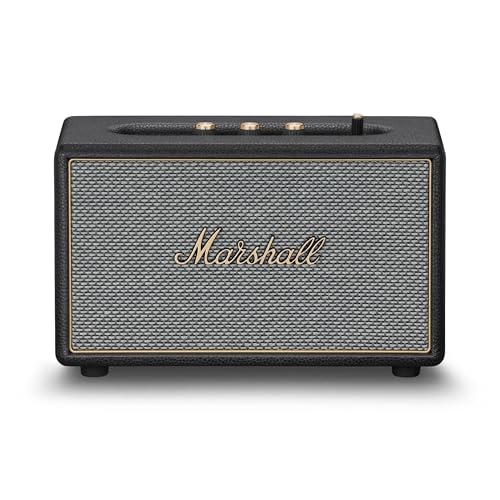
Why you: Marshall’s smallest home speaker, updated: RCA and 3.5mm inputs join Bluetooth 5.3 with LDAC and LC3, a 110W three-driver layout, and knobs, feet and grille sold as repair spares.
Trade-off: It is mains powered with no battery and no Wi-Fi, so it is a one-room wired-or-Bluetooth speaker, and the RCA input is line-level only, so a turntable still needs its own phono stage.
Marshall Acton IV specifications
| Spec | Marshall Acton IV |
|---|---|
| Product | Marshall Acton IV, Bluetooth home speaker in Black (Cream also available) |
| Drivers | 4-inch woofer with 2 x 0.75-inch tweeters; 110W total Class D power (60W woofer, 2 x 25W tweeters) |
| Frequency | 37Hz to 38kHz; maximum sound pressure level 95dB at 1 metre |
| Bluetooth | 5.3 with multipoint; codecs SBC, AAC, LDAC and LC3; Auracast ready |
| Inputs | RCA line input and 3.5mm aux input (no built-in phono stage); Marshall app with EQ and placement compensation |
| Build | 260 x 171 x 150mm; 2.65 kg; mains powered, no battery; knobs, feet and grille available as repair spares |
The inputs change the product
Previous Actons were Bluetooth speakers in amp clothing. The Acton IV adds an RCA line input and keeps a 3.5mm aux, and that one change moves it into a different conversation: the smallest credible speaker for a turntable setup. Plug a deck with a built-in phono stage, or a separate phono preamp, into the RCA sockets and the Acton becomes a compact vinyl system with volume, bass and treble on real knobs.
One caution belongs in bold: the RCA input is line-level. A turntable without a phono stage will sound thin and quiet plugged straight in, because the Acton IV has no phono preamp of its own. Check your deck for a line output switch, or budget for a small external phono stage, and the pairing works exactly as advertised.
Sound and codecs
The driver layout is a 4-inch woofer on 60W with two 0.75-inch tweeters on 25W each, 110W in total, in a cabinet just 260mm wide. Marshall quotes a 37Hz low-end reach, which is optimistic physics for a 4-inch driver, but the in-room result reviewers describe is consistent: a warm, weighty presentation with more bass presence than the size suggests, and a maximum output of 95dB that fills a living room without strain.
The codec story is unusually complete. Bluetooth 5.3 carries SBC, AAC, LDAC for high-resolution Android playback and LC3, with multipoint for two devices and Auracast readiness for broadcast audio. The Marshall app adds EQ and placement compensation, which adjusts the sound for the speaker’s position against a wall or in a corner, the places compact speakers actually live. Owners of Marshall’s portable line, like the Marshall Kilburn III, will find the same tuning philosophy in a mains-powered home body.
What it leaves out, on purpose
There is no battery, no Wi-Fi and no voice assistant. The Acton IV is a wired-power, one-room speaker, and its rivals split on exactly this point: smart speakers offer assistants and multiroom over Wi-Fi, the Acton offers inputs, codecs and repairability instead. Marshall sells the knobs, feet and grille as spare parts, a small thing that signals the speaker is meant to be kept, not replaced.
Portability seekers should look at the Marshall Middleton II or the Kilburn line instead. Buyers who want one handsome speaker for a shelf, fed by a phone and a turntable, with physical controls that need no app and no account, are exactly who the Acton IV was built for.
Against the Acton III, and the rest of the shelf
Owners of the previous Acton will ask what changed. The headline is the analogue inputs: the third generation relied on Bluetooth and a 3.5mm socket, while the Acton IV adds the RCA pair that turntable owners wanted, steps Bluetooth up to 5.3 with LDAC and LC3, and adds placement compensation in the app. The driver layout and the Marshall tuning carry over, refined rather than reinvented.
Against the wider shelf of compact home speakers, the Acton IV wins on character and connectivity and loses on smarts. Voice-assistant speakers answer questions and run multiroom over Wi-Fi; the Acton plays records and high-resolution streams through proper inputs, with controls that never need an update. Which speaker belongs on your shelf depends on which of those sentences sounds like your home.
A final point on longevity, because Marshall leans on it. Selling the knobs, feet and grille as spares, building the cabinet from partly recycled materials and keeping physical controls that cannot be bricked by an app update all point the same way: this is a speaker designed to be repaired and kept. In a category where a software decision can orphan a two-year-old product, that stance is a feature, and for buyers tired of replacing smart speakers, it may be the deciding one.
Who should buy the Marshall Acton IV
Buy it if you want a compact, good-looking home speaker with real analogue inputs for a turntable or CD player, high-resolution Bluetooth codecs, physical knobs and a warm, room-filling sound, in one room, plugged into the wall.
Skip it if you need a battery, Wi-Fi multiroom or a voice assistant, or if your turntable lacks a phono stage and you do not want to add one. Outdoor and portable use belong to Marshall’s battery speakers, not this one.
Frequently asked questions
Does the Marshall Acton IV have a battery?
No. The Acton IV is a mains-powered home speaker. Marshall’s Kilburn and Middleton lines are the battery-powered alternatives if you need to move the music around.
Can I connect a turntable to the Acton IV?
Yes, through the RCA input, with one condition: the input is line-level, so the turntable needs a built-in phono stage or an external phono preamp between the deck and the speaker.
What Bluetooth codecs does the Acton IV support?
Bluetooth 5.3 with SBC, AAC, LDAC and LC3, plus multipoint pairing for two devices. LDAC covers high-resolution playback from compatible Android phones, and LC3 support readies it for newer broadcast audio.
How loud is the Acton IV?
Marshall rates its maximum sound pressure level at 95dB at one metre, from 110W of Class D power across a 4-inch woofer and two tweeters. That is comfortably room-filling for a speaker 260mm wide.
Is the Acton IV a smart speaker?
No. It has no Wi-Fi and no voice assistant. Control is by the Marshall app, with EQ and placement compensation, or by the physical volume, bass and treble knobs on the cabinet.

I am the founder of Sound Mavericks, where I provide the polite truth about audio equipment. I started this site because consumer electronics reviews are often too technical. Instead of using a silent lab, I test headphones, earbuds, and Bluetooth speakers in the real world – like on a noisy subway or in a busy coffee shop.
To stay independent, I buy my own review units (mostly from the United States) rather than accepting free gifts from brands. Once I finish testing a product, I sell it locally to our community. My goal is to help you understand sound quality, active noise cancellation (ANC), and battery life without the marketing hype.

