
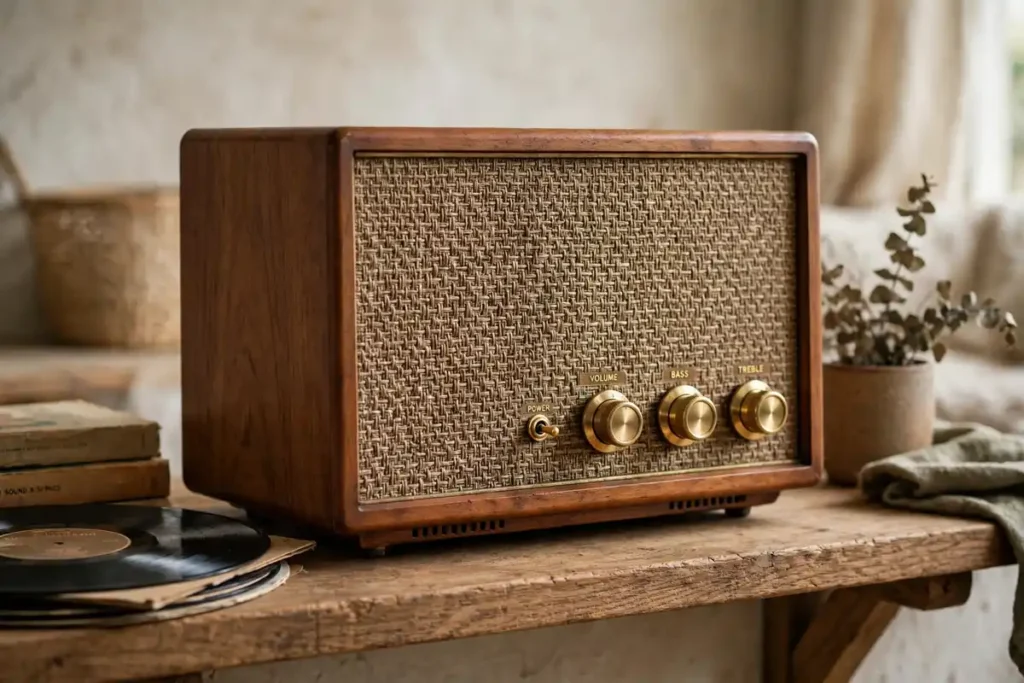
This marshall acton iii review covers the Marshall Acton III home speaker, the previous generation in Marshall’s home line. A live review on this site covers the current Acton IV, so to be plain about scope: this review is about the Acton III only, and the Amazon listing linked here is the Acton III in Black, ASIN B0BC27MM5Z, not the newer model. The Acton III is a mains-powered stereo Bluetooth speaker built to look like a small Marshall amp: 60W of Class D power split across a 4-inch woofer and two angled tweeters, Bluetooth 5.2, a 3.5mm wired input, and physical knobs for volume, bass and treble on a brass top panel. There is no battery, no Wi-Fi and no voice assistant. It stays in one room, plugged in, and plays music.
A note on method. This is a research review, built from Marshall’s published specifications, the verified Amazon US listing for this exact model, and independent coverage. We have not had a unit on the desk, so nothing here claims hands-on testing, and speaker products on this site carry no scores.
The Acton III is the home speaker to buy when you want the Marshall look and sound in the smallest box Marshall makes for the home. The angled tweeters give it a wider stereo image than most single-box speakers manage, the 60W system fills a bedroom or kitchen without strain, and the brass knobs let you set bass and treble by hand. Its limits are clear: Bluetooth and a 3.5mm jack are the only ways in, with no Wi-Fi, no microphone and no battery, and the current Acton IV adds extras above it in our Marshall Acton IV review. For the simpler speaker at a previous-generation price, the Acton III remains a strong pick. Check Price on Amazon

Why you: A 60W stereo home speaker with angled tweeters, physical bass and treble knobs, and the classic amp styling, in Marshall’s smallest home cabinet.
Trade-off: Mains power only with no battery, Bluetooth and 3.5mm are the only inputs, and there is no Wi-Fi, voice control or RCA input.
Marshall Acton III specifications
| Spec | Marshall Acton III |
|---|---|
| Product | Marshall Acton III, mains-powered home speaker, Black finish linked here; also sold in Cream |
| Power | 60W total: 30W Class D for the woofer, 2 x 15W Class D for the tweeters |
| Drivers | 1 x 4-inch woofer, 2 x 0.75-inch tweeters angled outward, ported cabinet |
| Frequency response | 45 Hz to 20,000 Hz |
| Connectivity | Bluetooth 5.2 with multipoint, 3.5mm wired input; no Wi-Fi |
| Controls | Top-panel knobs for volume, bass and treble; source and playback controls; Marshall Bluetooth app |
| Power supply | Mains only, no battery |
| Size and weight | 260 x 170 x 150 mm; 2.85 kg |
Sound: wide for a small box
The Acton III’s main trick is stereo width from a cabinet only 260 mm across. The two tweeters sit angled outward with waveguides, so high frequencies spread to the sides instead of firing in one narrow beam. In a room, that reads as a soundstage wider than the box, with vocals placed in the middle and guitars and backing parts pushed out to the edges. Most speakers this size are mono in practice even when they claim stereo. The Acton III earns the claim.
The tuning is the familiar Marshall one: warm through the middle, with enough low-end weight from the 4-inch woofer and its rear port to give rock and pop a solid footing. Bass does not reach the depth of the larger Stanmore class, and a shelf against a wall will add boom if you push the bass knob up. The physical bass and treble knobs matter here. A small turn down on the bass cleans up a corner placement in seconds, with no app and no menu. Placement Compensation in the Marshall Bluetooth app does a related job, adjusting for nearby reflective surfaces, and Dynamic Loudness keeps the tonal balance steadier at low volume, when most home speakers turn thin.
Volume is ample for the rooms this speaker is built for. Sixty watts in a compact sealed-and-ported cabinet gets loud enough for a living room gathering, and the sound holds together better at high volume than the small drivers suggest. Move far off to the side and the image narrows, as it does with any directional home speaker. Sit roughly in front of it, as you would at a desk or on a sofa, and the width is the first thing you notice.
Controls, app and connections
The top panel is the reason many buyers pick Marshall over a touch-controlled rival. Volume, bass and treble are real knobs with indicator lights. There is a source button, playback controls and the signature power switch. You can walk up, turn it down and walk away. Nothing about daily use requires a phone.
The Marshall Bluetooth app adds firmware updates, the Placement Compensation setting and another way to adjust bass and treble. Marshall recommends using the speaker with the app for the best experience, but the speaker works fully without it. Bluetooth 5.2 supports multipoint, so a phone and a laptop can both stay connected and take turns. The rated range is 10 metres, which in practice means the next room, not the far end of a house.
The connection list is short, and buyers should read it before ordering. Wireless means Bluetooth only: there is no Wi-Fi, so no AirPlay, no Chromecast and no Spotify Connect. Wired means a single 3.5mm input on the top panel. There is no RCA input, so a turntable needs its own phono stage and an RCA-to-3.5mm cable. There is no microphone, so there are no calls and no voice assistant. Speakers with Wi-Fi and voice built in sit in our best wireless speakers coverage if that is the product you actually want.
Acton III or Acton IV?
The current model, covered in our Acton IV review, is the one to buy if you want the newest Bluetooth features, the extra wired input and the longest run of firmware support. The Acton III’s case is value and simplicity. The core formula is shared: the amp styling, the three-knob top panel, the stereo driver layout and the warm tuning. As the previous generation, the Acton III is the one that turns up discounted, and for a bedroom or kitchen where Bluetooth from a phone is the whole use case, the newer model’s extras may never get used. Buyers stepping up in size rather than generation should also look at the larger home models in our Marshall Stanmore IV review, which trade the Acton footprint for more bass and more output.
Who should buy the Marshall Acton III
Buy it if you want a good-looking, good-sounding speaker for one room, you play music from a phone or laptop over Bluetooth, and you like adjusting sound with knobs instead of an app. It suits desks, shelves and bedside tables where a larger home speaker will not fit.
Skip it if you need Wi-Fi streaming, voice control, a battery for moving between rooms, or a direct RCA feed from a turntable. Each of those needs points to a different speaker, and the first two point away from Marshall’s home line altogether.
Frequently asked questions
Is this review about the Acton III or the Acton IV?
This review covers the Acton III, the previous generation. The current Acton IV is a different model with its own review on this site. The Amazon listing linked here is the Acton III, ASIN B0BC27MM5Z.
Does the Marshall Acton III have a battery?
No. The Acton III is mains-powered only. It is a home speaker designed to stay plugged in one room, not a portable speaker.
Does the Acton III have Wi-Fi or a voice assistant?
No. It has no Wi-Fi, no microphone and no built-in voice assistant. Wireless playback is Bluetooth 5.2, and the only wired input is a 3.5mm jack.
Can the Acton III connect to two devices at once?
Yes. Bluetooth multipoint lets two devices stay connected, so a phone and a laptop can take turns playing without re-pairing each time.
Can I connect a turntable to the Acton III?
Yes, through the 3.5mm input, but there is no RCA input and no built-in phono stage. Your turntable needs a built-in phono preamp, or an external one, plus an RCA-to-3.5mm cable.

I am the founder of Sound Mavericks, where I provide the polite truth about audio equipment. I started this site because consumer electronics reviews are often too technical. Instead of using a silent lab, I test headphones, earbuds, and Bluetooth speakers in the real world – like on a noisy subway or in a busy coffee shop.
To stay independent, I buy my own review units (mostly from the United States) rather than accepting free gifts from brands. Once I finish testing a product, I sell it locally to our community. My goal is to help you understand sound quality, active noise cancellation (ANC), and battery life without the marketing hype.

