
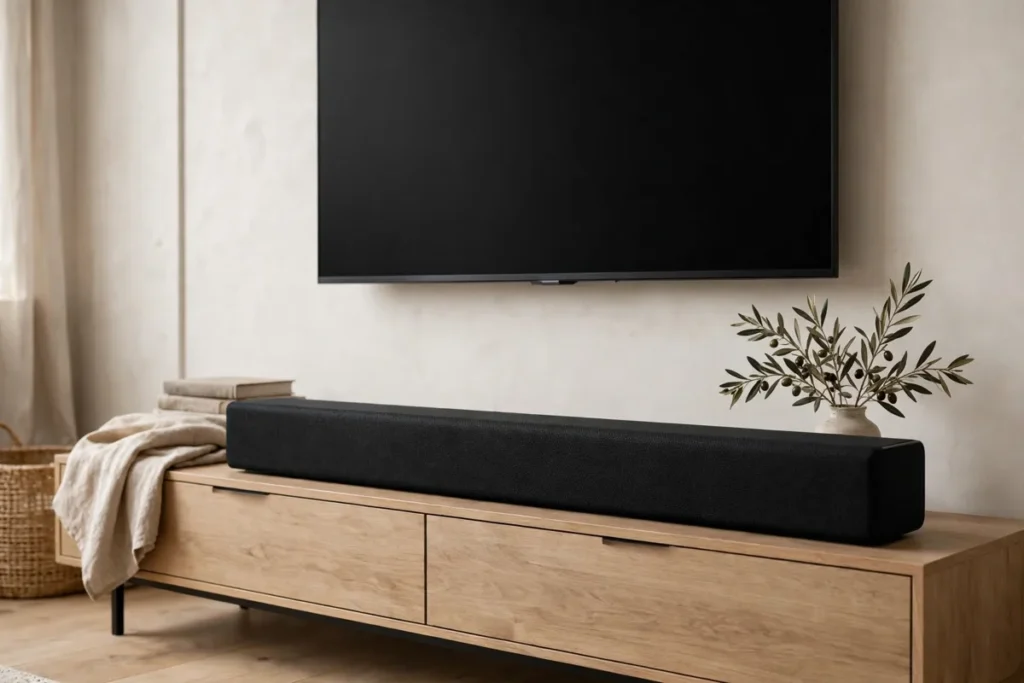
This Bose Smart Ultra Soundbar review covers the flagship all-in-one bar in the Bose TV range: nine drivers in a single cabinet, Dolby Atmos decoding, room calibration that tunes the bar to your seating position, and a dialogue mode built for the shows where voices keep getting buried. It is a research-based review. We have not tested this soundbar hands-on, so the verdict below rests on the published specifications, the listing details, and measured coverage from outlets that have run the bar in a room. Where a claim comes from Bose rather than from a measurement, we say so.
The short version is simple. The Ultra is the bar to buy if you want the biggest, widest sound Bose can get out of one cabinet and no separate subwoofer box on the floor. It asks a lot of money for that convenience, and buyers who want real rear speakers or the deepest bass will still need to add Bose surround speakers and a bass module later.
The Bose Smart Ultra Soundbar is the strongest single-bar option in the Bose range. Nine drivers, including two up-firing dipole transducers, give it a wide stage and genuine height effects on Atmos content, and A.I. Dialogue Mode fixes the most common complaint about TV sound without flattening the rest of the mix. Buy it for a clean one-box setup under a large TV. Skip it if you plan to build a full surround system from the start, because the add-on speakers and bass module push the total cost well past rival packages that include them in the box.

Why you: Nine drivers in one bar, with two up-firing dipole transducers for Atmos height effects, ADAPTiQ calibration that tunes the sound to your room, and a dialogue mode that lifts voices clear of music and effects.
Trade-off: There is no subwoofer in the box, so deep bass stays modest for the money, and the surround speakers and bass module that complete the system are separate purchases.
What the Smart Ultra is, and where it sits
The Smart Ultra is the top soundbar Bose sells for TV use, and it replaced the earlier Smart Soundbar 900 at the head of the range. Below it sits the smaller Bose Smart Soundbar, a five-driver bar for mid-size TVs, and below that the compact TV Speaker. The Ultra is built for large screens: at just over 41 inches wide it matches the span of a big TV without looking lost, and at 2.21 inches tall it sits low enough to clear most screens on a media console. Wall mounting is supported with an optional bracket.
Inside the cabinet are nine drivers. The two that matter most for Atmos sit at the top and fire upward at an angle. Bose calls them dipole transducers, and their job is to bounce height cues off the ceiling so rain and aircraft seem to come from above rather than from the bar itself. The remaining drivers handle the front stage, with side output that pushes the sound wider than the cabinet. There is no subwoofer and no rear speakers in the box, which is both the Ultra’s appeal and its limit.
Bose Smart Ultra Soundbar specifications
| Product | Bose Smart Ultra Soundbar (model 882963-1100, Black) |
| Drivers | Nine drivers, including two up-firing dipole transducers |
| Formats | Dolby Atmos decoding |
| Calibration | ADAPTiQ room calibration (headset microphone included) |
| Dialogue | A.I. Dialogue Mode |
| TV connection | HDMI eARC, optical |
| Streaming | Wi-Fi with AirPlay 2, Spotify Connect and Chromecast built in; Bluetooth |
| Voice control | Amazon Alexa built in; works with Google Assistant |
| Expansion | Pairs with Bose Bass Module 500 or 700 and Bose surround speakers (all sold separately) |
| Dimensions | 41.14 in W x 4.09 in D x 2.21 in H |
| Weight | 12.7 lb |
Sound: width first, height second, bass last
The first thing coverage of this bar agrees on is width. The Ultra throws a stage that reaches well past the ends of the cabinet, so a film mix feels placed around the TV rather than squeezed under it. That matters more in daily use than the Atmos badge, because most of what you watch is stereo or 5.1, and the bar presents both with space between instruments, voices and effects instead of a single block of sound.
On native Atmos content the up-firing drivers add a real height layer. Effects that pan overhead gain elevation, and the ceiling bounce works best in rooms with a flat, standard-height ceiling, which describes most living rooms. It is still a bounce, not a speaker above your head, so the effect reads as spaciousness more than pinpoint placement. Our guide to the best headphones for Dolby Atmos covers the same trade-off from the headphone side: virtual height can be convincing, and it is never the same as physical speakers.
Bass is where the one-box design shows its limits. The cabinet produces clean, controlled low end that flatters dialogue-driven shows and most music, but the deepest film effects, the kind you feel in your chest during an explosion, are beyond what a slim bar can move. Bose knows this, which is why the Bass Module 700 exists. Our honest read: if deep bass is a priority, budget for the module from the start or shortlist a package that includes a subwoofer, and compare options in our best Bose headphones and audio coverage before you commit to the ecosystem.
A.I. Dialogue Mode does the job it promises
Mumbled dialogue is the most common soundbar complaint, and this is the feature Bose built to answer it. A.I. Dialogue Mode analyses the mix and lifts the frequency range voices sit in, then holds the balance scene by scene rather than applying one fixed boost. In practice, per the published coverage, whispered exchanges stay intelligible at low volume, which makes late-night viewing without subtitles a realistic option. The mode can be left on permanently without making dramas sound thin, because the lift is applied to speech content rather than to the whole midrange.
There is a limit worth knowing. On heavily compressed streams from some apps the mode has less clean material to work with, and no processing fully rescues a bad mix. It also cannot help if your TV sends the bar a downmixed signal, so check that your TV is passing the full audio format over eARC. For listeners whose main problem is hearing speech on TV, this feature alone justifies shortlisting the Ultra over cheaper bars.
ADAPTiQ calibration, and why it matters in real rooms
Every room bends soundbar output. A bar pushed into a corner gains boomy bass, a bar in an open-plan space loses it, and the seat you actually sit in is rarely the spot the factory tuning assumed. ADAPTiQ is Bose’s answer: you wear a supplied headset microphone, sit in up to five listening positions, and the bar plays test tones and adjusts its output for your room and your seats.
It takes a few minutes and it is worth doing properly, in the seats people actually use. Recalibrate if you move the bar or rearrange the furniture. Room correction improves every source you play, because it fixes the room rather than the content.
Streaming, voice control and everyday use
As a music speaker the Ultra covers the main routes in. Wi-Fi streaming supports AirPlay 2, Spotify Connect and Chromecast built in, so any phone in the house can send music without a Bluetooth pairing step, and Bluetooth is there for guests. Multi-room grouping works with other Bose smart speakers in the Bose app. Stereo music gets the same wide presentation as film sound, which suits living-room listening.
Amazon Alexa is built in, so the bar answers questions, runs timers and controls smart home gear through its far-field microphones, and it also works with Google Assistant through a paired device. A physical microphone-off control is on the bar. Day to day, the Bose app handles volume, presets and dialogue and bass adjustments, and the included remote covers the basics. If your household splits listening between the TV and personal audio, our guide to the best Bluetooth speaker for TV use covers smaller-room alternatives.
Setup and connections
Setup is a short job. One HDMI cable to the TV’s eARC port is the connection to use, because eARC carries the full Atmos signal and lets the TV remote control the bar’s volume. An optical input is included as a fallback for older TVs, with the caveat that optical cannot carry the same formats. After the cable, the Bose app walks through Wi-Fi, the ADAPTiQ calibration and voice setup in order.
Two connection notes. There is no HDMI passthrough input, so consoles and media players connect to the TV, not the bar. That is standard at this level but worth confirming against your setup. And there is no analogue input, so a turntable or older source reaches the bar through the TV or Bluetooth.
Growing the system later
The Ultra is sold as a starting point as much as a finished system. The Bose Bass Module 500 and the larger Bass Module 700 both pair wirelessly and take over the low end the cabinet cannot reach. Bose surround speakers add true rear channels, which no amount of virtual processing fully replaces for film fans. Each addition is a separate purchase, and the fully expanded system costs substantially more than the bar alone.
Our advice is to buy the bar on its own merits and judge it as it sounds out of the box. If the one-box sound already satisfies you, you have saved the money. If it does not, the expansion path exists and the pieces are designed to match.
Smart Ultra vs the smaller Bose Smart Soundbar
The smaller Bose Smart Soundbar is the Ultra’s obvious rival inside the same range. It carries five transducers rather than nine, with the same A.I. Dialogue Mode and streaming platform, and suits mid-size TVs in smaller rooms. The Ultra earns its step up with the wider stage, the stronger height presentation and the headroom to fill a large room without strain. If your TV is modest and your room is small, the smaller bar covers the same daily needs. If the screen is big and the sofa sits far back, the Ultra is the right size of tool.
Who should buy it, and who should skip it
Buy the Smart Ultra if you want one clean cabinet under a large TV, you watch a mix of film and dialogue-heavy TV, and you value speech clarity and a wide stage over maximum bass. It also suits households that will use the bar daily for music streaming and voice control, where the platform features stop being extras and start being the point.
Skip it if you know you want physical rear speakers and a subwoofer on day one, because rival packages bundle them for less than the Bose system costs once expanded. Skip it too if your priority is the deepest possible bass for action films at high volume, or if your TV lacks eARC and cannot be upgraded, because you would be paying for an Atmos bar and feeding it a limited signal.
Frequently asked questions
Does the Bose Smart Ultra Soundbar include a subwoofer?
No. The bar is a single all-in-one cabinet with nine drivers and no separate subwoofer in the box. It pairs wirelessly with the optional Bose Bass Module 500 or Bass Module 700 if you want deeper bass later.
Does the Smart Ultra support Dolby Atmos?
Yes. It decodes Dolby Atmos and uses two up-firing dipole transducers to bounce height effects off the ceiling. Feed it over HDMI eARC from the TV to get the full Atmos signal.
What is A.I. Dialogue Mode?
It is a processing mode that identifies speech in the mix and lifts it against music and effects, scene by scene. Its purpose is clear dialogue at normal and low volumes without turning subtitles on.
Can the Smart Ultra be expanded into a surround system?
Yes. Beyond the bass modules, Bose surround speakers can be added for true rear channels. Each addition is sold separately, so price the full system before assuming the expansion route is cheaper than a bundled rival package.
Which TVs work best with the Smart Ultra?
Any TV with an HDMI eARC port gets the most from it, including full Atmos passthrough and TV-remote volume control. Older TVs can use the optical input, with reduced format support.
Final verdict
The Bose Smart Ultra Soundbar is a confident flagship: a wide, clear, well-calibrated bar that fixes TV dialogue, streams everything a household actually uses, and leaves a clean upgrade path open. Its weakness is written into the design. One slim cabinet cannot produce subwoofer depth, and the complete Bose system costs real money once the extras are added. Judged as the one-box product it is sold as, it is the strongest soundbar Bose makes and an easy recommendation for large TVs in rooms where simplicity matters.

I am the founder of Sound Mavericks, where I provide the polite truth about audio equipment. I started this site because consumer electronics reviews are often too technical. Instead of using a silent lab, I test headphones, earbuds, and Bluetooth speakers in the real world – like on a noisy subway or in a busy coffee shop.
To stay independent, I buy my own review units (mostly from the United States) rather than accepting free gifts from brands. Once I finish testing a product, I sell it locally to our community. My goal is to help you understand sound quality, active noise cancellation (ANC), and battery life without the marketing hype.

