Dolby Atmos changes what headphones are asked to do. Instead of pushing a left-right stereo image into your ears, an Atmos mix places sounds as objects in a three-dimensional space — above you, behind you, off to one side — and your playback chain renders that space down to two channels. That means the best headphones for Dolby Atmos are not one product category but two. Listeners streaming Atmos music on Apple Music or Tidal, or watching Atmos movies, benefit from head tracking, personalization, and strong noise cancelling. Creators monitoring Atmos mixes in a DAW need the opposite: a neutral, wired, open-back headphone that adds nothing of its own while the renderer does the spatial work. This guide serves both audiences, and it is honest about which picks genuinely track your head and which simply play a fixed render very well.
Quick Picks: Our Verdict
- Best for Apple listeners: Apple AirPods Max — true dynamic head tracking
- Best all-rounder: Sony WH-1000XM6 — elite ANC, plays Atmos renders from any service
- Best for movies: Bose QuietComfort Ultra (2nd Gen) — head-tracked Immersive Audio
- Best value with head tracking: Beats Studio Pro
- Best for Atmos mixing: Sony MDR-MV1 — built for spatial monitoring
- Best studio alternative: Sennheiser HD 490 PRO
- Premium creator pick: Audeze LCD-X
Start with our top listener pick:
How Dolby Atmos on Headphones Actually Works
Here is the fact that most buying guides bury: any stereo headphone can play a Dolby Atmos render. Atmos is object-based audio. When you stream an Atmos track, the service and your device decode those objects and produce a binaural render — a two-channel signal crafted with head-related transfer functions (HRTFs) so your brain perceives height, distance, and movement. The headphone itself receives ordinary left and right audio. No special “Atmos chip” inside a headphone is doing the decoding.
So why buy one headphone over another? Three things separate a forgettable Atmos experience from a convincing one. First, rendering quality: a clear, well-separated headphone with a wide perceived soundstage reproduces the binaural cues instead of smearing them. Second, personalization: some ecosystems scan your ears or calibrate to your ear shape, which sharpens object placement because generic HRTFs fit some listeners poorly. Third, head tracking, covered next, which anchors the virtual stage in the real world. The platform matters too: Apple sells Atmos playback as “Spatial Audio,” Windows and Xbox use the Dolby Access app for Dolby Atmos for Headphones, and mixing engineers work inside the Dolby Atmos Renderer in their DAW. Same object data, different renderers — and the headphone requirements for each audience diverge from there.
Content is the other half of the equation. Dolby Atmos music streams on Apple Music, Tidal, and Amazon Music; Spotify, as of this writing, does not offer it. If you are choosing between services as well as headphones, our Tidal vs Apple Music comparison breaks down their catalogs and tiers.
Head Tracking, Explained Honestly
Head tracking uses motion sensors in the headphone to keep the virtual sound stage fixed in space as you turn your head. Turn left during a film, and dialogue stays with the screen instead of rotating with you. It is the single biggest perceptual upgrade for movie watching, and a modest one for music, where many listeners prefer the stage to move with them.
Labels, however, are slippery, so here is the honest breakdown for every pick in this guide:
- True dynamic head tracking: Apple AirPods Max and Beats Studio Pro (on Apple devices), and the Bose QuietComfort Ultra in its “Motion” Immersive Audio mode.
- Ecosystem-limited tracking: the Sony WH-1000XM6 tracks your head inside Sony’s own 360 Reality Audio ecosystem. Dolby Atmos tracks from streaming services play as high-quality fixed binaural renders — still spacious, but the stage moves with your head.
- No head tracking, by design: the Sony MDR-MV1, Sennheiser HD 490 PRO, and Audeze LCD-X are wired studio headphones. For mixing, tracking would be a liability: the Dolby Atmos Renderer produces the binaural monitor mix, and the headphone’s job is to reproduce it neutrally while you sit at the desk.
One more honesty note: Bose Immersive Audio is Bose’s own spatial processing, not Dolby decoding. Your phone or computer still decodes the Atmos stream; Bose then re-spatializes what it receives, and it applies the same treatment to plain stereo. That is a genuine feature — everything sounds bigger — but it is not the same signal path as Apple’s Dolby-rendered, head-tracked playback.
Best Headphones for Dolby Atmos Listening
These four picks are for the listener audience: Atmos music, films, and shows. All are wireless with active noise cancelling, because a quiet background is what lets quiet spatial details survive — a point our guide to the best noise cancelling headphones explores in depth.
Apple AirPods Max — Best for Apple Listeners

If your Atmos life runs through an iPhone, iPad, Mac, or Apple TV, the AirPods Max remains the reference experience. Personalized Spatial Audio uses an iPhone’s TrueDepth camera to map your ears, then dynamic head tracking — driven by gyroscopes and accelerometers in each ear cup — locks the stage to your device. Atmos tracks on Apple Music and Atmos film mixes both benefit, and the effect is noticeably more stable than fixed renders. Apple’s custom dynamic driver and computational audio keep dialogue intelligible inside dense mixes, which is where cheaper headphones turn Atmos into mush.
The caveats are real: the AirPods Max is heavy for long film sessions, battery life runs up to 20 hours rather than the multi-day figures rivals manage, and outside Apple’s ecosystem the head tracking and personalization simply switch off. Creators should note a second use, though — mixers on Dolby’s professional forum recommend checking Atmos work on AirPods Max precisely because it represents how a huge share of the audience actually hears the binaural render.
Sony WH-1000XM6 — Best All-Rounder
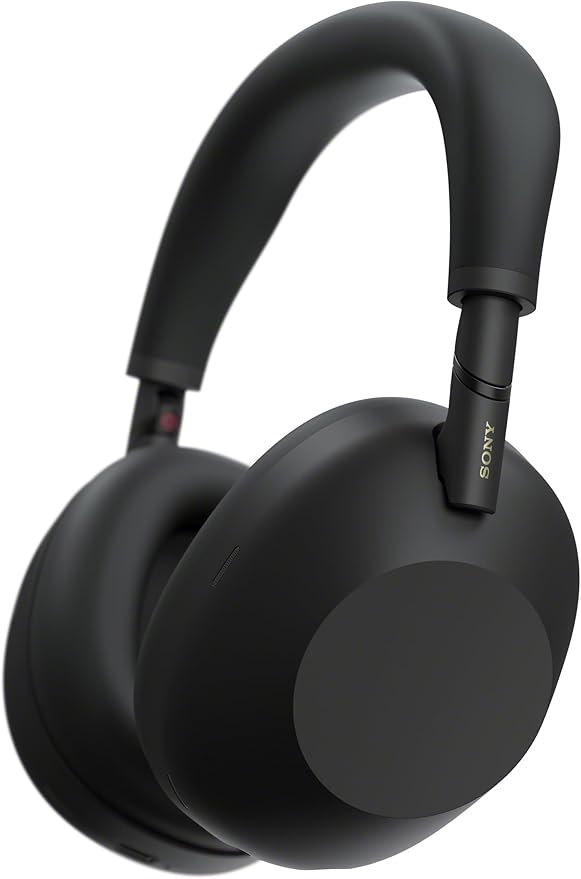
The WH-1000XM6 is the pick we recommend to listeners who are not locked into Apple — or who split time between phones, laptops, and consoles. Sony’s noise cancelling, driven by its HD Noise Cancelling Processor QN3 and 12 microphones, is class-leading, and the 30-hour battery, fold-flat design, and light 254-gram build make it the easiest of these headphones to live with daily. For Atmos, the XM6 faithfully reproduces the binaural render your streaming app produces, and its clean, detailed tuning — plus LDAC support for high-resolution stereo — keeps object placement easy to follow.
Be clear about the one limitation flagged above: Sony’s head tracking belongs to its 360 Reality Audio world. Play an Atmos track from Tidal or Apple Music and you get an excellent fixed render, not a tracked one. For music-first listeners that trade-off rarely matters, and the XM6’s all-round polish — calls, multipoint, comfort, ANC — makes it our default recommendation for Android users.
Bose QuietComfort Ultra Headphones (2nd Gen) — Best for Movies

Bose takes a different route: instead of waiting for perfectly rendered content, its Immersive Audio processing spatializes whatever you play. Choose “Still” mode and the stage sits in front of you like a pair of speakers; choose “Motion” and head tracking keeps that stage anchored as you move — genuinely effective for films, where the second-generation model adds a dedicated Cinema Mode. CustomTune calibration measures your ear canal and adapts the sound accordingly, which helps spatial cues land consistently.
Understand what you are buying, though. As explained above, this is Bose re-rendering a stereo or Atmos-decoded signal, not a Dolby-native head-tracked pipeline, and purists may find it widens some music unnaturally — it is fully defeatable in the app. What is not in doubt is the package around it: superb noise cancelling, up to 30 hours of battery (around 23 with Immersive Audio running), and the most convincing “theater in your head” effect here for movie nights.
Beats Studio Pro — Best Value with Head Tracking

The Beats Studio Pro is the most affordable way into genuine, Dolby-rendered head tracking. Pair it with an Apple device and you get Personalized Spatial Audio with dynamic head tracking for Atmos tracks on Apple Music — the same core pipeline as the AirPods Max — alongside fully adaptive noise cancelling and a more balanced tuning than the bass-heavy Beats of old. Uniquely here, it also plays well with Android, with one-touch pairing and the Beats app, though honesty requires the footnote Beats itself publishes: on Android it plays Atmos tracks from Apple Music, but head tracking is available only with Apple devices.
Extras strengthen the value case: USB-C lossless audio with three built-in sound profiles, a 3.5mm input, and up to 40 hours of battery life — double the AirPods Max. If you want tracked Atmos without flagship money, this is the sensible buy.
Best Headphones for Dolby Atmos Mixing and Monitoring
Creators work the other way around. In a DAW, the Dolby Atmos Renderer — or a binaural monitoring plugin — converts your object mix into a headphone feed, and the headphone must report that feed truthfully. That is why every pick below is wired, open-back, and tuning-first: as our guide to open-back vs closed-back headphones explains, open designs trade isolation for the wider, less resonant stage that spatial judgments demand. None of these headphones “supports Atmos” in the consumer sense, and that is precisely the point. Round out your research with our broader guide to the best headphones for mixing.
Sony MDR-MV1 — Best for Atmos Mixing

The MDR-MV1 is the rare studio headphone designed with immersive work as the brief, not an afterthought. Sony developed it with music creators and engineers specifically for mixing and mastering spatial and stereo sound, and it appears on B&H’s short list of reference headphones for Dolby Atmos creation. The open-back acoustic structure minimizes internal reflections and resonance, so binaural cues from the renderer arrive uncolored, and the custom 40mm driver reaches an ultra-wide 5Hz–80kHz frequency response.
Practical details suit long Atmos sessions: at 223 grams with thick, low-resilience earpads it stays comfortable for hours, the 24-ohm impedance runs happily from an audio interface or even a laptop output, and the detachable 2.5-meter cable includes a stereo plug adapter. It is also the headphone Sony pairs with its 360 Virtual Mixing Environment technology, which recreates a studio’s speaker layout over headphones. For creators starting an Atmos monitoring setup, this is our first recommendation.
Sennheiser HD 490 PRO — Best Studio Alternative

Sennheiser built the HD 490 PRO as a modern production reference, and two features make it unusually adaptable for immersive work. It ships with two switchable ear pad sets — producing pads with a warmer tilt for writing and tracking, and mixing pads with a flatter, more analytical response for critical decisions — so one headphone covers both halves of a session. It also bundles the dearVR MIX-SE plugin from Dear Reality, which simulates a studio control room inside your DAW and gives binaural monitoring a more speaker-like frame of reference.
The open-back design delivers the wide, dimensional stage Sennheiser is known for, the build is lightweight with washable, replaceable pads, and the overall tuning stays honest in the midrange where dialogue and vocal objects live. Like the MDR-MV1, it contributes no spatial processing of its own; paired with a good renderer, that neutrality is its qualification.
Audeze LCD-X — Premium Creator Pick

Step up to planar magnetic territory and the LCD-X is the creator headphone engineers reach for when budget allows. Its large planar drivers, Fazor phase-management elements, and near-zero-distortion design produce the kind of transparent, high-resolution monitoring where you can hear exactly where an object sits in the binaural field — and whether a reverb tail is masking it. Audeze describes the sense of space as enormous, and for Atmos work that imaging precision is the entire argument; our explainer on dynamic vs planar magnetic drivers covers why the technology images so well.
The trade-offs are weight, a wired-only life, and a real appetite for a capable headphone output — plan on a proper interface or amplifier rather than a dongle. Audeze’s studio line also includes the MM-500, developed with mix engineer Manny Marroquin, but the LCD-X remains the more widely stocked and broadly trusted reference of the two. Treat it as the buy-once monitoring anchor of an Atmos room-in-progress.
All Picks at a Glance
| Headphone | Best For | Spatial Approach | Head Tracking | Connection | Price |
|---|---|---|---|---|---|
| Apple AirPods Max | Apple listeners | Personalized Spatial Audio, Dolby-rendered | Yes — dynamic | Bluetooth, USB-C wired | Check Price |
| Sony WH-1000XM6 | All-round listening | Fixed binaural render; 360 Reality Audio ecosystem | 360 Reality Audio only | Bluetooth, 3.5mm | Check Price |
| Bose QuietComfort Ultra (2nd Gen) | Movies | Bose Immersive Audio, Still and Motion modes | Yes — Motion mode | Bluetooth, 3.5mm | Check Price |
| Beats Studio Pro | Value head tracking | Personalized Spatial Audio, Dolby-rendered | Yes — Apple devices only | Bluetooth, USB-C, 3.5mm | Check Price |
| Sony MDR-MV1 | Atmos mixing | Neutral open-back monitor for DAW binaural renders | No | Wired, detachable cable | Check Price |
| Sennheiser HD 490 PRO | Studio monitoring | Neutral open-back; dearVR MIX-SE virtual studio plugin | No | Wired, detachable cable | Check Price |
| Audeze LCD-X | Premium creator monitoring | Planar magnetic open-back reference | No | Wired | Check Price |
How to Choose — and Set Up
Listeners: match your ecosystem first. Head tracking and personalization live inside platforms, so an iPhone user gains more from AirPods Max or Beats Studio Pro than from any rival, while Android users should weigh the XM6’s fixed-render excellence or Bose’s platform-agnostic Immersive Audio. Then confirm your service actually streams Atmos and enable it — on Apple Music, set Dolby Atmos to Automatic or Always On; on Windows and Xbox, install Dolby Access.
Creators: buy neutrality, then check translation. Choose the wired open-back that fits your budget, monitor through the Dolby Atmos Renderer’s binaural mode, and periodically check the mix on a consumer head-tracked device — ideally the AirPods Max many listeners will use — plus a speaker setup when you can. A mix that survives both the MDR-MV1 and the AirPods Max will survive most real-world playback. Creators comparing dedicated studio options should also see our guide to the best headphones for mixing and mastering.
Frequently Asked Questions
Can any headphones play Dolby Atmos?
Yes. Your phone, computer, or streaming app decodes the Atmos mix into a two-channel binaural render, and any stereo headphone can play that render. Better headphones reproduce the spatial cues more clearly, and only certain models add personalization or head tracking on top.
Do I need special headphones for Dolby Atmos on Apple Music?
No special headphone is required to hear Atmos tracks, but the full experience — Personalized Spatial Audio with dynamic head tracking — needs compatible Apple or Beats headphones such as the AirPods Max or Beats Studio Pro. Third-party headphones receive a fixed binaural render instead.
What is the difference between Dolby Atmos and Spatial Audio?
Dolby Atmos is the object-based audio format the content is mixed in. Spatial Audio is Apple’s name for its playback system, which renders Atmos content through compatible headphones and can add head tracking. Other platforms use their own renderers, such as Dolby Access on Windows and Xbox.
Can you mix Dolby Atmos on headphones alone?
Yes — the Dolby Atmos Renderer provides a binaural headphone mode designed for exactly this, and many releases are mixed partly or wholly on headphones. Use a neutral, preferably open-back studio headphone such as the Sony MDR-MV1, and check the result on consumer devices and speakers before delivery.
Which streaming services offer Dolby Atmos music?
Apple Music, Tidal, and Amazon Music all stream music in Dolby Atmos. Spotify does not currently offer Dolby Atmos or spatial audio, so Atmos listeners should choose one of the other three services.
Is head tracking worth it for Dolby Atmos?
For movies and TV, yes — anchoring dialogue and effects to the screen makes the illusion markedly more convincing. For music, it is a matter of taste: many listeners prefer a fixed render that moves with them, which is why several excellent Atmos headphones in this guide do not track at all.
The bottom line: there is no single best headphone for Dolby Atmos — there is a best match for how you will use it. Apple listeners should start with the AirPods Max, Android and all-round listeners with the Sony WH-1000XM6, movie fans with the Bose QuietComfort Ultra, and creators building an Atmos monitoring setup with the Sony MDR-MV1. Choose by audience and ecosystem first, and the spatial magic follows.

I am the founder of Sound Mavericks, where I provide the polite truth about audio equipment. I started this site because consumer electronics reviews are often too technical. Instead of using a silent lab, I test headphones, earbuds, and Bluetooth speakers in the real world – like on a noisy subway or in a busy coffee shop.
To stay independent, I buy my own review units (mostly from the United States) rather than accepting free gifts from brands. Once I finish testing a product, I sell it locally to our community. My goal is to help you understand sound quality, active noise cancellation (ANC), and battery life without the marketing hype.