
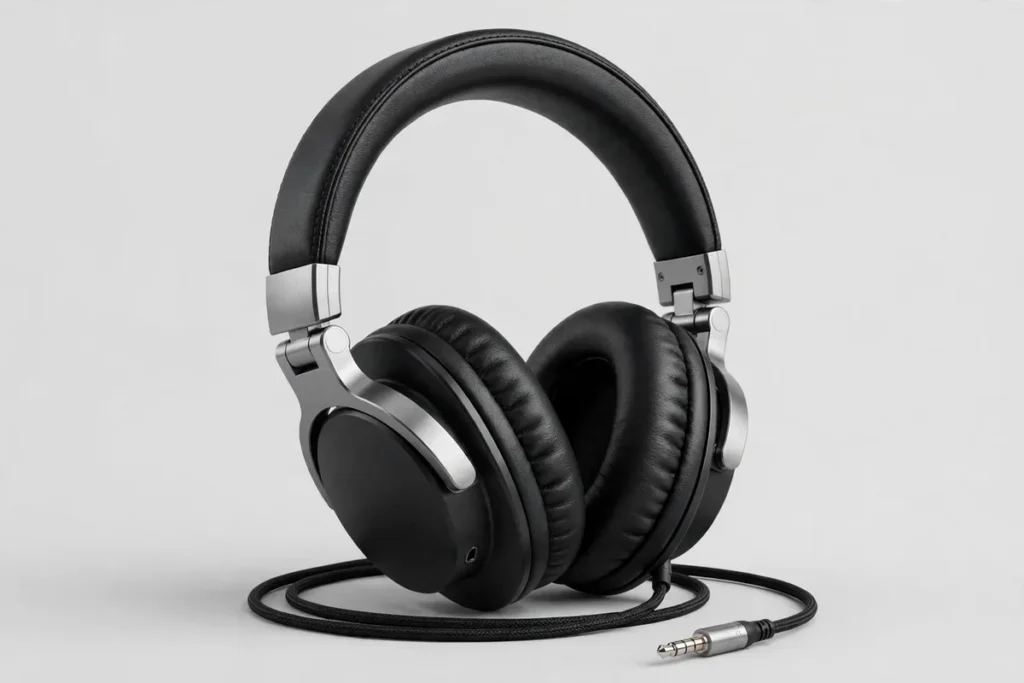
This Bowers & Wilkins P7 review covers the original wired P7: a closed-back over-ear built from aluminium and real leather, with 40mm drivers, a folding frame and no electronics of any kind. Bowers & Wilkins has long since moved the line to wireless models, but the P7 still changes hands constantly on the used market, and its build remains the standard a lot of portable headphones get judged against. The black wired P7 is listed on Amazon US through marketplace sellers, which is the only way to buy one now that production has ended.
This is a research review. We have not lived with the P7 on our own heads for this piece, so the verdict below is built from Bowers & Wilkins’ published specifications, the verified Amazon US listing, published measurements and long-term ownership reports. The score is provisional, and the wired-model bars are explained in plain terms under the card.

Bowers & Wilkins P7 5.5/10 provisional
Why you: you want the object as much as the sound. The P7 is built like hi-fi jewellery: aluminium arms, real leather everywhere your skin touches, hinges that fold flat, and cushions and cables you can replace when they wear. The sound matches that brief, big and confident, with deep bass and clear, lively detail.
Trade-off: the tuning is coloured rather than neutral, the clamp is firm, and isolation is weak for a closed-back design. Every pair on sale now is used, so condition matters more than the badge on the cup.
2x 40mm dynamic drivers · 22 Ω · 111 dB/V at 1 kHz · 10 Hz – 20 kHz · 290 g · Wired only, detachable cables
The score, explained: 5.5 on a wired scorecard
Our overall score is 5.5, the mean of the six bars above, and three of those bars need translating for a wired headphone. Battery scores 5.0 because there is no battery to grade: the P7 is passive, and 5.0 is the neutral placeholder we give wired models so they can sit in the same table as wireless ones. Noise cancelling scores 2.5, near the bottom of our passive band, because there is no cancelling hardware here and the closed-back seal is not a strong one. Rivals with tighter seals block more; the P7 lets a noticeable amount of the world in. Calls & mic scores 3.5, and that one is a real judgement rather than a placeholder. One of the two included cables carries an Apple remote and an inline microphone, so calls are possible, but owners consistently find the mic quiet, and you end up raising your voice in anything but a quiet room.
On the bars it actually competes on, the P7 does better. Sound scores 8.2: the detail, separation and sense of space are genuinely strong for a portable closed-back, held back from the top band by a tuning that pushes the bass and treble. Comfort scores 7.0, a split decision we explain below. Value scores 6.5: the materials and replaceable parts age well, but you are buying a discontinued headphone with no warranty, against new wired rivals that cost less and measure flatter. Read the 5.5 as a luxury wired portable graded partly on features it never claimed to have, then judge it on Sound, Comfort and Value.
Sound: big, warm and unapologetically coloured
Each cup carries a 40mm dynamic driver with a nylon-damped diaphragm, and Bowers & Wilkins voiced the P7 for impact rather than accuracy. Bass is the headline. It reaches low, hits with real weight, and gives kick drums and bass lines a physical presence that smaller portables cannot match. On well-recorded tracks the effect is thrilling. On dense or bass-heavy mixes the low end can crowd the lower midrange, and some listeners hear a slight bloom where a studio headphone would keep things separate.
The midrange is clear and articulate on voices, if a step behind the bass in prominence, and the treble is lively, with cymbals and strings carrying real sparkle. That sparkle sits close to the line: bright recordings can turn sharp at high volume. What surprises most people is the space. For a closed-back portable, the P7 sounds wide and open, with instruments placed convincingly apart rather than stacked between your ears.
Published measurements back the divided opinion. They show a broad bass lift and raised treble, exactly the recipe for a fun listen and a poor reference tool, and distortion rises when the drivers are pushed hard. So the honest summary is a matter of taste. If you want flat, buy a studio headphone. If you want your music served large, with detail on top, the P7’s voicing still holds up, and it is easy to drive while doing it: 22 ohms and 111 dB/V sensitivity mean a phone or a laptop gets loud without help from an amp.
Build and design: the part nobody argues with
The P7’s reputation rests here, and it is deserved. The frame mixes aluminium arms and hinges with a headband and ear cushions wrapped in real leather over memory foam. Everything feels dense and deliberate. The cups fold flat and the hinges fold the whole headphone down for the included carrying pouch, which made it a genuine travel portable rather than a desk ornament.
Ownership was designed in, too. The ear cushions lift off and can be replaced when the leather wears. Both cables detach, plugging in with 2.5mm connectors at the cups and a standard 3.5mm jack at the source, and the box carries two of them: a plain cable, and one with an Apple remote and microphone. A quarter-inch adapter is included for home gear. At 290 g the P7 is not light, but the weight is honest metal and leather rather than bulk. Long-term reports do include failed drivers on ageing pairs, a known weak point worth knowing about before you buy used, and another reason the replaceable cables and cushions only partly protect your money.
Comfort: premium materials, firm fit
Comfort is where owners split down the middle. The leather cushions are plush, the foam is good, and the finish against your skin is a class above most portable headphones. But the clamp is firm, the cups are on the smaller side for an over-ear design, and the headband can press on the top of the head. Some listeners wear the P7 all day without a thought. Others are taking a break inside the first hour, and the leather pads get warm in summer either way.
Two things help. The clamp eases with use, so a well-worn pair often fits better than a stiff one, and careful headband positioning spreads the pressure. Neither changes the basic shape of the thing: this is a compact, firmly clamping portable, not a loose home headphone. If you wear glasses or know you dislike clamp force, treat comfort as the main risk in a used purchase, ahead of the sound.
Isolation and calls: the portable brief, half met
A folding closed-back shape promises travel duty, but the P7’s isolation is modest. The cushions and closed cups take the edge off office hum and household noise, yet on a train or a bus you will hear the world and turn the volume up to cover it, and the people next to you will hear some of your music at those levels. As a home and desk headphone that leakage hardly matters. As a commuter tool it is the main reason the wireless models that followed it added active noise cancelling.
Calls follow the same pattern. Fit the cable with the inline microphone and the P7 works as a headset, with the remote handling calls and playback on Apple devices. The microphone itself is the weak link: it sits low, picks up quietly, and struggles anywhere with background noise. For a quiet room it is usable. For regular calls, look elsewhere, starting with the wireless successor below.
The P7 next to its wireless successor
Do not confuse this listing with the P7 Wireless, a separate Bluetooth model that shares the name and the shape. The wired original reviewed here came first, and the line then moved through the PX and PX7 generations to the current flagship we cover in our Bowers & Wilkins Px7 S3 review. The table below puts the wired original against that current model, because it is the choice most buyers are actually making.
| Specification | Bowers & Wilkins P7 (wired) | Bowers & Wilkins Px7 S3 |
| Design | Over-ear, closed-back, folding | Over-ear, closed-back, folding |
| Connection | Wired only, detachable cables | Bluetooth 5.3, multipoint, USB-C |
| Noise cancelling | None, passive isolation only | Adaptive active noise cancelling |
| Battery | None, passive | 30 hours playback |
| Codecs | Not applicable | aptX Lossless, aptX Adaptive, AAC, SBC |
| Weight | 290 g | 300 g |
The short version: the Px7 S3 is the better tool for almost everything modern, and our scoring of it reflects that. The wired P7 argues for itself on build, on repairability, and on a tuning some listeners still prefer to the current model’s. It argues as a used buy for home listening, not as a travel upgrade.
Bowers & Wilkins P7 specifications
| Product | Bowers & Wilkins P7 Headphones – Black (Wired) |
| Design | Over-ear, closed-back, folding hinges, replaceable ear cushions |
| Drivers | 2x 40mm dynamic drivers, nylon-damped diaphragm, CCAW voice coil |
| Frequency response | 10 Hz – 20 kHz |
| Impedance | 22 Ω |
| Sensitivity | 111 dB/V at 1 kHz |
| Distortion | <0.3% (1 kHz / 10 mW) |
| Connectivity | Wired only; detachable cables (3.5mm at source, 2.5mm at headphone) |
| Microphone | Inline microphone and Apple remote on one included cable |
| Noise cancelling | None (passive isolation only) |
| Included | Two detachable cables, carrying pouch, 6.35mm adapter |
| Weight | 290 g |
Who should buy the P7, and who should skip it
Buy a used P7 if you listen mostly at home or at a desk, you like a warm and lively tuning, and you value things that can be repaired: spare cushions and cables keep a good pair alive for years, and the build quality still embarrasses newer plastic rivals. Check any pair carefully before you commit: pads for cracks, both drivers for balance, and the cable sockets for looseness.
Skip it if you commute, fly often, or take calls on your headphones, because the isolation and the microphone are not up to those jobs. Skip it too if you want a neutral studio sound or a manufacturer warranty. Our Focal Stellia review shows where the wired closed-back flagship idea went at the high end, and the wireless successor above covers the everyday case. The P7’s lane is narrower than it was, but inside that lane it remains a pleasure to own.
Frequently asked questions
Is the Bowers & Wilkins P7 wireless?
No. This P7 is wired only, with detachable cables and no battery or Bluetooth. Bowers & Wilkins also sold a separate model called the P7 Wireless with Bluetooth; the two are different products, so check which one a listing describes before you buy.
Does the P7 have noise cancelling?
No. The P7 has no active noise cancelling. Its closed-back cups and leather cushions block some outside sound passively, but isolation is modest, and on trains or planes you will still hear your surroundings.
Can you take calls on the P7?
Yes, with the included cable that carries an inline microphone and Apple remote. The microphone is quiet by headset standards and struggles in noisy places, so it suits the occasional call in a quiet room rather than regular call duty.
Is the P7 still worth buying?
As a used buy for home listening, yes, if the pair is clean and the drivers are healthy. You get flagship build quality, replaceable cushions and cables, and a big, detailed sound. You give up warranty cover, noise cancelling and any wireless features, and comfort is a firm fit that not everyone gets along with.
What replaced the P7?
Bowers & Wilkins took the line wireless: first the P7 Wireless, then the PX and PX7 families. The current flagship is the Px7 S3, which adds adaptive noise cancelling, Bluetooth multipoint and a 30-hour battery in the same folding over-ear shape.

I am the founder of Sound Mavericks, where I provide the polite truth about audio equipment. I started this site because consumer electronics reviews are often too technical. Instead of using a silent lab, I test headphones, earbuds, and Bluetooth speakers in the real world – like on a noisy subway or in a busy coffee shop.
To stay independent, I buy my own review units (mostly from the United States) rather than accepting free gifts from brands. Once I finish testing a product, I sell it locally to our community. My goal is to help you understand sound quality, active noise cancellation (ANC), and battery life without the marketing hype.
