
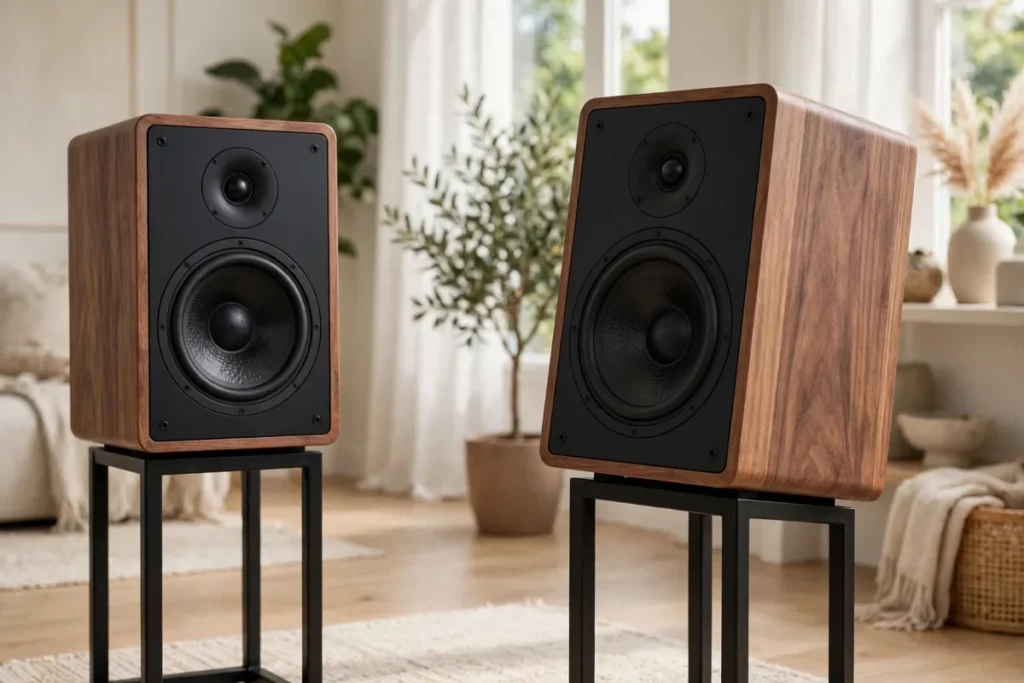
The best stereo speakers for a two-channel system are passive bookshelf pairs, and that is deliberate. A passive pair keeps the amplifier separate, so the speakers can stay in the room for a decade while the amp, the streamer and the sources change around them. The six pairs below cover the main ways people actually listen: a three-way flagship design at the top, honest budget pairs in the middle, one high-efficiency pair for movies and modest amps, and one pair built to slot into a home theater later.
Every pick here needs an amplifier or receiver. None has Bluetooth, Wi-Fi or a power cable of its own. Powered speakers put the electronics inside the cabinet, which is convenient and finite. Passive speakers put the money into drivers, crossovers and cabinets, and they never become obsolete because a streaming platform dropped support. Our best powered speakers guide covers the other route.
One honest note on availability. Five of these pairs sell steadily on Amazon in the US. The Wharfedale Diamond 12.1 is the exception: US stock runs through third-party sellers and comes and goes, and Wharfedale has since refreshed the model as the Diamond 12.1i. Its section below explains what to check before ordering.
Best overall: KEF Q Concerto Meta: the only three-way design here, with a dedicated midrange driver and KEF’s Metamaterial Absorption Technology behind the tweeter. Check Price on Amazon
Best budget pair: ELAC Debut 3.0 DB53: a current-generation Debut design with an aramid fiber woofer and an aluminium dome tweeter, easy to drive at 6 ohms. Check Price on Amazon
Best warm-sounding budget classic: Wharfedale Diamond 12.1: a smooth, forgiving listen built for long sessions, with the availability caveat explained in its section. Check Price on Amazon
Best compact pair: Q Acoustics 3020i: a small cabinet with point-to-point bracing and a decoupled tweeter, made for desks and smaller rooms. Check Price on Amazon
Best for movies and dynamics: Klipsch RP-600M II: horn-loaded and highly sensitive on paper, so it plays loud on modest amplifier power. Check Price on Amazon
Best home-theater-friendly pair: SVS Prime Bookshelf: a neutral, even pair that matches SVS center and satellite speakers when stereo grows into surround. Check Price on Amazon
What to know before buying passive stereo speakers
Three numbers decide whether a pair fits your system. Sensitivity tells you how loud a speaker plays for a given amount of power: each 3 dB step roughly doubles or halves the amplifier power needed for the same volume. Impedance tells you how hard the speaker loads the amplifier, and a 4 ohm minimum dip asks more of the amp than the headline figure suggests. Every pair here works with a normal stereo amplifier or AV receiver, but the KEF wants an amp comfortable with a 4 ohm load, while the Klipsch asks the least of whatever drives it.
Two-way versus three-way is the other real choice. Most bookshelf pairs are two-way: one woofer handles bass and midrange, one tweeter handles the top. A three-way design gives the midrange its own driver, which usually means cleaner vocals when the music gets busy. Our explainer on 2-way vs 3-way speakers walks through the difference in plain terms. Placement matters too: plan for stands or a deep shelf, a gap behind the cabinet, and tweeters roughly at ear height where you sit.
The best stereo speakers, pick by pick

Why you: It is the most complete speaker here. A dedicated midrange driver handles voices, the Uni-Q array places the tweeter at the center of that midrange for a single, focused image, and a separate bass driver does the heavy lifting below.
Trade-off: It is the largest and least sensitive pair on this list, and its 4 ohm impedance wants a proper amplifier rather than the cheapest receiver on the shelf.
The Q Concerto Meta is the largest bookshelf model in KEF’s Q Series and the first three-way bookshelf in that range. Its Uni-Q array combines a 19 mm vented aluminium dome tweeter with a 100 mm aluminium midrange cone, and a 165 mm hybrid aluminium bass driver sits below it. Crossovers at 430 Hz and 2.9 kHz split the work three ways. Behind the tweeter, Metamaterial Absorption Technology soaks up the sound coming off the back of the dome, which KEF credits for cleaner high frequencies. This is the pair here that keeps voices clear and separate when a mix gets dense.
Budget for the amplifier honestly. Sensitivity is 85 dB and nominal impedance is 4 ohms, dipping to 3.2 ohms, with a recommended amplifier range of 15 to 180 watts. A bargain AV receiver run hard will not do it justice. The cabinet is a standmount in the real sense, at 415 mm tall and 9.5 kg per speaker. Give it stands and some space behind the rear port, and it returns the most finished stereo performance in this roundup.

Why you: It is the sensible starting point for a first stereo system. The aramid fiber woofer is stiff and controlled, the aluminium dome tweeter keeps detail on top, and the 6 ohm impedance is an easy load for modest amplifiers.
Trade-off: Bass depth is limited by the small cabinet, and the top end can sound lean with bright recordings or a bright amplifier.
The Debut line has been the default recommendation for a first proper pair for years, and the 3.0 generation keeps the formula: a 5.25 inch aramid fiber woofer, a 1 inch aluminium dome tweeter, and a crossover at 1,900 Hz. ELAC rates frequency response at 70 Hz to 34 kHz at the -3 dB points, which is the honest way to read any small speaker’s bass claim. Sensitivity is 86.5 dB and recommended amplifier power runs from 20 to 120 watts, so a compact stereo amplifier drives a pair comfortably in a small or medium room.
What you get for the restraint is balance. Nothing in the DB53 shouts. Vocals sit where they should, the bass is tidy rather than inflated, and the walnut finish looks better than most budget cabinets. Our best budget bookshelf speakers guide covers the wider field at this level; the DB53 is the pair from that field we would start with now.

Why you: The Klarity cone woofer and woven textile dome tweeter produce a smooth, easy sound that flatters older recordings and long listening sessions. It is the pair here least likely to fatigue you.
Trade-off: US availability on Amazon is third-party and intermittent, and a refreshed Diamond 12.1i now exists. Check the seller and the exact model name carefully before ordering.
The Diamond name has anchored budget hi-fi for decades, and the 12.1 shows why. Its 130 mm Klarity woofer uses a polypropylene and mica blend for stiffness without harshness, paired with a 25 mm woven polyester dome tweeter. Wharfedale rates it at 65 Hz to 20 kHz, 88 dB sensitivity, and 8 ohms compatible with a 4 ohm minimum, with 20 to 100 watts of recommended amplifier power. Almost any stereo amplifier drives this pair well, and the presentation rewards that simplicity with a warm, coherent sound that suits folk, jazz, and older recordings.
Now the caveat, stated plainly. This listing is the original Diamond 12.1 in walnut, sold on Amazon in the US by third-party sellers, so stock and seller vary. Wharfedale has also introduced the Diamond 12.1i, a refresh with new finishes and a refined port design. The 12.1i keeps the same Klarity cone material and the same headline figures, 88 dB sensitivity and a 65 Hz to 20 kHz response, so it is a finishing update rather than a different speaker. If the listing shows a seller you trust, buy with confidence. If not, the 12.1i is the successor to look for, and the ELAC above is the in-stock budget alternative on this page.

Why you: It fits where the others cannot. The cabinet is compact but braced point to point to keep it quiet, and the tweeter is decoupled from the baffle, which keeps the top end clean at a desk or on a shelf.
Trade-off: A 5 inch woofer in a small box gives up real bass depth. Near a wall the rear port helps, but a subwoofer completes this pair for film work.
The 3020i is the small-room answer in this roundup. Q Acoustics made the cabinet about a quarter larger than the model it replaced, which buys a little more bass and scale, and used point-to-point bracing inside to stop the panels adding their own sound. The 125 mm bass driver and 22 mm tweeter cross over at 2.4 kHz. Rated response is 64 Hz to 30 kHz, sensitivity is 88 dB, and impedance is 6 ohms nominal with a 4 ohm minimum. Those figures make it an undemanding partner for a compact amplifier, and its tidy, rounded cabinet sits happily on a desk or a media unit where the KEF would dominate.
Set expectations by size. This pair images well and handles voices with real clarity, which makes it a strong nearfield and small-room choice. It does not move air like the 6.5 inch pairs here. Place it close to a rear wall for some port reinforcement, and add a subwoofer later if the room or the films demand it.

Why you: The horn-loaded tweeter and 6.5 inch Cerametallic woofer give this pair a live, direct sound with real punch. Klipsch rates sensitivity at 94.5 dB, far above the rest here, so small amplifiers play loud.
Trade-off: That forward character is a matter of taste. Listeners who prefer a laid-back presentation should look at the Wharfedale or the ELAC instead.
The RP-600M II is the extrovert of this list. A 1 inch titanium tweeter sits in a vented housing behind a Tractrix horn, which focuses the high frequencies and drives the efficiency up. The 6.5 inch Cerametallic woofer handles everything below the 1,500 Hz crossover. Klipsch rates the pair at 44 Hz to 25 kHz, 8 ohms compatible, with power handling of 100 watts continuous. One honest qualification: Klipsch’s sensitivity figure is measured on generous terms, and independent bench tests put real sensitivity a few decibels lower. Even allowing for that, this remains the easiest pair here to drive loud.
That directness cuts both ways. Rock, electronic music and films sound vivid, and a modest AV receiver fills a room without strain. Quiet acoustic recordings at close range can sound a touch insistent, and the rear port wants space behind the cabinet. If your listening is mostly films and energetic music, this is the pair. For late-night listening at low volume, pick one of the smoother pairs above.

Why you: A flat, honest response and a proper 6.5 inch woofer make it a strong stereo pair today and a matched front pair tomorrow. SVS sells Prime center and satellite speakers voiced to match it.
Trade-off: It has less character than the Klipsch or the KEF. Listeners chasing a distinctive presentation may find it plain, which is also its strength.
The Prime Bookshelf pairs a 1 inch aluminium dome tweeter, fitted with a diffuser designed to keep dispersion wide and even, with a 6.5 inch polypropylene woofer in its own sealed compartment inside the cabinet. SVS’s SoundMatch crossover hands over at 2.3 kHz. The published figures are refreshingly plain: 48 Hz to 25 kHz, 87 dB sensitivity, 8 ohms nominal impedance, and 20 to 150 watts of recommended amplifier power. What you hear matches: an even, unforced sound that keeps dialogue intelligible.
Buy this pair when the system has a future. As a stereo set it covers music honestly in a medium room. As the front pair of a growing home theater, it has matching partners in the same range, so the front stage stays consistent when a center channel arrives. It will not flatter a poor recording or thrill like the Klipsch, and that neutrality is exactly why it anchors systems that have to do everything.
All six pairs, side by side
| Speaker | Design | Response | Sensitivity | Impedance | Amp range | Best for | Buy |
|---|---|---|---|---|---|---|---|
| KEF Q Concerto Meta | 3-way, Uni-Q | 48 Hz to 20 kHz | 85 dB | 4 ohms | 15 to 180 W | Best overall | Check Price |
| ELAC Debut 3.0 DB53 | 2-way, aramid woofer | 70 Hz to 34 kHz (-3 dB) | 86.5 dB | 6 ohms | 20 to 120 W | Best budget pair | Check Price |
| Wharfedale Diamond 12.1 | 2-way, Klarity cone | 65 Hz to 20 kHz | 88 dB | 8 ohms compatible | 20 to 100 W | Warm budget classic | Check Price |
| Q Acoustics 3020i | 2-way, compact | 64 Hz to 30 kHz | 88 dB | 6 ohms | 25 to 75 W | Best compact pair | Check Price |
| Klipsch RP-600M II | 2-way, horn-loaded | 44 Hz to 25 kHz | 94.5 dB rated | 8 ohms compatible | 100 W continuous | Movies and dynamics | Check Price |
| SVS Prime Bookshelf | 2-way, SoundMatch crossover | 48 Hz to 25 kHz | 87 dB | 8 ohms | 20 to 150 W | Home-theater-friendly | Check Price |
Read the sensitivity column with the impedance column, not alone. The Klipsch plays loudest per watt by a wide margin. The KEF needs the most capable amplifier of the six and rewards it. The other four sit in the comfortable middle.
Setup notes that apply to all six
Stands are not an accessory with bookshelf speakers; they are part of the speaker. Put the tweeters at ear height, pull the cabinets away from the rear wall until the bass sounds clean rather than thick, and toe the pair in slightly toward the listening seat. Start with the speakers and your seat forming a rough triangle. If a pair must sit on a shelf or desk, raise it on isolation pads and keep the rear port clear.
On subwoofers: none of these pairs reaches the bottom octave. For music in a small or medium room, the KEF, Klipsch and SVS pairs satisfy on their own. For films, or for the smaller pairs in a larger room, a subwoofer crossed over around 80 Hz fills the gap. Add it after placement is right, not before.
Frequently asked questions
What are the best stereo speakers for a first two-channel system?
The ELAC Debut 3.0 DB53. It is balanced, easy to drive at 6 ohms, and forgiving of modest amplifiers and sources. Add a competent stereo amplifier and you have a system that shows exactly why separate speakers beat a single box.
Do passive speakers need a separate amplifier?
Yes. Every pair in this guide is passive, so each needs a stereo amplifier, an AV receiver, or an integrated amplifier with a source connected. There is no power cable or input on the speakers themselves, just terminals for speaker wire.
Which pair is best for movies as well as music?
The Klipsch RP-600M II for impact, thanks to its horn-loaded tweeter and high rated sensitivity, or the SVS Prime Bookshelf if a center channel and surround speakers may follow, since SVS sells matching Prime models voiced to work with it.
Is the Wharfedale Diamond 12.1 still worth buying now that a 12.1i exists?
Yes, with a check first. US Amazon stock for the 12.1 is third-party and intermittent. The 12.1i refresh keeps the same Klarity cone and the same headline specifications, with new finishes and a refined port. Buy the 12.1 from a seller you trust, or look for the 12.1i if the original is unavailable.
How much amplifier power do these speakers need?
Less than most people fear. In a normal room, 20 to 50 clean watts per channel drives the ELAC, Wharfedale, Q Acoustics, Klipsch and SVS pairs to strong levels. The KEF Q Concerto Meta is the exception: at 4 ohms and 85 dB sensitivity, it deserves an amplifier rated comfortably for 4 ohm loads.

I am the founder of Sound Mavericks, where I provide the polite truth about audio equipment. I started this site because consumer electronics reviews are often too technical. Instead of using a silent lab, I test headphones, earbuds, and Bluetooth speakers in the real world – like on a noisy subway or in a busy coffee shop.
To stay independent, I buy my own review units (mostly from the United States) rather than accepting free gifts from brands. Once I finish testing a product, I sell it locally to our community. My goal is to help you understand sound quality, active noise cancellation (ANC), and battery life without the marketing hype.

