
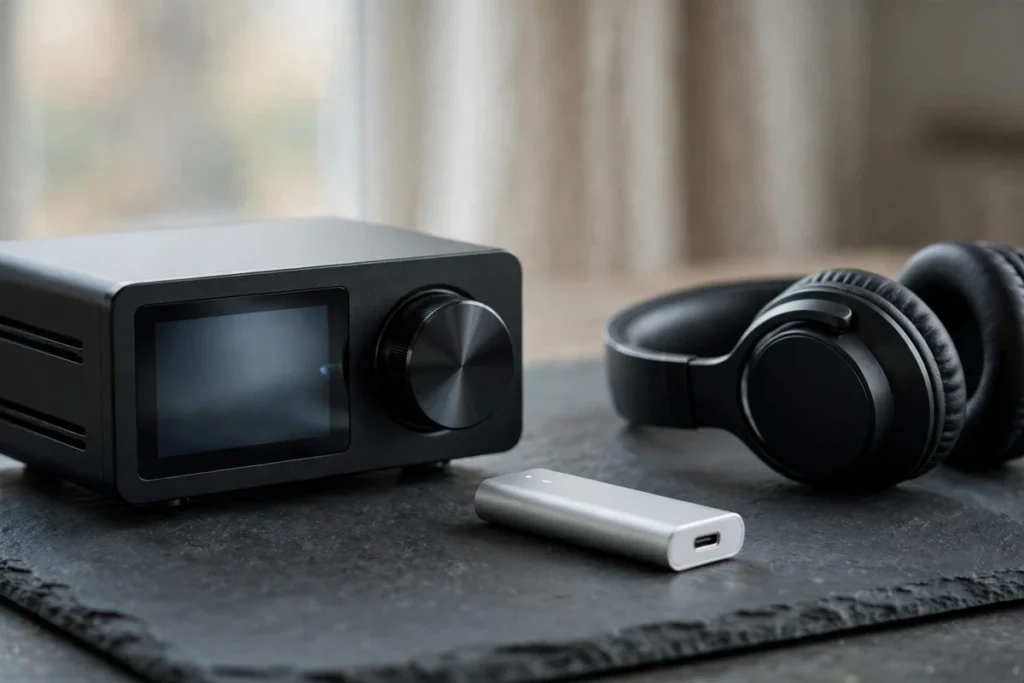
Ask for the best DAC under 200 dollars and you land in the most competitive tier in desktop audio. This is where conversion quality stops improving in big steps: a well-built unit at this level measures cleanly, drives real headphones, and takes every input a desk can offer. The five picks below are the ones worth your money, three of them scored in our main best DACs guide and two newer launch units we have covered but not scored yet.
Scope, so the list stays honest: this page ranks DACs and DAC-first units. Combos built purely around amplification sit in our DAC amp combo guide, and pocket dongles in our portable DACs and dongles guide. Scores are copied from our published coverage, specifications from the manufacturers; we have not bench-tested these units.
Our Top Pick

FiiO K11 R2R 9.1/10
Why you: you want the natural R2R ladder presentation plus a real amplifier in one box: 1,300mW of drive, balanced and single-ended headphone outputs, and NOS/OS modes you can switch by taste.
Trade-off: no Bluetooth, and the R2R character is a preference, not a measurement win; buyers who want the flattest measured response should look at the delta-sigma picks below.
24-bit R2R ladder · NOS + OS modes · 1,300mW · USB / coax / optical
Best DAC Under 200 at a Glance
| DAC | Best for | Type | Key spec | Score | Price |
|---|---|---|---|---|---|
| FiiO K11 R2R | Best overall | Desktop DAC/amp | 24-bit R2R ladder, 1,300mW | 9.1 | Check Price |
| iFi hip-dac 3 | Best portable | Portable DAC/amp | True-balanced, 400mW, 12h battery | 8.9 | Check Price |
| Schiit Modi+ | Best pure DAC | Desktop DAC | USB / coax / optical in, RCA out | 8.9 | Check Price |
| SMSL SU-3 | Best for speakers and balanced chains | Desktop DAC | XLR + RCA out, 32-band PEQ | Not scored yet | Check Price |
| Fosi Audio ZH1 | Most power in one box | Desktop DAC/amp | 2,300mW balanced, AI PEQ | Not scored yet | Check Price |
What the Under-$200 Tier Actually Buys
Below this tier, compromises are structural: dongle power limits, one input, plastic builds, conversion chips chosen on cost. At this level those limits mostly disappear. Every pick here converts at 24-bit/192kHz or far beyond, the desktop units take USB, coaxial and optical feeds, and two of the five offer balanced outputs. If you are new to the category, our what is a DAC explainer covers what the box does and where it sits in a chain.
What the tier does not buy is a different class of sound. Honest measurements of good DACs cluster close together, and the audible gaps between the five units here are smaller than the gaps between the headphones you plug into them. So the ranking below leans on the things that genuinely differ: conversion architecture, output power, inputs, whether there is a headphone stage at all, and tools like parametric EQ. Pick the unit that fits your chain and your headphones; the conversion itself is solved at this level. Our best DACs guide covers the flagship shelf if you want to see what more money actually adds.
One split matters more than any other here: pure DAC versus DAC/amp. A pure DAC (the Modi+ and the SU-3) outputs a line-level signal for powered speakers or a separate amplifier, and has no headphone socket. A DAC/amp (the other three) drives headphones directly. Buying the wrong type is the most common mistake in this tier, and no amount of sound quality fixes it.
1. FiiO K11 R2R: Best Overall
The K11 R2R takes the K11 chassis, a proven desktop DAC/amp frame, and replaces the delta-sigma chip with a fully differential 24-bit R2R resistor ladder built from 192 precision resistors. Ladder conversion is the oldest way to turn digits into sound, and listeners who like it describe a presentation that feels less processed than chip-based DACs. Our R2R DAC explainer covers how the ladder works and where the character comes from.
You are not locked into that character. NOS mode runs the ladder at the file’s native sample rate for the classic R2R presentation; OS mode oversamples to 384kHz and sounds closer to a modern delta-sigma unit. Switching between them is the cheapest experiment in audio: same box, same headphones, two conversion philosophies.
The amplifier side is a full desktop stage, not a token headphone socket: up to 1,300mW, 6.35mm and 4.4mm balanced outputs, three gain levels for IEMs through full-size planars, plus RCA line-outs if you later add powered speakers. USB, coaxial and optical inputs cover a PC, a TV and a streamer without cable swapping. In our best DACs guide it scored 9.1, the highest mark any unit in this tier holds, with its strongest showings in sound quality and value. If your desk gets one box and headphones are the priority, this is the one.
2. iFi hip-dac 3: Best Portable

iFi hip-dac 3 8.9/10
Why you: your listening happens away from a desk: a battery-powered, true-balanced DAC/amp with iEMatch for hiss-prone in-ears and XBass for recordings that run thin.
Trade-off: it sits right at the top of this tier, and 400mW is plenty for most headphones but not the hungriest planars.
True-balanced circuit · 400mW · 384kHz / DSD256 / MQA · Up to 12h battery
The hip-dac 3 is the pick that leaves the desk. Its flask-shaped aluminum case holds a true-balanced circuit with 400mW of output, a 4.4mm balanced jack and a 3.5mm S-Balanced jack, and a battery rated up to 12 hours. Two USB-C ports, one for audio and one for charging, fix the oldest annoyance in portable audio: you can listen and charge at the same time.
The daily-use controls are why it outlasts rivals in a bag. PowerMatch switches gain between sensitive IEMs and full-size headphones, iEMatch drops the hiss floor for very efficient in-ears, and XBass adds analog low-end weight without an app. It decodes PCM to 384kHz, DSD256 and MQA, which covers every streaming tier and local library format that matters. In our best DACs guide it scored 8.9, level with the Modi+ but aimed at a completely different listener: if your DAC needs to work on a train and a desk in the same day, this is the tier’s portable answer.
3. Schiit Modi+: Best Pure DAC

Schiit Modi+ 8.9/10
Why you: you already own an amplifier or powered speakers and want the cleanest, simplest conversion into them: three inputs, RCA out, nothing to configure, ever.
Trade-off: there is no headphone output and no volume control. On its own it makes no sound at all; it only works as part of a chain.
USB / coax / optical in · RCA line-out · 24-bit/192kHz · Designed and built in the USA
The Modi+ is the DAC we hand to someone building a first serious desk chain. Schiit designs and builds it in Texas, and the concept is deliberately plain: one small aluminum box that takes USB, coaxial or optical input and outputs clean analog over RCA. No drivers, no app, no menus, no firmware. A front-panel toggle switches between a computer, a TV and a CD player.
It handles 16-bit/44.1kHz up to 24-bit/192kHz on all three inputs, which covers every mainstream streaming service and the bulk of real music libraries; the very high sample rates on rivals are headroom most libraries never touch. What it pointedly does not do is amplify: pair it with powered speakers or a dedicated amp from our best headphone amps guide and the chain is complete. It scored 8.9 in our best DACs guide, with ease of use at 9.4, the highest mark in this roundup. For a set-and-forget digital front end, nothing in the tier is simpler.
4. SMSL SU-3: Best for Speakers and Balanced Chains

SMSL SU-3
Why you: your chain ends in powered speakers or a separate amplifier, and you want balanced XLR outputs plus a 32-band parametric EQ that keeps its settings through a power cut, in a box the size of a paperback.
Trade-off: it is a DAC only, with fixed output level: no headphone socket and no volume knob, so volume lives on your amp or speakers.
AKM AK4496 · XLR + RCA line-out · 32-band PEQ · PCM 768kHz / DSD512
Not scored yet: covered in our launch review, linked below.
Check Price on AmazonThe SU-3 is the newest unit on this page, launched in September 2026, and it spends its budget on the conversion path: an AKM AK4496 converter, an XMOS XU-316 USB interface and two femtosecond clocks, good for published figures of 126dB dynamic range and 0.00012% THD+N on the balanced output. It takes USB, optical and coaxial feeds, decodes PCM to 32-bit/768kHz and DSD512 over USB, and runs from USB bus power at under 5W. Our SMSL SU-3 launch review has the full paper analysis.
Two things set it apart in this tier. The outputs are balanced XLR at 4Vrms alongside RCA at 2Vrms, which the Modi+ cannot match for feeding balanced amps and active monitors; shoppers comparing balanced line-outs should also see our best balanced DACs ranking. And the 32-band parametric EQ is rare at this level, stored in the unit rather than an app. We have not scored the SU-3 yet: it is launch coverage, paper analysis only, and independent measurements are still arriving. On specification and feature set, though, it is the strongest speaker-chain DAC in the tier.
5. Fosi Audio ZH1: Most Power in One Box
Fosi Audio ZH1
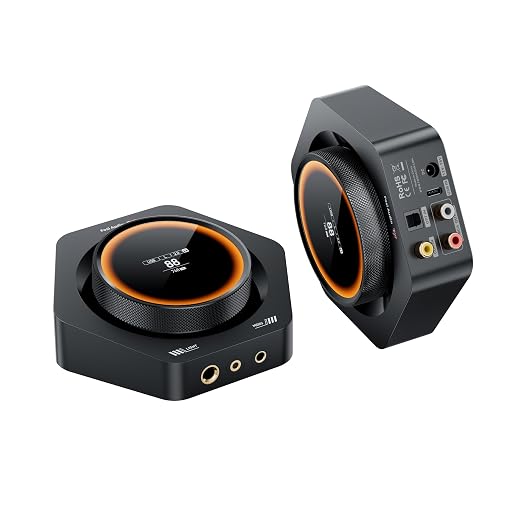
Why you: you want one box with serious drive for hard-to-move headphones, plus an AI-assisted parametric EQ, for a desk split between music and games.
Trade-off: no Bluetooth at all, and the smart EQ runs through a web panel rather than an app, so tuning sessions need a browser open.
ESS ES9039Q2M · 2,300mW balanced · AI PEQ · USB / coax / optical
Not scored yet: covered in our launch review, linked below.
Check Price on AmazonThe ZH1, announced at IFA Berlin in September 2026, is the brute of this roundup. Its ESS ES9039Q2M converter feeds a fully balanced Class AB amplifier built on twin TI TPA6120 chips, rated by Fosi at 2,300mW per channel into 32 ohms from the balanced output, the highest figure in the tier by a wide margin. Headphone outputs cover 3.5mm, 4.4mm and 6.35mm, with an RCA line-out for speakers, and published ranges run from 8 to 300 ohm headphones. Our Fosi ZH1 launch review breaks down the full specification.
The talking point is the Smart Acoustic Assistant, an AI-assisted parametric EQ adjusted through a web panel. Treat it as a promising extra rather than the reason to buy; the reason to buy is power per dollar that nothing else here approaches. Like the SU-3, the ZH1 is launch coverage and carries no score yet, and its long-term reliability record is unwritten. If your headphones are the demanding kind and your budget stops at this tier, it is the one-box shortcut. Our impedance explainer shows how to check whether your headphones actually need that much drive.
How to Choose a DAC in This Tier
Start with the chain, not the chip. Headphones plugged straight in means a DAC/amp: K11 R2R for a desk, hip-dac 3 for everywhere, ZH1 for demanding cans. Powered speakers or an existing amp means a pure DAC: Modi+ for simplicity, SU-3 for balanced outputs and EQ.
Match inputs to sources. A PC-only setup needs USB and nothing else. Add a TV or a streamer and you want optical; add a CD transport and coaxial matters. Every desktop pick here covers all three, which is one reason the tier is a sweet spot.
Check the power math before the format list. Sample rates above 192kHz and DSD support look good on a box and matter only if your library uses them. Output power matters every day: efficient IEMs need little, full-size planars and 300 ohm dynamics need the desktop units. Balanced headphone outputs roughly double available power on the DAC/amps that offer them.
Decide if EQ is a must. Parametric EQ used to start well above this tier. The SU-3 and ZH1 both include it, and for listeners who know their headphones’ weak spots, that can matter more than any converter difference on this page.
Frequently Asked Questions
What is the best DAC under 200 dollars overall?
The FiiO K11 R2R. It pairs an R2R ladder converter with a 1,300mW amplifier, balanced and single-ended outputs, and three digital inputs in one desktop box, and it holds the highest score in this tier in our best DACs guide at 9.1. If you need a pure DAC instead, the Schiit Modi+ and SMSL SU-3 are the picks.
Is a DAC under $200 worth it over a cheaper dongle?
For desk use, yes. A dongle is the right first step for a phone, but this tier adds real output power for full-size headphones, multiple inputs, line outputs for speakers, and in two cases parametric EQ. For phone-only listening, stay with the dongle guides and save the difference.
What is the best DAC under 200 for a PC?
The FiiO K11 R2R for headphone listening at a PC desk, since it combines the converter and the amplifier in one box with USB, coaxial and optical inputs. If your PC feeds powered speakers, the SMSL SU-3 is the better fit, with balanced XLR outputs and a 32-band EQ.
Should I buy a pure DAC or a DAC/amp combo?
Buy a DAC/amp if headphones plug directly into the unit; buy a pure DAC if you already own an amplifier or powered speakers. A pure DAC has no headphone socket, so it only works as one link in a chain. Our preamp vs amp explainer maps out how the pieces connect.
Do I need balanced outputs at this price?
Only if the rest of your chain is balanced. Balanced line-outs help with long cable runs and hum-prone desks, and balanced headphone outputs deliver more power on the units that offer them. In a short, quiet chain, a good single-ended DAC sounds the same. Our best balanced DACs guide covers the balanced-only shelf.
The Bottom Line
The best DAC under 200 dollars is the FiiO K11 R2R for most desk listeners: the strongest score in the tier, a real amplifier, and two conversion modes to grow into. Take the iFi hip-dac 3 if the DAC has to travel, the Schiit Modi+ if you want a pure DAC you never think about again, the SMSL SU-3 for a balanced speaker chain with EQ, and the Fosi ZH1 when headphone power is the whole point. Every one of them converts well enough that the next upgrade should be headphones, not another converter.

I am the founder of Sound Mavericks, where I provide the polite truth about audio equipment. I started this site because consumer electronics reviews are often too technical. Instead of using a silent lab, I test headphones, earbuds, and Bluetooth speakers in the real world – like on a noisy subway or in a busy coffee shop.
To stay independent, I buy my own review units (mostly from the United States) rather than accepting free gifts from brands. Once I finish testing a product, I sell it locally to our community. My goal is to help you understand sound quality, active noise cancellation (ANC), and battery life without the marketing hype.

