
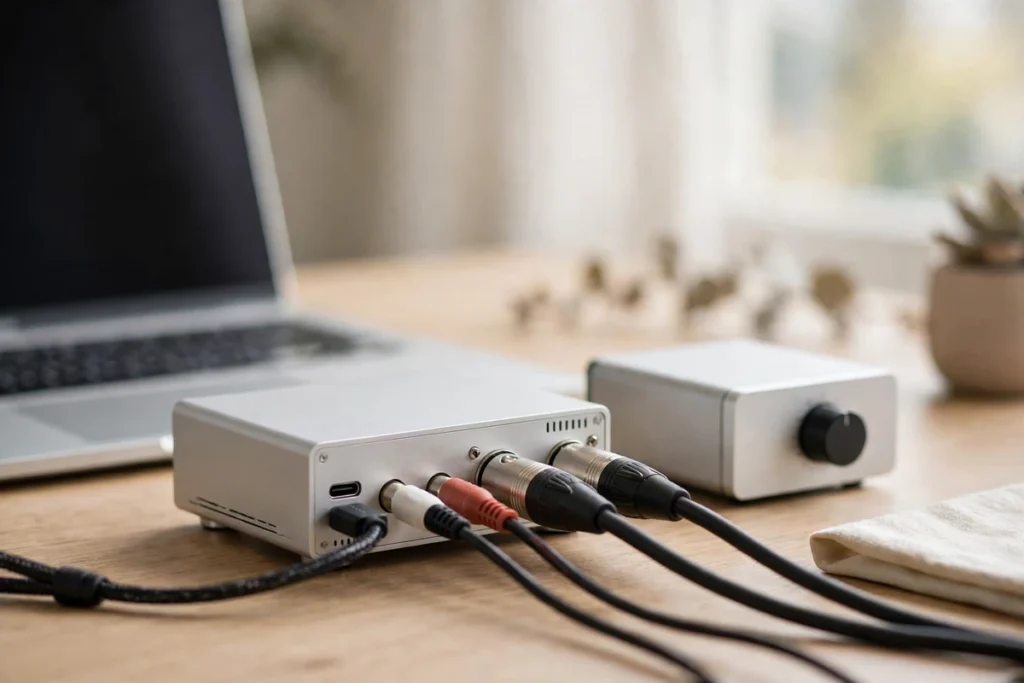
The SMSL SU-3 is a compact desktop DAC built around AKM’s AK4496 converter and an XMOS XU-316 USB interface. It accepts PCM up to 32-bit/768kHz and DSD512 over USB, outputs balanced XLR at 4Vrms alongside RCA at 2Vrms, and adds a 32-band parametric equalizer that keeps its settings when the power goes off. SMSL launched it on September 23, 2026, and it is on sale at Amazon US and Apos Audio.
This is a launch review, built from SMSL’s published specifications as carried by Apos and Audiophonics, and the verified Amazon US listing. We have not listened to the SU-3, and nothing here pretends otherwise. What follows is paper analysis: the hardware, its place in the SU line, and who should buy now or wait. This page will be updated as independent measurements and reviews appear.

SMSL SU-3 On sale now
What it is: a small, USB-powered desktop DAC with balanced and single-ended line outputs. The AK4496 and dual femtosecond clocks do the conversion; a 32-band PEQ does the adjusting.
Watch out: it is a DAC only. There is no headphone output and no volume control, so it needs an amplifier or powered speakers behind it, and there is no Bluetooth input.
AK4496 DAC chip · XMOS XU-316 USB · PCM 32-bit/768kHz and DSD512 · XLR 4Vrms and RCA 2Vrms · 32-band PEQ
SMSL SU-3 quick facts
| Type | Desktop DAC (line-level outputs only, no headphone amplifier) |
| Launch price | $189 at Apos Audio |
| Status | Launched September 23, 2026; Apos availability announced October 5, 2026 |
| Where to buy | Amazon US and Apos Audio |
| Amazon US | Listed, ASIN B0HKS2QJQM (verified November 3, 2026) |
| DAC chip | AKM AK4496, with XMOS XU-316 USB interface |
What the SU-3 is
The SU-3 is the latest restart of SMSL’s entry-level SU line, and the specification is ambitious for the price bracket. The conversion numbers are the current desktop standard at their best: native DSD512 and 32-bit/768kHz PCM over USB, with optical and coaxial inputs behind at 24-bit/192kHz. Output levels are full-size rather than dongle-grade: 4Vrms from the balanced XLR pair, 2Vrms from RCA. SMSL specifies THD+N of 0.00012 percent and dynamic range of 126dB from the XLR output.
Two features do the differentiating. The first is clocking: SMSL fits two low-phase-noise femtosecond quartz oscillators as the conversion reference, hardware that usually shows up further up the price ladder. The second is the equalizer. A 32-band parametric EQ on a DAC at this price is unusual, and SMSL stores the settings in the device with power-off memory, so a correction dialled in for a room or a pair of speakers stays put. The chassis is CNC-machined aluminium at 116 by 40 by 87mm and 310g, and the whole unit runs from USB bus power at under 5W, with a dedicated filter system on the USB supply that SMSL says is there to keep computer power noise out of the audio path.
Where it sits in the SU line
SMSL’s own launch post tells the story of a line that keeps changing its mind. The SU-1 won its following with a low price, an AK4493S chip and MQA support. The SU-2 swung toward traditional hi-fi hardware with an ESS ES9039Q2M and an AES/EBU input, and dropped USB entirely. The SU-3 swings back: an AKM chip again, USB restored as the main input, and two things neither predecessor had, balanced XLR outputs and the parametric EQ. One absence is worth noting: SMSL’s launch materials for the SU-3 do not list MQA decoding, which the SU-1 carried.
In our own coverage, the SU-3 lands in the territory of our best DACs roundup: small fixed-output converters that feed an amplifier. Because there is no headphone stage, it pairs with a separate amp, and our best headphone amps guide is the natural second half of that chain.
SMSL SU-3 specifications
| Product | SMSL SU-3 Check Price |
| Type | Desktop DAC |
| DAC chip | AKM AK4496 |
| USB interface | XMOS XU-316, asynchronous |
| Inputs | USB, Toslink optical, coaxial SPDIF |
| Outputs | RCA single-ended, XLR balanced (fixed level) |
| Output level | 2Vrms RCA; 4Vrms XLR |
| Sampling rates, USB | PCM 32-bit/768kHz; DSD512 native |
| Sampling rates, optical/coaxial | PCM 24-bit/192kHz |
| THD+N | 0.00012% (-118dB) |
| Dynamic range | 126dB XLR; 123dB RCA |
| SNR | 126dB XLR; 123dB RCA |
| Equalizer | 32-band parametric EQ, settings saved with power-off memory |
| Clocking | 2x low-phase-noise femtosecond quartz oscillators |
| Power | USB bus powered, under 5W |
| Compatibility | Windows 7 to 11, macOS 10.6 or later, Linux |
| Dimensions | 116 x 40 x 87mm |
| Weight | 310g |
| Launch price | $189 |
Architecture: an AKM chip, two clocks and an equalizer
The design logic, as SMSL presents it, is to spend the budget on the conversion path rather than on features around it. The AK4496 is a known quantity in this class, and SMSL pairs it with the dual femtosecond oscillators so that clock jitter is handled by dedicated hardware instead of being recovered from the USB stream. The USB power filter is the third leg: because the SU-3 runs from bus power, SMSL says it filters noise, ripple and interference from the computer’s supply before it can reach the analogue stage. These are manufacturer claims about design intent; the published distortion and dynamic-range figures are consistent with them without proving them.
The PEQ is the feature with practical consequences. Thirty-two bands is more resolution than most listeners will use, but even a handful of bands can pull a desk setup’s bass bloom into line or soften a bright speaker, and because the settings live in the DAC, every source upstream inherits the correction. For a fixed-output DAC with no volume control and no remote, that stored EQ is effectively the SU-3’s personality setting.
Early coverage
Coverage so far is the launch itself: SMSL’s launch post on Head-Fi on September 23, 2026, Apos Audio’s availability announcement on October 5, and retailer listings including Audiophonics. As of November 3, 2026, we have not seen independent reviews or third-party measurements. This section updates as they appear.
Should you buy, or wait?
The buy case is a desktop chain that needs a converter, not another box with a volume knob. If your amplifier or powered speakers already handle level, the SU-3 gives you balanced outputs, modern format support and a stored parametric EQ at an entry-level price, in a box small enough to sit behind a monitor.
The wait case: nothing independent has measured or reviewed it yet, and the fixed outputs make it the wrong product entirely if your headphones plug straight into your DAC. Buyers who need a headphone output and volume in the same box are shopping for a DAC and amp combo instead, a different shelf covered in the scored alternatives below.
Also consider
Three desktop DACs from our best DACs roundup, already covered and scored.

The beginner desktop DAC from our roundup, with top marks for ease of use and value. No balanced output and no EQ, but a proven first separate DAC.

The all-in-one alternative from the same roundup: a DAC with a real headphone amplifier and volume control built in. Pick it if one box has to do everything.

The resistor-ladder alternative in our roundup, with a headphone stage on board. For listeners who want R2R conversion rather than a delta-sigma chip.
FAQ
When is the SMSL SU-3 released?
SMSL launched the SU-3 on September 23, 2026, and Apos Audio announced its availability on October 5, 2026. It is on sale now at Amazon US and Apos.
How much does the SMSL SU-3 cost?
The launch price is in the quick facts box at the top of this page. Apos listed it at launch, and the Amazon button shows the current US figure.
Where can I buy the SMSL SU-3?
It is on sale at Amazon US under ASIN B0HKS2QJQM, and at Apos Audio. The button at the top of this page goes to the Amazon listing.
Is the SMSL SU-3 on Amazon?
Yes, as a listing under ASIN B0HKS2QJQM, verified on November 3, 2026.
Does the SMSL SU-3 have a headphone output?
No. The SU-3 is a line-level DAC with RCA and balanced XLR outputs at fixed level and no volume control. It needs a headphone amplifier, an integrated amplifier or powered speakers behind it.
Does the SMSL SU-3 support MQA?
SMSL’s launch materials for the SU-3 do not list MQA decoding. The older SU-1 supported MQA, so SU-1 owners who rely on it should note the change before upgrading.

I am the founder of Sound Mavericks, where I provide the polite truth about audio equipment. I started this site because consumer electronics reviews are often too technical. Instead of using a silent lab, I test headphones, earbuds, and Bluetooth speakers in the real world – like on a noisy subway or in a busy coffee shop.
To stay independent, I buy my own review units (mostly from the United States) rather than accepting free gifts from brands. Once I finish testing a product, I sell it locally to our community. My goal is to help you understand sound quality, active noise cancellation (ANC), and battery life without the marketing hype.

