
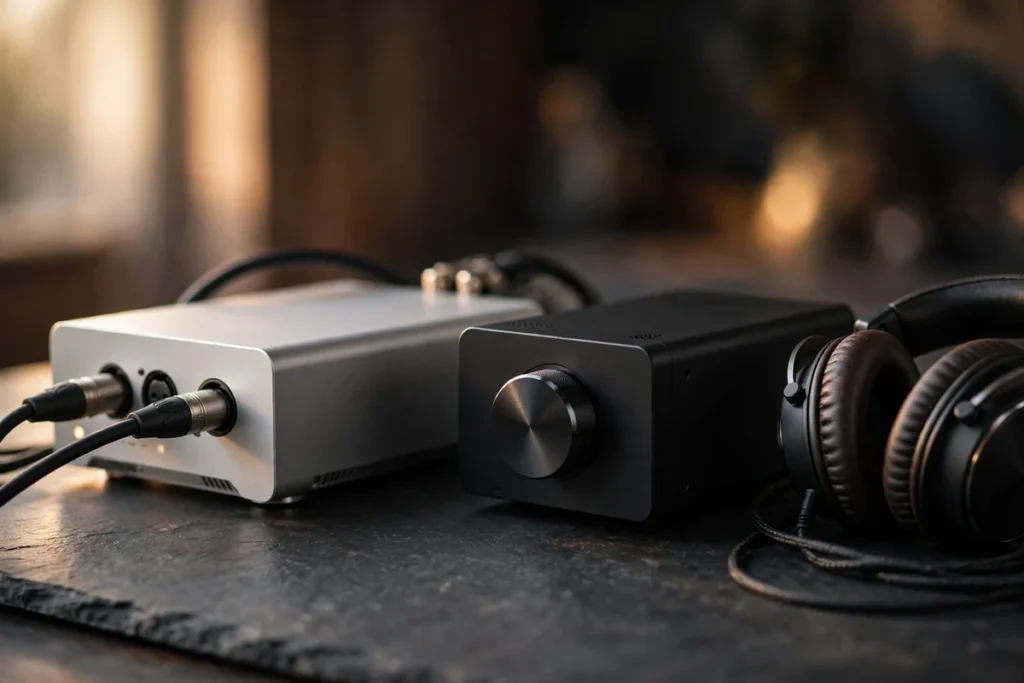
Most DAC roundups mix balanced and single-ended models in one list. This one does not. Every pick below has a true balanced output stage, an XLR line-out, a 4.4mm balanced headphone output, or both, backed by published balanced specifications. If a model could not prove a differential circuit on paper, it did not make the list.
The picks and scores are built from manufacturer specifications, our own published coverage, and independent reviews. We have not bench-tested these units, and scores say so where they are provisional. For the wider field, our best DACs guide is the broader ranking; this page is its balanced-only shelf.
Our Top Pick

FiiO K7 9.2/10
Why you: you want one desktop box that does the whole job: THX AAA 788+ amp modules, 2,000mW from the balanced output, and every input a desk needs.
Trade-off: the line-out is RCA only, so the balanced path serves headphones, not a balanced amp; no Bluetooth either.
Dual AK4493SEQ · THX AAA 788+ · 2,000mW balanced · 4.4mm + 6.35mm
Balanced DACs at a Glance
| DAC | Best for | Type | Balanced outputs | Score | Price |
|---|---|---|---|---|---|
| FiiO K7 | Best overall | DAC/amp combo | 4.4mm headphone out | 9.2 | Check Price |
| Topping DX5 II | Most powerful, best features | DAC/amp combo | XLR line-out + 4.4mm / 4-pin XLR outs | 9.0 | Check Price |
| iFi ZEN DAC 3 | Best for beginners | DAC/amp combo | 4.4mm headphone out + 4.4mm line-out | 9.0 | Check Price |
| FiiO K13 R2R | Best R2R | DAC/amp combo | XLR line-out + 4.4mm headphone out | 8.9 | Check Price |
| SMSL D400 MK2 | Best pure DAC | DAC only | XLR line-out (variable, 5Vrms) | 8.8 | Check Price |
| FiiO K13 ESS | Best value power | DAC/amp combo | XLR line-out + 4.4mm headphone out | 8.7 | Check Price |
| SMSL SU-3 | Best budget balanced DAC | DAC only | XLR line-out (4Vrms) | 8.5 | Check Price |
What a Balanced Output Actually Buys You
A balanced connection carries each channel twice: the signal and its mirror image. Noise lands on both copies equally, and the receiving circuit subtracts one from the other, cancelling the noise and keeping the signal. That is common-mode rejection, why studios standardized on XLR long before home audio did. On a desk full of powered monitors, it is a practical fix for hum, not a luxury.
Balanced headphone drive buys voltage swing: a balanced stage pushes roughly twice the voltage, which is why balanced power figures here run two to four times the single-ended ones. For high-impedance dynamics and low-sensitivity planars, that headroom is the difference between comfortable and strained. Published separation shows it too: the DX5 II’s XLR line-out rates -147dB crosstalk, against -135dB from its RCA.
What balanced does not buy is detail that is not in the recording. It cannot rescue a weak amp stage, and in a short, quiet chain a well-built single-ended DAC can sound every bit as clean. Treat balanced as insurance for noisy environments and hard loads, not an automatic upgrade.
One caution: a 4.4mm socket on its own proves nothing; some products wire it to a single-ended circuit. The test is the spec sheet: a true balanced design publishes separate balanced power figures and names a differential circuit. Every pick below passes it.
1. FiiO K7: Best Overall
The K7 pairs two AKM AK4493SEQ chips with dual THX AAA 788+ amp modules and rates the balanced output at 2,000mW: enough for sensitive IEMs on low gain and demanding full-size headphones on high. Best overall at 9.2 in our headphone amp DAC combos guide, it holds that place here because its balanced output sits inside the most complete desktop package in this list.
Connectivity carries it: USB, optical, coaxial and analogue in; 4.4mm, 6.35mm and 3.5mm headphone outs; an RCA line-out for powered speakers. The RGB indicator tracks the incoming sample rate, a small feature that earns its keep when confirming a hi-res stream.
- DAC: dual AK4493SEQ; dual THX AAA 788+ amp modules
- Balanced output: 4.4mm headphone out, 2,000mW rated
- Inputs: USB, optical, coaxial, analogue AUX
2. Topping DX5 II: Most Powerful, Best Features

Topping DX5 II 9.0/10
Why you: you want the full balanced chain in one unit: XLR line-out, three headphone outputs including 4-pin XLR, a 10-band EQ, and more balanced power than any headphone here can use.
Trade-off: you pay for depth most listeners never open: PEQ profiles, trigger outputs and preamp modes are enthusiast tools.
Dual ES9039Q2M · 7,600mW x2 balanced · XLR 5.0Vrms · 10-band PEQ · LDAC
Two ES9039Q2M chips feed an X-Hybrid amp circuit, with the largest output figures here: 7,600mW per channel balanced into 16 ohms. An XLR line-out at 5.0Vrms and 132dB published SNR means it fronts a balanced amp or powered monitors as credibly as it drives headphones. It scored 9.0 in our best headphone amps guide, our strongest features mark for a desktop unit.
The feature list is the reason to step up: a 10-band EQ with per-output profiles, Bluetooth 5.1 with LDAC and aptX Adaptive (our Bluetooth codec explainer covers those), preamp mode, and a 12V trigger.
- DAC: dual ES9039Q2M, XMOS XU316 USB
- Balanced outputs: XLR line-out (5.0Vrms), 4.4mm and 4-pin XLR headphone outs
- Power: 7,600mW x2 balanced at 16 ohms; 990mW x2 at 300 ohms
- Inputs: USB, optical, coaxial, Bluetooth 5.1 (LDAC, aptX Adaptive)
3. iFi ZEN DAC 3: Best for Beginners

iFi ZEN DAC 3 9.0/10
Why you: you want your first real desktop DAC with balanced outputs on both sides, headphone and line, running off one USB-C cable.
Trade-off: 390mW balanced covers most headphones but runs out of headroom on the hardest planars, and USB is the only digital input.
Burr-Brown DAC · 390mW balanced · 4.4mm headphone + line out · XBass+
The ZEN DAC 3 converts with a Burr-Brown design rather than ESS or AKM, and the character shows: a warmer presentation that pairs well with lean headphones, helped by XBass+, an analogue bass lift for open-backs that ship light in the low end. It took 9.0 as the beginner pick in our combos guide: balanced connections without a learning curve.
It is balanced on both sides: 6.3mm and 4.4mm sockets in front, RCA and a 4.4mm line-out behind, switchable fixed or variable so it doubles as a speaker preamp. The ceiling is output: 390mW balanced is honest mid-tier drive, not a planar party trick.
- DAC: Burr-Brown, up to PCM 768kHz and DSD512, MQA
- Balanced outputs: 4.4mm headphone out; 4.4mm line-out (fixed or variable)
- Power: up to 390mW balanced
- Inputs: USB-C
- Extras: PowerMatch gain, XBass+, preamp mode
4. FiiO K13 R2R: Best R2R

FiiO K13 R2R 8.9/10
Why you: you want the resistor-ladder sound with a fully differential output stage: XLR line-outs, balanced headphone out, NOS/OS modes and PEQ.
Trade-off: it is the premium chassis here, and the tuning depth is wasted if your plan is to press play and leave settings alone.
24-bit R2R ladder, 192 resistors · NOS / OS modes · XLR + 4.4mm · 2,400mW · LDAC · 10-band PEQ
The K13 R2R converts with a fully differential 24-bit resistor ladder FiiO developed in-house: 192 precision thin-film resistors. NOS and OS modes switch the presentation, and our R2R DAC explainer covers why listeners chase this architecture. It scored 8.9 as the premium pick in the combos guide; here it is the only ladder DAC in the list.
Balanced provision is complete: XLR and dual RCA line-outs, 4.4mm and 6.35mm sockets, 2,400mW, Bluetooth 5.4 with LDAC, and a 10-band PEQ with auto-EQ. That depth is the trade-off: if your idea of setup is one cable and a volume knob, the K13 ESS or the K7 suits you better.
- DAC: fully differential 24-bit R2R ladder, NOS and OS modes
- Balanced outputs: XLR line-out; 4.4mm headphone out
- Power: 2,400mW rated headphone output
- Inputs: USB, optical, coaxial, Bluetooth 5.4 (LDAC)
- Extras: 10-band PEQ with auto-EQ, app control
5. SMSL D400 MK2: Best Pure DAC

SMSL D400 MK2 8.8/10 provisional
Why you: you run a balanced amp or powered monitors and want flagship conversion in front of them: AKM’s top architecture, an oven-controlled clock, and a 5Vrms XLR output.
Trade-off: there is no headphone output at all; the money goes entirely on conversion and clocking. SMSL’s own documents also disagree on the converter chip count.
AK4191 + AK4499EX · 10MHz OCXO · XLR 5Vrms preamp out · AES + I2S · LDAC
The D400 MK2 is a converter, full stop: no headphone socket, because the budget went into conversion and clocking. AKM’s flagship split architecture does the work, processing in the AK4191 and conversion in the AK4499EX, behind a 10MHz oven-controlled oscillator. Our SMSL D400 MK2 launch coverage works through the full spec.
Connectivity is the broadest here: USB, optical, coaxial, AES/EBU, I2S over HDMI, plus LDAC Bluetooth. The variable XLR output runs to 5Vrms, enough to drive a power amp directly. Choose it when a balanced amp or powered monitors already sit in the chain.
- DAC: AK4191 processor + AK4499EX converter, XMOS XU-316 USB
- Balanced output: XLR, variable to 5Vrms; RCA alongside
- Inputs: USB, optical, coaxial, AES/EBU, I2S (HDMI), Bluetooth (LDAC)
- Extras: 10MHz OCXO clock, preamp volume control; no headphone output
6. FiiO K13 ESS: Best Value Power

FiiO K13 ESS 8.7/10 provisional
Why you: you want the K13 formula with ESS conversion instead of the ladder: fully balanced, 2,400mW per channel balanced, XLR line-outs, LDAC and the same PEQ.
Trade-off: the chassis and feature depth match the R2R version, so it is a large, settings-rich unit if you only ever use the volume knob.
Dual ES9039Q2M · Fully balanced · 2,400mW x2 balanced · XLR + 4.4mm · LDAC
The ESS version of the K13 keeps the R2R chassis and swaps the ladder for two flagship ES9039Q2M chips: the measurements-first take on the same formula. The circuit is fully balanced: 2,400mW per channel balanced against 1,220mW single-ended, with XLR and RCA outputs behind. Our FiiO K13 ESS launch coverage has the full spec.
The working features carry over: Bluetooth 5.4 with LDAC, two USB-C inputs, coaxial and optical, PO / PRE / LO output modes, and the shared 10-band PEQ. Pick between the two K13s on conversion character alone; the amplifier, outputs and software are identical.
- DAC: dual ESS ES9039Q2M, XMOS XU316 USB
- Balanced outputs: XLR line-out; 4.4mm headphone out
- Power: 2,400mW x2 balanced; 1,220mW x2 single-ended (32 ohms)
- Inputs: dual USB-C, optical, coaxial, Bluetooth 5.4 (LDAC)
- Extras: 10-band PEQ, PO / PRE / LO modes, coax pass-through
7. SMSL SU-3: Best Budget Balanced DAC

SMSL SU-3 8.5/10 provisional
Why you: you want a true balanced line-out feeding a balanced amp or speakers without paying for a headphone stage, plus a 32-band PEQ that keeps its settings.
Trade-off: it is a DAC only: no headphone output, no volume control and no Bluetooth, so an amplifier or powered speakers must sit behind it.
AK4496 · XMOS XU-316 · XLR 4Vrms + RCA 2Vrms · 32-band PEQ
The SU-3 restarts SMSL’s entry-level SU line with specs that used to cost far more: an AK4496 behind an XMOS XU-316 interface, dual femtosecond clocks, and full-size output levels, 4Vrms balanced and 2Vrms RCA, with THD+N rated at 0.00012%. A balanced XLR line-out at this level is still rare, which makes the SU-3 the natural front end for a budget balanced amp. Our SMSL SU-3 launch coverage has the full spec.
The surprise is a 32-band parametric EQ that keeps its settings with the power off. The compromises: DAC only, no headphone output, no volume control, USB-powered, no Bluetooth. For a PC and balanced amp chain, none of that matters; if you want one box that also drives headphones, start again at the K7.
- DAC: AK4496, XMOS XU-316 USB, dual femtosecond clocks
- Balanced output: XLR at 4Vrms; RCA at 2Vrms
- Inputs: USB, optical, coaxial
- Extras: 32-band PEQ, persistent settings; no headphone out
How to Choose a Balanced DAC
Start from the chain, not the DAC. A balanced line-out earns its keep only into a balanced amp or powered speakers with XLR inputs, and a balanced headphone output needs a 4.4mm or 4-pin XLR cable. If neither exists yet, these DACs still serve you through their single-ended outputs, but the first purchase might honestly be the cable or the amp. Our explainer on headphone impedance and whether you need an amp covers the matching math.
Decide DAC-only or DAC/amp. The two SMSL picks convert and nothing else; the other five drive headphones directly. With a demanding planar or a 300-ohm classic, weight the balanced power figures heavily. With desk IEMs, gain switching matters more than output you will never call on.
Portable balanced is a different shelf. Balanced dongles live in our portable DACs and dongles guide; this page covers the desktop end.
Frequently Asked Questions
What is a balanced DAC?
A balanced DAC keeps each channel in differential form, a hot and a cold leg, to a balanced output: an XLR line-out for an amplifier, or a 4.4mm or 4-pin XLR socket for headphones. Noise picked up equally by both legs cancels at the receiving end. A DAC with only RCA outs and a 6.35mm socket is single-ended.
Does a balanced output sound better than single-ended?
It sounds cleaner where balanced connections were designed to work: long cable runs, noisy desks, chains where hum is a real problem. Balanced drive also delivers more power for demanding planars and high-impedance models. In a short, quiet chain, a good single-ended DAC can sound identical.
Is every 4.4mm socket a balanced output?
No. The socket is only a connector; some units wire a 4.4mm jack to a single-ended circuit. The giveaway is in the published figures: a true balanced design publishes separate, higher power numbers for balanced and describes a differential circuit. Every pick in this guide does.
Do I need balanced cables to use a balanced DAC?
Yes, on the balanced leg of the chain. Headphones need a cable terminated in 4.4mm or 4-pin XLR; an amplifier or powered speakers need XLR interconnects. The single-ended outputs keep working with standard cables, so you can move one part of the chain at a time.
Can I run a balanced DAC into a single-ended amplifier?
Yes. Every pick here also provides RCA line-outs or a 6.35mm output, so it can feed a single-ended amplifier today and a balanced one later. The noise rejection applies only to the balanced leg.
The Bottom Line
For most desks, the FiiO K7 is the one to buy: a true balanced output inside the most complete package here. The DX5 II is the step up for XLR line-out, PEQ and power; the SU-3 is the budget route where an amp already waits. Every pick can prove its balanced circuit on paper.

I am the founder of Sound Mavericks, where I provide the polite truth about audio equipment. I started this site because consumer electronics reviews are often too technical. Instead of using a silent lab, I test headphones, earbuds, and Bluetooth speakers in the real world – like on a noisy subway or in a busy coffee shop.
To stay independent, I buy my own review units (mostly from the United States) rather than accepting free gifts from brands. Once I finish testing a product, I sell it locally to our community. My goal is to help you understand sound quality, active noise cancellation (ANC), and battery life without the marketing hype.

