
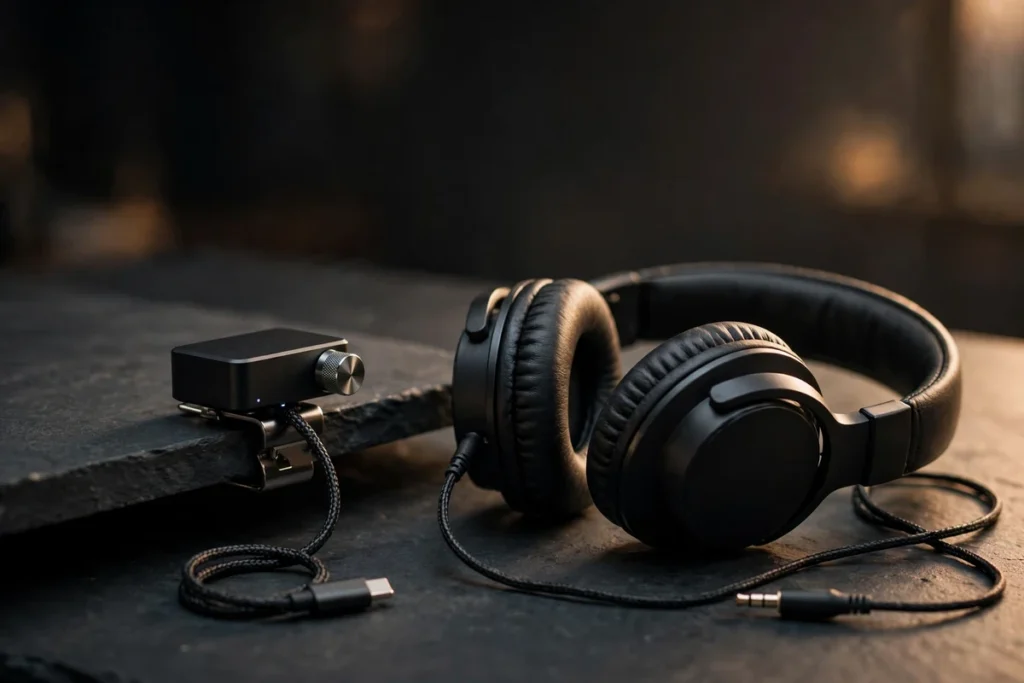
A Bluetooth DAC/amp sits between your phone and a wired headphone. The phone sends audio over Bluetooth, the little box clipped to your shirt converts and amplifies it, and your headphone or IEM plugs into the box instead of the phone. The wireless link is the product. Every unit here receives the same Bluetooth feed, so the differences that matter are the codec carrying it, the power at the jack, the EQ app behind it, the battery, and how well the box works over USB at a desk.
This guide covers Bluetooth receiver DAC/amps only: devices that drive wired headphones. Plain Bluetooth adapters and transmitters, the kind that plug into a TV or plane seat and send audio to wireless earbuds, do the opposite job and are out of scope. Rankings rest on manufacturer specifications, verified Amazon US listings and published third-party reviews. We have not tested these units hands-on: new picks carry provisional scores, and two picks carry scores copied from our existing coverage. Desktop-first buyers belong in our best DACs and best headphone amp and DAC combos guides, which mention several of these models as single picks without judging the link itself.
Our picks at a glance
Best overall: FiiO BTR17: aptX Lossless, LDAC and desktop-mode power in one box.
Check PriceBest for EQ: Qudelix 5K: the strongest parametric EQ app in the category, in 25 grams.
Check PriceBest budget: FiiO BTR13: LDAC and a balanced output at entry-level money.
Check Price| Product | DAC | Bluetooth / top codecs | Max power (balanced) | Outputs | Battery | Score | Price |
|---|---|---|---|---|---|---|---|
| FiiO BTR17 | Dual ES9069Q | 5.4 · LDAC, aptX Lossless | 650mW (desktop mode) | 3.5mm + 4.4mm | ~8h (LDAC) | 8.8 | Check Price |
| Qudelix 5K | Dual ES9219 | 5.0 · LDAC, aptX Adaptive | 240mW | 3.5mm + 2.5mm | 6-20h | 8.7 | Check Price |
| FiiO BTR7 | Dual ES9219 | 5.1 · LDAC, aptX HD | 320mW | 3.5mm + 4.4mm | ~9h | 8.7 | Check Price |
| FiiO BTR13 | Dual CS43131 | 5.1 · LDAC, aptX Adaptive | 220mW | 3.5mm + 4.4mm | ~8h | 8.6 | Check Price |
| Shanling UP6 | Dual ES9069Q | 5.2 · LDAC, aptX Adaptive | 626mW | 3.5mm + 4.4mm | 4.5-6.5h | 8.3 | Check Price |
| iFi GO blu | CS43131 | 5.1 · LDAC, aptX Adaptive | 245mW | 3.5mm + 4.4mm | ~10h | 8.3 | Check Price |
1. FiiO BTR17: Best Overall

FiiO BTR17 8.8/10 provisional
Why you: you want the most complete wireless link going: aptX Lossless and LDAC, desktop-mode power, and enough balanced drive for full-size planars.
Trade-off: the biggest unit here at 73 grams, and LDAC battery life is a working day, not a weekend.
Bluetooth 5.4 · LDAC / aptX Lossless · Dual ES9069Q · 650mW balanced (desktop mode) · 10-band PEQ
The BTR17 is FiiO’s flagship Bluetooth DAC/amp and the most complete link here. Its Qualcomm QCC5181 chip runs Bluetooth 5.4 with the full current codec set: LDAC, aptX Lossless, aptX Adaptive, aptX HD, aptX, AAC and SBC. aptX Lossless is the headline: on a Snapdragon Sound phone it carries CD-quality audio bit-perfect, which no other unit here can do, while LDAC covers high-end Android phones that skip Qualcomm’s codec.
Dual ES9069Q DACs feed a fully balanced THX AAA 78+ amp stage: 300mW per channel into 32 ohms on battery. Feed the separate power port and desktop mode raises that to 650mW per channel, enough for full-size planars. USB mode runs through an XMOS XU316 to 768kHz/32-bit and DSD512, the strongest wired mode here.
The 10-band parametric EQ runs in the FiiO Control app and a web interface, with settings saved on the device. The compromise is size and stamina: 73 grams, roughly 8 hours on LDAC. Buy it for one box that covers commute and desk.
2. Qudelix 5K: Best for EQ and Tuning

Qudelix 5K 8.7/10 provisional
Why you: you tune. The Qudelix app carries a full parametric EQ, an AutoEQ preset library and per-device profiles no rival here matches.
Trade-off: modest 240mW balanced power, and the balanced jack is 2.5mm, so many balanced cables need an adapter.
Bluetooth 5.0 · LDAC / aptX Adaptive · Dual ES9219 · 240mW balanced · 25 g
The Qudelix 5K is a 25-gram clip with an unremarkable spec-sheet headline and the best software in the category. Its app offers a full parametric EQ with independent channels, an AutoEQ library covering hundreds of headphones, and settings that follow the headphone rather than the phone. If you own a headphone with one annoying treble peak, this is the box that fixes it.
Hardware is dual ES9219 behind a QCC5124 chip, with LDAC and aptX Adaptive leading the codec list. Output is 80mW per channel from the 3.5mm jack and 240mW from the 2.5mm balanced jack. That socket is the catch: most balanced cables sold today end in 4.4mm, so plan on an adapter. Bluetooth is version 5.0 per Qudelix’s own spec sheet and USB mode tops out at 96kHz/24-bit, both a generation behind the BTR17.
Battery life swings from about 6 hours on LDAC to 20 hours on efficient settings, the widest range here. Nothing else at this size gives you this much control over the sound, and the control is the reason to buy it.
3. FiiO BTR7: Best Screen and Wireless Charging

FiiO BTR7 8.7/10
Why you: you want codec and sample rate on a color screen at a glance, plus Qi wireless charging.
Trade-off: a generation older: no aptX Lossless, and far less power than the BTR17’s desktop mode.
Bluetooth 5.1 · LDAC / aptX HD · Dual ES9219 · 320mW balanced · Qi charging
The BTR7 was FiiO’s flagship before the BTR17, and the scores on its card are copied unchanged from our full BTR7 review, where it earned 8.7 overall. The 1.3-inch color screen shows the active codec, sample rate and volume, and it is the only unit here with Qi wireless charging. Dual ES9219 DACs and THX AAA-28 amps deliver 320mW per channel balanced over Bluetooth 5.1, with LDAC, aptX Adaptive, aptX HD, aptX, AAC and SBC.
Next to the BTR17 it gives up aptX Lossless and much of the power; its wired mode tops out at 384kHz/32-bit with DSD256. What it keeps is better bedside manners: drop it on a charging pad at night and pick it up full. If the screen and wireless charging matter more than the Lossless codec, the older flagship is still a rational buy.
4. FiiO BTR13: Best Budget Pick

FiiO BTR13 8.6/10
Why you: you want LDAC, a balanced output and app EQ without flagship money. The cheapest real step up from a phone’s own headphone output.
Trade-off: 220mW balanced is IEM-and-easy-headphone territory, and battery life trails the other FiiOs.
Bluetooth 5.1 · LDAC / aptX Adaptive · Dual CS43131 · 220mW balanced · 28.6 g
The BTR13 already holds the portable Bluetooth slot in our best headphone amps roundup, and the scores on its card are copied from that coverage. The hardware case is simple: dual CS43131 DACs, Bluetooth 5.1 with LDAC and aptX Adaptive, a 4.4mm balanced output next to the 3.5mm jack, and 220mW per channel balanced in a 28.6-gram body with a shirt clip.
A three-position PC, Bluetooth and Phone switch turns the same box into a USB DAC at a laptop, and the FiiO app adds parametric EQ, rare at this tier. The limits are power and stamina: 220mW suits IEMs and easy over-ears, not demanding planars, and the battery is rated around 8 hours. For most wired IEM owners, this is the sensible spend for going wireless.
5. Shanling UP6: Most Power on Battery

Shanling UP6 8.3/10 provisional
Why you: you need real drive away from a desk: 626mW balanced from the internal battery, no desktop mode or power cable required.
Trade-off: the battery pays for that power: 4.5 hours balanced, the shortest runtime here by a margin.
Bluetooth 5.2 · LDAC / aptX Adaptive · Dual ES9069Q · 626mW balanced · 1.54-inch screen
Every other high-power unit in this guide needs a desk and a power cable to reach its headline number. The UP6 does not. Its dual SGM8262 amp stages deliver 626mW per channel balanced at 32 ohms on the internal 950mAh battery, with dual ES9069Q DACs and an XMOS XU316 USB input matching the BTR17’s wired ceiling.
The QCC5125 chip runs Bluetooth 5.2 with LDAC and aptX Adaptive leading the codec list. Some retail listings print Bluetooth 5.4 for this model; Shanling’s own specification says 5.2, and the manufacturer’s spec sheet is what counts. A 1.54-inch screen, NFC pairing and Music, Game and Car modes suit frequent source-switchers; the Eddict Player app handles settings and EQ.
The trade is battery life: 6.5 hours single-ended and 4.5 hours balanced per Shanling, the shortest runtimes here by a clear margin. Buy it for the drive, and accept the charger becoming part of the routine.
6. iFi GO blu: Best for Skipping the App

iFi GO blu 8.3/10 provisional
Why you: you hate EQ apps. A volume knob, two analog sound switches (XBass, XSpace) and a balanced output, in 26 grams.
Trade-off: no parametric EQ, no app at all, and flagship money for mid-pack power.
Bluetooth 5.1 · LDAC / aptX Adaptive · CS43131 · 245mW balanced · 26 g
The GO blu is the contrarian pick. There is no EQ app, no firmware menu and no screen. A milled volume knob, one button cycling the analog XBass and XSpace circuits, and two outputs: 4.4mm balanced at 245mW per channel and iFi’s 3.5mm S-Balanced at 165mW. At 26 grams it is the smallest unit here after the Qudelix.
The Bluetooth side is complete: version 5.1 with LDAC, aptX Adaptive and LHDC into a Cirrus Logic CS43131 DAC, plus a built-in microphone for calls. Sound shaping is analog and instant, for listeners who want a bass lift without building a curve. iFi rates the 450mAh battery at up to 10 hours, the longest figure in this guide.
You pay flagship money for that simplicity, and the power ceiling is IEM-and-portable-headphone territory. If apps irritate you and your headphones are easy to drive, the GO blu is the one you will enjoy using daily.
The codec decides the ceiling
The DAC chips here are all good enough that the codec feeding them matters more. LDAC at its 990kbps setting is the strongest link most Android phones can offer. aptX Lossless goes further on Snapdragon Sound phones, carrying 16-bit/44.1kHz audio without lossy compression, but lives only on the BTR17 here. aptX Adaptive trades a little quality for low latency, which suits video and games. iPhones cap every unit here at AAC, so iPhone owners are paying for power and EQ rather than codec headroom. Our Bluetooth audio codecs guide and the AAC vs LDAC vs aptX comparison break down what each codec does to the signal.
Power, and how much you actually need
IEMs and most portable headphones live happily on 100mW or less, a bar every pick here clears. Full-size planars and 300-ohm classics sit at the other end: they want voltage swing and current headroom, and that is where the BTR17 in desktop mode and the UP6 pull away. If you are unsure what your headphone needs, our impedance and amp explainer walks through the numbers. Balanced outputs deliver two to three times the single-ended power on most of these units, so a balanced cable is the cheapest upgrade in the category.
The wired mode is half the product
Every pick also works as a USB DAC, and the wired ceilings split the field. The BTR17 and UP6 reach 768kHz/32-bit and DSD512 through XMOS XU316 chips; the BTR7 manages 384kHz and DSD256; the Qudelix 5K stops at 96kHz/24-bit. If the box will spend weekdays plugged into a laptop, weigh the USB specification as heavily as the Bluetooth one.
Frequently Asked Questions
Does a Bluetooth DAC/amp work with an iPhone?
Yes. Every pick here pairs with an iPhone, but the connection runs on AAC, the only high-quality codec iOS supports. You still gain amp power, a balanced output and any EQ the unit offers. LDAC and aptX Lossless stay out of reach; both need an Android phone.
LDAC or aptX Lossless: which codec is better?
aptX Lossless is technically cleaner: it carries CD-quality audio without lossy compression. But it needs a Snapdragon Sound phone and, in this guide, only the BTR17. LDAC is far more widely supported on Android and at 990kbps is very close in practice. Match the codec to your phone first.
Can a Bluetooth DAC/amp drive the Sennheiser HD 600?
The BTR17 and UP6 can, on the balanced output with high gain; both deliver the voltage swing a 300-ohm headphone wants. The Qudelix 5K and GO blu manage moderate volume but run out of headroom on quiet recordings. The BTR13 is the wrong tool for that job.
Can I take phone calls through one?
Yes. The BTR17, BTR13, UP6, Qudelix 5K and GO blu all carry built-in microphones, with call noise reduction on the UP6 and BTR13. Quality is phone-call grade: fine for conversation, not for recording.
What is the difference between a Bluetooth DAC/amp and a Bluetooth adapter?
Direction. A Bluetooth DAC/amp receives audio and feeds wired headphones. A Bluetooth adapter or transmitter sends audio from a TV, console or plane seat to wireless earbuds. They solve opposite problems, and nothing in this guide transmits.
Bluetooth DAC/amp or a USB dongle DAC: which sounds better?
On paper, a good dongle over USB, because nothing is compressed. The Bluetooth box wins on freedom: no phone cable, a clip instead of a dangling dongle, and EQ that stays with the headphone across sources. Our portable DAC and dongle guide covers the wired side.
The verdict
Buy the BTR17 for the strongest all-round link, the Qudelix 5K if you tune, the BTR13 if you are sensible about money, the UP6 if your headphones are hungry and your days short, and the GO blu if you never want to open an audio app again. The BTR7 is the pick for a screen and wireless charging, with scores our earlier review settled.

I am the founder of Sound Mavericks, where I provide the polite truth about audio equipment. I started this site because consumer electronics reviews are often too technical. Instead of using a silent lab, I test headphones, earbuds, and Bluetooth speakers in the real world – like on a noisy subway or in a busy coffee shop.
To stay independent, I buy my own review units (mostly from the United States) rather than accepting free gifts from brands. Once I finish testing a product, I sell it locally to our community. My goal is to help you understand sound quality, active noise cancellation (ANC), and battery life without the marketing hype.

