
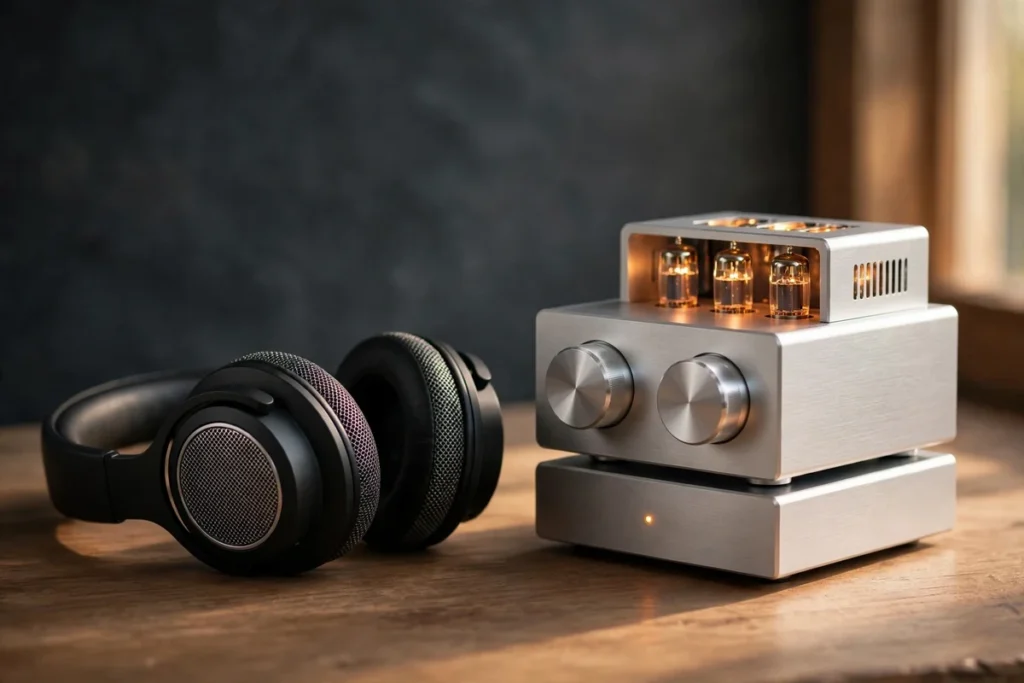
Shopping for the best dac amp combo for hd600 duty looks complicated because spec sheets argue about the wrong number. Every box here advertises watts into 32 ohms. The HD 600 is a 300-ohm headphone, and at 300 ohms the contest is about voltage swing, not wattage. So this guide starts with the electrical math, then ranks six pairings: three one-box combos, two amp-led stacks, and one tube hybrid. Every pick was chosen for the Sennheiser HD 600 and its Massdrop sibling, the HD 6XX. Power figures are manufacturer ratings; the FiiO and TOPPING scores come from our existing coverage. Nothing here is presented as bench-tested.
Short on time? The FiiO K11 is the default buy, the K11 R2R adds a ladder DAC, the JDS Atom 2 stack is the two-box route, the Schiit Magni 6 is the amp to build around, the xDuoo MT-04 brings tubes, and the TOPPING DX5 II is the endgame.
1. FiiO K11: best overall for the HD 600

FiiO K119.2/10
Why you: one box, three digital inputs, and enough voltage on either jack: 4.2 V single-ended, 8.7 V balanced into 300Ω. Our default hand-off for an HD 600 owner starting from a laptop jack.
Trade-off: no Bluetooth, no EQ, and a basic status display. You pay for conversion and power, nothing else.
CS43198 DAC · 250 mW @ 300Ω balanced · USB-C / optical / coaxial · 6.35mm + 4.4mm outputs
The K11 pairs a Cirrus Logic CS43198 DAC with USB-C, optical and coaxial inputs, so a PC, console and TV can all feed it. Into 300 ohms it is rated at 60 mW single-ended and 250 mW balanced: 4.2 V from the stock cable, 8.7 V from a balanced one, against 2.24 V needed for 110 dB peaks. Even the weaker jack clears a 115 dB target by a whisker. In our best headphone amps roundup it took the top spot on value, and the HD 600 changes nothing about that.
The HD 600’s electrical reality: voltage first
Sennheiser rates the HD 600 at 300 ohms with a sensitivity of 103 dB SPL for 1 Vrms at 1 kHz, and the HD 6XX matches it. Run the numbers from that single volt and the shopping problem shrinks:
| Peak level | Voltage needed | Power at 300Ω | Current drawn |
|---|---|---|---|
| 100 dB | 0.71 Vrms | 1.7 mW | 2.4 mA |
| 105 dB | 1.26 Vrms | 5.3 mW | 4.2 mA |
| 110 dB | 2.24 Vrms | 17 mW | 7.5 mA |
| 115 dB | 3.98 Vrms | 53 mW | 13 mA |
| 120 dB | 7.08 Vrms | 167 mW | 24 mA |
Two lessons fall out of that table. First, the current figures are tiny: at a loud 110 dB peak the HD 600 draws seven and a half milliamps, so small amps run out of volts long before current. A planar magnetic at 32 ohms flips the problem and asks for current instead. Second, you do not need much: music averages 85 to 95 dB with peaks 15 to 20 dB above it, so a 110 dB target is generous and 115 dB covers EQ work. Our explainer on impedance and whether you need an amp covers other headphones.
One more curve matters. Published measurements show the HD 600’s impedance climbing past 500 ohms around its 100 Hz resonance, so bass notes draw even less current than the table suggests. The curve also explains the tube folklore: an amp with output impedance in the tens of ohms forms a voltage divider with that curve and lifts the region around the hump, adding warmth where the HD 600 is lean. Classic OTL designs have done this for decades, accidentally or otherwise. Keep output impedance under an eighth of the headphone’s impedance, about 37 ohms here, and it renders flat. Every solid-state pick below sits under 2.4 ohms.
Every pick against the requirement
Manufacturer ratings at 300 ohms, converted with V = √(P × 300). Headroom is against the 2.24 V needed for 110 dB peaks.
| Pick | Type | Output @ 300Ω | Volts | Headroom | Our score | Check Price |
|---|---|---|---|---|---|---|
| FiiO K11 | DAC/amp combo | 250 mW (balanced) | 8.7 V | +11.7 dB | 9.2 | Check Price |
| FiiO K11 R2R | DAC/amp combo | 220 mW (balanced) | 8.1 V | +11.2 dB | 9.1 | Check Price |
| JDS Labs Atom 2 Stack | DAC + amp stack | 286 mW | 9.3 V | +12.3 dB | Not scored | Check Price |
| Schiit Magni 6 | Amp (DAC card optional) | 500 mW | 12.2 V | +14.8 dB | Not scored | Check Price |
| xDuoo MT-04 | Tube hybrid amp | 400 mW (balanced) | 11.0 V | +13.8 dB | Not scored | Check Price |
| TOPPING DX5 II | DAC/amp combo | 990 mW (balanced) | 17.2 V | +17.7 dB | 9.0 | Check Price |
The cheapest row already clears the requirement several times over. The rest are about features, flavor and future headphones.
2. FiiO K11 R2R: the ladder-DAC alternative

FiiO K11 R2R9.1/10
Why you: the K11’s chassis and amp with a resistor-ladder DAC inside. NOS mode runs the native sample rate, OS mode oversamples, and the balanced jack delivers 8.1 V into 300Ω.
Trade-off: the single-ended jack is the tightest here at 3.9 V: 110 dB peaks yes, 115 dB peaks no. A balanced cable is close to mandatory.
24-bit R2R ladder DAC · NOS + OS modes · 220 mW @ 300Ω balanced · 6.35mm + 4.4mm outputs
The R2R swaps the K11’s delta-sigma chip for a fully differential 24-bit resistor ladder, 192 precision resistors doing the conversion. It keeps the same chassis, inputs and gain levels, and adds NOS mode at the native sample rate or OS mode with oversampling to 384 kHz. Our R2R DAC explainer covers how ladder conversion differs. Electrically it sits a half-step behind the standard K11: 50 mW single-ended and 220 mW balanced at 300 ohms. On the stock cable that is 3.9 V, enough for 110 dB peaks and just short of the 115 dB line; a balanced cable closes the gap. It scored 9.1 in our best DACs guide: a slightly softer-edged conversion in front of a revealing headphone.
3. JDS Labs Atom 2 Stack: the measurement-first route

JDS Labs Atom 2 Stack (Atom DAC 2 + Atom Amp 2)Not scored yet
What it is: a matched two-box stack from Illinois. The Atom DAC 2 takes USB-C and optical and outputs a clean 2.0 Vrms line signal; the Atom Amp 2 turns that into 9.3 V into 300Ω.
Watch out: JDS sells mainly direct, so Amazon stock runs through marketplace sellers and comes and goes. Both amp jacks are single-ended internally; the 4.4mm socket is for cable convenience, not balanced drive.
Atom DAC 2: USB-C + optical · Atom Amp 2: 286 mW @ 300Ω · 0.7Ω output impedance · Preamp output
JDS Labs publishes the numbers most brands hide. The Atom Amp 2 is rated at 286 mW into 300 ohms, and JDS states the voltage directly: 9.27 Vrms, with a 0.7-ohm output impedance. The Atom DAC 2 accepts USB-C and optical, handles 384 kHz PCM and DSD128 over USB, and outputs 2.0 Vrms with a published SINAD of 113 dB. Together they clear the 110 dB requirement by about 12 dB, and a preamp output covers powered speakers. The caveats: JDS sells primarily from its own store, and two boxes mean two power supplies. Own a good DAC already? Buy the Atom Amp 2 alone.
4. Schiit Magni 6: the amp to build around

Schiit Magni 6Not scored yet
What it is: Schiit’s sixth-generation Magni: a fully discrete, current-feedback amp with 500 mW into 300Ω (12.2 V, the most single-ended voltage here) and a preamp output. Add the internal Mesh 2 DAC card and it becomes a true combo.
Watch out: the base unit is amp only, and its 4.4mm jack carries Schiit’s Halo feedback circuit. It is not a balanced output.
Fully discrete, current-feedback · 500 mW @ 300Ω · <0.1Ω output impedance · Optional DAC card
The Magni 6 is the strongest argument here for buying an amp first and a DAC second. Schiit’s figures give it 500 mW into 300 ohms from a fully discrete, current-feedback stage: 12.2 V single-ended, more voltage than the balanced jack on either FiiO, with output impedance under 0.1 ohms. Two ways to feed it: the Modi is the matching DAC in our best DACs guide, or order it with the Mesh 2 DAC card installed and run USB-C straight in. Gain is 0 dB or +15 dB; the high setting suits the HD 600. Schiit builds these in Texas with a three-year warranty. No screen, no app, no firmware.
5. xDuoo MT-04: tubes, without the OTL compromises

xDuoo MT-04Not scored yet
What it is: two 6H3 tubes in the preamp stage ahead of a Class A transistor output stage: the tubes shape the signal, the transistors do the lifting. 400 mW balanced and 330 mW single-ended into 300Ω, roughly 11 V and 10 V.
Watch out: amp only, so it needs a DAC in front of it, plus a 30-second warm-up before the relay passes signal. Published distortion figures are loose next to the solid-state picks, which is the nature of the design.
2 × 6H3 tube preamp · Class A output · 400 mW @ 300Ω balanced · +12 / +18 dB gain
The MT-04 is the tube pick for owners who want the ritual and the harmonics without a high output impedance rewriting the headphone’s bass response. Our xDuoo MT-04 review has the full launch breakdown, including xDuoo’s power table: 330 mW single-ended and 400 mW balanced at 300 ohms, so both jacks clear 10 V into the HD 600. Gain switches between +12 and +18 dB. As an amp only, it leaves the DAC half yours to choose from our best DACs list. The tubes are a flavor decision, not a fidelity one.
6. TOPPING DX5 II: the fully loaded endgame

TOPPING DX5 II9.0/10
Why you: one box that ends the search. Dual ESS DACs, 990 mW balanced into 300Ω (17.2 V), 10-band parametric EQ, LDAC Bluetooth, and balanced XLR outputs.
Trade-off: you pay for power and features an HD 600 alone will never touch. It earns its keep when a planar joins the desk.
Dual ES9039Q2M DACs · 990 mW @ 300Ω balanced · 10-band PEQ · Bluetooth 5.1 with LDAC
Nothing here needs 990 mW into 300 ohms, and the DX5 II offers it anyway, alongside the deepest feature set in the guide. The 10-band parametric EQ matters most for this headphone: a small shelf under 100 Hz answers the HD 600’s lean low end, and the negative preamp that keeps EQ clean eats headroom the DX5 II has in reserve. Bluetooth 5.1 with LDAC covers phone listening, and balanced cables plug into the 4-pin XLR or 4.4mm jacks. It scored 9.0 in our best headphone amps roundup, dragged down only by value. Buy it as the last DAC/amp on your desk.
Combo or stack: which route suits the HD 600?
A combo is the tidy answer: one box, one power supply, matched gain staging, and in the FiiO pair a balanced jack that doubles the voltage ceiling for the price of a cable. Plugging into a laptop today? A combo is the cleanest first purchase, and probably the last one you need.
A stack earns its shelf space when you want to change one half at a time. DAC features age faster than amplifiers, so an amp-first stack (Magni 6, Atom Amp 2, MT-04) lets a future DAC slot in without replacing the driving half. Stacks also open the tube door, since tube designs at this level are amp-only almost by definition. Our DAC amp combos guide covers one-box options beyond this headphone, and our high-impedance headphone amp guide goes wider on 300-ohm headphones. What you already own decides it: a DAC you like makes the amp-only picks the efficient spend, and a future planar points to the DX5 II or a Magni 6 stack.
Frequently Asked Questions
What is the best dac amp combo for hd600?
The FiiO K11 is the default answer: a clean DAC, three digital inputs, and 250 mW balanced into 300 ohms, about 8.7 V. Pick the K11 R2R for ladder-DAC flavor, and the TOPPING DX5 II for EQ and Bluetooth in one box.
Do you need an amp for the HD 600?
You need voltage more than an amplifier as such. The HD 600 makes 103 dB from one volt, and most laptop and phone jacks deliver 1 to 2 Vrms, reaching roughly 103 to 109 dB at their limit. Fine for quiet listening; too little for dynamic recordings at realistic levels. A dedicated amp buys headroom, so peaks stay clean instead of clipping.
How much power does the HD 600 need?
Less than the marketing suggests. At 300 ohms and 103 dB per volt, 110 dB peaks need 2.24 Vrms and 17 mW; 115 dB peaks need 3.98 Vrms and 53 mW. Every pick here clears 110 dB on at least one output. Shop by the output at 300 ohms, not the headline watts at 32 ohms.
Does the HD 6XX need a different amp from the HD 600?
No. The HD 6XX sits on the same 300-ohm, high-sensitivity platform as the HD 600 and HD 650 family, so the same voltage math and the same picks apply. Tuning differs; the electrical shopping list does not.
Are tube amps good with the HD 600?
They are the classic pairing. High-impedance loads suit tube output stages, and the HD 600’s impedance rises past 500 ohms around 100 Hz, so a high-output-impedance OTL amp adds a gentle lift there. A hybrid like the xDuoo MT-04 keeps a transistor output stage instead: tube harmonics, no impedance interaction.
Is a balanced cable worth it for the HD 600?
On the two FiiO combos, yes: their balanced jacks roughly double the single-ended voltage, worth about 6 dB of headroom, and the K11 R2R’s single-ended output is the one tight spot here. On the Magni 6, Atom Amp 2 and MT-04, the single-ended outputs already deliver 9 V or more, so a balanced cable buys convenience, not capability.
The bottom line
The HD 600 asks for volts, gives back accuracy, and forgives almost any competent source. Buy the K11 to solve it in one box, the Atom stack or Magni 6 for separable halves, the MT-04 for tubes, and the DX5 II to stop shopping. The headphone was never the demanding part. Read the 300-ohm line of the spec sheet, not the 32-ohm one.

I am the founder of Sound Mavericks, where I provide the polite truth about audio equipment. I started this site because consumer electronics reviews are often too technical. Instead of using a silent lab, I test headphones, earbuds, and Bluetooth speakers in the real world – like on a noisy subway or in a busy coffee shop.
To stay independent, I buy my own review units (mostly from the United States) rather than accepting free gifts from brands. Once I finish testing a product, I sell it locally to our community. My goal is to help you understand sound quality, active noise cancellation (ANC), and battery life without the marketing hype.

