
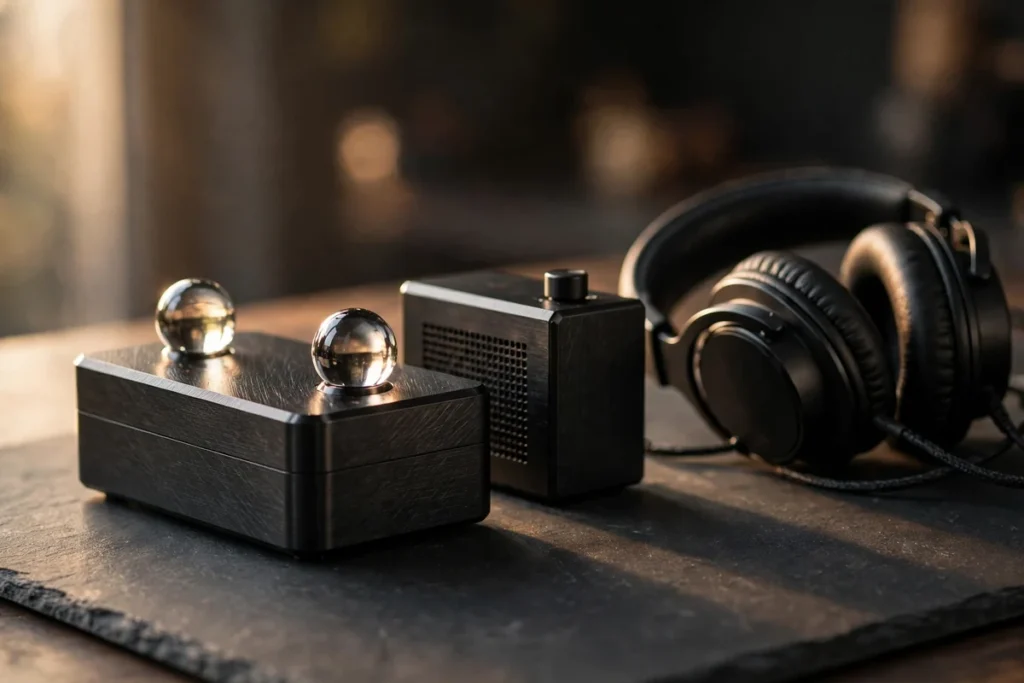
The Chord Qutest is a pure digital-to-analogue converter and nothing else: no headphone socket, no volume knob, no battery, no Bluetooth. Chord took the FPGA conversion architecture from its Hugo 2, removed the amplifier stage and the portable hardware, and put what was left in a milled aluminium block designed to sit permanently in one system. It launched in 2018, replacing the 2Qute, and it is still the DAC Chord sells to people who already own an amplifier they like.
This review is built from Chord’s published specifications and user manual, and hands-on reviews and lab coverage from other publications, not our own testing. The scores are provisional and research-based.
Chord Electronics Qutest 8.4/10 provisional
Why you: you own a good amp and want reference-grade conversion feeding it, in a box that never needs charging.
Trade-off: it converts and does nothing more: no headphone output, no volume control, no balanced XLR out. An amplifier is a requirement, not an accessory.
FPGA DAC · 49,152-tap WTA filter · USB-B, dual BNC and optical inputs · RCA out at 1V, 2V or 3V
Buying note: Amazon US does not list the Qutest directly at the time of writing (checked November 4, 2026), so the button runs a tagged Amazon search rather than a product page. US stock sits with authorized Chord dealers.
What the Qutest is, and what it refuses to be
Most products in our best DACs guide do at least two jobs: convert and amplify, convert and stream, or run from a battery so they can travel. The Qutest does one job. Digital goes in, an analogue line-level signal comes out of a pair of RCA sockets, and everything between those points is Chord’s own conversion hardware. There is no amplification stage and no headphone output. To hear anything you need a headphone amplifier, a preamp and power amp, an integrated amplifier, or powered speakers.
That single-mindedness is the product. Removing the amp stage and battery removes the parts of a portable DAC that compromise a fixed installation: no battery to age, no shared power rail with a headphone stage. It is built to be wired in and left alone for years. In Chord’s range, the Mojo 2 is the portable all-rounder and the Hugo 2 adds a serious headphone stage; the Qutest assumes your amplification is already sorted.
Our preamp vs amp explainer and our guide to the best headphone amps cover the stage the Qutest expects to feed.
The FPGA: 49,152 taps, explained without the fog
Most DACs in this class convert with an off-the-shelf ESS, AKM or Cirrus Logic chip. Chord does not use one. The Qutest runs its conversion on a Xilinx Artix-7 FPGA, a programmable chip loaded with code written by Chord’s digital designer, Rob Watts. The headline number is the tap length of the WTA filter, which reconstructs the waveform between samples: 49,152 taps, at 16FS oversampling. A longer filter works with a bigger window of the signal when it rebuilds each sample point, and Chord’s claim is that this is what lets its DACs time transients, the starts of notes, with unusual precision.
You do not have to buy the theory to follow the results. The published figures are strong by any standard: 124 dB of dynamic range, distortion of 0.0001% at 1 kHz, channel separation of 138 dB, and a ten-element pulse array doing the final conversion. Reviews that have measured Chord’s FPGA DACs have consistently found vanishingly low distortion. The filter is a design position rather than a neutral pipe, and the four settings (two neutral, two warm, each with an optional high-frequency roll-off) let you lean it a degree either way.
The two BNC inputs also combine into a dual-data connection for Chord’s own upscalers, so the DAC is not the ceiling of the system.
Sound: what the reviews consistently report
The Qutest has been reviewed for eight years, and the reports line up to an unusual degree. Detail retrieval is the headline: reviewers describe hearing low-level information in familiar recordings that other DACs glossed over, and the stereo image is wide and deep. Timing is the second theme. What Hi-Fi?, which made the Qutest a repeat award winner, places it between the Mojo 2 and the Hugo 2 and calls it the DAC lesser rivals look up to at its price. The Absolute Sound called it arguably Chord’s best value, since it carries most of the digital processing found in the Hugo and DAVE models for far less money.
The criticisms are just as consistent. The presentation leans neutral and analytical, and in an already bright system some reviewers find it short on warmth and body. The Warm filters shift the balance, but a filter is a nudge rather than a personality transplant. Bass is tight and defined rather than heavy. Our 9.5 sound score reflects that record: near-universal praise for resolution, timing and imaging, held below a perfect mark by the lean-presentation caveat.
Inputs, outputs and the things that are missing
Round the back there are three digital inputs. The USB Type-B input is galvanically isolated and takes PCM up to 768kHz and DSD up to 512 with the Windows ASIO driver, or DSD256 over DoP. The twin BNC coaxial inputs take 384kHz each, or pair up for dual-data mode. The optical input takes 192kHz, the natural socket for a TV or console. Two glass spheres on the top panel handle selection and change colour to show the input and sample rate. There is no screen and no remote.
Output is a single pair of RCA sockets. The line level is selectable at 1V, 2V or 3V RMS, set by holding both spheres during start-up: 1V suits sensitive amplifiers and powered speakers, 3V suits preamps that like a hotter signal. What there is not: a balanced XLR output, which rules the Qutest out for balanced systems, and no volume control, so the amplifier it feeds must handle level. No streaming, no Bluetooth, no AES/EBU input. The 5V supply connects by micro-USB and the USB audio input cannot power the unit. The omissions are the design, and they shape our features and connectivity scores: 7.8 and 8.0, against sound and build marks in the nines.
Chord Qutest vs Mojo 2: which Chord, for which desk
This is the comparison most buyers actually face: the Mojo 2 is the top pick in our best DACs guide and costs a good deal less. Both are FPGA designs, built for different rooms. The Mojo 2 is a DAC and headphone amplifier in one 185 g box with a battery, two headphone outputs and a lossless DSP section for tone control and crossfeed. It travels and drives headphones directly. The Qutest gives up all of that for a dedicated converter with a dual-data input and a choice of output voltages.
| Chord Qutest | Chord Mojo 2 | |
|---|---|---|
| Type | Desktop DAC only. No amplifier, no battery | Portable DAC and headphone amplifier with battery |
| Conversion | Custom FPGA, 49,152-tap WTA filter, 10-element pulse array | Custom FPGA with UHD DSP (tone control, crossfeed) |
| Inputs | USB-B, 2x BNC coaxial (dual-data), optical | USB-C, micro-USB, optical, coaxial |
| Outputs | 1x stereo RCA line out, selectable 1V / 2V / 3V | 3.5mm and 4.4mm headphone outputs |
| Max format | 768kHz / 32-bit PCM, DSD512 (ASIO) | 768kHz / 32-bit PCM, DSD256 (DoP) |
| Power | External 5V supply | Battery (up to 8 hours), desktop mode |
| Weight | 770 g | 185 g |
| Our published overall | 8.4 (this review) |  9.4 in our best DACs guide |
The Mojo 2’s higher overall is not a contradiction. In the guide it earns Sound Quality 9.6, Features and Flexibility 9.5, Build Quality 9.4, Portability 8.5 and Value 8.6 as a complete one-box answer: source in, headphones on, done. The Qutest is scored as the narrower tool it is, and its marks fall where the tool is narrow, on features and connectivity. Pick the Mojo 2 if you listen at more than one desk, or if it will be your only DAC. Pick the Qutest if it will live in one system in front of an amplifier you already rate. Our portable DACs and dongles guide covers the smaller end of the same decision.
Where the Qutest sits against R2R DACs
The other school competing for this desk space is the resistor ladder. Our R2R DAC review covers the approach in full: a ladder of precision resistors converts without the heavy oversampling and filtering that delta-sigma chips and Chord’s FPGA rely on, and listeners who favour it describe a natural, relaxed presentation. The Qutest is the opposite philosophy pushed just as far: convert with enormous computational effort, filter at 49,152 taps, and measure the result into the floor. Neither is objectively correct; choose by the presentation you prefer. If your system leans relaxed, the Qutest’s precision is the likely complement. If it leans bright, an R2R DAC may be the better counterweight.
Chord Qutest specifications
| Product | Chord Electronics Qutest Check Price |
| Type | Desktop DAC. No headphone amp, no volume control |
| DAC | Chord custom-coded Xilinx Artix-7 (XC7A15T) FPGA, 10-element pulse array |
| Filter | WTA1 16FS, 49,152 taps; four filters (Incisive Neutral, Incisive Neutral HF roll-off, Warm, Warm HF roll-off) |
| Inputs | USB Type-B (galvanically isolated), 2x BNC coaxial, optical |
| Outputs | 1x stereo RCA line out. No XLR, no headphone output |
| Output level | Selectable 1V, 2V or 3V RMS |
| Max PCM | 768kHz / 32-bit via USB; 384kHz per BNC, 768kHz dual-data; 192kHz optical |
| DSD | Up to DSD512 native (Windows ASIO), DSD256 via DoP, DSD64 via optical |
| Frequency response | 20Hz to 20kHz, +/- 0.2dB |
| Dynamic range | 124 dB A-weighted |
| THD | 0.0001% at 1kHz, 2.5V RMS, 300 ohm |
| Channel separation | 138 dB at 1kHz, 300 ohm |
| Power | External 5V supply via micro-USB (included). Cannot be powered from the USB audio input |
| Controls | Two top-panel spheres (input, filter). No remote, no display |
| Dimensions | 160 x 72 x 41 mm (W x D x H) |
| Weight | 770 g |
| In the box | Qutest DAC, 5V power supply, micro-USB power cable, manual. Three-year warranty |
A note on the scores
The five marks mirror the categories we use for desktop DACs in our best DACs guide, and the overall is their mean: Sound Quality 9.5, Features and Flexibility 7.8, Build Quality 9.2, Connectivity 8.0, Value 7.6, giving 8.4 out of 10. The spread is the story: conversion and casework are reference-grade, the feature list is deliberately short, and the value mark reflects a converter that still leaves you to buy the amplification. These are research-based scores, not our own listening or bench tests. When we have a unit in the system, the marks will be revisited.
FAQ
Is the Chord Qutest a DAC/amp?
No. The Qutest is a DAC only: no headphone amplifier, no headphone socket, just a stereo RCA line output, so it needs an amplifier or powered speakers to make sound.
What is the difference between the Chord Qutest and the Mojo 2?
The Qutest is a desktop DAC with a dual-data BNC input and a selectable 1V, 2V or 3V line output. The Mojo 2 is a portable DAC and headphone amplifier with two headphone outputs and DSP tone control. The Mojo 2 is the one-box answer; the Qutest is the dedicated converter for a system that already has amplification.
What does the Qutest’s 49,152-tap filter actually do?
The WTA filter is the interpolation filter that rebuilds the analogue waveform from the digital samples, and tap length is the size of the signal window it works from: 49,152 taps at 16FS oversampling. Chord’s claim is that a longer filter times the starts of notes, transients, more accurately, which underpins the house sound its DACs are known for.
Can the Chord Qutest drive headphones directly?
No. There is no headphone output and no volume control. The RCA output is a line-level signal at 1V, 2V or 3V. Pair it with a headphone amp, or powered speakers with their own volume control.
Does the Chord Qutest have balanced XLR outputs?
No. The only analogue output is a single-ended stereo RCA pair. If your amplifier needs a balanced connection, the Qutest is the wrong shape of DAC, and a balanced model from our best DACs guide will suit better.
Can I use the Chord Qutest with an M Scaler?
Yes. The two BNC inputs combine into a dual-data connection, the link Chord’s Hugo M Scaler and Blu MkII use to feed the Qutest 768kHz material. A single BNC input tops out at 384kHz.
Verdict
The Qutest is the Chord DAC for people who have finished choosing amplifiers. Eight years on, the review record still reads the same way: reference-level detail, timing and imaging from a converter that does nothing else. The FPGA front end and the milled case are as good as this class gets. The bill is the honest one: an amplifier is mandatory, balanced systems need not apply, and with no US Amazon listing, most buyers will land at a Chord dealer. Scored as the narrow tool it is, it earns 8.4 out of 10, with Sound Quality at 9.5 carrying the case.

I am the founder of Sound Mavericks, where I provide the polite truth about audio equipment. I started this site because consumer electronics reviews are often too technical. Instead of using a silent lab, I test headphones, earbuds, and Bluetooth speakers in the real world – like on a noisy subway or in a busy coffee shop.
To stay independent, I buy my own review units (mostly from the United States) rather than accepting free gifts from brands. Once I finish testing a product, I sell it locally to our community. My goal is to help you understand sound quality, active noise cancellation (ANC), and battery life without the marketing hype.

