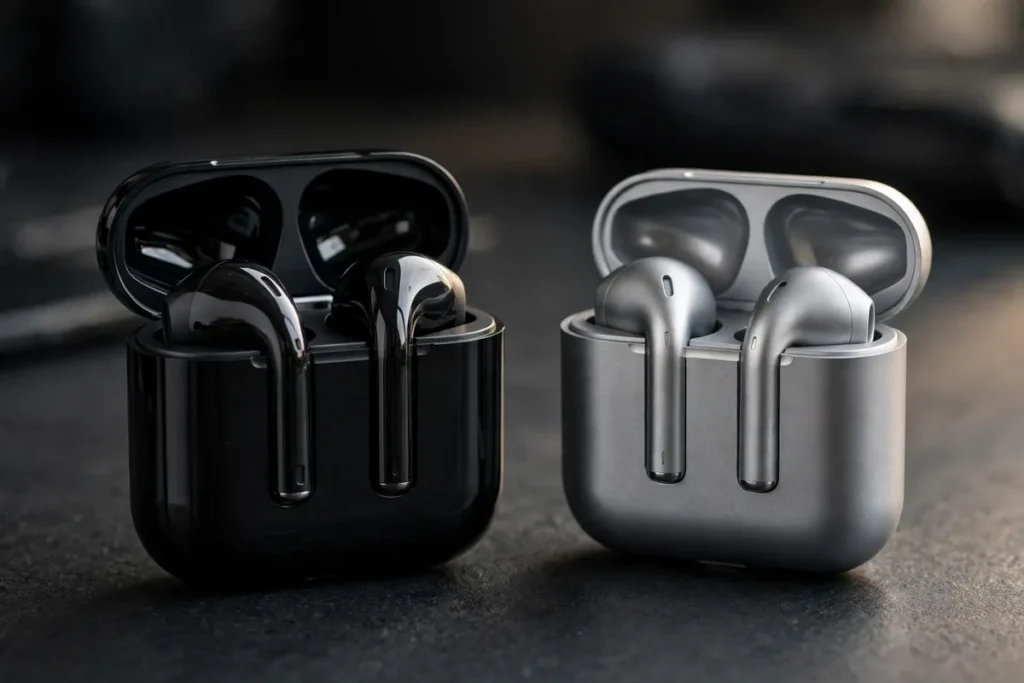
This technics eah az100 vs sony wf 1000xm5 comparison settles the flagship fight most Android listeners end up having: Panasonic’s hi-fi offshoot against the default recommendation. Both are LDAC flagships with adaptive noise cancelling, wireless charging and multipoint. Both score at the top of our database. And the overall result is close enough to need the category detail: the Sony WF-1000XM5 takes it 9.0 to 8.9, while the Technics EAH-AZ100 wins more of the individual rounds, including the two that decide most working days, calls and battery.
The short version is this. Buy the Technics if your earbuds double as your phone headset and your travel battery. Buy the Sony if you want the most even flagship, the one with no weak bar anywhere on its card. The sections below split the difference category by category, and the scorecard at the end lines all six bars up side by side.

Technics EAH-AZ100 8.9/10
Why you: you take calls on your earbuds and travel on one charge. Calls score 9.5, the highest call bar we give any earbud, and the buds run 10 hours before the case is needed.
Trade-off: no aptX on board, so hi-res audio runs over LDAC only, and the overall crown stays with Sony by a tenth of a point.
10mm magnetic fluid driver · LDAC · 3-device multipoint · 10 h buds, 28 h total · Wireless charging

Sony WF-1000XM5 9.0/10
Why you: you want the flagship with no weak point. Every bar on this card sits at 7.8 or above, and the foam-tip fit suits long, sealed listening better than any rival here.
Trade-off: no aptX support, the foam tips will not suit everyone, and calls and battery both trail the Technics by a clear margin.
8.4mm Dynamic Driver X · LDAC · 2-device multipoint · 8 h buds, 24 h total · IPX4 · Wireless charging
Sound, silence and calls
Sound quality
Sound splits 9.3 to 9.2, and the character difference matters more than the tenth of a point. The AZ100’s 10mm magnetic fluid driver is built to keep distortion down at volume, and the result is a clean, open presentation that resolves fine detail without pushing it at you. The WF-1000XM5 counters with an 8.4mm driver tuned for drive: warmer, punchier, more eager in the low end. What Hi-Fi?, in its own head-to-head of these two, reached the same split, crediting the Technics with greater detail, clarity and openness while calling the Sony the more rhythmically engaging and punchy listen. Both readings are right. Acoustic, classical and vocal-led libraries lean Technics. Pop, electronic and hip-hop lean Sony. Our full Technics EAH-AZ100 review digs into the driver’s behaviour in more depth.
One more practical point belongs in this section, because it shapes how both sound on a phone. Both run LDAC at full quality on Android, and both fall back to AAC on iPhones with no penalty worth worrying about at this level. Neither offers aptX in any form, which closes off the low-latency route some Android gaming setups prefer. For music and video the difference never shows. For competitive mobile gaming it might, and buyers who care should know the shared limit sits on both sides of this comparison rather than one.
Winner: Technics EAH-AZ100
Noise cancelling
This is the dead heat of the comparison. Both score 8.8, both run adaptive systems that adjust to your surroundings, and both sit one step below the very strongest cancelling in the class while staying firmly in flagship territory. On a train or in an open office, neither leaves you wishing for the other. The practical difference is fit-driven: the Sony’s foam tips add passive isolation on top of the electronics, while the Technics relies on its silicone seal, so a poor tip choice costs the AZ100 more. Get the seal right on either and the category stays level.
Winner: Tie
Calls
Calls are where this comparison stops being close. The AZ100 scores 9.5, the highest call bar on any earbud in our database, against a respectable 8.5 for the Sony. The reason is Technics’ Voice Focus AI, which cleans up both directions of a conversation: your voice going out and the caller’s voice coming in. In a station or on a windy street, that second direction is the one you notice, because most rivals only process what you send. The Sony’s microphone array and bone-conduction sensor handle quiet and moderate settings well, and our best earbuds for music and calls guide rates it highly. It simply gives ground here to the best call earbud we track.
Winner: Technics EAH-AZ100
Fit, battery and daily use
Comfort and fit
Comfort splits 8.7 to 8.6 for the Sony, and the tenth reflects two good answers rather than a good one and a bad one. The WF-1000XM5 is small, light and sealed with polyurethane foam tips in four sizes that expand to the canal, which suits listeners who want the buds to disappear. The AZ100 ships with five sizes of silicone tips and a concha-shaped housing that spreads contact across the outer ear, which suits listeners whose canals dislike foam or deep pressure. Our Sony WF-1000XM5 review covers the foam tip trade-offs, including the fact that foam wears out faster than silicone and needs replacing to keep the seal honest.
Winner: Sony WF-1000XM5
Battery and charging
Battery is a clear Technics round. The AZ100 runs 10 hours from the buds and 28 hours in total, scoring 9.2. The Sony runs 8 hours and 24 in total, scoring 8.5. Both cases charge wirelessly as well as by cable, so convenience is equal and capacity is the whole story. Two extra hours per charge is the difference between charging the case on Sunday night and charging it on Friday as well, and on a long travel day it is the difference between finishing the journey on the buds you started with and finishing it in silence.
Winner: Technics EAH-AZ100
Features and value
The feature lists rhyme until multipoint. Both run Bluetooth 5.3, both carry LDAC alongside AAC and SBC, both offer an app with EQ, and neither supports aptX. The Technics then pulls ahead twice: it holds three devices at once against the Sony’s two, which is the setup a phone, a laptop and a tablet actually need, and it adds Dolby Atmos with head tracking for video. Our best multipoint Bluetooth earbuds roundup treats three-way connection as a genuine work feature, not a spec-sheet flourish. Value ties at 7.8, since both sit at flagship money and both justify it on features rather than discounts, so the category goes to the longer list.
Winner: Technics EAH-AZ100
Apps, controls and ownership
Day to day, both live in well-made apps with proper EQ, customisable controls and firmware updates that arrive without drama. The ownership difference is in the tips. Sony’s foam tips are consumables: they compress, they tear, and they need replacing on a cycle to keep the seal and the ANC honest, which is a small running cost Technics owners never meet because silicone tips effectively last the life of the buds. Against that, the Sony case is the slightly neater pocket object, and its buds charge a little faster from flat. Neither point should decide a flagship purchase on its own, but over three years of daily use the tip drawer is the one you will actually notice.
Winner: Sony WF-1000XM5
Technics EAH-AZ100 vs Sony WF-1000XM5 specs
| Spec | Technics EAH-AZ100 | Sony WF-1000XM5 |
|---|---|---|
| Driver | 10mm magnetic fluid driver | 8.4mm Dynamic Driver X |
| Codecs | SBC, AAC, LDAC | SBC, AAC, LDAC |
| Bluetooth | 5.3 | 5.3 |
| Multipoint | 3 devices | 2 devices |
| Noise cancelling | Adaptive ANC | Adaptive ANC |
| Battery, buds | 10 hours | 8 hours |
| Battery, total with case | 28 hours | 24 hours |
| Wireless charging | Yes | Yes |
| Water resistance | IPX4 | IPX4 |
| Ear tips | Silicone, five sizes | Polyurethane foam, four sizes |
Scorecard
| Category | Technics EAH-AZ100 | Sony WF-1000XM5 |
|---|---|---|
| Sound | 9.3 | 9.2 |
| ANC | 8.8 | 8.8 |
| Calls | 9.5 | 8.5 |
| Comfort | 8.6 | 8.7 |
| Battery | 9.2 | 8.5 |
| Value | 7.8 | 7.8 |
| Overall | 8.9 | 9.0 |
Verdict
Buy the Sony WF-1000XM5 if you want one flagship that does everything well. Its 9.0 overall is built on consistency: sound 9.2, ANC 8.8, comfort 8.7, and no category where it embarrasses itself. For most people, most days, that is the right answer.
Buy the Technics EAH-AZ100 if your priorities are specific. It wins sound by a hair, calls by a mile and battery by two hours a charge, and its three-device multipoint is the version of the feature that matches how people actually work now. A buyer who lives on calls will feel the difference every day, and for that buyer the 8.9 overall undersells it. The crown goes to Sony. The working week goes to Technics.
Either way, this is the current state of the flagship art: two LDAC earbuds separated by a tenth of a point and a difference in temperament. Pick by the category you will feel daily, not by the headline number, and neither purchase needs defending.
Frequently asked questions
Which is better, the Technics EAH-AZ100 or the Sony WF-1000XM5?
On our scores, the Sony WF-1000XM5, by the narrowest margin: 9.0 overall against 8.9. The Technics wins more individual categories, including calls, battery and sound, but the Sony is the more even performer across the whole card, with no bar below 7.8. Pick the Technics if calls and battery lead your list; pick the Sony for the safest all-round flagship.
Which has better call quality, the AZ100 or the WF-1000XM5?
The Technics EAH-AZ100, clearly. It scores 9.5 for calls against the Sony’s 8.5, the biggest single gap in this comparison. Its Voice Focus AI works on both the voice you send and the audio you hear, which keeps conversations usable in stations and on busy streets where the Sony starts to struggle.
Which lasts longer on a charge?
The Technics EAH-AZ100. Its buds run for 10 hours with 28 hours in total from the case, against 8 hours and 24 hours total for the Sony WF-1000XM5. Both cases support wireless charging, so the difference is capacity, not convenience.
Do the AZ100 and WF-1000XM5 both support LDAC and multipoint?
Yes to both. Each supports LDAC for hi-res audio on Android, and each holds a multipoint connection. The Technics goes further, staying connected to three devices at once where the Sony manages two. Neither supports aptX, so hi-res listening on both runs over LDAC only.
Which is more comfortable, the AZ100 or the WF-1000XM5?
Very close, with the Sony ahead by a tenth: Comfort scores 8.7 against 8.6. The fit philosophies differ. The Technics ships with five sizes of silicone tips and a concha-shaped housing; the Sony uses four sizes of polyurethane foam tips that mould to the canal. Foam fans will prefer the Sony seal; silicone fans will prefer the Technics.

I am the founder of Sound Mavericks, where I provide the polite truth about audio equipment. I started this site because consumer electronics reviews are often too technical. Instead of using a silent lab, I test headphones, earbuds, and Bluetooth speakers in the real world – like on a noisy subway or in a busy coffee shop.
To stay independent, I buy my own review units (mostly from the United States) rather than accepting free gifts from brands. Once I finish testing a product, I sell it locally to our community. My goal is to help you understand sound quality, active noise cancellation (ANC), and battery life without the marketing hype.