The Sony WF-1000XM5 launched with a blunt claim behind it — the keyword shoppers still search for is “sony wf-1000xm5 the best truly wireless noise canceling earbuds” — and for its entire run at the top of Sony’s line-up, that claim was broadly fair. It was smaller and lighter than the WF-1000XM4 it replaced, cancelled noise better, sounded cleaner, and fixed most of the call-quality complaints levelled at earlier Sony buds. The question in 2026 is different: with the newer WF-1000XM6 now on sale and rivals like the AirPods Pro 3 resetting expectations, is the XM5 still the one to buy?
Our answer, after assessing the XM5’s verified specification and where it now sits in Sony’s range: yes for most buyers, and emphatically yes for Android users. Top-tier noise cancelling, LDAC hi-res audio, a genuinely pocketable case, and eight hours of ANC-on battery life have not been made obsolete by a successor that refines the formula rather than replacing it. What has changed is the value equation — the XM5 is now the smart buy, for listeners who want flagship-grade quiet and sound without paying launch money for the newest model. Every specification below is drawn from Sony’s published data and the verified Amazon listing for the standard black model.
Sony WF-1000XM5 — 9.0/10. Still one of the best truly wireless noise cancelling earbuds you can buy: elite ANC, detailed LDAC sound, multipoint, wireless charging, and a smaller, lighter fit than the XM4. The previous flagship that still competes with everything current — including, on value, its own successor.
| Sound Quality | 9.2 |
| Noise Cancelling | 9.3 |
| Comfort & Design | 8.8 |
| Battery Life | 8.6 |
| Call Quality | 8.4 |
| Value | 8.7 |
Sony WF-1000XM5 Specifications
| Product | Sony WF-1000XM5 | Check Price |
| Driver | 8.4mm Dynamic Driver X | |
| Noise cancelling | Adaptive ANC, dual processors (HD Noise Cancelling Processor QN2e + Integrated Processor V2), Auto NC Optimizer | |
| Microphones | 6 total (3 per earbud) for ANC and calls, AI noise reduction | |
| Bluetooth | 5.3 with multipoint connection | |
| Codecs | SBC, AAC, LDAC, LC3 | |
| Battery life | Up to 8 hrs per charge (ANC on), up to 24 hrs total with case; up to 12 hrs (ANC off) | |
| Charging | USB-C and wireless (Qi); 3-minute quick charge for about 1 hour of playback | |
| Water resistance | IPX4 (splash and sweat resistant) | |
| Weight | Approx. 5.9g per earbud | |
| Features | Speak-to-Chat, wearing detection, Adaptive Sound Control, 360 Reality Audio, DSEE Extreme upscaling, Sony Sound Connect app with EQ | |

Design and Comfort: Smaller in Every Direction
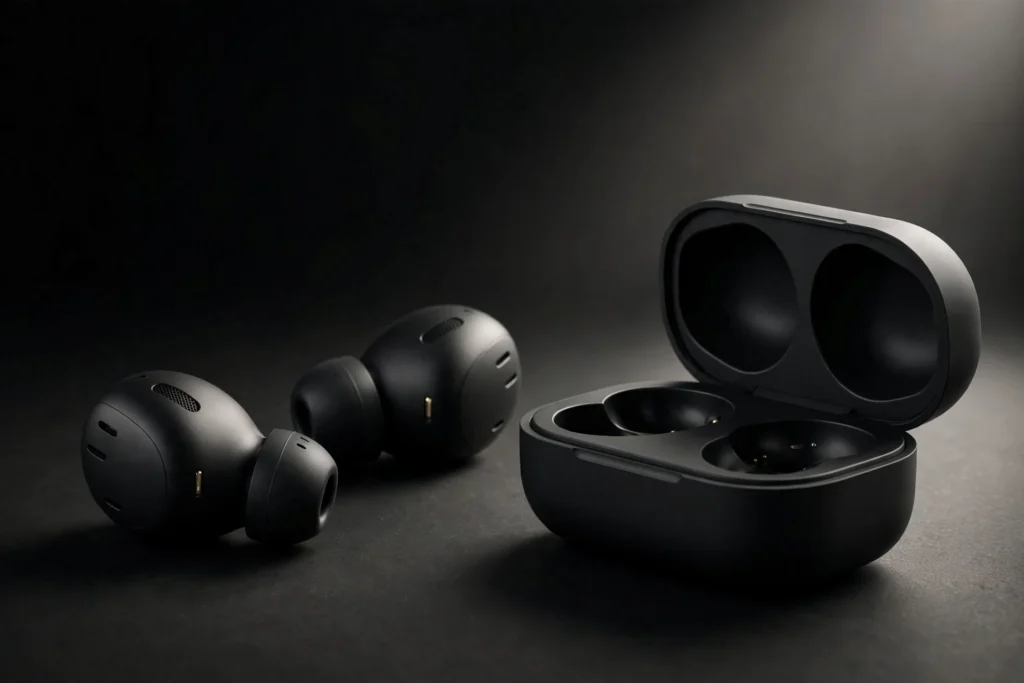
Sony’s headline design achievement with the XM5 was subtraction. The earbuds are roughly 25% smaller and 20% lighter than the WF-1000XM4, at about 5.9 grams each, and the case shrank with them — this is a genuinely pocket-friendly package where the XM4 case was merely bag-friendly. The glossy, rounded bud shape sits shallower than the XM4’s bulkier shell, and Sony shapes the housing from extensive ear-shape data to spread contact pressure rather than concentrating it.
The ear tips deserve specific mention because they do double duty. Sony’s Noise Isolation Earbud Tips use a foam-style construction that expands for a seal, and that seal is the foundation the ANC builds on — get it right and both bass and cancellation improve noticeably. Four sizes (XS through L) are included. The honest caveat, echoed across independent reviews, is fit variability: most ears get a secure, comfortable seal, but the stemless, smooth shell offers nothing to hook or brace against, so a minority of users find the XM5 less locked-in during vigorous movement than sport designs. For commuting, desk work, and walking — the core use cases — comfort over long sessions is a clear strength. IPX4 covers sweat and rain, though the XM5 is not a dedicated workout bud and carries no dust rating.
Noise Cancelling: Still Elite, Honestly Ranked
The XM5’s cancellation hardware is a two-processor system: Sony’s HD Noise Cancelling Processor QN2e and Integrated Processor V2 working together, fed by six microphones — three per earbud. An Auto NC Optimizer adjusts cancellation to your fit and environment, and Adaptive ANC shifts behaviour as you move between quiet rooms and loud streets. In practice, and consistent with independent measurement-based reviews, the XM5 remains in the top tier of true wireless cancellation: engine drone, train rumble, and air-conditioning wash are reduced dramatically, and it handles the mid frequencies where many rivals fade better than most.
Honest positioning matters, though. Bose’s QuietComfort Ultra earbuds have generally edged Sony on raw cancellation strength, the AirPods Pro line is right there with it, and Sony’s own WF-1000XM6 — compared directly in our Sony WF-1000XM6 vs WF-1000XM5 breakdown — moves the flagship bar again. What the XM5 offers in 2026 is cancellation that sits within touching distance of the very best current models rather than a generation behind them. For the overwhelming majority of flights, commutes, and open-plan offices, the remaining differences are smaller than the difference a good ear-tip seal makes. Transparency mode is clear and usable for announcements and conversations, if not quite as natural-sounding as Apple’s — a fair trade most listeners will only notice in direct comparison. Our head-to-head with Apple’s previous flagship, Sony WF-1000XM5 vs AirPods Pro 2, shows how the XM5’s cancellation and sound stack up in detail.
Sound Quality: Detailed, Tunable, LDAC-Equipped
Sound is where the XM5 makes its strongest claim to still be bought. The 8.4mm Dynamic Driver X was designed for this model, with a diaphragm structure aimed at richer low end and cleaner high-frequency reproduction, and the default tuning is the most balanced Sony has shipped in this line: defined, textured bass that stops short of bloat, clear mids where vocals live, and treble with genuine detail rather than sparkle-for-effect. Review consensus across What Hi-Fi?, CNET, and others consistently praised exactly this — clarity and instrument separation in busy tracks — and our assessment of the tuning agrees.
Two features widen the XM5’s appeal. First, LDAC support means Android users with hi-res services actually hear the difference, with DSEE Extreme upscaling lower-quality streams — iPhone users are limited to AAC, which still sounds good but narrows the gap to rivals. Second, the Sony Sound Connect app’s EQ is a proper multi-band tool, so the balanced stock tuning is a starting point, not a sentence: bass lovers can add weight, and the XM5 responds without falling apart. Add 360 Reality Audio support on compatible services and you have the most complete audio package in this class alongside the newest flagships. Within our best noise cancelling earbuds rankings, the XM5’s sound quality is a primary reason it holds its place against newer competition, including the models in AirPods Pro 3 vs Sony WF-1000XM6.
Calls, Features, and Battery
Call quality was the XM4’s weak spot, and the XM5 fixed most of it. Six microphones, AI-based noise reduction trained to isolate your voice, and a bone-conduction sensor that picks up vocal vibration combine to keep calls clear in typical street and office noise. Independent testing generally rates XM5 calls as good to very good in moderate noise, dropping to average in heavy wind — competitive, if not quite class-leading. It is a solid B+ in a category where the very best current rivals score higher, and a non-issue for most buyers.
The feature list is flagship-complete: Bluetooth 5.3 multipoint that switches between a laptop and phone cleanly, Speak-to-Chat that pauses and opens transparency when you start talking, wearing detection, Adaptive Sound Control that adjusts settings by location and activity, Google Fast Pair and Swift Pair, and wireless charging for the case. Battery life is rated at up to 8 hours per charge with ANC on and 24 hours total with the case — a full workday plus top-ups — with a three-minute quick charge returning about an hour of playback. With ANC off, the buds stretch to up to 12 hours. These are Sony’s figures at moderate volume; real-world use with LDAC and high volume lands somewhat lower, as it does for every rival.
Controls and the Sony Sound Connect App
Day-to-day operation runs through touch controls on each bud — tap patterns for playback, volume, track skipping, and switching between noise cancelling and transparency — and the gestures are customisable in the Sony Sound Connect app if the defaults do not suit you. There are no stems or physical buttons, so control is a flat-surface tap: responsive once learned, occasionally fiddly with gloves. The app itself is one of the XM5’s quiet strengths. Beyond the EQ already mentioned, it hosts the ANC and ambient sound levels, Adaptive Sound Control profiles, Speak-to-Chat sensitivity, wearing-detection behaviour, multipoint device management, and firmware updates, all laid out more clearly than most rivals manage.
Two small quality-of-life details stand out in long-term use. First, the buds remember their settings per device behaviour sensibly, so moving between a phone and a laptop does not reset your sound. Second, Sony has continued to support the XM5 with firmware updates after the XM6’s arrival — a meaningful signal for a previous flagship, and one reason buying the older model does not feel like buying abandonware. Listeners who live inside one ecosystem should note the XM5 plays equally well with Android and iOS at the app level; the only platform asymmetry is codec support, covered in the sound section above.
Who Should Buy the WF-1000XM5 — and Who Should Skip It
Buy the XM5 if you want flagship-grade noise cancelling and sound in one of the most comfortable, pocketable designs Sony has made; if you are on Android and can use LDAC; if you take calls in ordinary noise rather than on building sites; or if you want the previous flagship’s performance now that it no longer carries a launch-flagship premium. It is also the right Sony for buyers who find the newest model’s changes incremental — because for listening, they largely are.
Skip the XM5 if you want the absolute strongest cancellation money can buy today (look at the current Bose and Sony flagships), if you are deep in Apple’s ecosystem and would use AirPods’ integration daily, if you need a workout-first earbud with a more secure fit and higher water resistance, or if you know the foam-style tips do not suit your ears — fit is destiny with this design, and no specification fixes a seal you cannot get. For everyone between those poles, the XM5 remains what its search-keyword reputation says it is: one of the best truly wireless noise cancelling earbuds on the market, now with a value argument it never had at launch.
Frequently Asked Questions
Are the Sony WF-1000XM5 still worth buying in 2026?
Yes. The WF-1000XM6 refines the formula, but the XM5’s noise cancelling, LDAC sound, multipoint, and 8-hour ANC battery life remain flagship-grade, and it now competes on value as well as performance. For most listeners it is the smarter Sony buy; only buyers who want the newest model’s incremental gains need to step up.
How long does the Sony WF-1000XM5 battery last?
Sony rates the WF-1000XM5 at up to 8 hours per charge with noise cancelling on, and up to 24 hours in total with the charging case. With ANC off, the buds run up to 12 hours. A quick 3-minute charge adds about an hour of playback.
Is the Sony WF-1000XM5 waterproof?
The earbuds are IPX4 rated, which means they resist splashes and sweat — fine for rain, commuting, and light workouts. They are not designed for swimming or submersion, and the charging case is not water resistant.
Sony WF-1000XM5 vs XM6: which should I buy?
Buy the XM6 if you want Sony’s newest flagship and its latest refinements. Buy the XM5 if you want the core flagship experience — elite ANC, LDAC, multipoint, and a compact fit — for less. Our full Sony WF-1000XM6 vs WF-1000XM5 comparison breaks down every difference to help you decide.
Do the Sony WF-1000XM5 work with iPhone?
Yes. The WF-1000XM5 pairs with iPhones over Bluetooth using the AAC codec, and the Sony Sound Connect app is available on iOS for EQ and settings. LDAC hi-res playback requires an Android device, since iPhones do not support the codec.

I am the founder of Sound Mavericks, where I provide the polite truth about audio equipment. I started this site because consumer electronics reviews are often too technical. Instead of using a silent lab, I test headphones, earbuds, and Bluetooth speakers in the real world – like on a noisy subway or in a busy coffee shop.
To stay independent, I buy my own review units (mostly from the United States) rather than accepting free gifts from brands. Once I finish testing a product, I sell it locally to our community. My goal is to help you understand sound quality, active noise cancellation (ANC), and battery life without the marketing hype.