
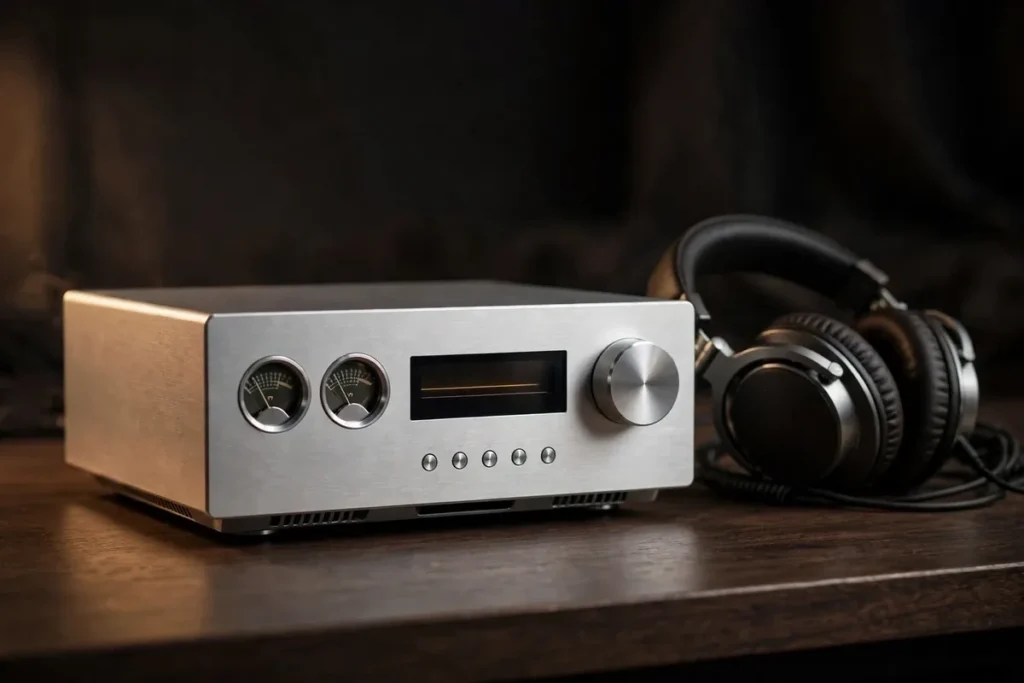
The T+A DAC 200 does three jobs in one chassis: converter, analogue preamplifier and headphone amplifier. Built in Herford, Germany, as the centre of the Series 200 range, it splits conversion in two. PCM runs through a quadruple differential converter: eight 32-bit Burr-Brown chips. DSD takes a separate path, a True 1-bit converter handling the native bitstream at up to DSD1024. Nothing about it is portable or battery-powered. It is system furniture, built to sit between your sources and a power amplifier for years.
This T+A DAC 200 review is built from T+A’s published specifications, independent bench measurements and reviews from other publications, not our own testing, so the scores are provisional and research-based.
T+A DAC 200 8.9/10 provisional
Why you: you want one box running your system: reference conversion for PCM and DSD, relay volume control that drives a power amp directly, and a headphone stage that is a real amplifier, not an afterthought.
Trade-off: flagship-tier US pricing, no streaming or Bluetooth built in, and no Amazon US stock, so buying means going through a T+A dealer.
True 1-bit DSD to DSD1024 · PCM to 768 kHz · Relay-ladder volume · 4.4 mm Pentaconn headphone out
Buying note: Amazon US does not list the DAC 200 directly at the time of writing (checked November 5, 2026), so the button runs a tagged Amazon search rather than a product page. US sales run through authorized T+A dealers.
What the DAC 200 is
Most products in our best DACs guide convert digital audio and hand the result to something else. The DAC 200 keeps going. Behind the converter sits a discrete Class A preamplifier section with a double-mono output stage, a relay-switched volume control, one analogue input for an outside source such as a phono stage, and a dedicated headphone amplifier. In a Series 200 system it is the hub: the matching MP 200 multi-source player feeds it, and the variable XLR or RCA outputs drive a power amplifier directly, with no separate preamp in the chain.
That makes it a different purchase from a pure converter like the Chord Qutest. The Qutest assumes your amplification and volume control already exist. The DAC 200 replaces them, and its price has to be judged against the stack it removes: a DAC, a preamp and a headphone amp of comparable standard would normally be three boxes, three power supplies and three sets of cables. Our preamp vs amp explainer covers what the preamp stage is doing in that chain, and our what is a DAC guide covers the conversion side for newer readers.
Two converters in one box
The DAC 200’s defining decision is that PCM and DSD never share a conversion path. PCM is handled by what T+A calls a double-differential quadruple converter: four 32-bit sigma-delta converters per channel, eight Burr-Brown chips in total, arranged so their non-linearities cancel and the noise floor drops. It converts at up to 768 kHz and offers a set of selectable filters, including FIR and Bezier options and NOS modes that skip oversampling altogether, followed by a phase-linear Bessel analogue filter with a switchable 60 or 120 kHz cut-off.
DSD bypasses all of that. The True 1-bit converter processes the DSD bitstream natively, with no conversion to PCM on the way, at rates up to DSD1024 over USB. There are two catches worth knowing. DSD512 and DSD1024 need T+A’s driver on a Windows PC, or a Linux machine; and DSD sent as DoP tops out at DSD256. Around both paths sits T+A’s supporting engineering: a De-Jitter Masterclock that re-clocks incoming signals in two stages, and full galvanic isolation between the digital and analogue sections, so noise from a computer’s USB port has no electrical path to the outputs.
Sound: what the reviews and measurements report
The hands-on record is strongly positive. Future Audiophile’s reviewer ran the DAC 200 with the matching MP 200 as source and praised the pairing’s quality and integration, and The Absolute Sound covered it in the same register. Owners who feed it upsampled DSD from software such as HQPlayer are more emphatic still: the native 1-bit path is the reason many of them bought it, and the DSD input has become its calling card in that community.
The bench record adds one honest caveat. GoldenSound’s measurements found dynamic range of 115.2 dB and very low crosstalk, and the preamp section measured very well. The DSD path measured clearly better than the PCM path, with harmonic levels roughly 10 dB lower. PCM distortion, though, rises at high signal levels, and performance near full scale is merely good rather than exceptional. In practice that argues for feeding the DAC 200 DSD material, or PCM with a little digital headroom, and it is why our sound score sits at 9.4 rather than higher: the DSD conversion is reference-class, the PCM conversion is excellent with a documented quirk at the top of its range.
The preamp and the headphone stage
Volume is set by a ladder of gold-contact relays in 1 dB steps, from -90 dB to 0 dB. Relay ladders are the expensive way to build a volume control, and the point of them is channel balance that does not drift with level, which matters most at the low volumes where systems with power amps actually get used. The outputs can run variable, for driving a power amp directly, or fixed, if the DAC 200 is feeding an existing preamp or integrated amplifier instead. A remote control is included, and the front panel carries the two analogue meters and display that mark out the Series 200 design.
The headphone output is a single 4.4 mm Pentaconn socket fed by its own discrete stage, running in Class A at up to 200 mA with a low 6 ohm output impedance. That is enough current for demanding full-size headphones, and the low output impedance keeps the response honest with sensitive models. It is one socket rather than a bank of them, and there is no single-ended 6.35 mm jack, so older headphone cables need an adapter. Buyers who listen only on headphones should also look at the HA 200, T+A’s headphone-first sibling in the same series.
T+A DAC 200 vs Chord Qutest vs Mojo 2
These three products mark out the high end of our DAC coverage, and they answer different systems. The DAC 200 is a system centrepiece. The Qutest is a pure converter for an amplifier you already own. The Mojo 2 is the portable all-rounder that tops our best DACs guide. Scores are not interchangeable across those roles, and the table below shows why.
| T+A DAC 200 | Chord Qutest | Chord Mojo 2 | |
|---|---|---|---|
| Type | DAC, analogue preamp and headphone amplifier | Desktop DAC only. No amplifier, no battery | Portable DAC and headphone amplifier with battery |
| Conversion | Two paths: quadruple differential sigma-delta for PCM, True 1-bit converter for DSD | Custom FPGA, 49,152-tap WTA filter, 10-element pulse array | Custom FPGA with UHD DSP (tone control, crossfeed) |
| Inputs | 2x USB, AES/EBU, BNC, 2x coaxial, 2x optical, 1x analogue RCA. Optional HDMI module | USB-B, 2x BNC coaxial (dual-data), optical | USB-C, micro-USB, optical, coaxial |
| Outputs | XLR and RCA pre-outs, variable or fixed. 4.4 mm Pentaconn headphone out | 1x stereo RCA line out, selectable 1V / 2V / 3V | 3.5mm and 4.4mm headphone outputs |
| Max format | 768kHz / 32-bit PCM, DSD1024 native via USB | 768kHz / 32-bit PCM, DSD512 (ASIO) | 768kHz / 32-bit PCM, DSD256 (DoP) |
| Volume control | Relay ladder in 1 dB steps, remote control | None | Yes, button-controlled |
| Weight | 6.2 kg | 770 g | 185 g |
| Our published overall | 8.9 (this review) | 8.4 in our Qutest review |  9.4 in our best DACs guide |
The Mojo 2 keeps the highest overall because it is the complete one-box answer at a fraction of the commitment: source in, headphones on, and it travels. The DAC 200 outscores the Qutest on features and connectivity because it does so much more, and its sound score rests on the DSD path and the measured quality of its preamp section. Pick the DAC 200 if you are building a fixed system and want the conversion, volume control and headphone stage settled in one purchase. Our best balanced DACs guide covers the wider balanced field it sits in.
T+A DAC 200 specifications
| Product | T+A DAC 200 Check Price |
| Type | D/A converter with analogue preamplifier and headphone amplifier |
| PCM conversion | Double-differential quadruple converter, four 32-bit sigma-delta converters per channel, up to 768 kHz |
| DSD conversion | T+A True 1-bit converter, native bitstream, up to DSD1024 (49.2 MHz) |
| Filters | Selectable upsampling filters (FIR short, FIR long, Bezier variants, NOS). Phase-linear Bessel analogue filter, switchable 60 or 120 kHz |
| Digital inputs | 2x USB DAC (44.1 to 768 kHz PCM, DSD to DSD1024), 1x AES/EBU, 1x BNC, 2x coaxial, 2x optical (S/PDIF to 192 kHz) |
| Analogue input | 1x RCA high level, 250 mV to 4.5 V, 10 kohms |
| Outputs | Balanced XLR and RCA pre-outs. Variable: 0 to 5.0 V (XLR) / 0 to 2.5 V (RCA). Fixed: 5.0 V / 2.5 V. 22 ohms |
| Volume control | Gold-contact relay ladder, 1 dB steps, -90 dB to 0 dB |
| Headphone output | 4.4 mm Pentaconn, discrete Class A stage, up to 200 mA, 6 ohm output impedance |
| Frequency response | 0.1 Hz to 200 kHz (+0 / -3 dB) |
| Signal to noise | 110 / 114 dB |
| THD | Less than 0.001% |
| Channel separation | Greater than 108 dB |
| Optional | HDMI module: 2x HDMI inputs, 1x HDMI output with ARC |
| Dimensions | 32 x 34 x 10 cm (W x D x H) |
| Weight | 6.2 kg |
| Finishes | Silver or black |
A note on the scores
The five marks mirror the categories we use for desktop DACs in our best DACs guide, and the overall is their mean: Sound Quality 9.4, Features and Flexibility 9.0, Build Quality 9.4, Connectivity 9.2, Value 7.4, giving 8.9 out of 10. The value mark needs its context: the DAC 200 costs flagship money, and judged as a bare converter that would sink it. Judged as the three components it replaces, each of which would cost serious money on its own, it reads differently. These are research-based scores drawn from T+A’s specifications, published bench measurements and other reviewers’ listening time, not our own tests. When we have a unit in the system, the marks will be revisited.
FAQ
Is the T+A DAC 200 a DAC/amp?
It is three components in one chassis: a DAC, an analogue preamplifier with relay volume control, and a headphone amplifier with a 4.4 mm Pentaconn output. It can drive headphones directly and feed a power amplifier for speakers.
Does the DAC 200 play DSD1024 natively?
Yes. Its True 1-bit converter processes the DSD bitstream natively at up to DSD1024 (49.2 MHz) over USB, with no conversion to PCM. DSD512 and DSD1024 need T+A’s driver on Windows, or a Linux system. DSD sent as DoP tops out at DSD256.
Can the DAC 200 replace a separate preamp?
Yes. The variable XLR and RCA outputs are driven by a gold-contact relay volume control in 1 dB steps, so the DAC 200 can feed a power amplifier directly. It also has one analogue input for an outside source, and fixed outputs if you would rather keep an existing preamp.
Does the DAC 200 have HDMI or streaming?
There is no streaming or Bluetooth built in. An optional HDMI module adds two HDMI inputs and one output with ARC, which suits a TV-based system. For streaming, pair it with a separate streamer or the matching T+A MP 200.
What is the difference between the DAC 200 and the HA 200?
The HA 200 is T+A’s headphone-first sibling in the Series 200 range, built around its headphone stage. The DAC 200 is the system component: full preamplifier outputs for speaker systems, one analogue input, and a single Pentaconn headphone socket alongside.
Where can I buy the T+A DAC 200 in the US?
Amazon US does not list the DAC 200 directly, so US sales run through authorized T+A dealers. The buttons on this page run a tagged Amazon search instead of opening a product page.
Verdict
The DAC 200 is the most complete single box in our DAC coverage: a genuinely dual-path converter whose DSD side is reference-class, a relay-ladder preamp that measured as well as it reads, and a headphone stage with real current behind it. The caveats are equally clear. PCM playback has a measured quirk near full scale, the price is flagship money, and US buyers will be talking to a dealer rather than clicking a product page. Scored on what it is, it earns 8.9 out of 10, and it is the benchmark the rest of our high-end DAC coverage now has to answer.

I am the founder of Sound Mavericks, where I provide the polite truth about audio equipment. I started this site because consumer electronics reviews are often too technical. Instead of using a silent lab, I test headphones, earbuds, and Bluetooth speakers in the real world – like on a noisy subway or in a busy coffee shop.
To stay independent, I buy my own review units (mostly from the United States) rather than accepting free gifts from brands. Once I finish testing a product, I sell it locally to our community. My goal is to help you understand sound quality, active noise cancellation (ANC), and battery life without the marketing hype.

