
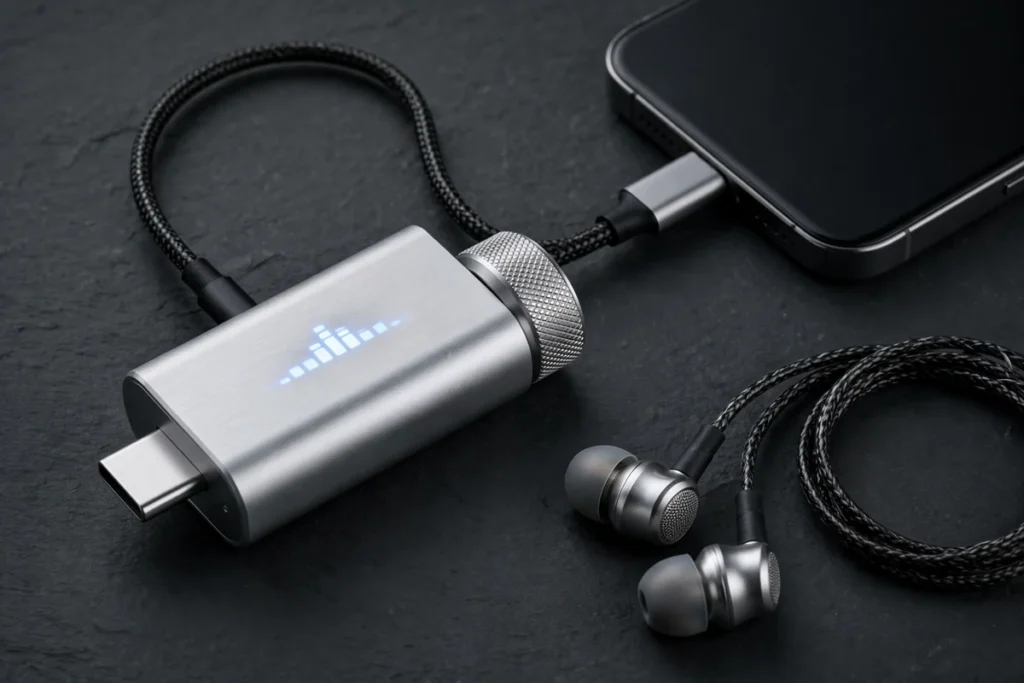
This AK HC5 USB DAC review starts with the part that makes the product interesting: Astell&Kern took the DAC pairing from its flagship SP4000 player, the AK4191EQ processor and AK4499EX converter, and built it into a USB dongle with a screen and a volume wheel. It tops A&K’s HC cable line, above the HC4, aimed at listeners running serious wired IEMs and efficient headphones from a phone or laptop.
Built from Astell&Kern’s published specifications and other publications’ hands-on coverage, not our own testing; the scores are provisional.
Astell&Kern AK HC5 8.3/10 provisional
Why you: you want flagship A&K conversion in your pocket, with a real volume wheel and a screen, for IEMs and efficient headphones on a phone or laptop.
Trade-off: it is big for a dongle and priced like a small DAP. No EQ, no app, no Bluetooth, and A&K rates output in volts only, so hard-to-drive planars still belong on desktop gear.
AK4191EQ + AK4499EX DAC · 1.62-inch OLED · 3.5mm + 4.4mm outputs · PCM 768kHz / DSD512 · 46 g aluminium
Buying note: Amazon US does not stock the AK HC5 directly at the time of writing (checked November 5, 2026), so the button runs a tagged Amazon search rather than opening a product page. US sales run through authorised Astell&Kern dealers such as Moon Audio and MusicTeck.
Flagship conversion in a dongle body
Most dongle DACs are built around a single mobile DAC chip that handles everything. The HC5 splits the job the way A&K’s players do. The AK4191EQ works as a digital processor in front of the AK4499EX converter, keeping the digital and analogue stages separate, which is the arrangement AKM designed the pair for and the same silicon combination found in the SP4000. This is the first time the pairing has appeared in a USB dongle, and it is the entire reason the HC5 exists.
Around the chips, A&K carried over its High Driving Mode amplification and a horizontal op-amp layout from the player line, plus a dual noise-shielded cable with tin-plated copper conductors and two layers of shielding. The published measurements are what you would hope for at this level: signal-to-noise of 121 dB unbalanced and 125 dB balanced, THD+N of 0.0005% unbalanced and 0.0004% balanced, and frequency response flat to ±0.006 dB across the audible band. Numbers like that do not guarantee a sound you will like, but they do mean the HC5 is not the bottleneck in any portable chain. Our what is a DAC explainer covers how much of this is audible in practice.
AK HC5 specifications
| Product | Astell&Kern AK HC5 |
| DAC | AKM AK4191EQ processor + AK4499EX converter |
| Formats | PCM up to 768kHz / 32-bit, native DSD up to DSD512 |
| Outputs | 3.5mm unbalanced, 4.4mm balanced (5-pole only) |
| Output level | 2.5 Vrms unbalanced, 5 Vrms balanced (no-load) |
| Output impedance | 0.5 ohm (3.5mm), 1.1 ohm (4.4mm) |
| Display | 1.62-inch OLED (volume, sample rate, DAR status, USB mode) |
| Volume | 150-step wheel, independent of the phone |
| Sound shaping | DAR upsampling (to PCM 384kHz / DSD256), six DAC filters, no EQ |
| Input | USB-C, UAC 2.0 and UAC 1.0 modes |
| Power | USB bus power, no battery, no Bluetooth |
| Body | Aluminium, Satin Silver, 32 × 64.3 × 16 mm, about 46 g |
| In the box | HC5, USB-C cable, Lightning cable |
| Buy | Check Price on Amazon |
The screen and the wheel are the real upgrade
Dongles usually ask you to guess. Volume lives on the phone, the sample rate is a mystery, and settings mean an app. The HC5 puts a 1.62-inch OLED on the front that shows the volume step, the incoming sample rate, whether DAR is active and which USB mode you are in. Under it sits a volume wheel with 150 steps, using the same encoder approach as A&K’s players. For sensitive IEMs, 150 steps is the difference between too quiet and too loud with nothing in between, and too loud with the next click. Here you get the in-between.
Every setting lives on the device itself: DAR on or off, the six DAC filters, and the UAC 1.0 or 2.0 switch, all handled from the screen and buttons. There is no companion app and no EQ, which A&K clearly treats as a philosophy rather than an omission. Two honest knocks from hands-on coverage: TechRadar found the physical controls slightly imprecise next to the rest of the build, and ecoustics pointed at visible slack in the wheel. And at 46 g and 16 mm thick, this is a chunky object by dongle standards. It will not disappear into a small IEM case the way a stick-style dongle does.
Sound: detail first, bass kept lean
The reviewers who have lived with the HC5 land in the same place. TechRadar calls it insightful rather than impactful: lavishly detailed, dynamically tidy, with a large and well-organised stage and a midrange that carries vocals convincingly, but with less low-frequency weight and punch than the presentation up top leads you to expect. Headfonia, testing with IEMs from mid-priced to flagship, found a neutral balance with no obvious roll-off at either end, and sound that scales with the earphone: feed it a better IEM and it shows you more.
DAR is the one lever you get over that signature. With DAR off, the HC5 sounds like a clean, honest AKM implementation. Headfonia’s listening notes credit DAR in PCM mode with extra stage width and depth, and the DSD mode with a smoother, more natural top end on top of that. Neither mode adds detail that is not in the recording, and neither fixes the bass reservation. If your favourite IEMs are already lean down low, audition before committing. If they are warm, the pairing makes more sense. The six DAC filters are the fine print, not the headline: they nudge the treble behaviour, they do not retune the product.
Power, stated honestly
Astell&Kern does not publish a wattage figure for the HC5, and this review will not invent one. The spec is voltage: 2.5 Vrms single-ended and 5 Vrms balanced, both measured with no load connected, so treat them as ceilings rather than working figures. Working backwards from those numbers, Headfonia estimates somewhere around 450 to 500 mW into 32 ohms, and reports driving FiiO’s FT7 planar to comfortable levels at about step 107 of 150. That is strong for a dongle, well beyond what IEMs need, and enough for efficient full-size headphones. Genuinely current-hungry planars and high-impedance classics still belong on a desktop amp, where the supply is not a phone battery.
Two details help real-world pairing. Output impedance is low, 0.5 ohm single-ended and 1.1 ohm balanced, so sensitive multi-driver IEMs keep their intended tuning; our impedance explainer covers why that matters. And because there is no internal battery, the HC5 draws everything from the source. Reviewers note the draw is heavier than basic dongles, which is the quiet cost of the amplification on offer. The UAC 1.0 mode earns its place too: it is what lets the HC5 work with a PlayStation 5 or a Nintendo Switch, which reject standard USB audio devices.
Against the dongles we already rank
Our best portable DACs and dongles guide ranks the field for phone-first listening. The HC5 does not knock out its premium pick or its power pick; it competes with them on different terms.
| Dongle | Astell&Kern AK HC5 | Questyle M15i | FiiO KA13 |
| DAC | AK4191EQ + AK4499EX | ESS ES9281AC | Dual CS43131 |
| Outputs | 3.5mm + 4.4mm | 3.5mm + 4.4mm | 3.5mm + 4.4mm |
| Output | 2.5 / 5 Vrms (no load) | 1.9 / 2.6 Vrms max | 170mW+ single-ended, 550mW+ balanced into 32 ohms |
| Interface | 1.62-inch OLED, 150-step wheel | Gain switch, no display | Buttons, desktop mode |
| Extras | DAR, six filters, UAC 1.0 console mode, Lightning cable in the box | MFi certified, current-mode amplification, frugal power draw | SPDIF output, USB-C, Lightning and USB-A cables in the box |
| Buy | Check Price on Amazon | Check Price on Amazon | Check Price on Amazon |
The M15i is the pocketable purist option: smaller, MFi certified, and deliberately feature-free, with a far gentler appetite for phone battery. The KA13 remains the output bargain of the guide, with published milliwatt figures the HC5 does not match on paper and a desktop mode for desk use. The HC5’s ground is narrower and higher: the best conversion hardware in the class, the best controls, and a signature tuned for detail. Our best DACs guide covers the desktop units that take over where dongles stop.
Should you buy the AK HC5?
Buy it if your portable listening already runs through good wired IEMs or efficient headphones, and the dongle is the weakest part of that chain. The HC5 is built for exactly that gap, and its screen and wheel make it the easiest premium dongle to live with day to day. The console support is a genuine bonus if your Switch or PlayStation shares the same headphones.
Skip it if you need EQ, an app, or Bluetooth: none of that is coming in a firmware update, because the hardware and the philosophy are not there. Our best Bluetooth DAC amps roundup covers the battery-powered route instead. Skip it, too, if your headphones are the demanding kind that made you look at desktop amps in the first place, or if a smaller, cheaper dongle from our guide would cover your actual listening. The HC5 is a flagship part at a flagship-dongle price, and it makes most sense bought deliberately, through an authorised dealer, once you know its one reservation, the leaner low end, suits your earphones.
AK HC5 FAQ
Does the AK HC5 work with iPhone?
Yes. USB-C iPhones connect directly, and Astell&Kern includes a Lightning cable in the box for older iPhones. The HC5 also offers a UAC 1.0 mode for devices that reject standard USB audio, which is the mode that matters for games consoles.
How powerful is the AK HC5?
Astell&Kern publishes voltage, not wattage: 2.5 Vrms from the 3.5mm output and 5 Vrms from the 4.4mm balanced output, both measured with no load. In practice that is plenty for IEMs and efficient portable headphones, and hands-on reviewers have driven moderately hungry planars from it, but A&K does not promise a milliwatt figure into a real load.
Does the AK HC5 have Bluetooth or a battery?
No. The HC5 is wired only and runs on USB bus power from your phone or computer, so there is nothing to charge. The trade is that its amplification draws on the source device’s battery instead.
What does DAR do on the AK HC5?
DAR is Astell&Kern’s Digital Audio Remaster upsampling. It resamples incoming audio up to PCM 384kHz, or converts it toward DSD up to DSD256, before conversion. It does not add information that was not in the file; reviewers comparing the modes describe a wider stage and a smoother top end rather than new detail.
AK HC5 vs Questyle M15i: which is the better premium dongle?
The HC5 is the stronger converter with the far better interface: a screen, a 150-step wheel, DAR and console support. The M15i is smaller, lighter on your phone battery, and MFi certified for iPhone. Choose the HC5 for sound and control, the M15i for pocketability and iPhone use.
Where can you buy the AK HC5 in the US?
Through authorised Astell&Kern dealers. As of November 2026, Amazon US does not stock the HC5 directly, which is why the buy buttons in this review run a tagged Amazon search instead of opening a product page.

I am the founder of Sound Mavericks, where I provide the polite truth about audio equipment. I started this site because consumer electronics reviews are often too technical. Instead of using a silent lab, I test headphones, earbuds, and Bluetooth speakers in the real world – like on a noisy subway or in a busy coffee shop.
To stay independent, I buy my own review units (mostly from the United States) rather than accepting free gifts from brands. Once I finish testing a product, I sell it locally to our community. My goal is to help you understand sound quality, active noise cancellation (ANC), and battery life without the marketing hype.

