
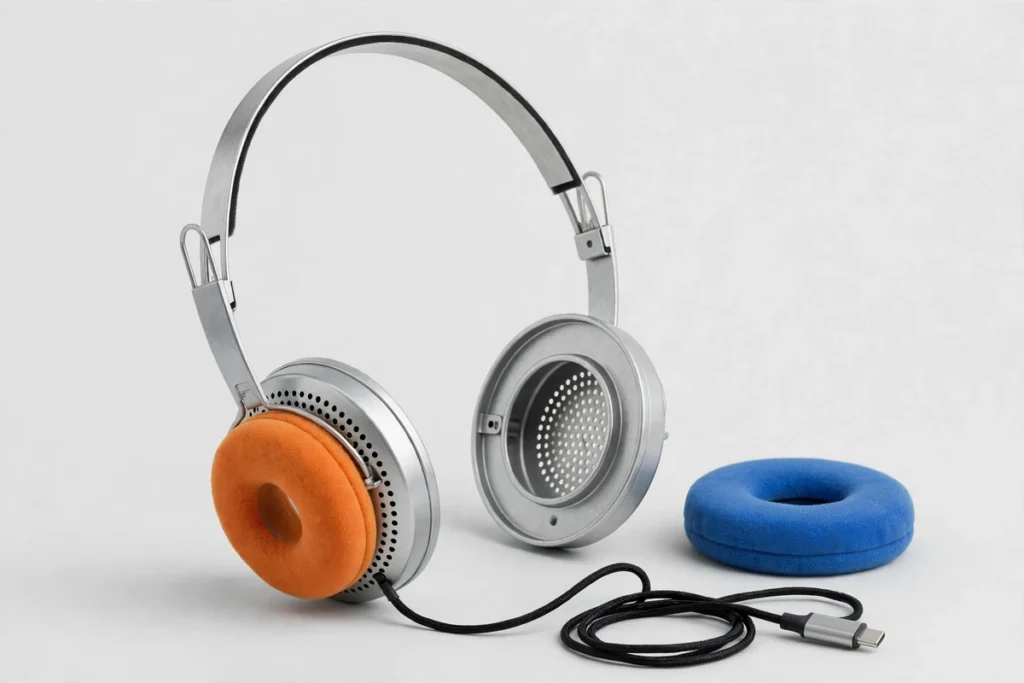
Sony has rebuilt the headphones that defined the first Walkman. The MDR-3R, announced on November 5, 2026, is a reissue of the MDR-3 that shipped with the TPS-L2 Walkman in 1979, the model collectors usually call the MDR-3L2. The open-air on-ear shape and foam pads are back, the weight is a claimed 38 grams, and the cable now ends in USB-C instead of a 3.5mm plug. It is already listed on Amazon US in Silver.
This is a research review. We have not tested the MDR-3R hands-on, so the verdict below is built from Sony’s published specifications, the verified Amazon US listing, and launch coverage. The score is provisional.

Sony MDR-3R 6.3/10 provisional
Why you: you want the lightest wired headphones for a phone or laptop, with the 1979 look intact and your ears open to the room.
Trade-off: USB-C only, so nothing with a 3.5mm socket can drive them directly, and the open-air fit leaks sound in both directions. Bass stays light.
23 mm driver · 38 g · USB-C, built-in 16-bit/48 kHz DAC · 1.2 m cable with mic · Blue and orange pads
The score, explained: 6.3 with two placeholder bars
Our overall score is 6.3, the mean of the six category bars above, and two of those bars need context before the number makes sense. Noise cancelling scores 2.0 because the MDR-3R has no cancelling hardware at all. It is an open-air design that rests on the ear behind a foam pad, so the room stays audible by intent, not by failure. Battery scores 5.0 because there is no battery. The MDR-3R is wired and draws its power from the USB-C port, and 5.0 is the neutral placeholder we give wired models so they can sit in the same table as wireless ones, the same treatment we gave the FiiO FT15.
The other bars are judgement calls from the spec sheet, and we label them that way. Comfort scores 9.0: at 38 grams with foam pads, this is close to the lightest thing you can wear that still calls itself a headphone. Calls & mic scores 7.5 for the inline cable microphone, a basic unit that should handle calls clearly without matching a dedicated boom mic. Sound scores 7.0, provisionally, on the strength of the driver design and Sony’s retune claims, and it stays provisional until ears confirm it. Value scores 7.5: part of what you pay for here is the 1979 story, and we score that openly rather than pretending the hardware alone carries it.
Design: 38 grams and two colours of foam
The MDR-3R keeps the original’s recipe. Small round housings ride on a slim band, foam pads rest on the ear, and nothing is inserted or sealed. At 38 grams excluding the cable, Sony calls it the lightest on-ear headphone in its current line, and with so little mass involved, fit pressure matters more than weight. The foam spreads what pressure there is, and because the pads sit on the ear rather than around it, glasses arms cause fewer hot spots than with most on-ear designs.
The pads are also the personality. Sony includes swappable foam pads in blue and orange in the box, so you can run the full retro look, swap colours to suit your mood, or replace a set when the foam eventually flattens, which foam always does. The colour on the Amazon US listing is Silver. A Stranger Things Edition exists in black with red pads, if the standard look is too plain.
1979: the original MDR-3, and what Sony kept
The first Walkman, the TPS-L2 of 1979, needed headphones that matched its idea: small, light, and open enough that you could still hear the street. The MDR-3 was that headphone, and its lightweight open-air design became the template for a decade of portable audio. Owners remember the foam pads and the featherweight feel more than any specification, because the specification was never the point. The MDR-3 made personal stereo feel casual instead of serious, and that is the feeling Sony is selling again.
Sony says the MDR-3R’s 23 mm dynamic drivers were re-engineered from the original drawings and then retuned. The open-air shape, the pads, the slim band and the featherweight build are the kept parts, faithfully so. This is a reissue that respects its source material, not a retro-styled new product wearing an old name, and the distinction matters for who should buy it. Collectors get the silhouette they remember; everyone else gets a genuinely light headphone that happens to carry a famous outline.
What changed: USB-C, a DAC in the plug, and a shorter cable
The big change is the plug. The MDR-3R ends in USB-C and carries a built-in DAC rated at 16-bit/48 kHz, running USB Audio Class 1.0, so phones, laptops and tablets drive it with no drivers and no dongle. There is no 3.5mm jack anywhere in the chain, and Sony itself notes the MDR-3R is not for use with old Walkman players, which is a funny sentence to write about a Walkman tribute. If your favourite sources still have headphone sockets, the dongles in our portable DACs and dongles guide plus a 3.5mm headphone remain the flexible route. If your phone dropped its socket years ago, the MDR-3R simply folds that dongle into the cable.
The cable is a 1.2 m Y-type lead, shorter than the roughly 2 m cord of the 1979 original. That length suits a phone in a pocket or a laptop on a desk and feels short across a living room. New on the cable is a three-button remote with a microphone, which the original never had: calls, volume and playback control now live on the lead. Sony also retuned the drivers for the reissue, claiming deeper bass, extended highs and clearer vocals than the 1979 tuning. Those are Sony’s claims from the launch materials, not measurements, and our Sound score treats them as claims.
Sound: honest expectations for an open-air reissue
Set expectations by physics first. An open-air driver behind a foam pad cannot pressurise the ear the way a sealed headphone does, so deep bass will be light, some of your music will leak to the person next to you, and traffic and conversation will leak in. That is the design working as intended. The MDR-3R is a companion for walks, desks and rooms you want to stay part of, not a tool for shutting out a train carriage.
Within those limits, the ingredients are sensible. A 23 mm driver is large for this class, the neodymium magnets keep it efficient enough for a phone’s USB-C output, and Sony aimed the retune at the original’s known weakness, thin low end, while pushing vocals forward. Spoken word, podcasts, pop, rock and acoustic music are the natural diet here. Bass-led electronic music will sound tidy rather than heavy, and quiet, detailed listening belongs to sealed headphones. We will not dress expectations up as impressions: this section is reasoned from the design and the spec sheet, and the provisional Sound score of 7.0 will move when tested impressions exist.
Sony MDR-3R specifications
| Product | Sony MDR-3R |
| Design | Open-air on-ear, foam ear pads, wired |
| Driver | 23 mm dynamic, neodymium, re-engineered from the original MDR-3 drawings and retuned |
| Connector | USB-C, USB Audio Class 1.0; no 3.5mm jack |
| DAC | Built in, 16-bit/48 kHz |
| Cable | 1.2 m Y-type, inline three-button remote and microphone |
| Weight | 38 g excluding cable (Sony figure) |
| In the box | Headphones, swappable foam ear pads in blue and orange |
| Colour | Silver (Amazon US listing) |
| Check Price | Check Price on Amazon |
MDR-3R vs the 1979 MDR-3
Side by side, the reissue is faithful about everything you can see and ruthless about the part you plug in. The comparison below sticks to what Sony has published for both models.
| Sony MDR-3R (2026) | MDR-3 (1979) | |
|---|---|---|
| Release | Announced November 5, 2026 | 1979, shipped with the TPS-L2 Walkman |
| Connector | USB-C | 3.5mm plug |
| DAC | Built in, 16-bit/48 kHz | None, analogue only |
| Cable | 1.2 m Y-type with three-button remote and microphone | About 2 m, no remote or microphone |
| Driver | 23 mm dynamic, re-engineered from the original drawings and retuned | Original 1979 design |
| Tuning | Retuned: deeper bass, extended highs, clearer vocals (Sony’s claims) | Original 1979 tuning |
| Ear pads | Foam, swappable; blue and orange sets in the box | Foam |
| Check Price | Check Price | Vintage market only |
The row that decides most purchases is the connector. The 1979 original plugs into almost five decades of audio gear. The reissue plugs into the phones and laptops people actually carry now, and into nothing else without an adapter chain it was never designed for.
Who should buy the Sony MDR-3R
Buy it if you own a USB-C phone or laptop and want the simplest wired option going: no dongle to lose, no battery to charge, no pairing, 38 grams. Buy it if the Walkman story genuinely pleases you, because the design fidelity is the product as much as the sound is. Buy it if you listen at a desk or on walks and like hearing the room while the music plays.
Skip it if your favourite sources still speak 3.5mm, including DAPs, headphone amps and, yes, actual Walkmans. Skip it if you want isolation on public transport, because open-air foam pads give you none and volume will not fix that. And skip it if you need one headphone that works with everything you own: the MDR-3R is deliberately a one-port headphone. If you like Sony’s hear-the-room idea but want it without a cable, Sony’s LinkBuds Clip takes the same approach wirelessly, and we scored it 7.2 in our review.
Frequently Asked Questions
Does the Sony MDR-3R work with an old Walkman?
No. The MDR-3R is USB-C only, with no 3.5mm plug, and Sony itself notes it is not for use with old Walkman players. It needs a USB-C device such as a phone, laptop or tablet, and connects as a USB Audio Class 1.0 device.
Does the Sony MDR-3R have Bluetooth or a battery?
No. It is fully wired and draws its power from the USB-C port, so there is nothing to charge and nothing to pair. Our battery score of 5.0 is the neutral placeholder we assign to wired models so they can be compared in the same table as wireless ones.
Does the Sony MDR-3R have noise cancelling?
No. The MDR-3R is an open-air on-ear design with no active noise cancelling and no seal. You hear traffic, voices and announcements while you listen, and people near you will hear some of your music at higher volumes.
Can you take calls on the Sony MDR-3R?
Yes. The cable carries an inline microphone and a three-button remote, so calls, volume and playback control are handled on the lead without touching your phone.
What ear pads come with the Sony MDR-3R?
Sony includes swappable foam ear pads in blue and orange in the box. You can swap colours, run one set while the other is cleaned, or replace a set when the foam wears flat.
Final verdict
The MDR-3R is a faithful reissue with one ruthless modernisation. Everything visual and tactile survived from 1979, and the connector jumped straight to USB-C with a DAC in the plug. As a piece of design history you can buy new and use with a current phone, it is hard to fault. As a headphone, it is a light, open, pleasant wired set whose 6.3 provisional score is dragged down by two bars that measure things it never tried to do. Judge it on lightness, simplicity and story, and it earns its place.

I am the founder of Sound Mavericks, where I provide the polite truth about audio equipment. I started this site because consumer electronics reviews are often too technical. Instead of using a silent lab, I test headphones, earbuds, and Bluetooth speakers in the real world – like on a noisy subway or in a busy coffee shop.
To stay independent, I buy my own review units (mostly from the United States) rather than accepting free gifts from brands. Once I finish testing a product, I sell it locally to our community. My goal is to help you understand sound quality, active noise cancellation (ANC), and battery life without the marketing hype.
