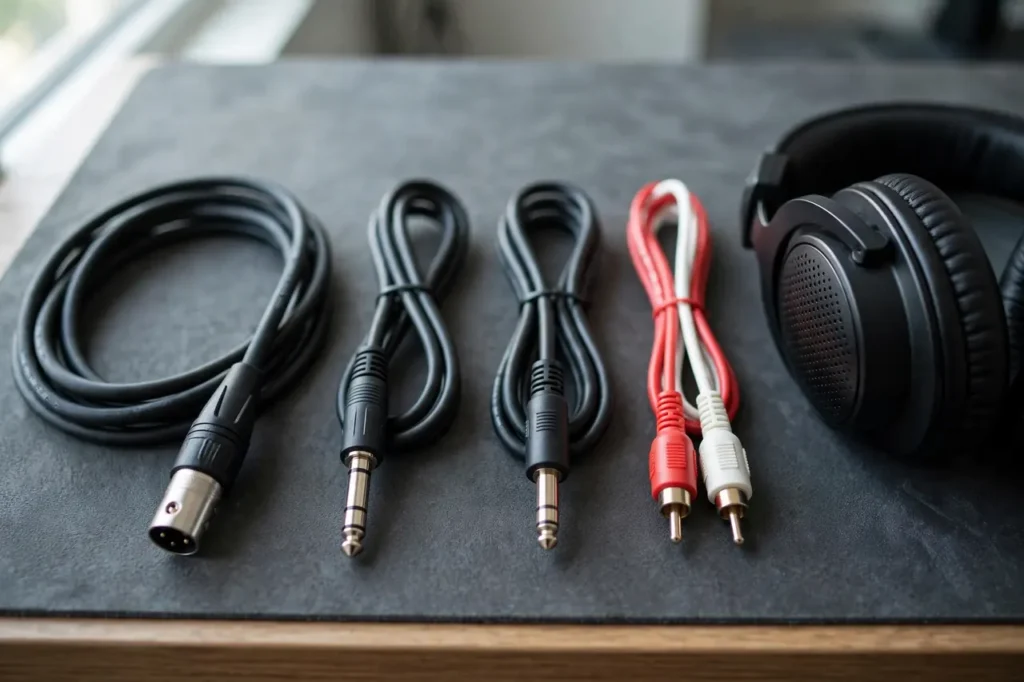
Quick Verdict: Balanced Cancels Noise — It Doesn’t Upgrade Your Music
A balanced connection sends your audio down two wires carrying opposite copies of the signal, so interference picked up along the way cancels out at the receiving end. An unbalanced connection sends it down one wire, and whatever the cable picks up — hum, buzz, interference — arrives with the music. That is the whole difference. Balanced is the right tool for microphones, long cable runs, and electrically noisy rooms. For a short cable between home audio components in a quiet setup, unbalanced sounds exactly the same. Buy balanced to solve a noise problem or to match your gear — not because it promises better sound by itself.
Few audio topics generate more confusion — and more unnecessary spending — than balanced vs unbalanced cables. The connectors look similar, the terminology overlaps with stereo, and marketing copy blurs the rest. So let’s settle it properly: how each connection actually works, why balanced rejects noise, which connectors carry which signal, how long each cable can run, and — most importantly — when any of it matters for headphone and home-audio listening.
SoundMavericks’ position up front: balanced audio is a noise-rejection technology, not a sound-quality upgrade. Once you understand the mechanism, every buying decision in this area becomes simple. If you are building out a desktop chain, our best headphone amps guide and our explainer on what impedance means and whether you need an amp pair naturally with this one.
Balanced vs Unbalanced Audio Cables: At a Glance
| Difference | Balanced | Unbalanced |
|---|---|---|
| Also called | Balanced line | Single-ended |
| Conductors | 3 — hot (+), cold (−), and ground/shield | 2 — signal and ground/shield |
| How the signal travels | Two opposite copies; receiver amplifies the difference | One copy, referenced to ground |
| Noise rejection | Cancels interference picked up along the cable (common-mode rejection) | No rejection — picked-up noise is added to the audio |
| Common connectors | XLR, 1/4-inch TRS | 1/4-inch TS, RCA, 3.5mm stereo |
| Typical level | +4 dBu (professional gear) | −10 dBV (consumer gear) |
| Practical cable length | 100 feet and well beyond | Under 10 feet ideal; about 25 feet maximum |
| Typical uses | Microphones, mixers, audio interfaces, studio monitors | Guitars, hi-fi components, DJ gear, short home runs |
| Cost | Usually a little more — extra conductor and hardware | Usually a little less — simpler construction |
What Is an Unbalanced Audio Cable?
An unbalanced connection is the simple one. Inside the cable there are two conductors: one carries the audio signal, and the other is the ground, which usually doubles as a shield wrapped around the signal wire. The receiving device measures the signal against that ground.
The weakness is built into the design. A cable running past power supplies, dimmers, fluorescent lights, or a tangle of mains leads acts like a small antenna. Any interference it picks up lands on the signal path — and because there is only one copy of the signal, the receiver cannot tell the interference apart from your music. It all gets amplified together. Over a short run in a tidy room, the picked-up noise is usually too quiet to hear, which is why unbalanced connections have served home audio perfectly well for decades. Over a long run, or in an electrically noisy environment, the hum and buzz become audible — and there is nothing the cable itself can do about it.
What Is a Balanced Audio Cable?
A balanced connection uses three conductors: a ground/shield, plus two signal wires, usually called hot and cold. The sending device puts the audio on both wires at once — but flipped. The hot wire carries the signal as-is; the cold wire carries an exact mirror image, inverted in polarity. The two signal wires are twisted together inside the cable so they sit in almost exactly the same position along the whole run.
That twisting is the quiet hero of the design. Because the two wires travel together, any interference the cable picks up — from a power cable it crosses, a lighting rig, a room full of electronics — lands on both wires equally. Noise doesn’t care about polarity; it adds itself the same way to each. Then the receiving input does one elegant thing: instead of listening to either wire on its own, it amplifies only the difference between them.
How Does Common-Mode Rejection Work?
This is the part worth understanding in plain language, because it explains everything else in this article.
Picture the original signal as the number +5 on the hot wire and −5 on the cold wire. The difference between them is 10. Now the cable runs past a power supply and picks up +2 of hum — the same +2 on both wires, because both wires were in the same place when it hit. The hot wire now reads +7 and the cold wire reads −3. The difference? Still 10. The hum added itself to both sides equally, so when the receiver subtracts one wire from the other, the hum cancels to zero and the music comes through untouched — in fact, the recovered signal is louder than a single-ended version, because the difference between +5 and −5 is twice the swing of one wire alone.
Engineers call this common-mode rejection: anything “common” to both wires gets rejected. It is not magic and it is not subtle — it is why a microphone signal, which is tiny and fragile, can travel a hundred feet across a stage full of lighting cables and arrive clean. One critical condition, though: the whole chain has to be balanced. The source, the cable, and the destination input must all be balanced designs. Put an unbalanced device anywhere in the chain and that leg loses the protection.
Balanced vs Unbalanced Connectors: XLR and TRS vs TS and RCA
Balanced or unbalanced is about the wiring, but connectors are your visual shortcut — with one famous trap we’ll flag below.
XLR — the professional standard
The three-pin XLR connector is always balanced: pin 1 is ground, pin 2 is hot, pin 3 is cold. It locks with a latch, shrugs off stage abuse, and is the standard for microphones and for connecting pro gear — interfaces, mixers, powered speakers. If you need one cable type to trust for a mic or a long run, this is it. A studio staple like the Mogami Gold Studio XLR cable shows what the format does best: quad conductors and serious shielding for hostile electrical environments.

Mogami Gold Studio XLR Cable (Balanced)
TRS — balanced mono or stereo, depending on the job
A TRS plug (tip-ring-sleeve) has three contact points — the two black rings you can see on the plug divide it into three sections. In a balanced connection, tip is hot, ring is cold, and sleeve is ground: one mono signal, protected. You’ll find balanced TRS on audio interfaces, mixers, patch bays, and powered studio monitors. A workhorse example is the Hosa CSS-110 balanced TRS interconnect, the standard short link between an interface and a pair of monitors. But the same plug also carries unbalanced stereo on headphone outputs — left on the tip, right on the ring, ground on the sleeve. The plug doesn’t decide; the wiring and the socket do. More on that trap below.
TS — the instrument cable
A TS plug (tip-sleeve) has only two contact points — one signal, one ground — so it is unbalanced by construction. This is the classic guitar and bass cable, and the right tool for instruments and short mono runs. It was never designed to travel far quietly.
RCA — home audio’s unbalanced default
RCA (phono) connectors carry one unbalanced signal each, so stereo uses a pair. They are the native language of home hi-fi, DJ gear, and older AV equipment, and they are always unbalanced — there is no such thing as a balanced RCA cable, whatever an adapter claims. If your components only offer RCA, keep the runs short and tidy and you’ll be fine; that’s exactly what they’re designed for. The same logic governs the speaker side of a system, where connection choices matter differently — see our 2-way vs 3-way speakers comparison and preamp vs amp explainer for how those pieces fit together.
How Long Can a Balanced or Unbalanced Cable Be?
Length is where the theory turns into a purchasing rule. Working guidelines used across pro and home audio:
- Unbalanced: keep it under about 10 feet for critical listening; 15–25 feet is the practical ceiling before hum, buzz, and treble loss from cable capacitance become realistic risks. Guitar cables are the strictest case — a guitar’s weak, high-impedance signal suffers first, which is why guitarists keep cables short.
- Balanced: 100 feet is routine, and professional installs run several hundred feet without audible noise, because common-mode rejection keeps cleaning the signal the whole way.
Notice the asymmetry: balanced doesn’t just tolerate length, it’s indifferent to it within reason. Unbalanced doesn’t suddenly fail at 11 feet either — it degrades gradually as the antenna gets longer and the room gets noisier. The rule of thumb we give readers: if the run is across a desk, either works; if the run crosses a room, goes near power cables, or leaves the house of one component for another rack entirely, go balanced wherever your gear allows it. And whenever cables must cross mains leads, cross them at a right angle and avoid long parallel runs side by side — routing discipline helps even unbalanced setups.
When Does Balanced Audio Actually Matter for Headphones and Home Audio?
Here is where we separate the interconnect story from the headphone story, because “balanced” means something different — and much less — at the headphone jack.
Between your components: sometimes, genuinely
Connecting a DAC to an amp, or an interface to powered monitors, with balanced XLR or TRS is worthwhile when: the run is longer than a few feet, your room has dimmers or lots of mains wiring nearby, you can hear hum or buzz now, or your gear offers balanced connections on both ends anyway. It also sidesteps ground-loop hum between components, one of the most common desktop-audio annoyances. In a short, quiet, hum-free desktop chain, expect no audible change — balanced isn’t worse, it just has nothing to fix.
At the headphone output: mostly about power, not noise
A “balanced headphone cable” — typically 4.4mm Pentaconn, 2.5mm, or 4-pin XLR — does not give your headphones common-mode rejection. Headphone drivers don’t work like a balanced line input, and a headphone cable is short and carries a strong signal, so cable-borne interference was never the problem. What a balanced headphone output can do is deliver more power: many amps and portable players put out substantially more voltage from their balanced output than their single-ended one. For hard-to-drive, high-impedance, or low-sensitivity planar headphones, that extra headroom is real and useful. For easy-to-drive headphones and IEMs, which need very little power, it typically changes nothing except the volume knob’s position — and any perceived difference usually disappears once levels are carefully matched. If you are unsure whether your headphones need that power at all, start with impedance and amp requirements before buying cables.
SoundMavericks’ take: spend on balanced interconnects where noise or distance is a genuine issue; treat balanced headphone cables as a power-and-convenience accessory for specific amps and headphones, not a sound-quality upgrade. And none of this changes what your music is stored as — if you’re chasing real quality gains, the recording and format matter more, as our FLAC vs MP3 comparison shows.
Balanced vs Unbalanced: Myths That Need Retiring
Myth: “Balanced always sounds better”
No. Balanced removes noise the cable picked up; it does not improve the signal itself. In a silent system, there is nothing to remove, and balanced and unbalanced sound identical. The comparison only becomes audible when the unbalanced setup has a noise problem — at which point balanced isn’t “better sounding,” it’s simply “not broken.”
Myth: “A balanced cable upgrades any setup”
A cable alone does nothing. Common-mode rejection happens in the receiving input’s circuitry, so the source and destination must both be balanced. A balanced cable plugged into an unbalanced input is just an expensive unbalanced connection.
Myth: “TRS means balanced, and TRS means stereo”
Both — and therefore neither, by itself. The identical TRS plug carries balanced mono in studio gear and unbalanced stereo on your headphone jack. Always check what the socket is wired to do; the plug can’t tell you.
Myth: “You can make RCA balanced with the right adapter”
RCA has two conductors and no way to carry the inverted second signal a balanced input needs. An XLR-to-RCA adapter cable exists and works, but the RCA leg is unbalanced and the whole run loses its noise rejection. Fine for a short link; don’t expect balanced performance from it.
Myth: “Expensive cables fix noise problems”
Noise picked up along a run is a wiring-topology problem, and topology — balanced vs unbalanced, grounding, routing — is what fixes it. A premium unbalanced cable in a noisy room still hums; a modest balanced cable in the same room usually doesn’t. Construction quality buys durability and reliability, which are worth paying for, but it doesn’t buy rejection.
Which Should You Use? A Simple Decision Guide
- Microphones, always: balanced XLR, no exceptions. Mic signals are tiny and runs are long.
- Interface to studio monitors: balanced TRS or XLR if both ends offer it — and they usually do.
- DAC to headphone amp or preamp: balanced if the run exceeds a few feet, you hear hum, or both units offer it. Short and silent? Unbalanced is equally good.
- Home hi-fi with RCA only: stay unbalanced, keep cables short, route away from power leads. Enjoy the music.
- Guitars and instruments: TS unbalanced — that’s the standard the gear is built for; keep lengths sensible.
- Headphones: use whichever output your amp drives best. Choose a balanced headphone cable when you need the extra power some amps reserve for that output — not for noise rejection.
Final Verdict
Balanced and unbalanced are not rivals with a winner — they are two tools with different jobs. Unbalanced is simpler, cheaper, universal in home audio, and completely transparent over the short distances most listeners actually use. Balanced adds one genuinely valuable ability — cancelling interference along the cable — and earns its place wherever distance, microphones, or a noisy electrical environment make that ability necessary. The SoundMavericks rule: fix noise with balanced connections where noise exists, and don’t pay a “balanced tax” where it doesn’t. Your gear, your room, and your cable lengths decide — now you know exactly how to read them.
Frequently Asked Questions
What is the difference between balanced and unbalanced audio cables?
An unbalanced cable carries the signal on one wire plus a ground, so any interference it picks up is added to the audio. A balanced cable carries the signal on two wires as opposite copies plus a ground, and the receiving input amplifies only the difference between them — interference picked up equally by both wires cancels out. That cancellation is called common-mode rejection.
Does a balanced cable improve sound quality?
Not by itself. Balanced connections remove noise picked up along the cable; they don’t change the signal’s quality. In a short, quiet setup with no hum or buzz, balanced and unbalanced sound identical. Balanced only becomes audible when the unbalanced connection has a noise problem to fix.
Is XLR better than TRS for balanced audio?
Electrically, no — XLR and TRS carry the same balanced signal. XLR wins on practicality: it locks in place and survives stage use, which is why microphones and live gear standardize on it. TRS is more compact and common on interfaces, mixers, and studio monitors. Choose by what your gear accepts.
How long can an unbalanced cable be?
Under about 10 feet is ideal, with roughly 25 feet as the practical maximum before hum, buzz, and high-frequency loss become likely. Balanced cables, by contrast, routinely run 100 feet or more with no audible noise, because interference is cancelled at the receiving input.
Can you plug a balanced cable into an unbalanced input?
Physically, often yes — the connection will pass audio. But you lose the benefit entirely: common-mode rejection requires a balanced source, balanced cable, and balanced input working together. One unbalanced link in the chain makes that whole run unbalanced.
Are balanced headphone cables worth it?
Only in specific cases. A balanced headphone cable does not give your headphones noise rejection — that’s not how headphone drive works. It is worth it when your amp or player delivers meaningfully more power from its balanced output and your headphones need that headroom. For easy-to-drive headphones and most IEMs, expect no audible benefit once volumes are matched.
Is RCA balanced or unbalanced?
Always unbalanced. Each RCA connector carries a single signal plus ground, with no second inverted conductor, so there is no balanced RCA standard. Adapters can connect RCA to XLR or TRS hardware, but the RCA side remains unbalanced and the run loses noise rejection.

I am the founder of Sound Mavericks, where I provide the polite truth about audio equipment. I started this site because consumer electronics reviews are often too technical. Instead of using a silent lab, I test headphones, earbuds, and Bluetooth speakers in the real world – like on a noisy subway or in a busy coffee shop.
To stay independent, I buy my own review units (mostly from the United States) rather than accepting free gifts from brands. Once I finish testing a product, I sell it locally to our community. My goal is to help you understand sound quality, active noise cancellation (ANC), and battery life without the marketing hype.