Quick Verdict: Studio Pro for Noise Cancelling, Solo 4 for Battery and Portability
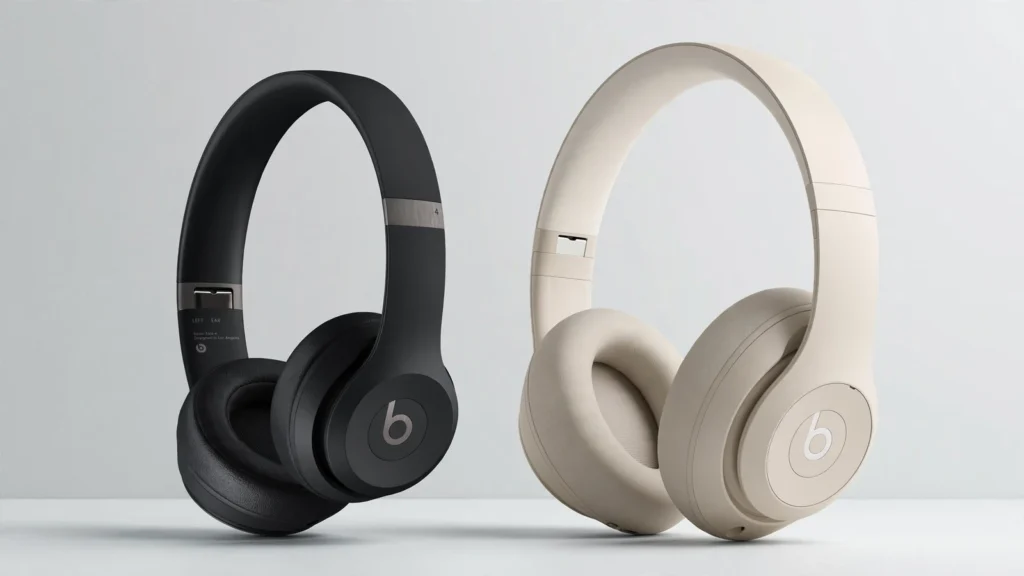
SoundMavericks’ verdict on beats solo 4 vs studio pro comes down to one feature: active noise cancelling. The Beats Studio Pro is the only one of the two with fully adaptive ANC and a Transparency mode, and it adds over-ear comfort and three USB-C sound profiles. The Beats Solo 4 answers with a lighter on-ear design, up to 50 hours of battery life, and the same spatial audio and lossless USB-C playback in a more portable package. If you fly, commute on transit, or work in a noisy space, choose the Studio Pro. If you want the longest battery, the smallest fold, and headphones that still let some of the world in, choose the Solo 4.
Beats sells two very different answers to the same question. The Solo 4 and the Studio Pro share a family look, 40mm drivers, Class 1 Bluetooth, and personalized spatial audio — but they are built for different days. One sits on your ears and runs for days between charges. The other surrounds your ears and actively silences the room around you. This comparison breaks the matchup down category by category — design, noise cancelling, sound, battery, wired audio, and calls — so you can see exactly what the step up to the Studio Pro buys, and what the Solo 4 gives back.


If you are still deciding between Beats and its biggest rival, our Beats Studio Pro vs Bose QuietComfort comparison covers the cross-brand fight, and our best Beats headphones guide ranks the full current lineup. For the wider field, see the best noise cancelling headphones roundup.
Beats Solo 4 vs Studio Pro: Specs Side by Side
| Spec | Beats Solo 4 | Beats Studio Pro |
|---|---|---|
| Form factor | On-ear | Over-ear |
| Active noise cancelling | No — passive isolation only | Yes — fully adaptive ANC |
| Transparency mode | No | Yes |
| Drivers | 40mm custom drivers | 40mm custom active drivers |
| Battery life (rated) | Up to 50 hours | Up to 40 hours (ANC off) / up to 24 hours (ANC on) |
| Fast Fuel charging | 10 min = up to 5 hours playback | 10 min = up to 4 hours playback |
| Spatial audio | Personalized Spatial Audio with dynamic head tracking | Personalized Spatial Audio with dynamic head tracking |
| USB-C audio | Yes — high-resolution lossless audio via USB-C | Yes — lossless audio via USB-C with 3 built-in sound profiles (Beats Signature, Entertainment, Conversation) |
| Other wired audio | 3.5mm analog input | 3.5mm analog input |
| Bluetooth | Class 1 Bluetooth 5.3 | Class 1 Bluetooth 5.3 |
| Weight | 217g (7.65 oz) | 260g (9.17 oz) |
| Case | Soft carrying case included | Woven carrying case included |
| Water resistance | No IP rating | No IP rating |
What Is the Difference Between Beats Solo 4 and Studio Pro?
Three differences decide this matchup. First, fit: the Solo 4 is an on-ear headphone whose cushions rest on your ears, while the Studio Pro is an over-ear headphone whose UltraPlush cushions surround them. Second, noise control: only the Studio Pro has active noise cancelling and Transparency mode — the Solo 4 relies on its cushion seal alone. Third, endurance versus features: the Solo 4 runs up to 50 hours on a charge, while the Studio Pro trades some of that stamina for ANC, a larger soundstage, and USB-C sound profiles. Almost everything else — spatial audio, Class 1 Bluetooth, one-touch pairing for iPhone and Android, USB-C and 3.5mm wired playback — is shared.
Does Beats Solo 4 Have Noise Cancelling?
No. The Solo 4 has no active noise cancelling and no Transparency mode, and that is the single biggest gap in this comparison. Its on-ear cushions provide some passive isolation, which takes the edge off a quiet office or a coffee shop, but engine drone, train rumble, and cabin noise pass through largely untouched because there is no microphone system working to cancel them.
The Studio Pro’s fully adaptive ANC monitors and counters ambient sound continuously, and its Transparency mode does the opposite job when you need it, piping the outside world back in for announcements, traffic, or a quick conversation without removing the headphones. SoundMavericks’ analysis is blunt here: if noise is a real part of your listening environment — flights, transit, open-plan offices — the Studio Pro is not a luxury step-up, it is a different tool. Review roundups from publishers such as SoundGuys and RTINGS reach the same conclusion, consistently placing the Studio Pro’s noise cancelling in a different class from the Solo 4’s passive isolation. If your listening happens in quiet rooms, that gap matters far less, and the Solo 4’s simplicity becomes a virtue.
Beats Solo 4 vs Studio Pro: Sound Quality
Both headphones use custom 40mm drivers and support personalized spatial audio with dynamic head tracking for compatible Dolby Atmos content, so movies and Atmos music mixes feel wide and anchored on both. The differences show up in tuning and in wired listening.
The Studio Pro’s larger over-ear chamber gives its sound more room to breathe: bass carries more weight and sub-bass presence, and the overall presentation sounds fuller, particularly at the low end where the Solo 4’s on-ear design is lighter. The Solo 4 counters with a clear, mid-forward clarity that flatters vocals and podcasts, and its smaller seal means it sounds more consistent for listeners who wear glasses or hats that break an over-ear seal.
Wired listening widens the gap in a specific way. Both models play high-resolution lossless audio over USB-C and both include a 3.5mm cable for planes and older gear. Only the Studio Pro, however, adds a built-in DAC with three selectable sound profiles over USB-C — Beats Signature for balanced listening, Entertainment for a wider, more cinematic sound, and Conversation for vocal clarity. If you regularly listen plugged into a laptop, that flexibility belongs to the Studio Pro alone.
Which Is More Comfortable: On-Ear or Over-Ear?
Comfort here is a trade between pressure and weight. At 217g, the Solo 4 is noticeably lighter, and its flex-grip headband and angled UltraPlush on-ear cushions keep it stable for walking, commuting, and the gym bag. The cost of the on-ear format is contact pressure: the cushions press on the ear itself, which many listeners feel after an hour or two, and ears tend to warm up faster.
The Studio Pro weighs 260g but distributes that weight around the ear rather than on it, with larger cushions designed for long sessions. For desk work, long films, and flights, SoundMavericks rates the over-ear fit as the more sustainable one — with the caveat that its clamping force is firm, so trying before a long trip is wise if you have found Beats headphones tight in the past. Both models fold for travel; the Solo 4 folds smaller and disappears into a bag more easily.
Beats Solo 4 vs Studio Pro: Battery Life
This is the Solo 4’s clearest win. Up to 50 hours of listening on a single charge means casual listeners can go weeks between plug-ins, and Fast Fuel returns up to 5 hours of playback from a 10-minute charge. There is no ANC system drawing power, and it shows.
The Studio Pro is rated at up to 40 hours with ANC and Transparency off, and up to 24 hours with ANC on — still enough for a week of commutes or a long-haul return trip with noise cancelling running the whole way. Its Fast Fuel figure is up to 4 hours from 10 minutes. In SoundMavericks’ view, the honest comparison is 50 hours of unfiltered listening versus 24 hours of silenced listening: pick based on which of those days sounds like yours.
Beats Solo 4 vs Studio Pro: Calls and Everyday Features
Both models handle calls with built-in voice-targeting microphones and support one-touch pairing on iOS and Android, Find My on Apple devices, and Google Fast Pair and Find My Device on Android. Neither offers true multipoint Bluetooth for staying connected to two devices at once in the way some rivals do, and neither carries an IP rating, so neither is a workout-first pick — keep them for commutes, desks, and travel rather than rainy runs.
On calls, the Studio Pro has a practical edge in noisy places for a simple reason: its ANC microphones and voice-targeting system work in the same loud environments where the Solo 4 leaves you raising your voice over background sound leaking in. In quiet rooms, both are clear and unremarkable in the best sense — set them up once and they behave the same on an iPhone or an Android phone.
Who Should Buy the Beats Solo 4?
Choose the Solo 4 if battery life and portability lead your list. It suits students, walkers, and everyday commuters listening in reasonably quiet places; listeners who dislike the sealed-off feeling of ANC; and anyone who wants spatial audio and lossless USB-C playback in the lightest, most bag-friendly Beats headphone. It is also the simpler gift: no modes to manage, nothing to configure, and a charge that lasts for weeks of casual use.
Who Should Buy the Beats Studio Pro?
Choose the Studio Pro if noise is part of your day. Frequent flyers, transit commuters, and open-plan workers get fully adaptive ANC, Transparency mode, over-ear comfort for long sessions, and the fuller, bass-stronger sound of the larger drivers — plus the three USB-C sound profiles for wired listening at a desk. It is the more complete headphone of the two, and the one SoundMavericks recommends for anyone whose listening happens on planes, trains, or busy streets. For a broader look at how it stacks up beyond the Beats family, start with our best noise cancelling headphones guide.
Beats Solo 4 vs Studio Pro: FAQ
Is Beats Solo 4 better than Studio Pro?
Not overall — they win different categories. The Studio Pro is better for noise cancelling, comfort over long sessions, and fuller sound, with fully adaptive ANC the Solo 4 lacks entirely. The Solo 4 is better for battery life (up to 50 hours), weight (217g vs 260g), and portability. Which one is better for you depends on whether silence or stamina matters more in your routine.
Does Beats Solo 4 have noise cancelling?
No. The Beats Solo 4 has no active noise cancelling and no Transparency mode. It relies on passive isolation from its on-ear cushions, which softens quiet indoor noise but does not cancel engine, train, or cabin drone. The Beats Studio Pro has fully adaptive ANC and a Transparency mode.
Which lasts longer, Beats Solo 4 or Studio Pro?
The Beats Solo 4 lasts longer, with up to 50 hours of listening on a single charge. The Beats Studio Pro is rated at up to 40 hours with ANC off and up to 24 hours with ANC on. Both support Fast Fuel: 10 minutes adds up to 5 hours on the Solo 4 and up to 4 hours on the Studio Pro.
Do Beats Solo 4 and Studio Pro both have spatial audio?
Yes. Both support personalized spatial audio with dynamic head tracking for compatible content, including Dolby Atmos music and video. Both also play high-resolution lossless audio over USB-C and include a 3.5mm cable. Only the Studio Pro adds three built-in USB-C sound profiles: Beats Signature, Entertainment, and Conversation.
Which is better for flying, Solo 4 or Studio Pro?
The Studio Pro, clearly. Its fully adaptive ANC targets exactly the low-frequency cabin drone that the Solo 4’s passive on-ear isolation cannot cancel, its over-ear cushions stay comfortable for longer stretches, and 24 hours of ANC-on battery covers even long-haul return trips. The Solo 4 is the better carry-on only if your flights are short and quiet.
Can you use Beats Solo 4 and Studio Pro with iPhone and Android?
Yes, both are dual-platform headphones. Each offers one-touch pairing on iOS and Android, Class 1 Bluetooth, Find My support on Apple devices, and Google Fast Pair and Find My Device support on Android. Spatial audio with head tracking works on compatible Apple devices and content.

I am the founder of Sound Mavericks, where I provide the polite truth about audio equipment. I started this site because consumer electronics reviews are often too technical. Instead of using a silent lab, I test headphones, earbuds, and Bluetooth speakers in the real world – like on a noisy subway or in a busy coffee shop.
To stay independent, I buy my own review units (mostly from the United States) rather than accepting free gifts from brands. Once I finish testing a product, I sell it locally to our community. My goal is to help you understand sound quality, active noise cancellation (ANC), and battery life without the marketing hype.