Short Answer: Hybrid ANC Uses Microphones Inside AND Outside the Ear Cup
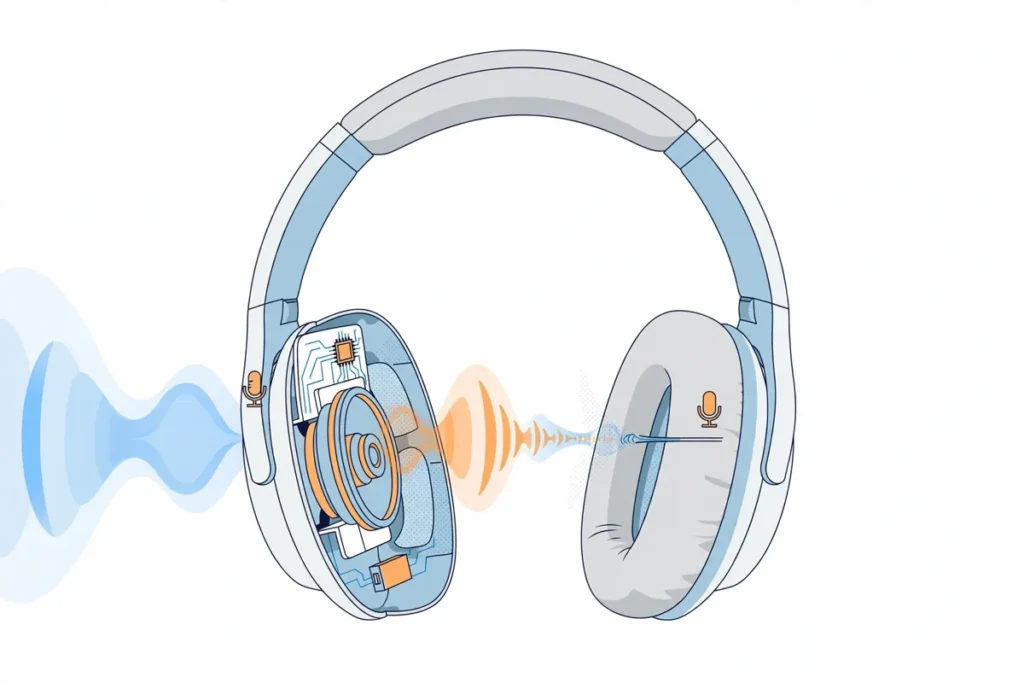
What are hybrid noise cancelling headphones? They are headphones whose active noise cancelling system listens with two sets of microphones at once — one set on the outside of the ear cup (feedforward) and one set on the inside, near your ear (feedback). A processor combines both signals to generate anti-noise, which lets hybrid systems cancel a wider range of frequencies, correct their own mistakes in real time, and handle wind and fit changes better than either single-microphone design. It is the architecture behind most flagship ANC headphones, including these three verified hybrid models:
Every active noise cancelling headphone works on the same basic trick: microphones sample the noise around you, a processor builds a mirror-image sound wave — anti-noise — and the driver plays that wave so the two cancel each other out before the noise reaches your eardrum. What separates one ANC headphone from another is not the trick itself. It is where the microphones sit, because microphone placement decides what the system can hear, how fast it can react, and which mistakes it can catch. There are three placements in use today — feedforward, feedback, and hybrid — and understanding them explains most of the real-world difference between a flagship that silences a plane cabin and a budget model that barely dents it.
What Is Feedforward ANC?
Feedforward ANC places its microphones on the outside of the ear cup or earbud, facing the world. The microphone hears incoming noise — engine drone, traffic, café chatter — a fraction of a second before that noise reaches your ear, and the processor uses that head start to prepare the anti-noise signal.
That early warning is feedforward’s great strength: because the system predicts rather than reacts, it handles higher-frequency and midrange sounds relatively well and can respond quickly to changing noise. Its weaknesses follow from the same placement. The outside microphone never hears what actually arrives at your ear, so it cannot correct for noise that leaks past the cushion seal, changes as it travels through the ear cup, or shifts when you turn your head. It is also exposed to the elements: wind rushing across an external microphone generates its own noise, which the system can mistake for ambient sound and amplify into a buffeting rumble. Feedforward alone is simple and inexpensive, which is why it appears in many entry-level ANC models.
What Is Feedback ANC?
Feedback ANC takes the opposite approach. Its microphone sits inside the ear cup, close to the driver and your ear canal, and listens to the sound that has actually gotten through — the mixture of leaked noise, your music, and any cancellation already applied. The processor then corrects whatever residue it hears, continuously.
Because it measures the real result at the ear rather than a prediction, feedback ANC is strong against the low-frequency rumble that matters most on planes and trains, stays consistent when your seal or fit changes, and is sheltered from wind by the ear cup itself. The trade-offs are control problems: the microphone hears your music as well as the noise, so the system must work hard not to cancel parts of the audio you want, and a feedback loop tuned too aggressively can become unstable, producing hiss or a faint ringing tone. Historically, feedback-only designs also struggled above the low frequencies. Classic Bose designs built their reputation on refined feedback-style systems, which is one reason older flagship ANC felt unbeatable on engine drone yet less complete against voices.
What Makes Hybrid ANC Different?
A hybrid system runs both microphone sets at the same time and fuses their signals in one processor. The feedforward microphones give the system an early, wide-band picture of the noise outside; the feedback microphone reports what is genuinely reaching your ear so the processor can trim its correction until the residual noise is as small as possible. In SoundMavericks’ analysis, hybrid is best understood as prediction plus proofreading: feedforward drafts the anti-noise, feedback checks the result at the eardrum and fixes the errors.
That combination produces three practical advantages. First, wider frequency coverage: the outside path helps with midrange and higher sounds while the inside path anchors the lows, so hybrid systems reduce a broader slice of the spectrum than either design manages alone. Second, self-correction: fit changes, glasses breaking the seal, or a cushion shifting mid-flight are visible to the feedback microphone, so cancellation stays consistent instead of silently degrading. Third, better wind and stability behaviour: with two sources of information, the processor can discount wind garbage on the external microphones and avoid the instability a feedback-only loop risks. The costs are real but modest — more microphones, more processing, slightly higher power draw, and a higher bill of materials, which is why hybrid ANC lives mostly in midrange and flagship models.
Feedforward vs Feedback vs Hybrid ANC: Comparison Table
| ANC Type | Microphone Placement | Strengths | Weaknesses |
|---|---|---|---|
| Feedforward | Outside the ear cup | Fast, predictive; good on midrange and higher-frequency noise; simple and cheap | Cannot hear leakage at the ear; wind-sensitive; no self-correction |
| Feedback | Inside the ear cup, near the ear | Measures the real residual sound; strong on low-frequency drone; wind-sheltered; consistent fit-to-fit | Must separate music from noise; stability and hiss risks if mistuned; weaker above the lows |
| Hybrid | Outside AND inside the ear cup | Widest frequency coverage; self-correcting; best wind handling and stability of the three | More microphones and processing; higher cost; slightly higher power draw |
For a broader grounding in how active cancellation differs from simply blocking sound with a seal, our active noise cancellation vs passive isolation explainer covers the other half of the equation.
Real Hybrid ANC Headphones: Verified Examples
These three current models all use dual-microphone hybrid architectures, at three very different positions in the market:
| Model | ANC Architecture | Best For | Price Check |
|---|---|---|---|
| Sony WH-1000XM6 | Hybrid — multi-microphone array inside and outside each cup, adaptive processing | Frequent flyers who want flagship cancellation plus top-tier sound | Check Price |
| Bose QuietComfort Ultra Headphones (2nd Gen) | Hybrid — microphones inside and outside each cup feeding Bose’s CustomTune calibration | Maximum quiet and immersive spatial audio | Check Price |
| Soundcore Space Q45 | Hybrid — dual feedforward and feedback microphones per side with adaptive modes | Hybrid ANC at a midrange budget, with very long battery life | Check Price |


How to Spot True Hybrid ANC in a Spec Sheet
“Hybrid” is a genuinely useful label, but only when it describes microphone placement rather than serving as decoration. Here is what to look for when a listing claims it:
Look for dual-placement language. Genuine hybrid spec sheets say microphones are positioned both inside and outside the ear cup — phrases like “dual feedforward and feedback microphones,” “inner and outer mics,” or a total microphone count that covers both jobs. A flagship may list many microphones overall because call and transparency systems share the array, but at minimum the ANC description should name both positions.
Check for adaptive behaviour. Hybrid hardware usually pairs with adaptive ANC that changes strength with your environment or fit. It is supporting evidence, not proof — adaptive processing can be layered on simpler hardware — but its absence on a “hybrid” claim is worth a second look.
Be cautious with vague claims. SoundMavericks’ caution: “hybrid noise cancelling” is also used loosely in marketing for unrelated combinations — ANC plus passive isolation, or ANC plus a transparency mode. If a listing cannot say where its microphones are, treat the hybrid label as unverified. Architecture is a strong predictor, not a guarantee: processing quality, driver behaviour, and the cushion seal still decide how quiet a headphone actually gets, which is why our best noise cancelling headphones rankings weigh measured performance alongside the spec sheet.
Is Hybrid ANC Worth It?
For most buyers who listen in genuinely noisy places — aircraft cabins, trains, open-plan offices, city streets — yes. Hybrid is the architecture behind effectively every current flagship for a reason: wider coverage, self-correction, and better wind behaviour are advantages you hear within the first minute on a plane. The honest exception is the quiet-room listener: if your listening happens at a desk in a calm home, a well-sealed single-system headphone can sound just as peaceful, and you keep the change. Battery impact, often raised as a hybrid downside, is minor on modern models — the extra microphones draw little next to the drivers and radios — so buy on cancellation quality and fit, not on architecture anxiety.
What Are Hybrid Noise Cancelling Headphones: FAQ
Is hybrid noise cancelling better?
Generally, yes. Hybrid ANC combines outside (feedforward) and inside (feedback) microphones, so it cancels a wider range of frequencies, corrects for fit and leakage in real time, and handles wind better than either system alone. It is the architecture used by most flagship models. Implementation still matters — a well-tuned simpler system can beat a poorly tuned hybrid one — but as a starting point, hybrid is the stronger design.
What is the difference between hybrid ANC and regular ANC?
“Regular” ANC usually means a single-microphone architecture: either feedforward (microphones outside the cup) or feedback (microphones inside). Hybrid ANC runs both sets simultaneously and merges their signals in one processor, adding prediction from outside and error-correction at the ear. The result is broader, more consistent cancellation than either single system typically achieves.
Do hybrid noise cancelling headphones use more battery?
Slightly, in principle — more microphones and more processing draw more power. In practice, on modern headphones the difference is small compared with the power used by the drivers, Bluetooth radio, and ANC processing shared by all designs. Rated battery life on hybrid flagships is comparable to simpler models, so battery should rarely decide the question.
Are all flagship noise cancelling headphones hybrid?
Nearly all current flagships use hybrid or hybrid-derived multi-microphone systems, including Sony’s WH-1000X line and Bose’s QuietComfort Ultra line. Brands describe their implementations differently and some add adaptive layers on top, but dual inside-and-outside microphone placement is now the standard flagship approach.
Does hybrid ANC block voices?
Better than single-system ANC, but not completely. Hybrid systems extend useful cancellation further into the midrange where voices live, and the passive cushion seal helps on top of that. No ANC fully erases nearby conversation — irregular, close-range sound is the hardest thing for any cancellation system — so expect voices to become muffled and distant rather than silent.

I am the founder of Sound Mavericks, where I provide the polite truth about audio equipment. I started this site because consumer electronics reviews are often too technical. Instead of using a silent lab, I test headphones, earbuds, and Bluetooth speakers in the real world – like on a noisy subway or in a busy coffee shop.
To stay independent, I buy my own review units (mostly from the United States) rather than accepting free gifts from brands. Once I finish testing a product, I sell it locally to our community. My goal is to help you understand sound quality, active noise cancellation (ANC), and battery life without the marketing hype.