
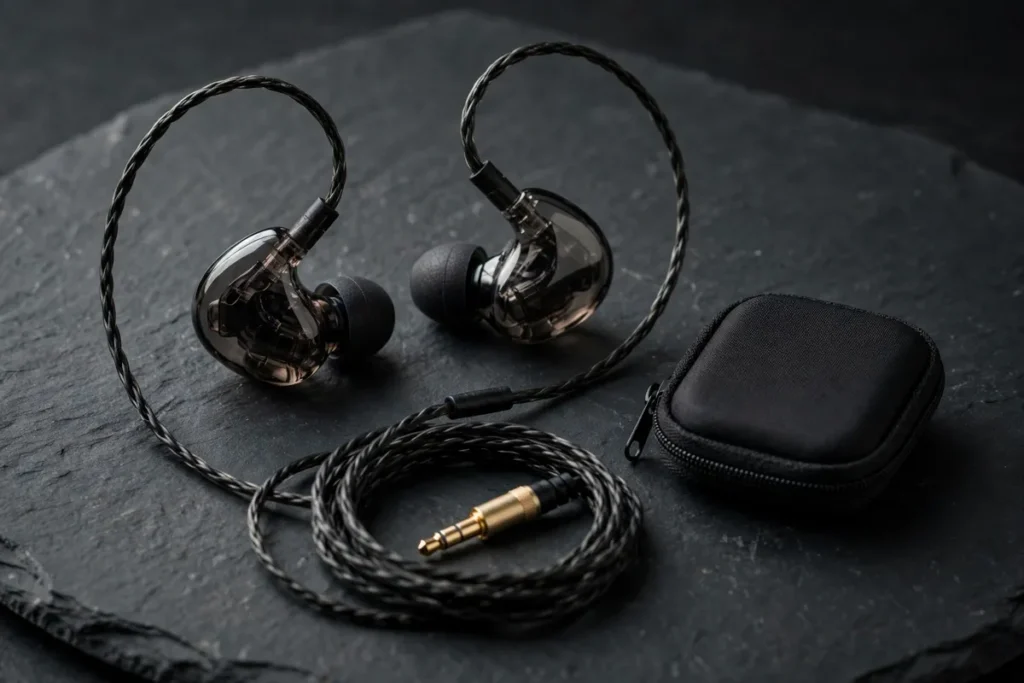
This Shure SE215 review covers the wired in-ear monitor that has been the default first step into stage earphones for years, sold today as the SE215 PRO. One dynamic MicroDriver per ear, a seal rated to block up to 37 dB of outside noise, and a detachable cable that wraps over the ear: the formula has barely changed because it works. The black SE215-K is listed on Amazon US with the standard 3.5 mm cable, a fit kit of flex and foam sleeves, and a zippered case.
This is a research review. We have not worn the SE215 on our own stages, so the verdict below is built from Shure’s published specifications, the verified Amazon US listing, and published measurement and ownership data. The score is provisional, and the wired-model bars are explained in plain terms under the card.

Shure SE215 6.4/10 provisional
Why you: you play live, travel in noise, or keep killing earphones at the cable. The sealed fit blocks up to 37 dB, the over-ear wireform stays put when you move, and a worn cable unplugs at the earpiece and swaps in seconds.
Trade-off: the cable in the box has no microphone and no remote, the tuning favors warmth over fine detail, and Shure charges a premium over the Chi-Fi sets it now competes with.
Single dynamic MicroDriver · 17 Ω · 107 dB SPL/mW · Up to 37 dB passive isolation · 162 cm detachable MMCX cable
The score, explained: 6.4 on a wired scorecard
Our overall score is 6.4, the mean of the six bars above, and three of those bars need translating for a wired earphone. Battery scores 5.0 because there is no battery to grade. The SE215 is wired, and 5.0 is the neutral placeholder we give wired models so they can sit in the same table as wireless ones. Calls & mic scores 3.0, and that one is a real limitation rather than a placeholder: the standard SE215-K cable linked in this review has no microphone and no remote, so calls mean talking into your phone. Noise cancelling scores 4.5, the top of our passive band, because there is no cancelling hardware here at all. What the SE215 does instead is seal the ear canal, and Shure rates that seal at up to 37 dB of attenuation, the strongest passive figure in its class. The bar grades the isolation honestly while the label stays plain: this is blocking, not cancelling.
On the bars the SE215 actually competes on, it holds up well. Sound scores 8.2 and Comfort 9.0, both carried from our published budget IEM coverage, where the SE215 PRO is our standing pick for stage musicians. Value scores 8.4: the tuning has strong competition at the price now, but the replaceable cable and two-year warranty change the long-term maths. Read the 6.4 as a stage tool graded partly on features it never claimed to have, then judge it on Sound, Comfort and Value.
Sound: warm, punchy, and not chasing detail
A single dynamic MicroDriver covers the full range in each ear, and Shure voices it for work rather than for graphs. The low end is the personality: mid-bass hits with real weight, kick drums and bass guitar sit forward, and the sub-bass holds together at stage volumes without turning loose. That warmth suits live monitoring, where a thin earphone disappears under a loud room, and it suits rock, pop and hip-hop listening for the same reason.
The midrange stays clear through the warmth. Vocals are present and easy to follow, which matters when the SE215 is being used the way it was designed to be used: picking your own voice or instrument out of a mix. Treble is where the compromises show. The top end rolls off early, cymbals and string detail sound softened, and listeners who come from brighter multi-driver sets tend to describe the SE215 as dark. Both descriptions are accurate. Fine detail is not what this driver does, and no amount of source quality changes that.
Two practical notes from the measurement record. The bass shelf responds well to EQ if you want more sub-bass depth, and several long-term owners report the low end tightening after extended early use. Neither changes the basic character. The SE215 is a warm, forgiving listen that flatters rough recordings and loud rooms, and it gives up the last layer of resolution to do it. In our budget in-ear monitors roundup it sits behind the Chi-Fi picks on raw sound per dollar and ahead of all of them on isolation and track record.
Isolation: the headline feature
Shure rates the SE215 at up to 37 dB of noise attenuation, and that number is earned mechanically. The low-profile shell sits deep in the ear, the sleeve seals the canal, and the cable routes over the ear so movement does not break the seal. With the foam sleeves fitted properly, the effect is closer to wearing earplugs that play music than to wearing ordinary earbuds. On a stage, that is hearing protection and monitoring in one device. On a train or a work site, it is quiet without batteries, charging, or a transparency mode to manage.
The rating depends on the seal, and the seal depends on the sleeve. The box includes flex sleeves and black foam sleeves in small, medium and large. Foam gives the deepest seal and the strongest isolation; flex sleeves go in faster and give up a little blocking. If the SE215 sounds thin when you first try it, the fit is wrong, not the driver: bass is the first thing a poor seal takes away. Our explainer on noise cancelling vs noise isolating covers why a passive seal like this one can out-block active cancelling at some frequencies while doing nothing at others.
Fit, build and the cable that saves it
The shells are small, rounded and light, shaped to rest in the ear rather than on it, and the wireform section at the top of each cable bends to your ear and holds the shape. Once the fit is dialed in, most owners stop noticing them, which is how the SE215 earns its Comfort score: full gigs and long flights are normal use, not endurance tests. The deep insertion is not for everyone. If you dislike anything sitting well inside the ear canal, this design will not convert you, and no sleeve in the box fixes that.
The cable is the reason the SE215 outlives its rivals. It detaches at each earpiece on an MMCX connector with a lock-snap mechanism and 360-degree rotation, so the most common failure point on any wired earphone becomes a replaceable part. The cable itself is Kevlar-reinforced and thick, which cuts both ways: it survives stage life, and it is stiffer and heavier than the cables on most Chi-Fi sets, the most consistent complaint in owner feedback. A minority of long-term owners also report the housing seam splitting after years of use. Treat the cable as a consumable you can actually replace, keep the earphones in the included zippered case, and the two-year warranty covers the early failures.
Which SE215 are you actually buying?
This section matters, because the SE215 name covers several variants and the cables differ. This review links the SE215-K, the translucent black model with the standard 162 cm (64 inch) detachable cable. That cable has no microphone and no remote. The clear finish is the SE215-CL, the same earphones in a transparent shell, sold on its own listing.
Shure also sells the earphones in a Special Edition with a slightly wider low-frequency rating (21 Hz against the standard model’s 22 Hz) and different finishes, plus separate MMCX accessory cables that add what the standard cable lacks: an inline mic and remote cable, and USB-C or Lightning versions for phones without a headphone socket. Any MMCX cable fits the SE215 earpieces, including third-party ones, so buying the plain cable now does not lock you out of calls later. It does mean the Calls score in this review grades the box linked above, not the accessory shelf.
Power: anything drives it
At 17 Ω with a sensitivity of 107 dB SPL/mW, the SE215 gets loud from a phone, a laptop socket, a game controller or a wireless bodypack with room to spare. No amp is needed, and a better source buys you very little here beyond cleaner output at low volume. If impedance numbers are new to you, our guide to impedance and when you need an amp explains why this pairing is a non-issue. One warning that follows from the sensitivity: the SE215 plays loud at low volume settings, so start low on a new source.
Shure SE215 specifications
| Product | Shure SE215 (SE215-K, Black) |
| Design | In-ear monitor, over-the-ear cable routing, sound isolating |
| Driver | Single dynamic MicroDriver per ear |
| Frequency range | 22 Hz to 17.5 kHz |
| Impedance | 17 Ω at 1 kHz |
| Sensitivity | 107 dB SPL/mW at 1 kHz |
| Noise attenuation | Up to 37 dB, passive (no active noise cancelling) |
| Cable | Detachable MMCX with lock-snap and wireform fit, 162 cm (64 in), Kevlar-reinforced |
| Connector | 3.5 mm plug, 6.35 mm (1/4 in) adapter included |
| Microphone | None on the included cable (mic cables sold separately) |
| In the box | Earphones, fit kit (flex and foam sleeves, S/M/L), zippered carrying case, 1/4 in adapter |
| Warranty | Two years |
| Check Price | Check Price on Amazon |
Who should buy it, and when to step up
Buy the SE215 if your priority is isolation and reliability: you monitor on stage, you work or travel somewhere loud, or you want one wired earphone that keeps working because its weakest part unplugs. Singers, drummers and worship-team musicians are the core audience, and commuters who dislike charging anything are the second one.
Look elsewhere if you listen mainly at a quiet desk and want maximum detail for the money. Multi-driver Chi-Fi sets resolve more, and our roundup linked above names the current ones. And if you like the Shure fit and isolation but want a flatter, more detailed sound, the step up inside the same family is real: our Shure SE535 review covers the triple-driver model that adds a dedicated tweeter and keeps the same cable system.
Verdict
The SE215 is not the best-sounding earphone at its price anymore, and this review has not pretended otherwise. It is the one with the strongest passive isolation, the most proven fit, and a cable you can replace in seconds, backed by a two-year warranty and a decade-plus record of surviving stages that kill lesser earphones. The 6.4 headline undersells it, because two of the six bars grade a battery and a microphone it never claimed to have. On the bars that describe the earphone itself (Sound 8.2, Comfort 9.0, Value 8.4) it remains the default recommendation for live work. Buy it for the seal and the cable, and it will earn its place in your gig bag.
FAQ
Does the Shure SE215 have a microphone?
No, not on the standard cable. The SE215-K linked in this review ships with a plain 162 cm cable with no mic and no remote, so calls use your phone or laptop microphone. Shure sells separate MMCX cables with an inline mic and remote, and any of them fits the SE215 earpieces.
Is the Shure SE215 good for stage monitoring?
Yes. That is the job it was built for. Up to 37 dB of passive isolation, a secure over-ear fit that stays in place while you move, and a reinforced detachable cable are exactly what singers, drummers and guitarists need from a first in-ear monitor.
Does the SE215 need an amp?
No. At 17 Ω with 107 dB SPL/mW sensitivity, it runs loud from a phone, laptop, controller or wireless bodypack. A dedicated amp adds nothing it needs.
What is the difference between the SE215 and the SE215 Special Edition?
The Special Edition rates its frequency range slightly wider at the bottom (21 Hz against 22 Hz) and comes in different finishes. The driver type, fit system, sleeve kit and detachable MMCX cable are shared. The standard SE215 is the one most listings stock in black (SE215-K) or clear (SE215-CL).
Can you replace the SE215 cable?
Yes. The cable detaches at each earpiece on an MMCX connector with a lock-snap mechanism and full rotation. Shure and third-party MMCX cables fit, including versions with a microphone, USB-C or Lightning plugs, and Bluetooth receivers.
How is the SE215 different from the SE425 and SE535?
The SE215 uses one dynamic driver per ear and a warm, bass-forward tuning. The SE425 and SE535 move to multiple drivers per ear for a flatter response and more detail, at higher prices, while keeping the same isolation design and cable system. They are upgrades in resolution, not in fit or blocking.

I am the founder of Sound Mavericks, where I provide the polite truth about audio equipment. I started this site because consumer electronics reviews are often too technical. Instead of using a silent lab, I test headphones, earbuds, and Bluetooth speakers in the real world – like on a noisy subway or in a busy coffee shop.
To stay independent, I buy my own review units (mostly from the United States) rather than accepting free gifts from brands. Once I finish testing a product, I sell it locally to our community. My goal is to help you understand sound quality, active noise cancellation (ANC), and battery life without the marketing hype.
