The Short Answer: One Cancels Sound With Electronics, the Other Blocks It With a Seal
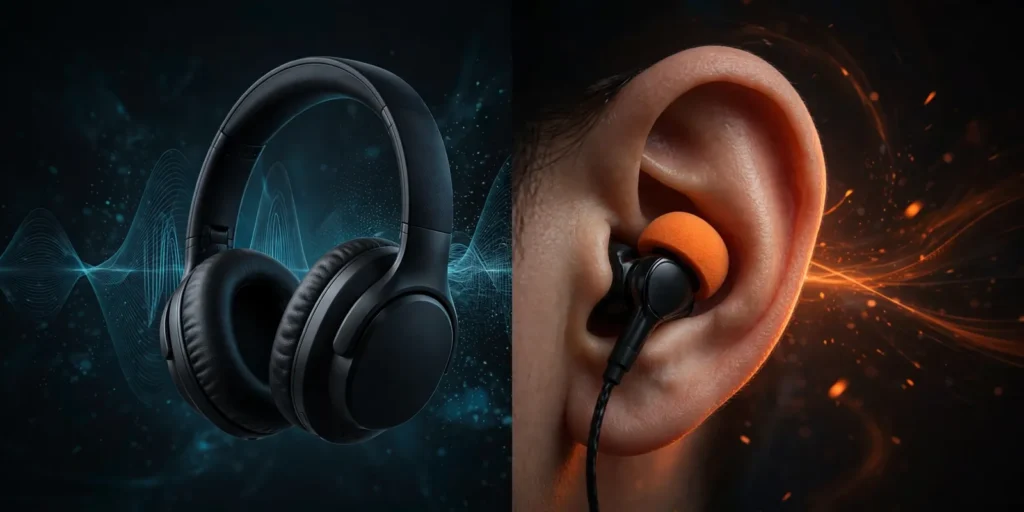
For noise cancelling vs noise isolating, SoundMavericks’ verdict is simple: they are not two names for the same thing. Noise cancelling (ANC) is active and electronic — microphones listen to the world and the headphones play back an inverted anti-noise signal that erases steady, low-frequency sound such as engine drone. Noise isolating is passive and physical — a tight earcup cushion or a deep-sealing ear tip works like an earplug, blocking sound across a broad range of frequencies with no battery at all. Fly a lot or work next to a constant hum? Choose ANC, exemplified by the Sony WH-1000XM6. Want simple, battery-free quiet for commuting, sleeping or stage monitoring? Choose isolation, exemplified by the Etymotic ER2XR.
The two terms sit side by side in every headphone aisle as if they were interchangeable. They are not, and confusing them is a common reason buyers end up disappointed. Someone buys isolating earbuds for a long-haul flight and wonders why the engine still rumbles through. Someone else buys flagship cancelling headphones to block a snoring partner or a chatty office, and wonders why voices still cut through. In both cases the product was doing its job — the buyer had simply bought the wrong technology for the noise they actually face.
This guide explains how each technology really works, where each one wins, and the buying mistakes to avoid.
Noise Cancelling vs Noise Isolating at a Glance
| Compare | Noise Cancelling (ANC) | Noise Isolating (Passive) |
|---|---|---|
| How it works | Microphones sample ambient sound; a processor generates an inverted anti-noise wave that cancels it before it reaches your ear | A physical barrier — sealed earcups, foam or triple-flange ear tips — blocks sound from entering the ear canal |
| Needs power? | Yes — battery required; cancellation stops when the battery dies | No — works indefinitely with zero power |
| Best against | Constant, low-frequency sound: jet engines, train rumble, air conditioning, traffic drone | Mid- and high-frequency sound: voices, typing, clatter, and sharp everyday noise, provided the seal is good |
| Weak against | Sudden, irregular sounds — a shout, a bark, a door slam is over before anti-noise can be built | Deep low-frequency rumble, which passes through foam and cushions far more easily |
| Depends most on | Processor and microphone quality, plus a decent seal to support it | Fit. A broken seal can collapse isolation dramatically |
| Typical form | Over-ear wireless headphones and true wireless earbuds | In-ear monitors and wired earphones, plus the passive seal built into every closed headphone |
| Effect on audio | Processing can add a faint hiss on some models and slightly alter tuning; in return you can listen at lower volume in loud places | No processing at all — the audio path stays clean, and a good seal usually strengthens bass response |
The key point: the two technologies are strongest against opposite kinds of noise. Everything else follows from that.
How Active Noise Cancelling Works
Sound travels as a wave — a repeating pattern of pressure peaks and troughs. Active noise cancelling exploits a neat piece of physics: if you generate the exact mirror image of a wave, a trough where the original has a peak, and play the two together, they add up to almost nothing. The noise is not blocked. It is cancelled, at your ear, in real time.
To do that thousands of times per second, ANC headphones carry microphones that listen to your surroundings. Feedforward designs place microphones outside the earcup or earbud, hearing noise before you do. Feedback designs place a microphone inside, checking what actually reached your ear and correcting the leftovers. Hybrid designs use both, and they are the current flagship standard — our explainer on how noise cancelling headphones work walks through each architecture in more detail.
Two consequences follow. First, ANC needs a predictable pattern to model, which is why it excels at steady, low-frequency sound: a jet cabin, a train on rails, a fan or air-conditioning unit. Second, it is inherently weak against sudden, irregular, higher-pitched sound — a voice, a bark or a dropped plate changes too fast to cancel cleanly. Good ANC headphones still muffle those sounds, but they do it with their physical seal: isolation doing the work, not the electronics.
ANC also costs power every second it runs, which is why the same headphone runs noticeably longer with it switched off.
How Noise Isolation Works
Noise isolation is far older and far simpler: put something solid between the noise and your eardrum. An isolating in-ear monitor seals the ear canal itself, using foam tips that expand to fill the space or silicone tips — often double- or triple-flange — that sit deep and close the gap completely. An isolating over-ear headphone seals around the ear instead, with dense cushioned earcups and enough clamping force to leave no leak.
Because the barrier is physical, isolation needs no battery, no processor and no software. It works the moment the seal is made, it works while music is off, and it keeps working for exactly as long as you wear it. It also works broadly: a good seal attenuates sound across the frequency range, and it is particularly effective in the mid and high frequencies where voices, keyboard clatter and café noise live — precisely the region where ANC is weakest.
The catch is that isolation is only as good as the fit. Shallow foam tips, wrong-size silicone tips, glasses breaking an over-ear cushion’s seal — any leak lets sound pour through, and low-frequency rumble is the first thing in and the hardest for a passive barrier to stop. That is why experienced monitor users treat tip selection as part of the product, and why the deep-insertion designs in our guide to IEMs vs headphones isolate so much better than loose-fitting earbuds.
Are Noise Isolating and Noise Cancelling the Same?
No — and the confusion is understandable, because the best products quietly use both. A flagship ANC headphone starts with a well-sealed earcup that isolates passively, then adds electronics on top to erase the low-frequency rumble the seal cannot stop. Turn its battery off and it does not become silent or useless; it becomes an isolating headphone. Turn the ANC on and the two layers divide the work between them.
Marketing blurs the line further. Plenty of products with no microphones and no cancellation circuitry are sold with phrases like “noise cancelling” when all they offer is a snug fit. A simple test cuts through it: if the product has no battery and no powered noise-cancelling mode, it isolates — whatever the listing says. Neither approach is a scam and neither is universally better. They are different tools, and the rest of this guide is about matching the tool to the job.
Where Noise Cancelling Wins: Flights and Constant Noise
Flights. This is ANC’s home ground, and it is not close. Cabin noise is loud, constant and dominated by low frequencies — the exact profile cancellation erases best. Removing that drone pays twice: your music and films stay clear at a lower, safer volume, and you arrive with noticeably less listening fatigue. If flying is your main use case, start with our roundup of the best noise cancelling headphones for airplanes and long flights and treat isolation-only options as a backup for when the battery dies.
Offices and study with a constant layer. Ventilation hum, traffic outside the window, a building’s mechanical murmur — ANC strips that layer away, and with music playing, nearby conversation drops to a workable level. The limit: voices themselves are the irregular, higher-frequency sounds ANC handles worst. ANC makes an open-plan office calmer; it does not make it private.
Trains, buses and commuting by vehicle. Engine and road rumble are steady and low, so cancellation does the heavy lifting while the seal handles the rest.
Where Noise Isolation Wins: Fit, Sleep, Stage and Simplicity
Commuting on foot and everyday carry. Small isolating in-ears disappear into a pocket, never need charging, and are ready the second you put them in. For a commute dominated by chatter and station noise, that simplicity often beats a full-size ANC headphone.
Sleep. You cannot sleep comfortably in over-ear headphones, and a battery-powered device is one more thing to die at 3 a.m. Low-profile isolating in-ears and purpose-built sleep earbuds win here because the seal does the work with no electronics, no bulk pressing into the pillow and nothing to charge — though, as with ANC, snoring’s low rumble is only reduced, never erased.
Stage and studio monitoring. Musicians have used isolating in-ear monitors for decades for two reasons ANC cannot match: the seal protects hearing by keeping the monitor mix at a lower volume, and a wired, passive design adds no processing latency and nothing that can run flat mid-performance.
Anyone who hates charging things. Isolation has no firmware, no app, no battery degradation and no hiss. A well-made passive monitor bought today works identically in ten years.
Two Examples That Show the Difference
Abstract technology is easier to judge in concrete products. These two verified examples sit at opposite ends of the comparison — one flagship cancelling headphone, one classic isolating monitor — and each is excellent at the job its technology is built for.
| Product | Technology | Why it represents its side | Best for | Check Price |
|---|---|---|---|---|
 Sony WH-1000XM6 | Active noise cancelling over-ear headphone, layered over a sealed earcup that also isolates passively | Sony’s flagship cancellation platform is built for exactly the steady, low-frequency noise — cabins, trains, air conditioning — that passive barriers handle worst | Frequent flyers, office focus, long commutes | Check Price on Amazon |
 Etymotic ER2XR | Passive noise isolation in-ear monitor — no battery, no ANC circuitry; the listing rates isolation at 35+ dB with a proper deep seal | Ships with an assortment of foam and flange ear tips so the seal — the entire mechanism — can be fitted properly; detachable cable for easy replacement | Commuting, sleeping, stage and studio monitoring, battery-free listening | Check Price on Amazon |
Neither product is the “winner.” Put the ER2XR on a long-haul flight and the engine drone will still be there under your music. Put the WH-1000XM6 on a stage or in bed and its size, battery and processing work against you. The comparison only makes sense once the job is named. For the numbers behind cancellation claims, see how many decibels noise cancelling headphones block.
Common Buying Mistakes
Mistake 1: Expecting ANC to silence voices, barking or snoring. Cancellation targets steady sound. Irregular sounds are reduced mainly by the seal, and only partly. If your problem noise is a person, shop for seal quality first and treat ANC as a bonus.
Mistake 2: Expecting isolation to kill engine rumble. Foam and cushions are weakest exactly where engines are loudest. Regular flyers who buy isolating earbuds alone almost always end up buying ANC later — the most expensive way to learn this lesson.
Mistake 3: Ignoring fit. For isolation, fit is not comfort trivia; it is the technology. Wrong-size tips can throw away most of the rated isolation. For ANC, a broken earcup seal — glasses arms are the classic culprit — undermines the electronics too.
Mistake 4: Trusting the label instead of the mechanism. If a “noise cancelling” product has no battery and no powered mode, it isolates. That can still be a fine purchase — the ER2XR above is proudly passive — but buy it for what it is.
Mistake 5: Forgetting the battery is part of the product. ANC headphones are consumables in a way passive monitors are not: batteries age, and when the cell fades, the headline feature fades with it. Factor that lifespan into the value calculation.
The Bottom Line: Which One Should You Buy?
Name your dominant noise first. If it drones — engines, trains, air conditioning, road rumble — buy active noise cancelling, ideally a hybrid design on a well-sealed headphone so both layers work for you. If it chatters or changes constantly — voices, cafés, stations — a properly fitted isolating in-ear will serve you better and never need a charger. If your life contains both, do what the flagships do: prioritise ANC, then judge it hard on its passive seal, because that seal is what you hear the moment the noise stops being steady.
Stop buying the wrong tech does not mean buying the most expensive tech. It means buying the mechanism that matches your noise.
Frequently Asked Questions
What is the difference between noise cancelling and noise isolating?
Noise cancelling is active: microphones sample ambient sound and the headphone generates an inverted anti-noise signal that cancels it, which works best on constant, low-frequency noise like engines. Noise isolating is passive: a sealed earcup or ear tip physically blocks sound, like an earplug, working across a broad range of frequencies with no battery. The two are strongest against opposite kinds of noise.
Are noise isolating and noise cancelling the same?
No. Isolation is a physical barrier and needs no power; cancelling is an electronic process and needs a battery. Many flagship ANC headphones use both — a sealing earcup for isolation plus electronics for low-frequency cancellation — which is why the terms get confused, but a product with no powered cancelling mode only isolates, whatever its listing claims.
Is noise cancelling or noise isolating better for flying?
Noise cancelling, clearly. Cabin noise is constant and dominated by low frequencies, which is the profile ANC erases best and passive barriers handle worst. A good ANC headphone also still isolates passively when its battery runs out, so it covers both jobs on a long flight in a way an isolating earphone cannot.
Can noise cancelling headphones block voices and snoring completely?
No. Voices and snoring are irregular sounds, and cancellation is built for steady ones. ANC will take the underlying hum and room tone down, and the headphone’s seal will muffle voices and snores noticeably — especially with music playing — but neither technology erases them entirely. Anyone promising complete silence for irregular noise is overselling both.
Do noise isolating headphones need batteries or charging?
No. Isolation is purely physical — foam or silicone tips sealing the ear canal, or cushioned earcups sealing around the ear — so it works indefinitely with nothing to charge and nothing to run flat. That is one of its biggest advantages for sleep, stage monitoring and travel backup, and why a passive monitor keeps working identically for years.
Does noise cancelling affect sound quality?
It can, slightly. The processing on some models adds a faint hiss or subtly changes the tuning, and many headphones sound marginally different with ANC on versus off. Set against that, cancelling removes the background noise your music would otherwise fight, so most listeners can play at a lower volume and hear more detail overall in any environment that is actually noisy.

I am the founder of Sound Mavericks, where I provide the polite truth about audio equipment. I started this site because consumer electronics reviews are often too technical. Instead of using a silent lab, I test headphones, earbuds, and Bluetooth speakers in the real world – like on a noisy subway or in a busy coffee shop.
To stay independent, I buy my own review units (mostly from the United States) rather than accepting free gifts from brands. Once I finish testing a product, I sell it locally to our community. My goal is to help you understand sound quality, active noise cancellation (ANC), and battery life without the marketing hype.