
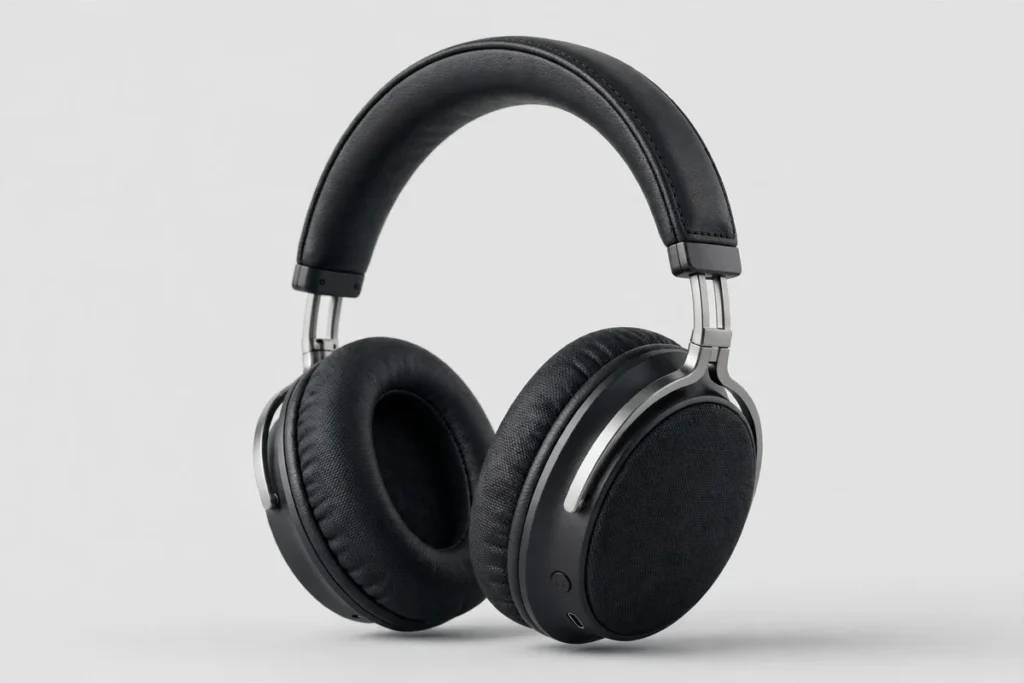
This Bowers & Wilkins Px7 S3 review is for the listener who reads the spec sheet from the bottom up: sound first, features second. The Px7 S3 is a wireless over-ear headphone built around two 40mm bio-cellulose drivers, each with its own dedicated amplifier, and it shows in the listening. Detail, separation and texture sit a clear level above the mainstream flagships, while the noise cancelling, calls and battery life stay close enough that you give up very little to get that sound. In our published Best Headphones Under $500 roundup we named it the best sound-first wireless pick, and it earns that label again here with an overall score of 8.4 out of 10.

Why you: Built like hi-fi, not like a gadget: metal arms, leather trim and 40mm bio-cellulose drivers tuned for detail. It is one of the few wireless models with aptX Lossless, so a compatible phone can feed it CD-quality audio without a cable.
Trade-off: Noise cancelling is good rather than great, and the earcups fold flat instead of collapsing, so the slim case still takes real room in a bag.
Sound: the reason this headphone exists
The Px7 S3 runs two 40mm bio-cellulose drivers, and Bowers & Wilkins changed more than the diaphragms this time. The drivers sit on a revised chassis with a new voice coil, suspension and magnet assembly, and each one gets its own dedicated amplifier fed by a 24-bit DSP. That is hi-fi thinking applied to a travel headphone, and the result is the most layered sound in the wireless class. Instruments separate cleanly, bass has texture instead of just weight, and small details like fret noise and room echo survive the Bluetooth link.
The stock tuning leans lively, with lifted bass and a treble that can draw attention to itself on bright recordings. Where you seat the earcups changes the balance slightly, because the drivers sit low in the cups, so a consistent fit matters. The B&W Music app helps here: it carries a proper five-band EQ, a big step up from the old two-band sliders, plus a TrueSound mode that bypasses EQ entirely if you want the factory tuning untouched. Our Sound score of 9.1 is the highest we give any wireless over-ear in this tier, and it was set when we scored the headphone for the Under $500 roundup.
Codec support is the other half of the sound story. Alongside SBC and AAC, the Px7 S3 covers the full aptX family: Classic, HD, Adaptive and Lossless. With a phone that supports aptX Lossless, the Bluetooth link itself stops being the bottleneck and the headphone gets a bit-perfect CD-quality stream. iPhone owners stay on AAC, which still sounds clean here, and everyone can bypass wireless completely with the USB-C port, which doubles as a 24-bit audio input.
Noise cancelling and calls
Eight microphones handle the noise cancelling, four in each earcup, split between feedback and feedforward positions. This generation took a real step forward: engine drone and cabin roar drop to a level that no longer distracts, and the system holds up well against wind and street noise. It still does not match the silence of the class leaders. Put it beside the Sony WH-1000XM6, which we cover in our Sony WH-1000XM6 review, and the Sony erases more of the world, especially voices and higher-frequency clatter. That gap is exactly what our ANC score reflects: 8.2 for the Px7 S3, strong, but not the benchmark.
Calls use the same eight microphones, all of them working for voice pickup, with Bowers & Wilkins’ Pure Voice processing cleaning up the signal. Voices come through clear and natural in quiet rooms and stay intelligible on a busy street, though heavy traffic noise does creep in around the edges. For a headphone bought mainly for music, call quality at this level is a genuine bonus rather than a compromise.
Design, comfort and controls
The Px7 S3 looks and feels like a product from a hi-fi company. The arms are metal, the earcups wear fabric and leather trim, and the whole frame is slimmer than the previous model. At 300 grams without the case it sits mid-pack for weight, and the memory foam cushions spread the load well. Clamping force is on the firm side, which larger heads notice on long sessions, but the seal it creates helps both the bass and the passive isolation. Our Comfort score of 8.8 says most listeners will wear these for a full workday without complaint.
Controls are physical buttons, not touch panels, and that choice keeps paying off. Volume, playback and ANC switching all work by feel, with gloves on, every time. The earcups fold flat but the arms do not collapse inward, so the carry case is wide even though it is slim. Replacement earpads and headband padding are available, which matters on a headphone at this level: the wear parts can be refreshed instead of retiring the whole product. It comes in Anthracite Black, Canvas White and Midnight Blue.
Battery and connections
Battery life is rated at 30 hours of playback, and the quick charge is one of the best in the class: 15 minutes plugged in returns about 7 hours of listening. That pairing covers a week of commuting or a long-haul return trip with a single top-up at the gate. Our Battery score of 8.2 reflects a figure that matches Sony and trails only the marathon runners in this tier.
Bluetooth is version 5.3 with two-device multipoint, so the headphone can sit on your laptop and phone at once and hop between them. Google Fast Pair speeds up the first connection on Android. Wired listening is properly covered too: USB-C carries digital audio at up to 24-bit resolution, and the case holds a USB-C to 3.5mm cable for planes and older gear. Very few wireless headphones at any level offer this many ways to connect, and none of them feel like an afterthought.
Specifications
| Bowers & Wilkins Px7 S3 | |
| Drivers | 2 x 40mm dynamic full-range bio-cellulose |
| Bluetooth | 5.3, multipoint (two devices) |
| Codecs | aptX Lossless, aptX Adaptive, aptX HD, aptX Classic, AAC, SBC |
| Microphones | 8 total, 4 per earcup, all used for calls |
| Noise cancelling | Adaptive ANC with app control |
| Battery life | 30 hours playback; 15-minute charge adds 7 hours |
| Wired options | USB-C digital audio (24-bit), 3.5mm cable included |
| App | B&W Music: five-band EQ, TrueSound mode, ANC and wear-sensor settings |
| Weight | 300 g (without carry case) |
| Finishes | Anthracite Black, Canvas White, Midnight Blue |
| Check Price on Amazon | |
Px7 S3 vs Px7 S2e: what changed
The Px7 S3 replaces the Px7 S2e as the middle step in the Bowers & Wilkins range, below the Px8 line. The driver platform is new rather than carried over: redesigned 40mm bio-cellulose units, each with its own amplifier, where the older model drove both channels from a shared stage. Noise cancelling moves to the eight-microphone layout described above, the app gains the five-band EQ, and aptX Lossless joins the codec list. The frame also slims down, which you feel in the case and on the head.
If you already own the S2e, the honest answer is that the S3 is a refinement, not a reinvention. The gains are real but spread thin: a little more detail, a little more silence, better EQ control and the Lossless option for owners of compatible phones. If you are buying fresh in this tier, the S3 is the one to get, and the gap to the Px8 above it is now mostly about materials and finish rather than a different level of sound.
Who should buy it, and who should not
Buy the Px7 S3 if sound quality decides your purchase and you still need a headphone that travels, takes calls and runs all week. Android owners with aptX Lossless support get the most from it, and anyone who values build quality and physical buttons will feel the difference every day. It also suits listeners who keep headphones for years, since the pads and headband padding can be replaced.
Look elsewhere if silence is the priority. Bose and Sony cancel more noise, and our guide to the best noise cancelling headphones shows where the Px7 S3 sits against them. Frequent flyers who pack light may also mind the wide case, and listeners who want every smart feature on day one should know Bowers & Wilkins tends to add software features over time through app and firmware updates.
Our scores come from published specifications, manufacturer data and the wider review record, scored on the same scale we use across the site. This is a research review; we do not claim hands-on testing.
FAQ
Does the Bowers & Wilkins Px7 S3 support aptX Lossless?
Yes. The Px7 S3 supports aptX Lossless, aptX Adaptive, aptX HD and aptX Classic alongside AAC and SBC. To hear the Lossless stream you need a phone or dongle that also supports it; iPhones use AAC instead.
How long does the Px7 S3 battery last?
Bowers & Wilkins rates the Px7 S3 at 30 hours of playback. A 15-minute charge adds about 7 hours, which is enough to cover a long flight after a short top-up.
Can you use the Px7 S3 with a cable?
Yes, two ways. The USB-C port accepts digital audio at up to 24-bit resolution from a phone or computer, and a USB-C to 3.5mm cable is included in the case for analogue sources and seatback screens.
Is the Px7 S3 noise cancelling as good as Sony or Bose?
It is good, and much improved over the previous model, but Sony and Bose still cancel more, particularly voices and higher-frequency noise. We score the Px7 S3 at 8.2 for ANC, a step behind the class leaders.
Does the Px7 S3 fold up for travel?
The earcups fold flat, but the arms do not collapse inward. The carry case is slim yet wide, so it takes more room in a bag than the cases from Sony or Bose.
What colours does the Px7 S3 come in?
Three finishes: Anthracite Black, Canvas White and Midnight Blue.

I am the founder of Sound Mavericks, where I provide the polite truth about audio equipment. I started this site because consumer electronics reviews are often too technical. Instead of using a silent lab, I test headphones, earbuds, and Bluetooth speakers in the real world – like on a noisy subway or in a busy coffee shop.
To stay independent, I buy my own review units (mostly from the United States) rather than accepting free gifts from brands. Once I finish testing a product, I sell it locally to our community. My goal is to help you understand sound quality, active noise cancellation (ANC), and battery life without the marketing hype.
