
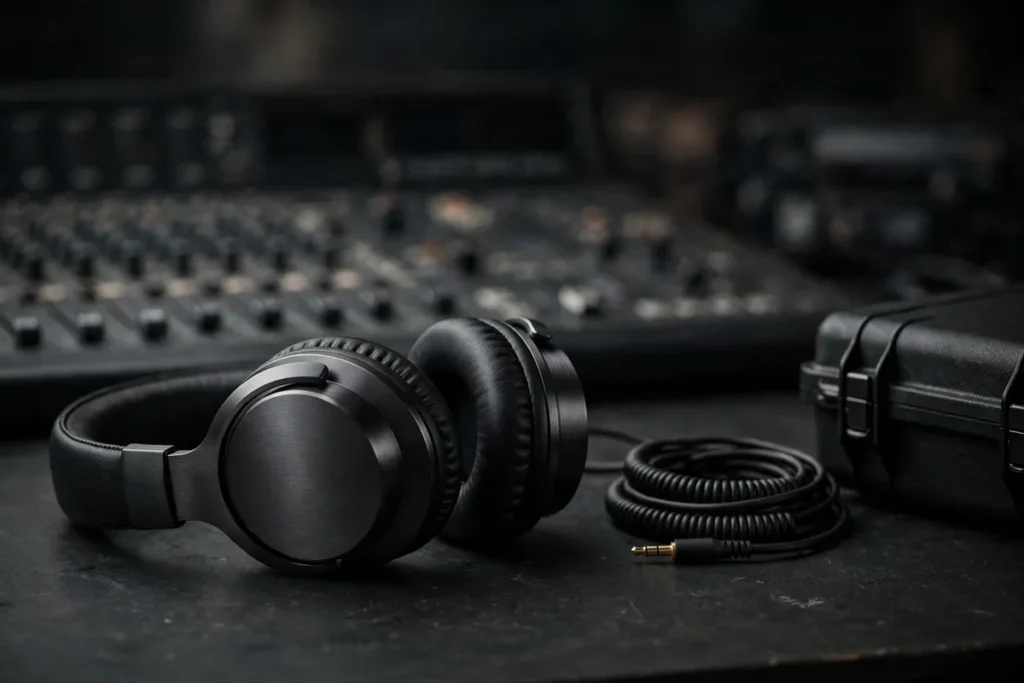
This Beyerdynamic DT 1770 Pro review covers the flagship of beyerdynamic’s closed-back studio line: a 45 mm Tesla 2.0 driver in a handmade German shell, 250 Ω of impedance, and passive isolation strong enough for tracking rooms. It sits above the DT 770 Pro that fills project studios everywhere, built for the same jobs, recording, monitoring and detailed listening at a desk. It is not portable, not wireless, and not cheap to run.
This is a research review. We have not tested the DT 1770 Pro on our own heads, so the verdict is built from beyerdynamic’s published specifications and published measurements and reviews of this exact model. The score is provisional.
Beyerdynamic DT 1770 Pro 6.0/10 provisional
Why you: you track, monitor or listen critically in a room you cannot treat, and want one closed-back that isolates like a studio tool and resolves like a flagship.
Trade-off: 388 g with a firm clamp taxes long sessions, the 250 Ω driver wants a real amp or interface behind it, and neither cable has a microphone.
45 mm Tesla 2.0 driver · 250 Ω · 388 g · 5 Hz to 40 kHz · Two pad sets and two cables in the box
The score, explained: 6.0 with wired-model bars
Our overall score is 6.0, the mean of the six bars above, and three of those bars need translating for a wired studio headphone. Battery scores 5.0 because there is no battery. The DT 1770 Pro is wired, and 5.0 is the neutral placeholder we give wired models so they can sit in the same table as wireless ones. Calls & mic scores 3.0, and that one is a genuine limitation rather than a bookkeeping entry: neither cable in the box carries a microphone, so calls and voice chat need a separate mic. Noise cancelling scores 4.0, and here the number undersells the hardware in one specific way. There are no cancelling electronics at all. The 4.0 rates passive isolation only, and beyerdynamic’s rated attenuation, roughly 18 dBA with the velour pads and 21 dBA with the leatherette pads, is strong for a passive closed-back.
The bars this headphone actually competes on are the ones to read. Sound scores 9.2 on the Tesla driver and its tuning, covered in detail next. Comfort scores 7.6: the pads are thick and the build is excellent, but 388 g and a firm clamp are real costs over a long session. Value scores 7.0. The box is generous, with two pad sets, two cables and a hard case, and the parts that wear out are replaceable, but the ticket is flagship money for a headphone that only does one job.
Sound: a Tesla driver with a point of view
The DT 1770 Pro was the first closed-back in beyerdynamic’s pro line built around its Tesla 2.0 technology. Tesla drivers use a high-flux neodymium magnet system that drives the diaphragm harder and with better control than a conventional motor, and beyerdynamic pairs it here with a three-layer diaphragm in a 45 mm driver. The published numbers back the ambition: distortion under 0.05 percent at 1 mW, a maximum output of 125 dB SPL, and a rated response from 5 Hz to 40 kHz.
The tuning is not a flat line, and pretending otherwise would waste your money. Published measurements and reviews agree on the broad shape: a bass shelf with real weight that stays controlled instead of blooming into the midrange, a midrange that sits slightly back, and an upper treble with the lift beyerdynamic is known for. In practice the low end is the headline. Kick drums and bass synths land with a punch that most closed studio headphones do not attempt, and it stays tight enough to judge low-end balance on. The treble lift is the argument. It brings air, edge definition and detail to the front, which is useful when you are hunting clicks, sibilance and reverb tails. It also means bright mixes sound brighter than they are, so anyone mixing on these needs to learn that top end before trusting it.
Imaging is precise, with instruments placed firmly rather than smeared, and the stage is wide for a sealed cup. It is still a closed-back stage, though: sounds sit close and centred compared with an open design. For tracking, editing and detailed listening at a desk, that trade is the right one. For someone who listens mainly for space and air around instruments, it is the wrong headphone no matter how good the driver is.
Design, comfort and build
The DT 1770 Pro is handmade in Germany, and the construction shows it. Aluminium yokes, a spring steel headband, and ear cups finished in matte black with no decoration beyond the model badge. Every wear part is replaceable: ear pads, headband padding and cables are all spare parts, which matters at this price because the headphone is meant to be serviced, not replaced.
Comfort is where reports split, and the specifications explain why. The headphone weighs 388 g without its cable, and the headband presses at roughly 7.2 N, which is a firm clamp by any standard. The pads are thick enough to carry that clamp for most people, and the seal they make is what produces the isolation figures above. Plenty of owners wear these for full studio days. Plenty of others take breaks. Head size and glasses frames decide which camp you land in more than any review can.
The two pad sets are not spares, they are two tunings. Velour breathes better and softens the seal, giving the leaner, airier listen and about 18 dBA of attenuation. Leatherette seals harder, pushes isolation to about 21 dBA, and firms up the bass. Swapping takes a minute, and most owners end up with a favourite per job: leatherette for tracking near live microphones, velour for long editing sessions.
Cables, power and the missing microphone
Two cables ship in the case: a 3 m straight cable and a 5 m coiled cable. Both lock into the left ear cup with a 3-pin mini-XLR connector, both end in a 3.5 mm plug, and a screw-on 6.35 mm adapter is included. Single-sided entry keeps the cable out of the way of a guitar strap or a desk edge, and if a cable ever fails, the repair is a new cable rather than a new headphone.
Driving the DT 1770 Pro takes some honesty about sources. The 250 Ω impedance paired with a sensitivity of 102 dB SPL at 1 mW means a phone or a laptop socket will produce sound, and quieter than you expect. An audio interface with a decent headphone output, or a small desktop amp, gives the headroom the driver is built for and keeps the bass controlled at working volume. If impedance numbers are new to you, our explainer on impedance and when you need an amp walks through why this pairing matters. There is no microphone on either cable, so streamers and remote workers need a separate mic in the chain.
DT 1770 Pro vs DT 770 Pro: what the flagship money buys
The DT 770 Pro is the headphone the DT 1770 Pro gets compared with, because it is the one already sitting in most studios. Our DT 770 Pro review covers that headphone in full. The short version of the gap: the 1770’s Tesla driver resolves more detail, its bass is weightier and better controlled, its isolation is stronger, and its parts list is aluminium and steel where the 770 is mostly plastic. The 770 is lighter, far easier to drive in its 80 Ω form, and costs a fraction as much. Studios buying tracking headphones in pairs still buy the 770. The 1770 is the one headphone a single engineer buys for their own desk.
| Product | Beyerdynamic DT 1770 Pro |  Beyerdynamic DT 770 Pro (80 Ω) |
| Driver | 45 mm dynamic Tesla 2.0 | 45 mm dynamic |
| Impedance | 250 Ω | 80 Ω |
| Frequency response | 5 Hz to 40 kHz | 5 Hz to 35 kHz |
| Weight | 388 g without cable | 270 g without cable |
| Cables | 3 m straight and 5 m coiled, detachable mini-XLR | 3 m straight, detachable |
| Check Price | Check Price on Amazon | Check Price on Amazon |
One more name needs clearing up, because listings blur it. Beyerdynamic also sells a DT 1770 Pro MKII, a newer and different model with a 30 Ω driver that runs happily from almost any source. It is not this headphone, it is not scored here, and a listing for one is not a listing for the other. Check the impedance on any listing before you buy: 250 Ω is the original flagship reviewed on this page.
Beyerdynamic DT 1770 Pro specifications
| Product | Beyerdynamic DT 1770 Pro Studio Headphones |
| Design | Closed-back, over-ear (circumaural), handmade in Germany |
| Driver | 45 mm dynamic Tesla 2.0, neodymium |
| Frequency response | 5 Hz to 40 kHz |
| Impedance | 250 Ω |
| Sensitivity | 102 dB SPL (1 mW / 500 Hz) |
| Max SPL | 125 dB SPL (200 mW / 500 Hz) |
| Distortion | THD under 0.05 percent (1 mW / 500 Hz) |
| Isolation | Passive, approx. 18 dBA (velour pads) / 21 dBA (leatherette pads) |
| Weight | 388 g without cable |
| Cables | 3 m straight and 5 m coiled, detachable 3-pin mini-XLR, single-sided |
| Connector | 3.5 mm plug, 6.35 mm adapter included |
| In the box | Headphones, velour and leatherette ear pad sets, two cables, hard carrying case |
| Microphone | None on the included cables |
| Check Price | Check Price on Amazon |
Verdict: who should buy the DT 1770 Pro
Buy it if your work happens in rooms you do not control: a home studio near a road, a shared space, a tracking room where the singer is three feet from the drummer. The DT 1770 Pro gives you flagship detail and bass you can make decisions on, behind a seal that keeps the room out and your click track in. It is also a strong buy for a listener who simply prefers closed-back punch and wants the best-built version of it, provided a proper amp or interface is already on the desk.
Skip it if your listening is mostly from a phone, if you need a microphone in the chain, or if a neutral, laid-back tuning is the goal. Skip it, too, if you know firm clamps bother you; no score on this page will talk your head out of that. Our best wired headphones roundup covers the lighter and easier-going alternatives, including the DT 770 Pro this flagship grew out of.
FAQ
Does the Beyerdynamic DT 1770 Pro need an amp?
Realistically, yes. At 250 Ω with 102 dB SPL sensitivity at 1 mW, a phone or laptop will make it play, but quietly and with less control. An audio interface with a solid headphone output or a small desktop amp gives it proper headroom.
Is the DT 1770 Pro the same as the DT 1770 Pro MKII?
No. The MKII is a newer, separate model with a 30 Ω driver built to run from almost any device. This review covers the original 250 Ω DT 1770 Pro. The two share a name and a shell shape, but they are different headphones, so check the impedance on any listing.
Which ear pads should I use, velour or leatherette?
Both sets are in the box. Leatherette seals harder, isolates more (about 21 dBA) and firms up the bass, which suits tracking. Velour breathes better over long sessions and attenuates about 18 dBA, which suits editing and mixing days.
Can I use the DT 1770 Pro for calls or voice chat?
Not on its own. Neither included cable has a microphone. You would need a separate microphone in your setup, which is normal for studio headphones in this class.
How is the DT 1770 Pro different from the DT 770 Pro?
The DT 1770 Pro uses beyerdynamic’s Tesla 2.0 driver for finer detail and stronger, tighter bass, isolates better, and is built from aluminium and steel with fully replaceable parts. The DT 770 Pro is lighter, much cheaper, and easier to drive in its 80 Ω version.
Are the cables and pads replaceable?
Yes. The cables detach at a locking mini-XLR connector, and the ear pads, headband padding and cables are all sold as spare parts, so wear items can be swapped instead of replacing the headphone.

I am the founder of Sound Mavericks, where I provide the polite truth about audio equipment. I started this site because consumer electronics reviews are often too technical. Instead of using a silent lab, I test headphones, earbuds, and Bluetooth speakers in the real world – like on a noisy subway or in a busy coffee shop.
To stay independent, I buy my own review units (mostly from the United States) rather than accepting free gifts from brands. Once I finish testing a product, I sell it locally to our community. My goal is to help you understand sound quality, active noise cancellation (ANC), and battery life without the marketing hype.
