
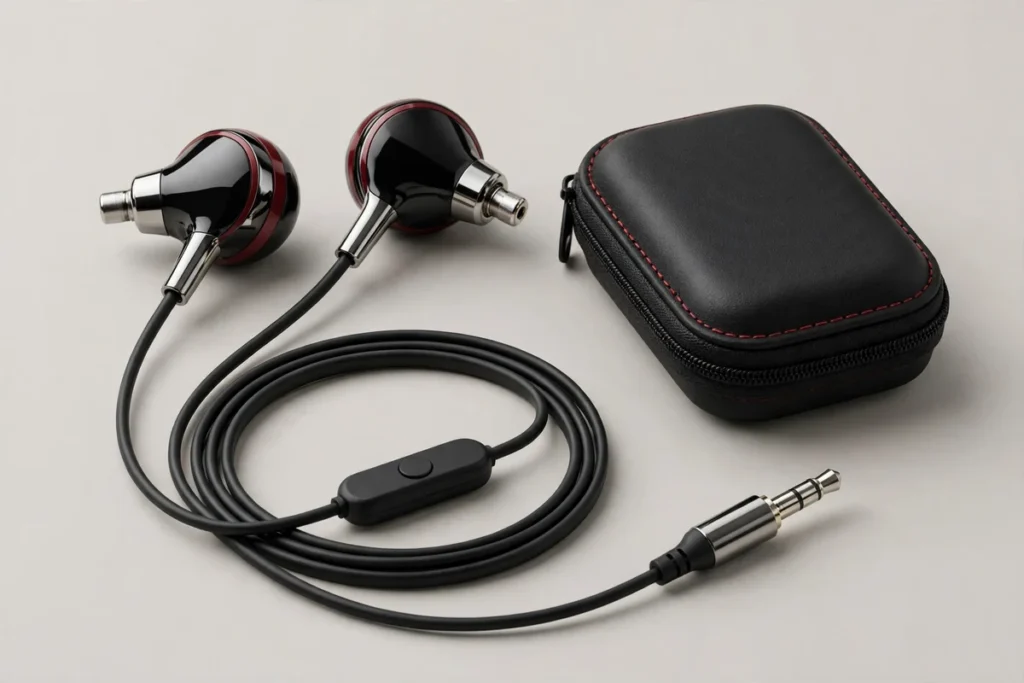
This Sennheiser Momentum In-Ear review looks at the smallest member of Sennheiser’s Momentum family: a wired in-ear with stainless steel sound tunnels, a bass-heavy tuning and a three-button remote on the cable. It was sold in two versions, for Apple devices and for Samsung Galaxy and Android phones, differing only in how the remote talks to the phone. The listing covered here is the iOS version in Black Red, model 508689, still listed on Amazon US.
Two things need saying before the verdict. First, this is a research review, not a hands-on test: the scores below are provisional, built from Sennheiser’s published specifications, the Amazon US listing, and the published review record. Second, Sennheiser has discontinued the model: the Amazon US listing is still up, but its stock is leftover and marketplace-led, so availability and condition vary week to week. Read this as a guide to what a genuine pair sounds like, and to what else the same money could buy today.

Sennheiser Momentum In-Ear 6.6/10 provisional
Why you: the V-shaped tuning puts real weight behind the bass and keeps the treble lively, the stainless steel housings feel a class above plastic rivals, and at 16 g the fit disappears once the music starts. On sound alone it still embarrasses most cheap wireless buds.
Trade-off: it is discontinued, so you are buying leftover stock. The midrange sits back behind the bass, the remote only works in full with the device family it was built for, and the fixed cable means a cable failure ends the earphone.
Single dynamic driver · 15 Hz–22 kHz · 18 Ω · 118 dB SPL · 1.3 m cable, 3.5 mm angled plug · 16 g
The score, explained: 6.6 on a wired scorecard
Three bars on a wired earphone need translating. Battery sits at 5.0 because there is no battery: it is the neutral placeholder we use for wired models, so the overall can be compared with wireless sets without pretending a cable needs charging. Noise cancelling is passive isolation only. There is no ANC hardware in the Momentum In-Ear, so the 3.5 reflects how much noise the sealed fit blocks on its own. Calls is a genuine score rather than a placeholder, because the in-line remote carries a real microphone.
The overall is also scored against today’s field, not the field this model launched into. Against current wired rivals, several of which cost less and carry detachable cables, a discontinued design with a fixed cable and no successor support lands at 6.6. The sound bar tells the happier part of the story: at 8.2, the tuning is the reason anyone still hunts this earphone down.
Sound: a V with a heavy left leg
The Momentum In-Ear is tuned for fun first and accuracy second, and the bass is where the fun lives. The low end is big, punchy and weighted toward the mid-bass, with genuine sub-bass depth underneath it. Kick drums land with a thump you feel as much as hear, and electronic and hip-hop tracks get the physical push that flat-tuned earphones leave out. The cost is some bloom: the mid-bass spills upward and warms everything above it, so double bass and bass guitar can blur at the edges on busy recordings.
The midrange sits a step back. Vocals are warm and clear enough to follow easily, but they perform from behind the rhythm section rather than in front of it, and the upper mids roll off early, which keeps the presentation smooth and fatigue-free at the expense of bite. Acoustic guitars and piano lose some of their attack. If your listening leans on singer-songwriter and jazz material where the voice carries the song, this recession is the main reason to look elsewhere.
Treble is the balancing act. It is detailed and lively, with enough sparkle to keep cymbals and strings interesting, and it wears a slightly dark tint that stops the top end turning glassy. Push the volume on a bright recording and some harshness and sibilance can creep in, which is the one place the tuning overreaches. Soundstage is respectable for a small sealed in-ear: instruments separate cleanly left to right, even if nothing escapes far outside the head. The published review record on this model is unusually consistent on all of the above, which is why the sound bar sits as high as it does.
Isolation and fit
Isolation is the quiet strength here. The nozzle angles into the canal at an adjustable 15 degrees, four sizes of ear sleeve are in the box (XS, S, M and L), and once the right size seals, outside noise drops hard for a consumer in-ear. Published reviewers singled the isolation out as stronger than average for the class, and it is good enough to take the edge off a train carriage or an open-plan office without any electronics involved. It is still passive, though: engine drone and low rumble leak through in a way real ANC would eat, which is what the 3.5 bar is recording.
Comfort follows from the same design. At 16 g the earphones weigh almost nothing, the housings are small, and the angled fit keeps pressure off the canal wall, so long sessions pass without the ache that bigger in-ears cause. The semi-flat cable resists tangling and carries an adjustable stopper to keep the split tidy. Its one habit is rub noise: brush the cable against a collar while walking and you hear it in the earpieces, a common trait of cable-down designs that an over-ear routing would have avoided.
Build, cable and the two-version trap
The build is the part that justified the Momentum name. The sound tunnels are precision-milled stainless steel rather than plastic, the housings are high-gloss with mirror chrome detailing, and the Black Red version of this listing pairs red housings with a black-and-red cable. The premium carrying case in the box, finished with red stitching, is better than the pouches most wired rivals ship with. Nothing about the earphones feels disposable.
The cable is where the compromises live. It is a fixed 1.3 m cable with an angled 3.5 mm plug, and fixed means final: if the cable fails at the strain relief, the earphones are finished. That is the sharpest contrast with the Shure SE215, whose cable unplugs at the earpiece and can be replaced in seconds. Buy the Momentum for its sound and build, but know that its lifespan hangs on one cable.
Then there is the version trap. Sennheiser sold the Momentum In-Ear as an iOS version and a Galaxy/Android version, and the difference is the three-button remote: each version’s volume controls speak only to its own platform. This listing, model 508689, is the iOS version, so its volume buttons work with Apple devices; on an Android phone you still get sound, the microphone and the centre button, but not volume control. Check which version a marketplace listing is actually selling before you pay, because sellers mix them up.
Calls and everyday use
The microphone lives on the back of the in-line remote, close enough to the mouth to pick up speech cleanly. Published call reports rate the voice quality as clear and easy to understand in quiet and indoor settings; like every single in-line mic, it has no defence against wind or street noise beyond its position. For desk calls, voice notes and the odd phone conversation it does the job without drama.
Everyday use has one modern catch. The Momentum In-Ear ends in a 3.5 mm plug, and many current phones have no socket for it. A small USB-C or Lightning dongle DAC restores the connection and drives these earphones easily, since 18 ohms and 118 dB of sensitivity ask very little of any source. Laptops, tablets with a jack, handheld consoles and older phones take it directly. There is no water resistance rating, so gym sessions in heavy sweat are a risk you take on your own.
Sennheiser Momentum In-Ear specifications
| Model | Sennheiser Momentum In-Ear (M2 IEi, iOS version, Black Red, model 508689) |
| Driver | Single dynamic driver, stainless steel sound tunnel |
| Frequency response | 15 Hz – 22 kHz |
| Impedance | 18 Ω |
| Sensitivity | 118 dB at 1 kHz / 1 Vrms |
| THD | <0.5% (1 kHz, 100 dB SPL) |
| Cable | 1.3 m, semi-flat, tangle-resistant, fixed (non-detachable) |
| Plug | 3.5 mm, angled |
| Remote and mic | Three-button in-line remote with integrated microphone (iOS version) |
| Weight | 16 g |
| Water resistance | None rated |
| In the box | Earphones, ear adapter set (XS, S, M, L), premium carrying case |
Who should buy it, and what to buy instead
Buy it if you find a genuine, sealed pair from a seller you trust and you want the wired sound that made this model popular: big bass, lively treble, a light and comfortable fit, and a build that still feels premium in the hand. Buy it as a known quantity, not as a long-term platform, because when the cable goes there is no repair path and no successor model to move to.
Skip it if your phone has no headphone jack and you refuse to carry a dongle, if you want a detachable cable, or if vocals and midrange detail are the centre of your listening. For a current Sennheiser wired in-ear with a detachable cable and a more balanced tuning, our Sennheiser IE 200 review covers the modern step up. If the Momentum name is the draw, the family now lives in true wireless, and our best Sennheiser headphones roundup maps where its budget buys the most today.
Verdict
The Momentum In-Ear earned its reputation honestly: a fun, bass-forward tuning in a small stainless steel shell that fits almost anyone, with isolation that shames many earphones sold with noise cancelling in the headline. Time has not dulled the sound. What time has done is end production, strand the design on a fixed cable, and hand its segment to rivals that are cheaper, repairable and still supported. At 6.6, this is a good earphone to buy knowingly at the right moment, and a poor one to buy by accident. If a clean pair turns up and the tuning sounds like your kind of fun, the Amazon US listing is where to check what is actually left.
FAQ
Is the Sennheiser Momentum In-Ear discontinued?
Yes. Sennheiser has ended production of the wired Momentum In-Ear, and there is no direct wired successor in the Momentum line. The Amazon US listing is still live, but the stock behind it is leftover and marketplace-led, so availability comes and goes and condition varies by seller.
What is the difference between the iOS and Android versions?
The earphones and sound are identical; the difference is the three-button in-line remote. Each version’s volume controls only work with its own platform, so the iOS version gives full remote control on Apple devices, while on an Android phone the volume buttons do nothing even though audio, the microphone and the centre button still work.
Does the Sennheiser Momentum In-Ear have a microphone?
Yes. A microphone is built into the in-line remote, and published call reports rate the voice quality as clear in quiet and indoor settings. There is no noise cancelling on the microphone, so wind and traffic will reach your caller.
Does the Momentum In-Ear need an amplifier?
No. At 18 ohms with 118 dB of sensitivity, it is one of the easiest earphones to drive. Phones, laptops and handheld consoles all run it to full volume with room to spare, and a small dongle DAC is only needed when the device has no 3.5 mm socket.
What replaced the Momentum In-Ear?
Nothing directly. Sennheiser moved the Momentum name to true wireless models and pointed wired buyers at its IE range instead. The IE 200 is the closest current step: a wired single-driver in-ear with a detachable cable and a more balanced tuning.

I am the founder of Sound Mavericks, where I provide the polite truth about audio equipment. I started this site because consumer electronics reviews are often too technical. Instead of using a silent lab, I test headphones, earbuds, and Bluetooth speakers in the real world – like on a noisy subway or in a busy coffee shop.
To stay independent, I buy my own review units (mostly from the United States) rather than accepting free gifts from brands. Once I finish testing a product, I sell it locally to our community. My goal is to help you understand sound quality, active noise cancellation (ANC), and battery life without the marketing hype.
