
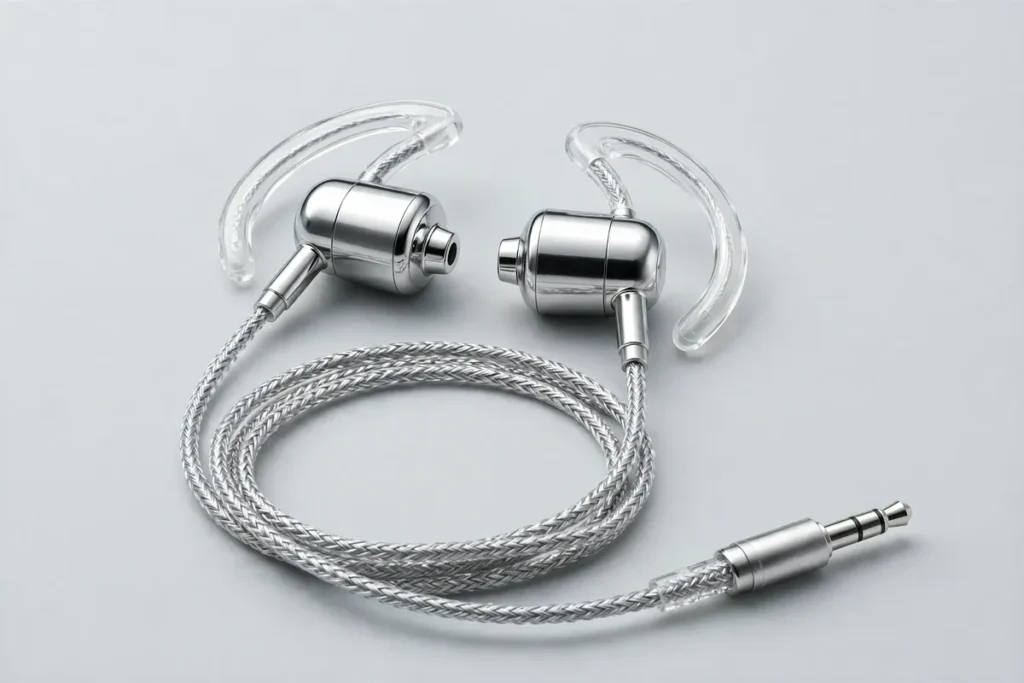
Our Moondrop KATO review covers an IEM that is easy to admire and increasingly hard to buy. The KATO is a wired in-ear monitor built around a single 10mm ULT dynamic driver with a third-generation DLC composite diaphragm, in shells machined from stainless steel. For a long stretch it was the default recommendation for anyone who wanted one good dynamic driver instead of a stack of balanced armatures, and the tuning is the reason why.
This is a research review. We have not worn the KATO on our own ears, so the verdict below is built from Moondrop’s published specifications, the verified Amazon US listing data for the Mirror Silver variant, and published measurement and review coverage. The score is provisional, and the wired-model bars are explained in plain terms under the card.
One fact shapes everything else here: Moondrop has discontinued the KATO and replaced it with the Kadenz. ShenzhenAudio and HiFiGo both list it sold out, and fresh stock has effectively dried up, so what remains is marketplace and used supply. The buy button below therefore runs to a tagged Amazon search rather than a single listing. If a copy is on sale, that is where it will show up.

Why you: One driver done properly. A coherent, natural tuning with clean sub-bass, honest mids and treble that stays controlled, in shells machined from stainless steel with swappable tuning nozzles.
Trade-off: Moondrop has discontinued it, so you are shopping marketplace and used listings with no warranty behind the sale. The polished steel shells are also heavy for an IEM and show every fingerprint.
The score, explained: 6.0 with three wired-model bars
Three of the six bars follow the house rules for wired models, so they can sit in the same table as wireless ones. Battery scores 5.0 as a neutral placeholder, because a wired IEM has no battery to judge. Calls scores 3.0, and that one is a real limitation rather than a placeholder: the stock cable has no microphone, so calls run through your phone or a replacement mic cable. ANC scores 4.0 for passive isolation only. There is no noise cancelling circuit here; the metal shells and a deep seal do the work, and they do it well enough to take the edge off a bus or an office.
That leaves Sound at 8.8 doing the heavy lifting, which is the honest shape of this product. The KATO was never about features. It is a tuning exercise in steel, and the score says exactly that.
Sound: the tuning that made one driver enough
Moondrop tunes the KATO to its VDSF target, a house curve in the Harman family with its own ideas about the bass shelf and upper mids. Published measurements agree on the broad shape, and so does most of the listening coverage: the bass reaches deep and stays clean, with the emphasis sitting low rather than in a mid-bass hump, so kick drums have weight without smearing the vocal in front of them. Mids are the strongest suit. Voices sound natural and forward enough to follow lyrics in a dense mix, and instruments keep a believable timbre, which is where single dynamic drivers often beat hybrids at this level: there is no crossover, so nothing hands off to a different driver halfway through a note.
The treble is controlled rather than sparkling. There is enough presence to keep cymbals and string detail in the picture, and the anti-blocking filter in the nozzle keeps the very top smooth, so long sessions stay easy. Listeners who want an aggressive, detail-forward top end will find the KATO polite. Soundstage divides opinion in the coverage: most hear a medium stage with clean imaging rather than a wide one, and the positioning inside that stage is the part reviewers consistently praise. Instruments stay separated and easy to place, even when the stage itself is not huge.
Against the multi-driver competition, the honest summary is coherence over fireworks. Our Moondrop Blessing 3 review covers the hybrid route from the same brand: more drivers, more technical reach, a different set of compromises. The KATO makes the simpler argument, and for a lot of listeners it is the more convincing one.
Two nozzles in the box: steel and brass
The KATO’s front nozzle unscrews, and Moondrop includes two pairs: stainless steel and brass. This is not a cosmetic extra. The nozzle forms part of the acoustic path, and the two materials nudge the tuning in different directions. The steel nozzle is the cleaner, brighter presentation, with a touch more air at the top. The brass nozzle fills out the low end slightly and takes a little edge off the treble. The differences are modest, not a second IEM in the box, but they are real and they are free.
Both nozzle pairs carry Moondrop’s third-generation anti-blocking acoustic filter, which is there to keep earwax and dust from clogging the mesh and slowly changing the sound. IEMs with blocked filters are a common cause of one side going quiet, so a filter system designed around the problem is a practical touch on a model people keep for years.
Design, build and comfort
The shells are made by metal injection moulding from stainless steel, then polished. In the Mirror Silver finish they look like small pieces of jewellery, dense and cold in the hand in a way resin shells never are. The shape is a smooth, rounded form with no sharp edges, and published fit reports are broadly positive: the nozzle angle and the shell contour suit medium ears well, and the included Spring Tips, with their tacky outer flange, help the seal stay put without deep insertion pressure. A set of foam tips is in the box too, and they buy extra isolation when you want it.
Two honest caveats. Steel is heavy. Each shell carries noticeably more weight than a resin IEM, and on long sessions some listeners feel that in the ear, even with a good seal sharing the load. And the mirror polish is a fingerprint magnet that also shows fine scratches over time. Neither flaw stopped the KATO becoming a benchmark, but both are worth knowing before you pay a premium for a used pair in allegedly mint condition.
Cable, power and the missing microphone
The cable detaches at a sunken 0.78mm 2-pin socket and ends in a plain 3.5mm plug. There is no microphone and no remote on the stock cable, full stop. Because the connector is the standard 2-pin fitting, any compatible replacement cable works, including the many third-party cables with an inline mic, and that is the practical fix if you take calls on your IEMs.
Driving the KATO is a non-issue. At 32 ohms with 123 dB/Vrms sensitivity, it gets loud from a phone, a laptop jack or a basic USB-C dongle, and it does not need a dedicated amplifier to sound like itself. Headroom-hungry desktop amps add nothing here beyond volume you will never use.
Moondrop KATO specifications
| Product | Moondrop KATO |
| Driver | Single 10mm ULT (Ultra-Linear-Technology) dynamic driver, third-generation DLC composite diaphragm |
| Housing | MIM stainless steel, Mirror Silver finish (also made in Dark Blue and Matte Steel) |
| Frequency response | 10 Hz – 45 kHz (IEC61094 free field); effective 20 Hz – 20 kHz (IEC60318-4, −3 dB) |
| Impedance | 32 Ω ±15% |
| Sensitivity | 123 dB/Vrms at 1 kHz |
| THD | Under 0.15% |
| Nozzles | Swappable; stainless steel and brass pairs included, anti-blocking acoustic filters fitted |
| Cable | Detachable, 0.78mm 2-pin sunken socket, 3.5mm single-ended plug, no microphone |
| Bluetooth | None (wired only) |
| Status | Discontinued; succeeded by the Moondrop Kadenz |
Moondrop KATO vs Moondrop Blessing 3
Both sit in Moondrop’s catalogue as serious wired listening tools, and they could hardly take more different routes to get there. The Moondrop Blessing 3 splits the work between two dynamic drivers and four balanced armatures per side. The KATO hands everything to one driver and asks tuning to do the rest.
| Moondrop KATO | Moondrop Blessing 3 | |
| Drivers | 1 × 10mm dynamic driver | 2 dynamic + 4 balanced armature hybrid |
| Impedance | 32 Ω ±15% | 14.8 Ω ±15% at 1 kHz |
| Sensitivity | 123 dB/Vrms at 1 kHz | 120 dB/Vrms at 1 kHz |
| Microphone | None on stock cable | None on stock cable |
| SoundMavericks score | 6.0 (provisional) | 6.1 (from our published review) |
The scores land close because the wired-model bars dominate the maths for both. The real choice is character: the Blessing 3 reaches further into detail and separation, the KATO sounds more of a piece, with a naturalness to voices and acoustic instruments that multi-driver sets often trade away. Our full Blessing 3 review has the breakdown.
Who should buy the Moondrop KATO
Buy it if you find a clean used pair or leftover marketplace stock at a fair price and you value tuning over spec-sheet drama. It remains one of the most convincing single-driver IEMs made, the build is a cut above resin rivals, and the two nozzle sets give you a small but genuine say in the final sound. It also belongs on the shortlist in our best IEMs guide for exactly those reasons.
Skip it if you need a warranty, easy returns or a microphone. In that case the Kadenz is the current model in this line and the safer purchase, and Moondrop’s wider range is covered by our Moondrop Starfield 3 review if you want the same house tuning philosophy in a newer shell. Also skip it if you know you dislike weight in the ear. Steel is the KATO’s charm and its compromise in the same gram.
Frequently Asked Questions
Is the Moondrop KATO discontinued?
Yes. Moondrop has ended production and replaced it with the Kadenz. Specialist retailers list the KATO sold out, so remaining supply is marketplace sellers and the used market.
What is the difference between the steel and brass nozzles?
The steel nozzle sounds a touch cleaner and brighter. The brass nozzle adds a little low-end weight and softens the treble slightly. Both pairs are in the box, and swapping takes a minute.
Does the Moondrop KATO have a microphone?
No. The stock cable has no mic or remote. The cable is a standard detachable 0.78mm 2-pin design, so any compatible cable with an inline microphone fits.
Is the KATO hard to drive?
No. At 32 ohms and 123 dB/Vrms sensitivity it runs happily from a phone, a laptop or a basic USB-C dongle. A dedicated amplifier is unnecessary.
Should I buy the KATO or the Kadenz?
The Kadenz is the current successor, with full availability and a warranty. The KATO makes sense if you find one at a fair price and want its specific tuning and steel build. At equal money, buy the Kadenz.
Final verdict
The KATO earned its reputation the slow way: one driver, tuned carefully, in a shell built like it was meant to be kept. Discontinuation changes the buying advice, not the sound. At a fair used or marketplace price it is still an easy recommendation for listeners who put natural timbre first. At inflated collector money, walk away and buy the successor. Either way, it stays the reference point for what a single dynamic driver can do.

I am the founder of Sound Mavericks, where I provide the polite truth about audio equipment. I started this site because consumer electronics reviews are often too technical. Instead of using a silent lab, I test headphones, earbuds, and Bluetooth speakers in the real world – like on a noisy subway or in a busy coffee shop.
To stay independent, I buy my own review units (mostly from the United States) rather than accepting free gifts from brands. Once I finish testing a product, I sell it locally to our community. My goal is to help you understand sound quality, active noise cancellation (ANC), and battery life without the marketing hype.
