
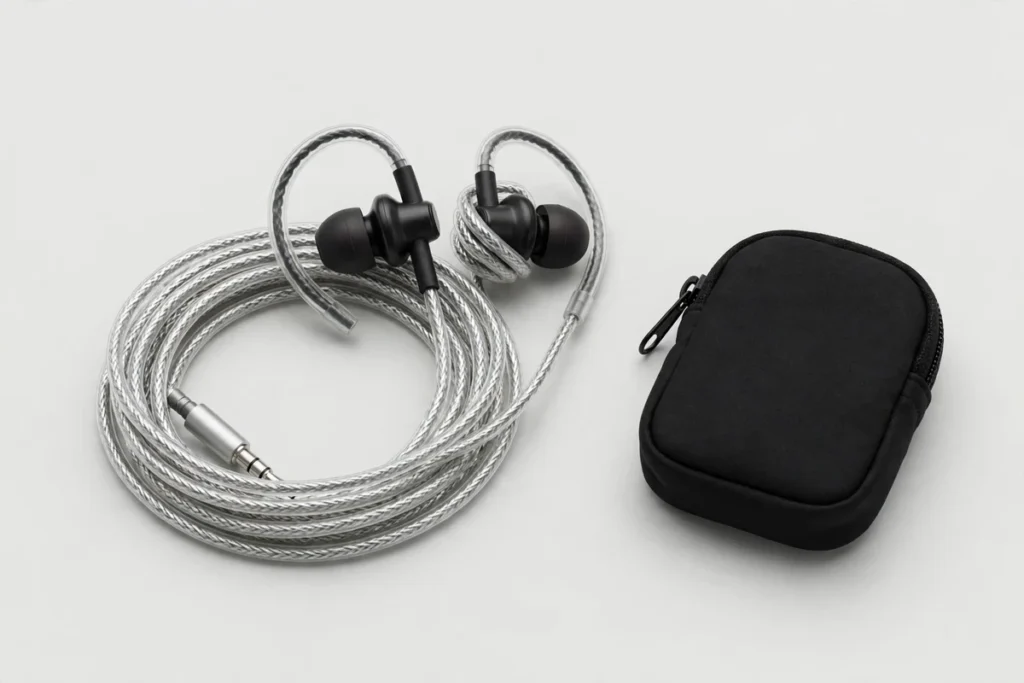
This Sennheiser IE 200 review covers the entry point to Sennheiser’s audiophile in-ear line: a tiny wired IEM built on the same 7 mm TrueResponse dynamic driver platform as the far pricier IE 600 and IE 900, with one trick none of its siblings have. Its ear tips mount in two positions, giving you two bass tunings from a single earphone. It is listed on Amazon US in black, and it skips nearly everything wireless earbuds compete on. There is no battery, no Bluetooth and no microphone. What it offers instead is a balanced tuning, a detachable cable and a 4-gram shell that disappears in the ear.
This is a research review. We have not tested the IE 200 on our own ears, so the verdict below is built from Sennheiser’s published specifications, the verified Amazon US listing and published measurement data. The score is provisional.

Sennheiser IE 200 6.5/10 provisional
Why you: you want a balanced, honest tuning from a major brand in a shell small enough to forget you are wearing, with a cable you can replace when it wears out.
Trade-off: the sound shifts with tip fit more than most IEMs, the stock cable is thin and passes handling noise, and there is no microphone for calls.
7 mm TrueResponse dynamic driver · 18 Ω with cable · 4 g per earpiece · 6 Hz to 20 kHz · Detachable MMCX cable
The score, explained: 6.5 with three wired-model bars
Our overall score is 6.5, the mean of the six bars above, and three of those bars grade things a wired IEM only partly tries to do. Start with the bars that describe the earphone itself. Sound scores 9.4, Comfort 8.8 and Value 8.9, and those three are not new numbers: they carry over from our best IEMs rankings, where the IE 200 sits as the top pick with a 9.0 overall on listening categories. The six-bar card here simply grades it on the same scorecard we apply to wireless earbuds, which is where the other three bars come from.
Battery scores 5.0 because there is no battery. The IE 200 is wired, and 5.0 is the neutral placeholder we give wired models so they can sit in the same table as wireless ones. Calls & mic scores 3.0, and that bar is a real limitation rather than a placeholder: the included cable has no microphone and no remote, so calls mean talking into your phone or laptop mic. Noise cancelling scores 4.0 because there is no cancelling hardware. What the IE 200 has is a closed shell and a tip seal that block sound passively, which is genuinely useful in an in-ear design and earns it the top of our passive band. Read the 6.5 as a wired earphone graded on a wireless scorecard, then judge it on Sound, Comfort and Value.
Sound: balanced, and honest about it
Sennheiser tuned the IE 200 toward a diffuse-field response, the house target behind its audiophile line, and published measurements from many rigs tell a consistent story. With the tips sealing properly, the bass shelf lands close to the modern in-ear target. The midrange is the strongest part of the tuning: vocals stay natural and clear, and nothing in the middle of the spectrum is pushed forward or buried. An upper-midrange dip follows, then some lift in the upper treble, which is where listener reports split. Many hear the top end as smooth and safe for long sessions; a minority hear grain on bright recordings. Both camps are describing the same measured shape through different ears and different seals.
What the IE 200 does not do is entertain like a consumer earbud. Bass is controlled rather than physical, so electronic and hip-hop tracks sound lean next to bass-forward rivals, and the stage is intimate: instruments are placed cleanly and separation is good, but the picture stays between your ears rather than spreading wide. That restraint is the point of the product. It is an earphone for hearing what a recording actually contains, and on well-recorded material the coherence of a single driver working alone is hard to argue with. Detail is good rather than class-leading, and the tuning forgives nothing in a bad mix, which mixing and production listeners tend to count as a feature.
The dual-tuning trick: fit is part of the sound
The IE 200’s signature feature is a vent in the nozzle that the ear tip either covers or leaves open. Push a tip all the way onto the nozzle and the vent closes, giving the full bass tuning. Click the tip into its forward position and the vent opens, rolling the low end off for a leaner, brighter sound. Two tunings, one earphone, no filters to lose and no switches to break. It is a genuinely clever piece of engineering, and it is also the reason opinions on this IEM divide so sharply.
The catch is that the stock silicone tips do not always hold the fully seated position in the ear. When the tip sits forward, or the seal breaks, the bass falls away and the IE 200 sounds thin and treble-forward, which is the version of this earphone its critics describe. The memory foam tips in the box seal harder and hold their position better, at the cost of softening the very top end slightly. Our advice is mechanical, not mystical: try both tip materials, try both mounting positions, and judge the earphone only in the configuration that seals. No IEM in this class is more fit-sensitive, and none rewards ten minutes of tip-rolling more.
Design, comfort and build
Each earpiece weighs 4 grams and the shells are small, smooth plastic that sit flush in the ear canal. Comfort is the IE 200’s quiet superpower. Reviewers with small ears routinely name it among the most comfortable IEMs they own, and the flush fit suits side-sleepers and anyone who wears earphones under a helmet or beanie. The flexible ear hooks on the cable hold the shells in place without clamping. Nothing about the fit asks your ears to adapt to the earphone, which is rarer than it should be at this level.
Build is where we stay plain. The plastic shells keep the weight down and shrug off daily use, but they feel less substantial than the metal housings further up the IE line. The cable is the known weak point: it is thin, it transmits handling noise when it rubs against clothing, and owner reports include cables and earpieces failing earlier than they should. Two things soften that verdict. The cable detaches at recessed MMCX connectors, so the most failure-prone part is replaceable rather than fatal, and Sennheiser covers the IE 200 with a two-year manufacturer warranty. The recessed sockets do narrow your replacement options, since not every aftermarket MMCX cable seats properly. Budget a better cable into long-term ownership and the package makes sense.
Cable, power and the missing microphone
The included cable is a 1.2 m braided lead ending in an angled 3.5 mm plug. There is no inline remote and no microphone, and no USB-C dongle in the box, so a phone without a headphone jack needs an adapter you supply yourself. Driving the IE 200 is the easy part. At 18 Ω for the complete system, earphone plus cable, with sensitivity of 119 dB, a phone, a laptop socket or a basic dongle DAC gets it loud with room to spare. A dedicated amp adds nothing it needs, though a clean source keeps the background silent. The MMCX sockets also accept balanced aftermarket cables if your player offers a balanced output. If the wire itself is your open question, our breakdown of whether wired earbuds are better than wireless covers what the cable buys you and what it costs in convenience.
Sennheiser IE 200 specifications
| Product | Sennheiser IE 200 |
| Design | Closed, in-ear (ear canal), wired |
| Driver | 7 mm TrueResponse dynamic, single per earpiece |
| Frequency response | 6 Hz to 20,000 Hz |
| Impedance | 18 Ω with cable (16 Ω earphone alone) |
| Sensitivity | 119 dB SPL at 1 kHz, 1 Vrms |
| Weight | 4 g per earpiece |
| Cable | 1.2 m braided, detachable, MMCX connectors, angled 3.5 mm plug |
| Ear tips | Silicone and memory foam sets (S, M, L), two mounting positions for two bass tunings |
| Microphone | None |
| In the box | IE 200 earphones, braided MMCX cable, silicone and memory foam tip sets, carry pouch, safety guide |
| Check Price | Check Price on Amazon |
Where the IE 200 sits in the IE line
The IE 200 is the bottom rung of a ladder it shares with the IE 300, IE 600 and IE 900, all built around 7 mm Sennheiser drivers. The IE 300 tunes livelier, with a wider stage and a tougher para-aramid cable, but it has become hard to find new from US retailers, which pushes most buyers back to the IE 200 by default. The IE 600 is the genuine step up: a 3D-printed metal housing, tighter channel matching and balanced cables in the box, at a multiple of the IE 200’s money. Against both, the IE 200 holds two cards of its own. It is the only model in the line with the dual-tuning tip system, and it is the one you can actually buy new today without hunting old stock.
Who should buy the Sennheiser IE 200
Buy it if this is your first serious IEM and you want a balanced tuning from a company with a long record in transducers. Buy it if your ears are small, or you listen in bed, or you wear earphones for hours at a desk and comfort decides what stays in your ears. Buy it if you are comfortable spending ten minutes on tip fit, because this earphone pays that time back every session.
Skip it if you want heavy bass, because the IE 200 will not give it to you in either tip position. Skip it if calls matter, because there is no microphone and that gap needs a different product, not an accessory. And skip it if you know you will never fiddle with ear tips: an earphone this fit-sensitive, worn carelessly, sounds like a much worse earphone than it is.
Frequently Asked Questions
Does the Sennheiser IE 200 have a microphone?
No. The included cable has no microphone and no inline remote. You can listen to calls through the earphones, but the other side hears you through your phone or laptop microphone.
Does the Sennheiser IE 200 have noise cancelling?
No. There is no active noise cancelling. The closed shells and ear tip seal block noise passively, and the memory foam tips isolate more than the silicone ones, but low rumble and engine noise still get through.
What is the dual-tuning feature on the IE 200?
The ear tips mount on the nozzle in two positions. Seated fully, the tip covers a vent in the nozzle and you get the full bass tuning. In the forward position the vent opens and the low end rolls off for a leaner, brighter sound. Same earphone, two tunings.
Do I need an amp or a DAC for the IE 200?
No. At 18 Ω with 119 dB sensitivity, the IE 200 gets loud from a phone, a laptop headphone socket or a basic USB-C dongle DAC. A better source can clean up the background, but power is never the problem. Phones without a 3.5 mm jack do need a dongle, and none is included.
Can you replace the IE 200 cable?
Yes. The cable detaches at MMCX connectors, so a worn or damaged cable is a replacement part rather than a dead earphone. The sockets are recessed, so check that an aftermarket cable is made to seat in them before buying.
Should I buy the IE 200 or the IE 300?
For most buyers, the IE 200. It is the more neutral tuning, it adds the dual-tuning tips, and it is the model you can buy new with a warranty today. The IE 300 sounds livelier with a wider stage, but new US stock is scarce, so it is mainly a used-market option now.
Final verdict
The IE 200 is the sensible front door to Sennheiser’s audiophile line: the same driver platform as its expensive siblings, a tuning that tells the truth about your music, and comfort that embarrasses bigger, pricier earphones. The 6.5 headline undersells it, because three of the six bars grade a battery, a microphone and cancelling hardware it never claimed to have. On the bars that describe the earphone itself (Sound 9.4, Comfort 8.8, Value 8.9) it is the strongest starting point we know for serious wired listening. Get the tips right and it will earn its place in your pocket.

I am the founder of Sound Mavericks, where I provide the polite truth about audio equipment. I started this site because consumer electronics reviews are often too technical. Instead of using a silent lab, I test headphones, earbuds, and Bluetooth speakers in the real world – like on a noisy subway or in a busy coffee shop.
To stay independent, I buy my own review units (mostly from the United States) rather than accepting free gifts from brands. Once I finish testing a product, I sell it locally to our community. My goal is to help you understand sound quality, active noise cancellation (ANC), and battery life without the marketing hype.
