
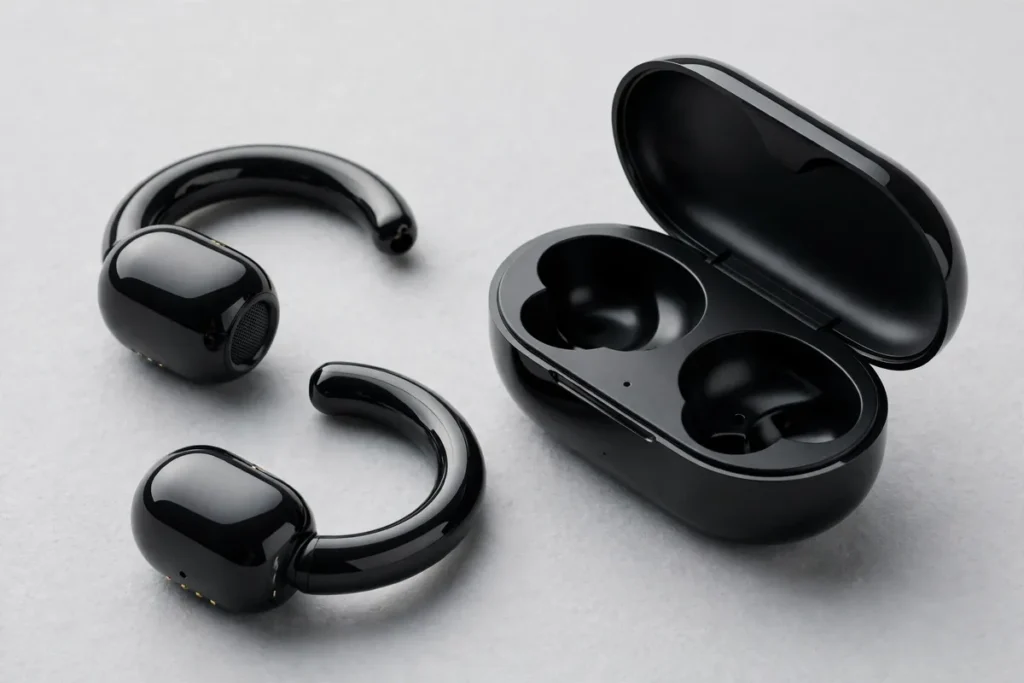
A Samsung Galaxy Buds On review has to start with the obvious: nothing goes in your ear. These are Samsung’s first clip-on earbuds, a C-shaped band that hooks over the outer ear and plays music from just outside the ear canal. The canal stays open, so traffic, a colleague’s question and a platform announcement all reach you naturally, with no transparency mode in between. Samsung has sold sealed buds with strong noise cancelling for years. The Buds On are the opposite bet.
This is a research-based review. We scored the Buds On from Samsung’s published specifications, the verified Amazon US listing and early hands-on coverage, using the same six-category scale we apply to every earbud on this site. The scores are provisional: fit over months of runs and band durability are questions only long-term testing settles. What the specs already make clear is where Samsung aimed: the longest battery life in the Galaxy Buds range, call hardware a step above the clip-on field, and a hands-free AI layer built for Galaxy phones.

Why you: They keep your ear canal completely open, run up to 9.5 hours per charge, and carry the strongest call setup in the clip-on class: three microphones, a jaw-sensing Voice Pickup Unit and AI noise reduction working together.
Trade-off: There is no noise cancelling of any kind, and the headline extras (24-bit UHQ audio, Gemini Live, head gestures) need a Galaxy phone. On an iPhone, this is a much plainer product.
Our provisional score: 7.2 out of 10. The ANC bar sits at 2.0 on purpose. The Buds On have no noise cancelling, and like every open-ear model we rate, they pick up only a small mark because automatic volume adjustment compensates a little when your surroundings get loud. Sound, calls and comfort are where this product earns its score.
Design and fit: a clip, not a plug
The Buds On wrap around the back of the earlobe. The speaker module rests at the opening of the ear canal, the battery sits behind the lobe as a counterweight, and a flexible band joins the two. Samsung says the band’s shape was refined using more than 119 million ear data points, with the stiffness tuned for low pressure across different ear shapes. The band angle can be adjusted once you have them on, and each bud weighs 6.65 grams, light enough that the clip does most of the holding work rather than friction in your canal.
Tap controls handle playback and calls, and Samsung claims the buds stay in place under vigorous head movement. Clip-ons also play well with glasses and sunglasses, since nothing competes for space inside the ear. The buds carry an IP54 rating against dust and splashes. The charging case has no water resistance at all, and Samsung advises against pool and beach use. Black is the only colour at launch.
Sound: TwinBoost against the open-ear bass problem
Every open-ear bud fights the same physics: with no seal, bass leaks away before it reaches you. Samsung’s answer is the TwinBoost speaker, an 11.3mm dual dynamic driver built to push more low-frequency energy toward the canal opening. It runs on Qualcomm’s Snapdragon S7 Gen 1 sound platform with a high-efficiency Class-D amplifier, which Samsung credits for holding volume up without draining the battery. Early coverage out of Korea describes playback staying clear while cycling in traffic, which is the use case this design lives or dies on.
Codec support is broad on paper. Galaxy phones get Samsung’s SSC and SSC UHQ, the latter carrying 24-bit/96kHz audio, while AAC, SBC and LC3 cover everything else, and Bluetooth 6.2 with LE Audio handles the connection. LE Audio also opens the door to Auracast broadcasts in venues that support them, a forward-looking extra most clip-on rivals skip. Two features work on the open-ear format’s known weaknesses. Audio Leakage Reduction fires reversed sound waves from the back of the speaker to cancel what escapes, so the person next to you hears less of your music. Automatic Volume Adjustment raises the level as ambient noise climbs. Neither turns an open bud into a sealed one, and bass weight will never match a Galaxy Buds Pro-style plug. Expect a clear, present sound that keeps voices and detail, scored 7.6 here against the Bose Ultra Open Earbuds, which still lead the class on our scale for pure sound.
Calls and Galaxy AI: where the Buds On pull ahead
Calls are the headline. Each bud packs three microphones plus a Voice Pickup Unit that senses jaw vibration when you speak. Personalised beamforming and deep neural network noise reduction (Samsung calls the package Intelligent Clear Call) then separate your voice from wind and street noise, with HD Voice on supported networks. Open-ear rivals mostly treat calls as an afterthought. Samsung has clearly built the Buds On for people who take calls outdoors, and the 8.4 calls score reflects that hardware lead. Talk time is rated at 5.5 hours per charge and 25 hours with the case.
Paired with a Galaxy phone, the buds double as a hands-free AI front end. A voice prompt starts a Gemini Live conversation without touching the phone, Bixby is on board as well, and head gestures let you nod to answer a call or shake to reject one, dismiss alarms, or act on notifications. It is a genuinely different pitch from Sony and Bose: the buds as an always-on assistant you happen to play music through. The catch is real. Samsung rates the Buds On for Android 12 and later, and the UHQ codec, Gemini Live and the full Galaxy Wearable app feature set live inside that ecosystem. On an iPhone you get Bluetooth music and calls, and not much of the story above.
Battery and charging
Battery life is the spec Samsung leads with, and it holds up against the field. The buds run up to 9.5 hours of music per charge, the longest rating in the Galaxy Buds portfolio, and the slim 41-gram case stretches that to 38 hours in total. Each bud holds a 61 mAh cell and the case 530 mAh. Charging is USB-C, and the case also takes Qi wireless charging, which matters for a product designed to be worn all day and dropped on a pad at night. Against the Sony LinkBuds Clip at 9 hours per charge and 37 in total, Samsung edges ahead on both numbers.
Specifications
| Spec | Samsung Galaxy Buds On |
|---|---|
| Product | Samsung Galaxy Buds On (SM-U600) |
| Form factor | Open-ear clip-on, C-shaped band |
| Driver | 11.3mm TwinBoost speaker, dual dynamic drivers |
| Audio platform | Qualcomm Snapdragon S7 Gen 1, Class-D amplifier |
| Bluetooth | 6.2 with LE Audio |
| Codecs | SSC, SSC UHQ (24-bit/96kHz), AAC, SBC, LC3 |
| Noise cancelling | None (Automatic Volume Adjustment instead) |
| Microphones | 3 per bud plus Voice Pickup Unit, DNN noise reduction |
| Battery (buds) | Up to 9.5h music, 5.5h talk (61 mAh) |
| Battery (with case) | Up to 38h music, 25h talk (530 mAh) |
| Charging | USB-C, Qi wireless charging |
| Water resistance | IP54 (earbuds only) |
| Weight | 6.65 g per bud, 41 g case |
| Controls | Tap controls, head gestures |
| Requirements | Android 12 or later for full features |
How the Buds On stack up
The clip-on shelf is suddenly crowded. Sony’s LinkBuds Clip is the closest match in shape and intent, Bose’s Ultra Open line owns the premium end, and the Soundcore AeroClip 2 undercuts everyone while scoring 8.4 in our Finder database. The Buds On sit between them: mid-pack on sound, ahead on calls and battery, behind Bose on polish.
| Product | Speaker | Bluetooth | Buds battery | Total battery | Water resistance | Our score |
|---|---|---|---|---|---|---|
| Samsung Galaxy Buds On | 11.3mm TwinBoost | 6.2 | 9.5h | 38h | IP54 | 7.2 (provisional) |
| Sony LinkBuds Clip | 10mm | 5.3 | 9h | 37h | IPX4 | 7.2 |
| Bose Ultra Open Earbuds (2nd Gen) | Bose open-ear driver | 5.4 | 9h | 28.5h | – | 8.2 |
Samsung wins the battery and connectivity rows outright, and its call hardware is the strongest of the three. Bose still sounds better and feels more finished, which its score reflects. Sony matches the Buds On overall while asking less of your phone, since its feature set is not tied to one handset brand. Our full best open-ear earbuds roundup scores the whole field side by side.
Who should buy the Buds On, and who should skip them
Buy them if you carry a Galaxy phone and want one pair of buds for the office, the commute and the run home: all-day comfort with nothing in your ears, calls that survive a windy street, and an AI assistant you can talk to hands-free. They also suit anyone who has never got on with silicone tips and wants out of the sealed-bud world without giving up a big brand’s polish. Parents, cyclists and dog walkers who need to hear the world as a safety feature, not a mode they toggle, are the natural audience for this shape.
Skip them if you fly or ride trains often, since open ears plus no noise cancelling is the wrong tool for engine drone. Skip them if you use an iPhone, where half the feature list never switches on. And skip them for swimming: IP54 is splash protection, nothing more.
Frequently asked questions
Do the Samsung Galaxy Buds On have noise cancelling?
No. The Buds On are open-ear earbuds with no active noise cancelling. Instead, an Automatic Volume Adjustment feature raises the playback level as your surroundings get louder.
How long does the Galaxy Buds On battery last?
Up to 9.5 hours of music playback per charge and up to 38 hours in total with the charging case. Talk time is rated at up to 5.5 hours per charge and 25 hours with the case.
Can you swim or shower with the Galaxy Buds On?
The earbuds are IP54 rated against dust and splashes, and the case has no water resistance at all. Light rain and sweat are fine, but Samsung advises against pool and beach use, so they are not swim buds.
Do the Galaxy Buds On work with an iPhone?
They pair over Bluetooth for music and calls, but Samsung rates them for Android 12 and later. The 24-bit UHQ codec, Gemini Live hands-free, head gestures and the full Galaxy Wearable app feature set need an Android phone, ideally a Galaxy.
How do the Galaxy Buds On stay on your ear?
A flexible C-shaped band clips over the outer ear. The speaker sits at the opening of the ear canal while the battery end rests behind the earlobe as a counterweight, and the band angle can be adjusted to your ear shape.

I am the founder of Sound Mavericks, where I provide the polite truth about audio equipment. I started this site because consumer electronics reviews are often too technical. Instead of using a silent lab, I test headphones, earbuds, and Bluetooth speakers in the real world – like on a noisy subway or in a busy coffee shop.
To stay independent, I buy my own review units (mostly from the United States) rather than accepting free gifts from brands. Once I finish testing a product, I sell it locally to our community. My goal is to help you understand sound quality, active noise cancellation (ANC), and battery life without the marketing hype.
