
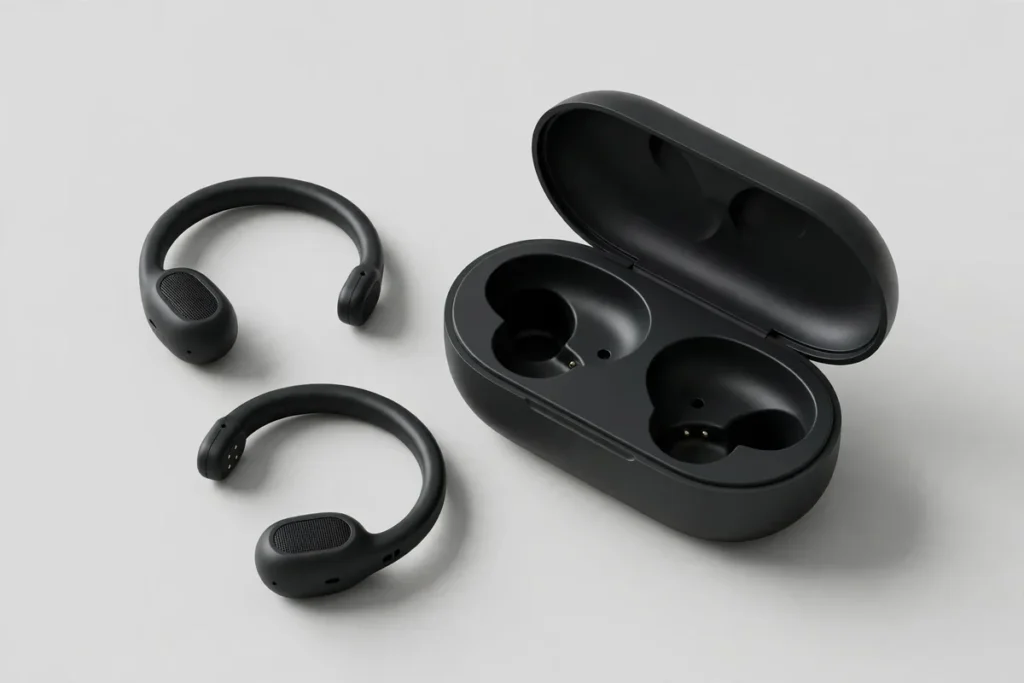
This Bose Ultra Open Earbuds review covers the original cuff-style model, the one that clips around your ear instead of plugging it. Bose built these for people who want music and podcasts running all day without losing track of the room, the road or the people talking to them. That single design choice explains everything else about them: the comfort is the best in the category, the awareness is total, and the bass and noise blocking are limited by physics rather than by engineering effort.
Our verdict up front: if your ears reject in-ear tips, or your listening happens around other people, these are the open earbuds to beat. If your listening happens on planes and loud trains, they are the wrong tool, and no firmware update will change that. The score below reflects the open-ear job they are hired to do, judged against other open earbuds.

How we score: SoundMavericks has not hands-on tested this model. This review is based on Bose’s published specifications, the Amazon listing data and the wider body of independent testing, and the scores above are the same ones carried in our product database. Where the open-ear format sets a ceiling, we score against other open earbuds, not against sealed noise-cancelling flagships.
Design and comfort: a cuff, not a plug
Each bud is a small cuff. A flexible band wraps around the outer ear, a barrel sits behind it as a counterweight, and the speaker rests at the ear opening without entering the canal. There are no tips to size, nothing to twist into place and nothing pressing on the canal walls. At roughly 6.4 grams per bud, most of the weight sits behind the ear rather than hanging off it.
This is why our comfort score is 9.4, the highest mark in this review. People who pull ordinary earbuds out after an hour because of canal pressure can wear these through a working day. Glasses wearers get a particular win: the cuff occupies the same real estate as a frame arm but sits lower and softer, so the two rarely fight. The fit is also secure in a way loose in-ear buds are not. The cuff grips the ear itself, so head turns, chewing and a steady run do not work it loose.
Two honest caveats. First, cuffs depend on ear shape more than tip-sized buds do, so a minority of ears will find the grip loose or slightly pinchy; buy from somewhere with painless returns if this is your first open-ear pair. Second, Bose rates the buds IPX4, which covers sweat and splashes. Rain on a run is fine. Swimming and showers are not.
Sound quality: clear, forward, light at the bottom
Bose’s OpenAudio system fires sound toward the ear canal from close range and shapes it to limit how much spills outward. The result, judged against the open-ear field, is the class benchmark this model set: vocals sit forward and stay intelligible at modest volume, mids carry real detail, and highs are clean without turning sharp. Podcasts and acoustic music suit them particularly well, because the presentation stays clear even with the room audible underneath.
The limit is bass, and it is structural. A sealed bud pressurises the canal, which is what makes sub-bass feel physical. An open cuff cannot do that, so deep electronic lows and the lowest rumble of a film soundtrack arrive thinned out. Mid-bass is present and reasonably warm, kick drums and bass guitar read clearly, but anyone whose library leans on low-end weight will feel the gap. Our sound score of 8.0 is scored within the open-ear category; measured against sealed flagships in a silent room, the same hardware would score lower, and that is the format talking.
Volume headroom matters more here than in sealed buds, because these compete with whatever is happening around you. The Ultra Open get loud enough for streets and stations, but pushing volume to mask a loud environment is the wrong fight to pick with them: sound leaks out as it leaks in, and your neighbours will hear a thin version of your music on a quiet train. In a moderate setting, leakage at normal listening levels is low enough that a colleague at the next desk will not follow your podcast.
Immersive Audio: a wider stage, at a price in hours
Bose’s spatial mode processes stereo so music seems to sit in a space around you rather than inside your head, with head tracking in Still and Motion modes. On the right recordings it is genuinely pleasant: live albums and well-produced pop gain width, and voices stay anchored when you turn your head. On dense or bass-led tracks the effect thins the sound out, and since bass is already this design’s weak point, many owners will leave it off for music and save it for video and podcasts.
The bigger cost is battery. Bose rates playback at up to 7.5 hours in standard stereo and up to 4.5 hours with Immersive Audio running. Treat spatial audio as a per-session choice, switched on for a film or an album you want to sit inside, not as a default you forget about.
Calls: fine at walking pace, weak in wind
The microphones sit outside the ear canal and work without any seal to help them, so call performance depends heavily on where you are. Indoors and on quiet streets, your voice comes through clearly and callers rarely ask you to repeat yourself. Add traffic or wind and the picture changes: gusts hit the mics directly, and because Bose keeps your own environment audible to you, a loud street makes the whole conversation harder work at both ends.
We score calls 7.8. That is respectable for an open design and enough for the way these buds are actually used, which is calls taken while walking, working or watching kids. If your job is back-to-back phone calls from busy places, a sealed pair with a strong mic array will serve you better.
Battery and charging: read the fine print once
The headline numbers deserve one careful pass, because the Amazon listing title advertises up to 48 hours and that figure is standby time, not playback. Here is the real picture from Bose’s own documentation: the buds play for up to 7.5 hours in stereo, or up to 4.5 hours with Immersive Audio on. The case holds up to 19.5 extra hours in stereo, or up to 12 hours if you listen with spatial audio, giving roughly 27 hours of total playback before the case itself needs a cable.
That is strong endurance for open earbuds, and it drives our battery score of 9.0. A full workday per charge plus a case that refills the buds about two and a half times is the right side of enough for almost everyone.
The case is the weak point in daily use. It charges over USB-C only. There is no wireless charging pad support, so the case cannot share the pad your phone sleeps on, and a forgotten cable on a trip means a dead case by the end of it. Bose fixed this on the newer generation; on this model it remains the most-cited everyday annoyance, and it is worth knowing before you buy rather than after.
App, controls and connectivity
Bluetooth 5.3 holds a steady connection to about 30 feet and supports multipoint, so a laptop and a phone can stay connected together and the buds follow whichever one starts playing. Codec support covers SBC and AAC for everything, plus aptX Adaptive under Snapdragon Sound for Android phones that support it, which brings lower latency and higher quality where the phone allows.
Controls are a physical button on each bud’s barrel, handling playback, volume and calls. Buttons beat the tap panels many rivals use: they work with gloves, they do not misfire when you adjust the cuff, and they respond the same way every time. In the Bose app you get an adjustable equaliser, mode and control customisation, and the spatial audio settings. The buds also work with Bose’s SimpleSync, so they can pair with compatible Bose soundbars and smart speakers when you want the TV in your ears and nowhere else.
Bose Ultra Open Earbuds: specs
| Product | Bose Ultra Open Earbuds |
| Design | Open-ear cuff, clips around the ear, nothing in the canal |
| Audio | Bose OpenAudio |
| Noise cancelling | None. Open design, full situational awareness |
| Spatial audio | Immersive Audio with head tracking (Still and Motion) |
| Bluetooth | 5.3 with multipoint (two devices) |
| Codecs | SBC, AAC, aptX Adaptive (Snapdragon Sound) |
| Battery, buds | Up to 7.5 hours stereo; up to 4.5 hours with Immersive Audio |
| Battery, case | Adds up to 19.5 hours stereo (12 hours with Immersive Audio); USB-C charging only, no wireless charging |
| Water resistance | IPX4 (sweat and splashes) |
| Weight | About 6.4 g per bud; case 56.5 g with buds |
| Controls | Physical button on each bud; Bose app with adjustable EQ |
| Colours | Black, White Smoke, plus limited editions |
| Buy | Check Price on Amazon |
Original or 2nd Gen?
Bose has since released a second generation, and the honest summary is that it improves this model point by point rather than replacing the idea. Our full Bose Ultra Open Earbuds (2nd Gen) review covers it in detail. The differences that matter:
Bose Ultra Open Earbuds |  Bose Ultra Open Earbuds (2nd Gen) | |
| Battery, buds | Up to 7.5 hours | Up to 9 hours |
| Case charging | USB-C only | USB-C and wireless |
| Spatial audio | Immersive Audio | Immersive Audio plus Cinema Mode |
| Calls | Standard Bose processing | SpeechClarity call technology |
| Bluetooth | 5.3, multipoint | 5.4, multipoint |
| Buy | Check Price | Check Price |
If the original is selling for meaningfully less, it remains the better value: same cuff, same OpenAudio idea, same awareness. Pay the extra for the newer model when battery life, wireless charging and call clarity are the things you care about most.
Who should buy the Bose Ultra Open Earbuds?
Buy them if your listening wraps around a life rather than replacing it. Office workers who need to hear a question over their music. Parents who need the house audible. Runners and cyclists who treat traffic awareness as a safety feature, not a compromise; our best running headphones guide puts them in context against sportier options. And anyone whose ear canals simply will not tolerate tips, for whom this cuff is the first design that stays on and stays comfortable.
Skip them if your listening happens where the world is the problem: flights, loud trains, open-plan offices you want gone. No open earbud can help there, and the sealed field in our best noise cancelling earbuds guide exists for exactly that job. Bass-first listeners should also look elsewhere, or compare the wider field in our best open-ear Bluetooth earbuds roundup before spending at this level.
Bose Ultra Open Earbuds: FAQ
Do the Bose Ultra Open Earbuds have noise cancelling?
No. They are an open-ear design with no active noise cancelling and no seal, so your surroundings stay fully audible. That is the point of the product. Our ANC score of 1.5 reflects near-zero isolation, which is a design choice here, not a defect.
How long does the battery last?
Up to 7.5 hours from the buds in stereo, or up to 4.5 hours with Immersive Audio on. The case adds up to 19.5 hours, for roughly 27 hours of total playback. The 48-hour figure in the Amazon listing title is standby time, not playtime.
Can they connect to two devices at once?
Yes. Bluetooth 5.3 multipoint keeps two devices connected, such as a phone and a laptop, and playback follows whichever device is active.
Are the Bose Ultra Open Earbuds good for running?
Yes, for awareness-first training. The cuff grips the ear and stays put, the IPX4 rating covers sweat, and you hear traffic the whole time. Wind noise and gym music come straight through, because nothing is blocked.
Do they support wireless charging?
No. The case charges over USB-C only. Wireless case charging arrived with the 2nd Gen model.
Should you buy these or the 2nd Gen?
The 2nd Gen adds battery life, a wireless charging case, Cinema Mode and clearer calls. The original counters with the same comfort and open-ear sound, usually for less money. Our 2nd Gen review has the full comparison.

I am the founder of Sound Mavericks, where I provide the polite truth about audio equipment. I started this site because consumer electronics reviews are often too technical. Instead of using a silent lab, I test headphones, earbuds, and Bluetooth speakers in the real world – like on a noisy subway or in a busy coffee shop.
To stay independent, I buy my own review units (mostly from the United States) rather than accepting free gifts from brands. Once I finish testing a product, I sell it locally to our community. My goal is to help you understand sound quality, active noise cancellation (ANC), and battery life without the marketing hype.
