
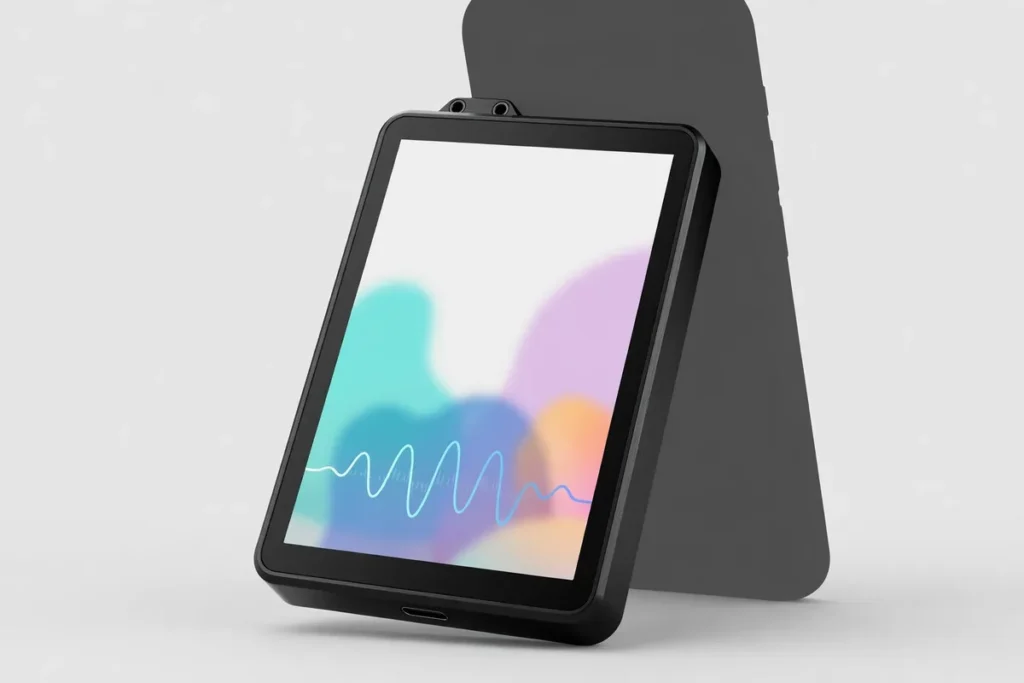
The FiiO DT11 is a portable digital transport. Read that carefully first: the DT11 has no DAC chip and no headphone output. The two 3.5mm sockets on its body look exactly like headphone jacks but carry digital coaxial and optical signals; plugging headphones into them gets you silence. Its job is to store and play your files, then hand a clean, clocked digital signal to an external DAC or DAC/amp, which does the actual listening part.
A note on what this page is. This is a research review and launch briefing built from FiiO’s published specifications and launch details. We have not had a unit on the desk, so there is no hands-on verdict or score from us yet.

Launch review On sale now
Why you: you own a DAC or DAC/amp you rate and want a dedicated source for it: files up to 768kHz and DSD512, dual femtosecond clocks, and a magnetic back that stacks it against your phone.
Trade-off: it makes no sound on its own, so budget for a DAC as well; the sockets that look like headphone jacks are digital outputs only.
Snapdragon 680, Android 13Dual RIVER femtosecond clocksUSB audio to 768kHz / DSD51264GB + microSD to 2TB
FiiO DT11 quick facts
| Product | FiiO DT11 portable digital transport (no DAC, no headphone output) |
| Price | $339.99 (US) |
| Status | On sale now and already in users’ hands; firmware FW1.0.2 is out |
| Amazon US | Live on Amazon US; stock was thin at the time of writing |
| Outputs | 2 x 3.5mm coaxial (one shared with optical), 3.5mm optical, USB-C audio. All digital |
| Battery | 4,000mAh; FiiO rates 24 hours of local playback over coax/optical under test conditions |
What a digital transport is, and why one exists
A digital audio player does three jobs: it stores and plays the files, converts them to analogue, and amplifies the result for your headphones. A transport does only the first job. The DT11 is the player half of a DAP with the conversion and amplification left out, so the whole budget goes into the player half: a fast processor, proper file handling, careful clocking, and outputs that feed the DAC you already chose.
The buyers FiiO has in mind are easy to picture. You own a desktop DAC at home and a dongle DAC for travel, and you are tired of your phone acting as the source for both, interrupting music with notifications and draining its own battery. Or you keep a library of local files and want a screen and a player app without a phone attached. It also streams: open Android 13 runs the usual music apps, with Roon Ready and AirPlay for home use.
Keep the framing honest. FiiO sells a full DAP at this level, with a DAC and a headphone output inside. The DT11 spends the whole budget on the transport half instead. That deliberate, narrow choice only pays off if the DAC on the other end of the cable is good enough to show the difference.
The clock architecture
The engineering headline is the clocking. A Snapdragon 680 runs the system, an EF2L45UG132B FPGA handles the audio data path, and the master clocks are a pair of RIVER femtosecond crystal oscillators, the same clock architecture FiiO uses in its flagship M27 player. Two clocks matter because sample-rate families split in two (44.1kHz multiples and 48kHz multiples), and giving each its own precise oscillator avoids deriving one from the other.
FiiO quotes coaxial jitter below 67 picoseconds RMS. Treat it as a manufacturer figure: FiiO has not published the test method, so it cannot be compared against anyone else’s number, and nobody has measured it independently yet. Jitter is easy to chase on paper and hard to hear; read the dual-clock design as careful engineering, not a promise about what your ears will report.
Outputs, formats and the limits of each
There are four ways out, all digital. USB-C audio is the strongest path: up to 768kHz/32-bit PCM and DSD512 into a compatible DAC. Coaxial from the two 3.5mm sockets, one dedicated and one shared with optical, reaches 384kHz/24-bit with DSD128. Optical tops out at 192kHz/24-bit, the usual ceiling for the format. On-device decoding runs natively to 384kHz/32-bit and DSD256, with MQA full decode, an ALL TO DSD mode, and a 10-band parametric EQ with AUTO EQ.
The shared socket is where a first-time buyer will stumble, so once more: that 3.5mm port carries a coaxial or optical digital signal, not headphone audio. There is no analogue output anywhere on this device. DACs with only a USB input use the USB-C; coax and optical inputs are covered too.
Around the outputs sit the practical details. The 4.7-inch laminated touchscreen runs at 750×1334. Storage is 64GB built in, about 52GB usable, plus microSD up to 2TB. Two USB-C ports split data from charging, there is a HOLD switch, and a magnetic ring on the back stacks the DT11 against a phone MagSafe-style. Bluetooth transmits with aptX HD, LDAC and LHDC and receives with SBC and LDAC; dual-band Wi-Fi covers AirPlay, Roon and file transfer. It measures about 68.7 x 121 x 17.7mm, weighs about 192g, and comes in black or silver.
Battery life and the power strategy
The battery is 4,000mAh, and FiiO’s headline figure needs its conditions attached: 24 hours of local playback over the coaxial or optical outputs, playing MP3 files at 44.1kHz/16-bit with the screen off and EQ off. Driving FiiO’s own QX11 dongle over USB, FiiO rates 12 hours single-ended and 11 hours balanced, because the battery is now feeding the DAC as well.
That second job is deliberate: up to 9W of reverse output powers a connected dongle DAC, so the stack runs off one battery instead of draining two unevenly. A separate POWER IN port keeps charging apart from data, and PD fast charging refills the battery in about two hours on FiiO’s figures. Our portable DAC for iPhone guide covers the phone-plus-dongle setup this device is designed to replace.
What it pairs with
A transport is only half a system; FiiO’s own dongles are the obvious partners: the FiiO QX11 is the gaming-leaning one, the FiiO QX13 the flagship that spends everything on conversion quality. Either completes the rig, as does any DAC you own with a USB, coaxial or optical input.
FiiO DT11 full specifications
| Product | FiiO DT11 Check Price |
| Type | Portable digital transport. No DAC and no headphone output; the 3.5mm sockets carry digital coaxial/optical only |
| Price | $339.99 (US) |
| Processor | Qualcomm Snapdragon 680; FPGA EF2L45UG132B |
| Clocks | Dual RIVER femtosecond crystal oscillators |
| Coaxial jitter | Below 67ps RMS (FiiO figure; test method not disclosed) |
| Operating system | Android 13 (open). Modes: Android, Pure Music, AirPlay, USB DAC, Bluetooth receiving |
| Display | 4.7-inch laminated touchscreen, 750×1334 |
| Memory and storage | 4GB RAM; 64GB storage (about 52GB usable); microSD up to 2TB |
| Digital outputs | 2 x 3.5mm coaxial (one dedicated, one shared with optical); 3.5mm optical (shared); USB-C audio |
| Format ceilings | USB audio to 768kHz/32-bit and DSD512; coaxial to 384kHz/24-bit and DSD128; optical to 192kHz/24-bit |
| Decoding | Native to 384kHz/32-bit and DSD256; MQA full decode; ALL TO DSD; 10-band PEQ with AUTO EQ |
| Wireless | Wi-Fi 2.4/5GHz (AirPlay, Roon Ready, Wi-Fi transfer); Bluetooth 5.0 transmit (SBC, aptX, aptX HD, LDAC, LHDC) and receive (SBC, LDAC); FiiO Link app |
| Ports and controls | USB-C (USB 3.0, charge/data); separate USB-C POWER IN; HOLD switch; magnetic back ring |
| Battery | 4,000mAh. FiiO rates 24 hours of local playback over coax/optical (MP3 44.1kHz/16-bit, screen off, EQ off); 12 hours (single-ended) or 11 hours (balanced) driving a FiiO QX11 over USB; up to 9W reverse output for a connected DAC; PD fast charge in about 2 hours |
| Size and weight | About 68.7 x 121 x 17.7mm; about 192g; black or silver |
Who the DT11 is for, and who should skip it
Buy it if you already own the other half: a desktop DAC that lacks a decent source, a dongle DAC you want to feed from something other than your phone, a large local library you want on a dedicated screen. The magnetic back also makes the phone stack tidier than a loose dongle on a cable.
Skip it if you do not own a DAC. Most people shopping at this level need the DAC first, because the DT11 plus no DAC equals no music. Skip it if one box is the appeal: a DAP puts the player, DAC and amplifier in a single unit for similar money. And skip it if you stream from your phone through a dongle you are happy with: the DT11 improves the source half of that chain, and if that half was never your problem, there is nothing here to fix.
FiiO DT11 FAQ
Can I plug headphones straight into the FiiO DT11?
No. The DT11 has no DAC and no headphone output. Its 3.5mm sockets carry digital coaxial and optical signals, so headphones need an external DAC or DAC/amp between the DT11 and them.
What does a digital transport do that a phone does not?
It plays your files and apps on a dedicated device with its own battery, a local library on microSD, and precisely clocked digital outputs, including coaxial and optical connections a phone cannot offer. The conversion still happens in your DAC; the transport just feeds it cleanly and leaves your phone out of the chain.
How long does the DT11 battery last?
FiiO rates it at 24 hours of local playback over the coaxial or optical outputs with MP3 files at 44.1kHz/16-bit, the screen off and EQ off. Powering a FiiO QX11 dongle over USB, the rating drops to 12 hours single-ended and 11 hours balanced.
Which DACs pair well with the DT11?
Any DAC with a USB, coaxial or optical input. FiiO’s own QX11 and QX13 dongles are the natural partners, and a desktop DAC gains a portable, screen-equipped source it can share with your travel setup.

I am the founder of Sound Mavericks, where I provide the polite truth about audio equipment. I started this site because consumer electronics reviews are often too technical. Instead of using a silent lab, I test headphones, earbuds, and Bluetooth speakers in the real world – like on a noisy subway or in a busy coffee shop.
To stay independent, I buy my own review units (mostly from the United States) rather than accepting free gifts from brands. Once I finish testing a product, I sell it locally to our community. My goal is to help you understand sound quality, active noise cancellation (ANC), and battery life without the marketing hype.

