
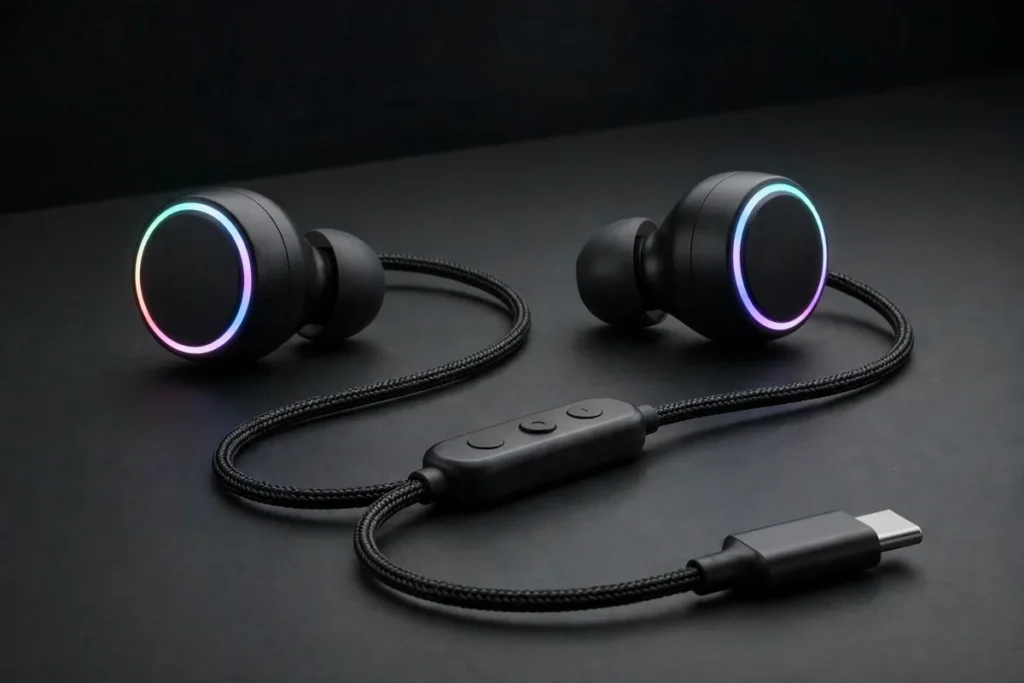
This Razer Hammerhead V3 Chroma review covers the wired earbud oddity of the moment: a USB-C gaming pair with active noise cancelling and no battery anywhere in the design. The ANC electronics, the dual drivers and the Chroma lighting all run on power drawn down the cable from your phone, handheld or PC. Nothing needs charging and nothing runs flat mid-match. The trade is a cable, and a USB-C port that stays busy while you listen.
Our verdict is research-based, and we say so plainly. It is built from Razer’s published specifications, the verified Amazon US listing linked below, and early hands-on coverage from gaming outlets, then scored on the same six categories we use across the site. We have not tested the V3 Chroma on our own ears, so treat the scores as provisional.

Why you: Real feed-forward ANC and two drivers per ear in a wired bud that never needs charging, plus a 90-degree plug shaped for phones and handhelds held sideways.
Trade-off: The ANC is gentle rather than strong, the cable is on the stiff side, and the plug occupies your USB-C port for as long as you listen.
One score needs a note before the detail. The Battery bar reads 5.0 because that is our neutral placeholder for wired models, and the V3 Chroma has no battery to rate. That pulls the 7.3 overall down on paper. In practice the missing battery is the point of the product: the ANC, the lights and the drivers sip power from the host device instead of a cell of their own, so the cancellation never dies halfway through a session. Read the other five bars as the real verdict.
ANC with no battery to charge
Noise cancelling needs power, and power is the reason every ANC earbud until now has carried a battery. Razer moves that cost onto the device at the other end of the cable. The V3 Chroma draws its power over USB-C, which is what makes ANC possible in a bud this small with no case to recharge and no runtime figure to manage.
The implementation is feed-forward, the simpler of the two common ANC designs. A microphone on the outside of each housing samples the noise around you, and the electronics play an inverted copy of it through the driver. Feed-forward systems cope well with steady, low sound: fan hum, air conditioning, engine drone, train rumble. They struggle with irregular sound, and early hands-on reports line up with that. Voices in a shared room and the clack of a mechanical keyboard stay audible, just dulled. A good seal from the ear tips matters more than usual here, because the single external microphone has no partner inside the ear to correct what leaks past.
Set expectations accordingly. This is ANC for taking the edge off a commute or a noisy living room during a match, not the deep quiet of a flagship wireless bud. Razer publishes no cancellation depth figure, and no transparency mode has been announced, so hearing traffic or a doorbell means taking a bud out.
Design: the 90-degree plug does the quiet work
The detail that gives the design away is the plug. A straight USB-C connector sticks out of the bottom of a phone or handheld and digs into your palm when you hold it sideways. The V3 Chroma bends its plug 90 degrees, so the cable turns along the edge of the device and stays clear of your grip. It is a small thing that solves a real annoyance for handheld gaming, and it costs nothing in sound.
Controls live on an inline remote where the two earbud cables meet, with raised buttons you can find by touch: volume, play and pause, an ANC switch, a microphone mute and control of the RGB lighting. The omnidirectional microphone sits on the same remote. Each housing carries a ring of Chroma RGB, lit from the cable power and set through Razer’s software, with 16.8 million colors on tap. Early reviewers liked the light weight and the secure fit from the included tip sizes. The cable itself drew the one repeated complaint: its coating is stiff, holds bends and tangles more readily than a soft rubber cord. IPX4 sealing covers sweat and rain. It is not a rating for the shower or the pool.
Sound quality: two drivers per ear
Each earbud runs two drivers. An 11mm dynamic driver handles the low end, and a dedicated 6mm tweeter takes the highs, so neither driver has to stretch across the whole range. The signal path is digital and wired end to end, which means no Bluetooth compression between your device and the drivers. Early listening reports describe a balanced, clear presentation with good separation between instruments, and a low end that can feel light with acoustic material that leans on bass weight. Game effects and dialogue sit in the part of the range this tuning handles best.
Four EQ presets cover Gaming, Music, Movies and Calls, with one custom profile for your own tuning. On PC, Razer Synapse 4 adds THX Surround Sound 7.1, which widens the image for games and films. That surround processing is a PC feature delivered by software, not something the earbuds produce on their own, and it stays behind when you plug into a phone. Our PC gaming earbud guide is the place to compare this approach with the wider field: see our best earbuds for PC gaming roundup.
Calls and team chat
The microphone is omnidirectional and sits on the inline remote, which puts it closer to your mouth than the microphones built into a wireless bud’s housing. That placement is the right call for chat: your voice arrives louder relative to the room, and the mute switch on the remote kills your mic mid-match without opening a menu. Razer builds this line for gaming first, so chat clarity gets priority over the wind handling a commuter bud would need. Calls from a quiet room or a desk setup play to its strengths.
Compatibility: USB-C or nothing
The V3 Chroma is a digital USB-C device, full stop. It works with phones, tablets, handheld consoles and computers that output audio over USB-C. It has no Bluetooth radio and no 3.5mm plug, so a headphone jack cannot save it and older phones with Lightning ports are out. Two practical consequences follow. First, your only port is occupied while you listen, so charging at the same time needs a second port or a splitter. Second, the buds draw a small amount of power from the host the whole time, ANC and lighting included. It is a sip rather than a gulp, but on a long handheld session it comes out of the same battery you are gaming on. The bigger wired-versus-wireless trade-offs are covered in our wired vs wireless headphones comparison.
Razer Hammerhead V3 Chroma specs
How it differs from the Hammerhead V3 Wired
Razer also sells a plainer Hammerhead V3 Wired, and the two are easy to confuse. That model connects over 3.5mm, runs a single 11mm driver per ear, and has no noise cancelling and no lighting. The Chroma version in this review swaps the jack for USB-C, adds the 6mm tweeter, the feed-forward ANC, the Chroma rings and the THX processing on PC. If your devices still have headphone jacks and you want the simplest wired option, the plain model exists for that. If ANC and the handheld-friendly plug are the draw, the Chroma is the one built for you.
Who should buy the Hammerhead V3 Chroma
Buy it if you game on a handheld or phone and hate the charging ritual. It is ready the second you plug it in, it adds real if modest noise cancelling for shared rooms and commutes, and the angled plug respects how handhelds are actually held. It also suits desk players who want one wired pair for PC matches, calls and music, and it sits in the competitive band covered by our best gaming earbuds under 100 guide.
Skip it if your phone still needs its port free while you listen, if you want the strong ANC a flagship wireless bud delivers on a flight, or if a 3.5mm jack is the whole reason you buy wired gear. Skip it, too, if cables themselves are the dealbreaker: no angled plug fully fixes a cord catching on a jacket zip.
The short version: the V3 Chroma takes the two annoyances of wireless gaming buds, charging and latency, and deletes both, then spends the savings on ANC and a second driver. What it asks in return is your USB-C port and your tolerance for a cable. For handheld players, that trade reads fair.
FAQ
Does the Razer Hammerhead V3 Chroma need charging?
No. There is no battery in the buds or anywhere else in the design. The drivers, the ANC and the lighting draw power from the connected device over USB-C, so the earbuds keep working for as long as the host device has charge.
How strong is the noise cancelling?
It is feed-forward ANC, sampled by a single external microphone on each earbud. Early coverage finds that it takes the edge off steady low noise such as fans and engine drone, while voices and sharp sounds still get through. Razer publishes no cancellation depth figure, and no transparency mode has been announced.
Does the Hammerhead V3 Chroma work with iPhone?
It works with any device that outputs audio over USB-C, including USB-C iPhones, Android phones, tablets, handheld consoles and computers. It cannot connect to a Lightning port or a 3.5mm headphone jack.
Is THX 7.1 available on a phone?
No. THX Surround Sound 7.1 runs on PC through Razer Synapse 4. Plugged into a phone or handheld, you get the dual-driver stereo output and the ANC, without the surround processing.
Is the microphone good enough for team chat and calls?
The omnidirectional microphone sits on the inline remote, closer to your mouth than microphones built into an earbud housing, and the remote carries a mute control. It is built for chat and calls first, which is how the Calls score above reads it.

I am the founder of Sound Mavericks, where I provide the polite truth about audio equipment. I started this site because consumer electronics reviews are often too technical. Instead of using a silent lab, I test headphones, earbuds, and Bluetooth speakers in the real world – like on a noisy subway or in a busy coffee shop.
To stay independent, I buy my own review units (mostly from the United States) rather than accepting free gifts from brands. Once I finish testing a product, I sell it locally to our community. My goal is to help you understand sound quality, active noise cancellation (ANC), and battery life without the marketing hype.
