
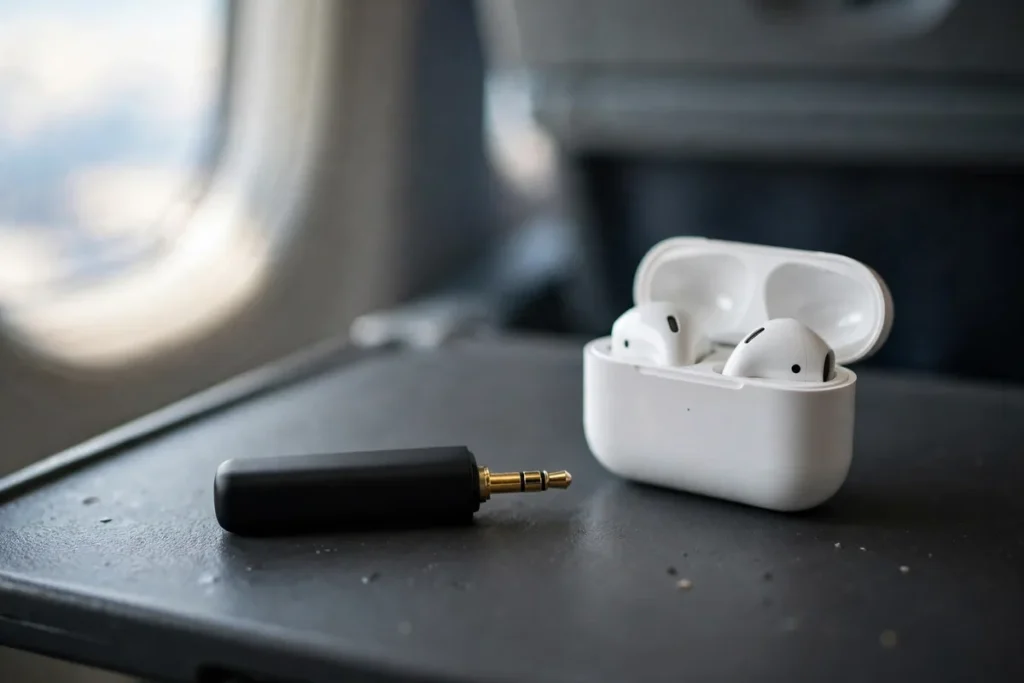
The iFi UP Travel Max is a pocket Bluetooth transmitter and receiver built for the two places wireless headphones still fall down: the seatback screen on a plane and the aux socket in an older car. It steps up from the original UP Travel with Bluetooth 5.4 and one headline change, aptX Lossless that works in both directions. LDAC, Auracast and a separate Cirrus Logic MasterHIFI DAC sit underneath. It is on sale now through iFi’s own store and listed on Amazon US.
A note on what this page is. This is a launch review: a paper analysis built from iFi’s published specifications, the verified Amazon US listing and the first launch coverage. We have not had a unit on the desk, so there is no hands-on verdict or score from us yet. This page updates as hands-on coverage appears.

Launch review On sale now
What it is: A two-way Bluetooth 5.4 adapter with a hi-fi layout: a dedicated Qualcomm Bluetooth chip handles the link, a separate Cirrus Logic MasterHIFI DAC handles conversion, and the 3.5mm plug flips out of the body like a car key.
Watch out: aptX Lossless only delivers CD quality when the device at the other end supports it too. The rest of the spec sheet is iFi’s own figures until hands-on reviews land.
Bluetooth 5.4 TX + RXaptX Lossless both waysLDAC + AuracastMasterHIFI DAC400mAh, 10h+ battery
iFi UP Travel Max quick facts
| Product | iFi UP Travel Max Bluetooth transmitter/receiver and DAC |
| Modes | Transmitter (TX) and receiver (RX), selected by a side switch |
| Bluetooth | 5.4, with Auracast broadcast |
| Codecs | aptX Lossless, LDAC, LHDC/HWA, aptX Adaptive, aptX HD, aptX, AAC, SBC |
| DAC | Cirrus Logic MasterHIFI, separate from the Qualcomm Bluetooth chip |
| Battery | 400mAh, rated at least 10 hours, charges over USB-C |
| Launch price | $129 (US) |
| Status | On sale now |
| Where to buy | iFi’s online store and Amazon US |
| Amazon US | Listed, ASIN B0HN73BXCF |
What the UP Travel Max is
The Max is a step-up model, not a replacement: the original UP Travel stays in the range below it. The shape carries over, a USB-stick footprint of 55 x 30 x 16.8mm and 25.7 grams, with the 3.5mm plug folded into the body. Press the power button and the plug springs out, car-key style, with no dangling cable.
In transmit mode the plug goes into anything with a headphone jack: a seatback entertainment system, a laptop, a classic iPod or portable CD player. The audio streams out to your wireless headphones. USB-C works as a digital input in this mode too, taking audio up to 24-bit/96kHz from a phone or computer. In receive mode the flow reverses: plug the Max into a car’s aux input or a powered speaker, and it pulls a Bluetooth stream from your phone and feeds it out in analogue. A built-in microphone with Qualcomm noise and echo suppression covers hands-free calls on the road.
Controls stay physical, which matters in a cramped seat. A CODEC button cycles the Bluetooth format in transmit mode, an A/B button manages two paired headsets, and in receive mode a voice prompt announces the codec or sample rate.
Lossless in both directions
aptX Lossless is the reason this model exists. It carries CD-quality audio, 16-bit/44.1kHz, over Bluetooth without the lossy compression of standard codecs. Travel adapters have offered it for sending before; iFi says the Max is the first that also receives it, so a phone that supports the codec can feed a car stereo or home system losslessly, with the Max’s own DAC doing the conversion. Treat the first-in-class line as iFi’s claim. The condition that matters is simpler: Lossless only engages when the device at the other end of the link supports it, and when the radio conditions let the link hold the rate.
Underneath Lossless sits a full ladder. LDAC covers hi-res streaming to and from compatible gear. aptX Adaptive includes a low-latency mode that keeps dialogue in step with the picture on a film, the detail that makes or breaks seatback viewing. aptX HD, aptX, AAC and SBC fill out the compatibility end. One gap in iFi’s material: the codec list is published as a single roster, with no split of which formats run in which direction. Our Bluetooth codecs explainer walks through what each format can and cannot do.
A DAC of its own
Most adapters let the Bluetooth chip’s built-in converter do the analogue work, because it is cheap and small. iFi splits the jobs between specialists instead. A dedicated Qualcomm chip runs the wireless link, and a Cirrus Logic MasterHIFI DAC with its own amplifier stage handles conversion, the same DAC family iFi fits in its portable hi-fi gear. The split matters most in receive mode, where the 3.5mm output is the product: iFi rates it at 70mW and 1.5V into 32 ohms, with signal-to-noise of at least 120dBA and THD+N at 0.004% or lower. Those are manufacturer figures, not measurements.
Two software pieces ride on top. JVCKENWOOD’s K2 Technology aims to restore harmonics and fine detail that compression strips out; it is switched from the iFi Nexis app, which also handles over-the-air firmware updates, codec management and the Auracast controls.
Sharing the stream: dual pairing and Auracast
Two pairs of headphones can connect at once in transmit mode, which answers the two-people-one-screen problem on a flight without a splitter or a shared earbud. Auracast goes further: it broadcasts the stream so any number of compatible receivers, headphones, earbuds or speakers, can tune in at once. The gear at the other end has to support the standard, but it turns one seatback socket into a group feed, and iFi lists even its own portable DACs among the things that can listen in.
UP Travel Max vs the original UP Travel
The comparison that decides most purchases is inside iFi’s own range. The original keeps the same two-way idea, MasterHIFI DAC and 400mAh battery. The Max adds a newer Bluetooth generation, Lossless at both ends, Auracast and K2.
| iFi UP Travel Max | iFi UP Travel | |
|---|---|---|
|  | |
| Bluetooth | 5.4 | 5.2 |
| aptX Lossless | Yes, transmit and receive | No |
| Other codecs | LDAC, LHDC/HWA, aptX Adaptive, aptX HD, aptX, AAC, SBC | LDAC, LHDC/HWA, aptX Adaptive, aptX HD, aptX, aptX Low Latency, AAC, SBC |
| Auracast | Yes | No |
| K2 Technology | Yes, via the Nexis app | No |
| DAC | Cirrus Logic MasterHIFI | Cirrus Logic MasterHIFI |
| Battery | 400mAh, at least 10 hours | 400mAh, about 10 hours |
| Check Price | Check Price |
iFi UP Travel Max full specifications
| Product | iFi UP Travel Max Check Price |
| Type | Bluetooth transmitter/receiver with DAC, flip-out 3.5mm plug |
| Bluetooth | 5.4, transmit and receive, Auracast broadcast, dual headphone pairing |
| Codecs | aptX Lossless, LDAC, LHDC/HWA, aptX Adaptive, aptX HD, aptX, AAC, SBC |
| DAC chip | Cirrus Logic MasterHIFI, with hi-fi amplifier stage |
| Bluetooth chip | Qualcomm, dedicated to the wireless link |
| Analogue output (RX) | 70mW / 1.5Vrms into 32 ohms |
| THD+N | 0.004% or lower at 1kHz, 32 ohms |
| SNR | At least 120dBA into 32 ohms |
| Inputs | TX: 3.5mm aux, USB-C (digital audio up to 24-bit/96kHz). RX: Bluetooth 5.4 |
| Outputs | TX: Bluetooth 5.4. RX: 3.5mm aux |
| Microphone | Built in, Qualcomm noise and echo suppression, for hands-free calls in RX mode |
| Battery | 400mAh, at least 10 hours; charges over USB-C |
| Dimensions | 55 x 30 x 16.8mm |
| Weight | 25.7g |
| App | iFi Nexis (firmware updates, codec management, K2 and Auracast controls) |
| Launch price | $129 (US) |
Early coverage and what is still unknown
Coverage so far is announcement-led. Head-Fi carried iFi’s launch release, Notebookcheck and MajorHiFi covered the announcement, and TechRadar picked out the use cases: flights, older cars, classic iPods. Nobody has published a hands-on review yet, so there are no independent sound impressions and no measured battery figures. Everything above traces back to iFi’s spec sheet and launch material.
Three details stay open. First, the per-direction codec split: the roster is published whole, so which formats run in transmit and which in receive is unconfirmed. Second, launch write-ups disagree on the shared-stream codec with two headphones paired: one reports the stream now holding aptX Adaptive instead of dropping to SBC, another’s spec summary lists SBC only for that mode. iFi’s own comparison material calls the dual pairing improved without naming the codec. Third, battery: at least 10 hours is the rating, and on the original model one reviewer measured about 8.5 hours running LDAC at high volume, so plan on high-bitrate codecs landing under the headline number.
Should you buy the UP Travel Max, or wait?
The buy case is a specific kit list. You fly with aptX Lossless headphones and want seatback audio at the codec’s full rate rather than a lossy fallback. You drive an older car with an aux socket and a phone full of music. You keep a classic player in service and want it on wireless headphones. One 25.7 gram stick covers all three jobs, and the receive direction is the part no rival adapter we know of matches yet.
Choose differently if your headphones top out at AAC or SBC: the original UP Travel does the same two-way job for less. If your car already streams well, you only need the transmit half, and simpler adapters exist. The headphone side matters as much as the adapter: our best noise cancelling headphones for travel guide covers the sets worth pairing with it, and the wider field of wireless DAC gear sits in best Bluetooth DAC amps.
Also consider
Two adapters that cover part of the same ground.
The original two-way adapter: Bluetooth 5.2, LDAC, dual pairing and the same MasterHIFI DAC, without aptX Lossless or Auracast.

The travel adapter most people start with: pairs two sets of AirPods or headphones with a seatback screen, in a simpler package without the hi-fi codec roster.
iFi UP Travel Max FAQ
How much does the iFi UP Travel Max cost?
The US launch price sits in the quick facts box above. The card’s Check Price button shows the current Amazon figure.
What does the UP Travel Max actually do?
It moves audio across the wired and wireless divide in both directions. In transmit mode it takes sound from a headphone jack or USB-C source, a seatback screen or a laptop, and sends it to Bluetooth headphones. In receive mode it takes a Bluetooth stream from your phone and feeds it into a car aux input or powered speaker as analogue audio.
Is aptX Lossless really two-way on the UP Travel Max?
iFi says yes: the Max is presented as the first travel adapter that can both send and receive aptX Lossless. Your headphones or source need to support the codec as well; when they do not, the Max falls back to LDAC or the next best shared format.
How long does the UP Travel Max battery last?
The 400mAh cell is rated for at least 10 hours and charges over USB-C. Expect high-bitrate codecs such as Lossless and LDAC to land under that headline figure; no independent battery test exists yet.
Where can I buy the iFi UP Travel Max?
It is on sale at iFi’s online store and listed on Amazon US (ASIN B0HN73BXCF). Check the listing is the UP Travel Max itself, not the original UP Travel, which stays on sale below it.

I am the founder of Sound Mavericks, where I provide the polite truth about audio equipment. I started this site because consumer electronics reviews are often too technical. Instead of using a silent lab, I test headphones, earbuds, and Bluetooth speakers in the real world – like on a noisy subway or in a busy coffee shop.
To stay independent, I buy my own review units (mostly from the United States) rather than accepting free gifts from brands. Once I finish testing a product, I sell it locally to our community. My goal is to help you understand sound quality, active noise cancellation (ANC), and battery life without the marketing hype.

