
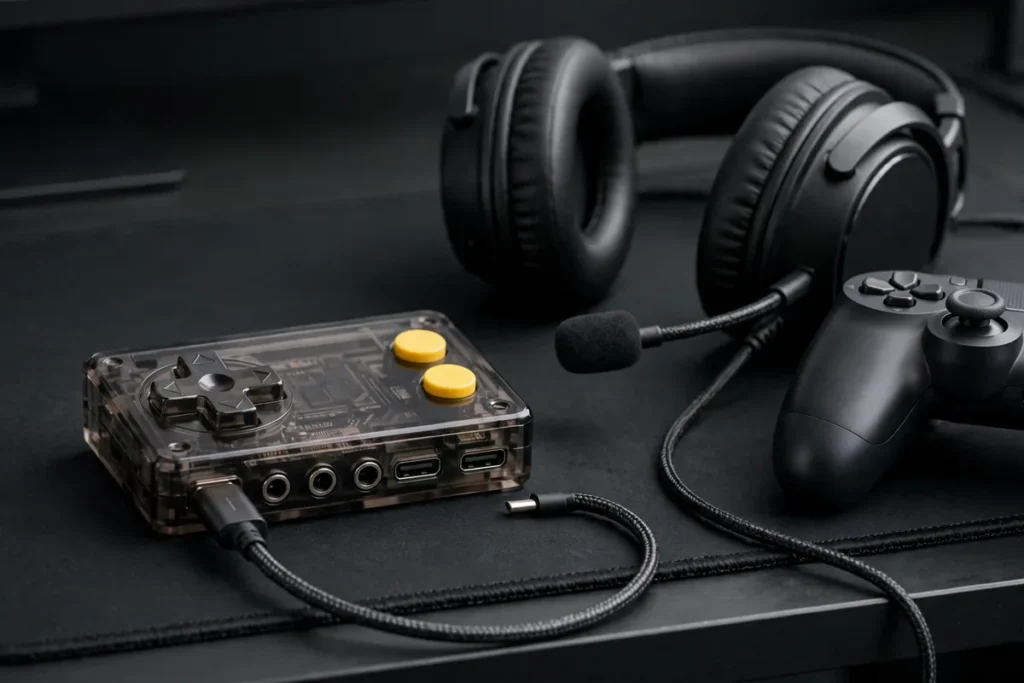
The FiiO Snowsky Mage is a USB-C gaming sound card styled like a tiny retro handheld console, built around a 400MHz SpaceTouch SPV6040D processor. It promises virtual 7.1 surround for games, a proper microphone input with AI noise reduction for voice chat, and 60W passthrough charging for the host device, across PC, PS5, Switch, Android and iOS. Snowsky is FiiO’s retro-styled budget brand, and the Mage is its first gaming sound card.
A note on what this page is. This is a launch review: a paper analysis built from FiiO’s published specifications and the launch coverage so far. We have not had a unit on the desk, so there is no hands-on verdict or score from us yet. This page updates as independent reviews and measurements appear.

Launch review On sale now
What it is: FiiO’s gaming sound card under the Snowsky brand: a 400MHz DSP dongle with virtual 7.1 surround, separate 3.5mm sockets for headphone, headset and microphone, and a second USB-C port passing 60W charging to the host.
Watch out: FiiO publishes no output-power figure, so plan on IEMs and easy-to-drive headphones rather than demanding full-size sets. The 60W figure is charging for your device, not audio power, and the 7.1 is virtual processing over stereo headphones.
SpaceTouch SPV6040D 400MHz DSPVirtual 7.1 surround (HRTF)60W PD passthrough chargingPCM 384kHz / DSD256
FiiO Snowsky Mage quick facts
| Product | FiiO Snowsky Mage USB-C gaming DAC |
| Processor | SpaceTouch SPV6040D, 400MHz, NPU + DSP multi-core, up to 100 GOPS |
| Outputs | Three 3.5mm sockets: headphone, headset and microphone |
| Launch price | $19.99 (US) |
What the Mage is
Snowsky is where FiiO puts its playful hardware: retro-styled mini players sold well below the main FiiO line. The Mage takes the same approach to a gaming sound card. The shell is shaped like a small handheld console, with gamepad-style controls on the face and a board you can see through the transparent finishes. At about 15 grams it adds almost nothing to a phone or a Switch case.
Three finishes exist: Trans Black, Trans Green and Grey, and the Amazon US listing linked here is the black version. FiiO’s launch material shows a braided USB-C to USB-C cable and a quick start guide in the box. Compatibility is the point: one small box that gives any of those hosts a wired headset output, a microphone input and better processing. It sits at the opposite end of FiiO’s range from the flagship FiiO QX13 dongle, which spends everything on conversion quality for music; the Mage spends its much smaller budget on gaming features.
The chip and the virtual 7.1
The SPV6040D is a 400MHz audio processor from SpaceTouch with NPU and DSP cores, rated by FiiO at up to 100 GOPS. That headroom runs the Mage’s main trick: eight independent audio channels are processed and folded down to stereo using an HRTF-based spatial engine, which is what “virtual 7.1” means here. There are no real surround speakers; the chip places sounds around your head using timing and level cues on ordinary headphones.
Gaming mode carries four tuning presets, for FPS, MOBA, RPG and rhythm games. The FPS preset matters most if it works as advertised, because footstep and reload cues live in a narrow band a preset can push forward. Virtual surround quality varies a lot between implementations, so treat this as FiiO’s claim until independent listening tests appear.
HiFi mode and the FiiO Control app
A second mode drops the gaming processing for music. HiFi mode has seven built-in sound profiles, and the FiiO Control app adds a 10-band parametric EQ on top. Decoding runs to PCM at 32-bit/384kHz with native DSD256, level with FiiO’s budget music dongles on format support. FiiO cites metal film resistors and tantalum capacitors as quality evidence. The honest reading is that the music hardware is built to a price: the Mage’s pitch against a music dongle is that it does gaming as well, not that it replaces one.
The microphone half: three jacks and AI noise reduction
Most dongles give you one socket and walk away; the Mage has three 3.5mm connections: headphone output, headset socket, dedicated microphone input. The third one matters most: it lets a streamer or competitive player run a separate wired microphone instead of the one built into a headset, and gives a Switch or phone a mic input those devices handle badly on their own.
The mic path runs through a TI OPA330 precision op-amp, with an AI noise reduction algorithm pitched at stripping keyboard clatter and room noise out of voice chat. There is a physical mute button on the body, the control you actually want mid-game. How well the noise reduction works is untested outside FiiO’s demos.
Charging: the second USB-C port
Two USB-C ports split the jobs. One carries audio from the host; the other, marked POWER IN, takes a charger and passes up to 60W of PD charging through to the device doing the playing. That solves the oldest dongle problem for handhelds: audio or charging, pick one. The Mage has no battery and runs on host power, and the 60W ceiling depends on your charger and your device asking for it; the Mage is the bridge, not the power source.
Who the Mage is for
The clearest case is a console or phone gamer with a wired headset who wants cleaner voice chat and wider game audio, without buying a full gaming DAC. Streamers starting out get the mic input and mute button. Our best DAC amp for gaming guide covers the bigger, more powerful end of this category.
Skip it if music is the whole job: FiiO’s own budget dongles below do that with published power figures. Skip it if your headphones are hard to drive, because with no output-power figure published there is no evidence the Mage will push demanding full-size sets. And skip it if you need balanced output or wireless; the Mage is 3.5mm and USB only.
Mage vs QX11 and KA11
The cross-shops sit inside FiiO’s own catalogue. The FiiO QX11 is the serious gaming dongle: dual ESS DAC chips, a balanced output with real power behind it, a display and a built-in microphone, at a far higher price. The KA11 is the simple music dongle at Mage money, with a published 245mW output and nothing for a microphone. The Mage threads between them: the QX11’s gaming brief at KA11 pricing, and no published power figure where both rivals state theirs.
| FiiO Snowsky Mage | FiiO QX11 | FiiO KA11 | |
|---|---|---|---|
|  |  | |
| Main chip | SpaceTouch SPV6040D (400MHz DSP) | Dual ESS ES9069Q | Cirrus Logic CS43131 |
| Headphone outputs | 3.5mm headphone, plus separate headset and microphone sockets | 3.5mm + 4.4mm balanced | 3.5mm |
| Output power | Not published by FiiO | 800mW + 800mW balanced (Desktop Mode, 32Ω); 360mW + 360mW on USB power | 245mW at 16Ω; 200mW at 32Ω |
| Gaming and mic | Virtual 7.1, four game presets, AI mic noise reduction, mic mute button, 60W passthrough charging | Gaming presets, built-in microphone, 1.14-inch display | None; UAC1.0 console mode via the app |
| Check Price | Check Price | Check Price |
FiiO Snowsky Mage full specifications
| Product | FiiO Snowsky Mage Check Price |
| Processor | SpaceTouch SPV6040D, 400MHz, NPU + DSP, up to 100 GOPS |
| Audio channels | 8 independent channels; virtual 7.1 surround (HRTF) |
| Game mode | Four presets: FPS, MOBA, RPG, rhythm |
| HiFi mode | Seven built-in sound profiles |
| EQ | 10-band parametric EQ via the FiiO Control app |
| Max format | PCM 32-bit/384kHz, native DSD256 |
| Headphone outputs | 3.5mm headphone socket, 3.5mm headset socket |
| Microphone input | 3.5mm mic socket; TI OPA330 op-amp; AI noise reduction; physical mute button |
| USB ports | 2 × USB-C (audio from host; POWER IN for charging) |
| Charging | PD passthrough to the host, up to 60W |
| Battery | None; powered by the host device |
| Weight | Approx. 15g |
| Launch price | $19.99 (US) |
Early coverage and what is still unknown
Coverage so far is launch news rather than reviews: KitGuru and Vortez ran the release with FiiO’s feature list. Nobody has published a review, a measurement set or a listening test of the surround processing or the microphone noise reduction. FiiO’s launch material also leaves gaps: no output-power figure, no SNR or distortion numbers, no dimensions. Until units reach reviewers, the paper specification is all there is to judge.
Should you buy the Mage, or wait?
The buy case is the bundle. Nothing else in our coverage at this level combines a microphone input, virtual surround processing, passthrough charging and hi-res decoding in one 15-gram box. If you game on a Switch, a handheld PC or a phone with a wired headset, it reads like it was written from your complaint list.
Choose differently if you need proven power or proven sound: the QX11 publishes its output figures and has been through reviewers’ hands, and the music dongles below are the safer spend when gaming is not the job. Waiting costs little either: the first independent reviews will settle whether the 7.1 processing earns its place.
Also consider
Portable DACs we have already reviewed and scored.
Our top budget dongle: a CS43131 DAC with a published 245mW output, the simple first upgrade for phone listening.

Dual CS43198 chips and 550mW with a 4.4mm balanced output: the FiiO dongle to pick when music comes first.

Battery-powered, so it never drains your phone: 400mW balanced output, XBass, iEMatch.
FiiO Snowsky Mage FAQ
What does the FiiO Snowsky Mage do?
It is a USB-C sound card that plugs into a PC, PS5, Switch, Android phone or iPhone and gives you a headphone output, a headset socket and a microphone input, with virtual 7.1 surround processing, game presets and AI microphone noise reduction from its 400MHz DSP chip.
Is the Mage’s 7.1 surround real surround sound?
No. It is virtual: the Mage processes eight audio channels and folds them down to stereo using HRTF cues, so ordinary headphones carry the effect. How convincing it feels depends on the game and the listener, and independent tests are not out yet.
Can the Mage charge my phone or handheld while I play?
Yes, within limits. A second USB-C port takes a charger and passes up to 60W of PD charging through to the host device. Your charger and device decide how much of that 60W flows.
Does the Snowsky Mage have a battery?
No. It draws power from the host device it is plugged into.
How does the Mage differ from the FiiO QX11?
The QX11 is FiiO’s serious gaming dongle: dual ESS DAC chips, a 4.4mm balanced output with published power figures, a display and a built-in microphone. The Mage is smaller and far cheaper; instead of a built-in mic it gives you an input for your own microphone or headset, and its second USB-C port charges the host while you play.

I am the founder of Sound Mavericks, where I provide the polite truth about audio equipment. I started this site because consumer electronics reviews are often too technical. Instead of using a silent lab, I test headphones, earbuds, and Bluetooth speakers in the real world – like on a noisy subway or in a busy coffee shop.
To stay independent, I buy my own review units (mostly from the United States) rather than accepting free gifts from brands. Once I finish testing a product, I sell it locally to our community. My goal is to help you understand sound quality, active noise cancellation (ANC), and battery life without the marketing hype.

