The honest answer to how long do airpods last is that two clocks are running at once. Per charge, a current pair gives you five to eight hours of listening. Across their life, the earbuds give most daily users two to three years before the battery fades enough to matter, because the tiny lithium-ion cells inside them wear out a little with every charge and cannot be replaced. The case lasts longer, the big over-ear Max lasts longer again, and how you treat the battery moves every one of those numbers.
The short answer, by model
Apple rates battery life per charge, and those are the figures to judge wear against later. Lifespan in years is a different number, and Apple does not publish one, so the year ranges below are the pattern across owner reports and battery-service experience, not an Apple specification.
| Model | Listening per charge (Apple rating) | Typical useful life, daily use |
|---|---|---|
| AirPods 4 | Up to 5 hours, 30 with the case | 2–3 years |
| AirPods Pro 2 | Up to 6 hours with ANC on, 30 with the case | 2–3 years |
| AirPods Pro 3 | Up to 8 hours with ANC on | 2–3 years (too new for a settled pattern) |
| AirPods Max | Up to 20 hours with ANC on | 3–5 years |
The Max is the exception that explains the rule: its battery is far larger, so it is rarely run flat, and shallow cycles age a cell much more slowly than deep ones. Earbuds live the opposite life, charged and emptied in small, constant loops, which is why their two-to-three-year window is so consistent across owners.
Why the battery fades
Every charge cycle moves a lithium-ion cell a small step toward lower capacity, and AirPods accumulate cycles quickly because their batteries are tiny: a few hours of listening is a full cycle. RefurbMe’s lifespan guide estimates the practical window for earbuds of this size at roughly 300 to 500 charge cycles before capacity falls away, which is where the two-to-three-year figure comes from for a daily user. Apple publishes no cycle or capacity rating for any AirPods model, so treat that range as an informed estimate, not a promise.
Heat is the other half of the story, and it is the half you control. Apple’s own battery guidance warns that high temperatures can permanently reduce capacity, and the usual culprits are mundane: a case left in a hot car, on a sunny windowsill, or against a warm charger for days. Calendar aging continues even on a shelf, which is why a little-used pair can still fade with time. Features matter too: noise cancelling and high volume draw more power per hour, so Pro models used hard all day rack up cycles faster than standard AirPods used lightly. If your pair suddenly seems quieter rather than shorter-lived, that is a different problem, covered in our guide to how to make AirPods louder.
Signs your AirPods are wearing out
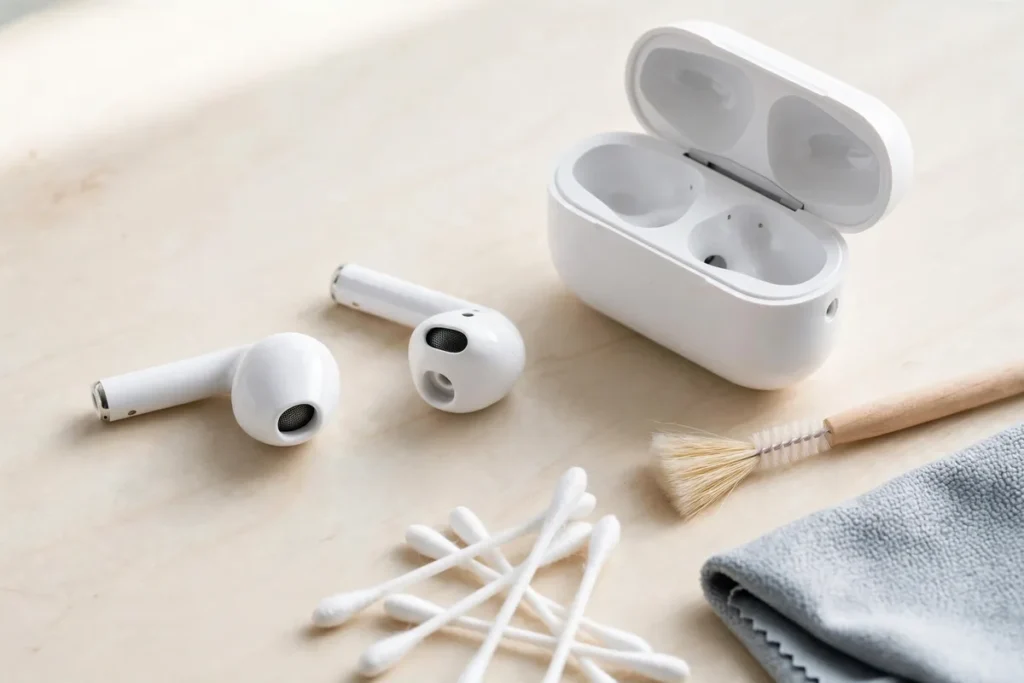
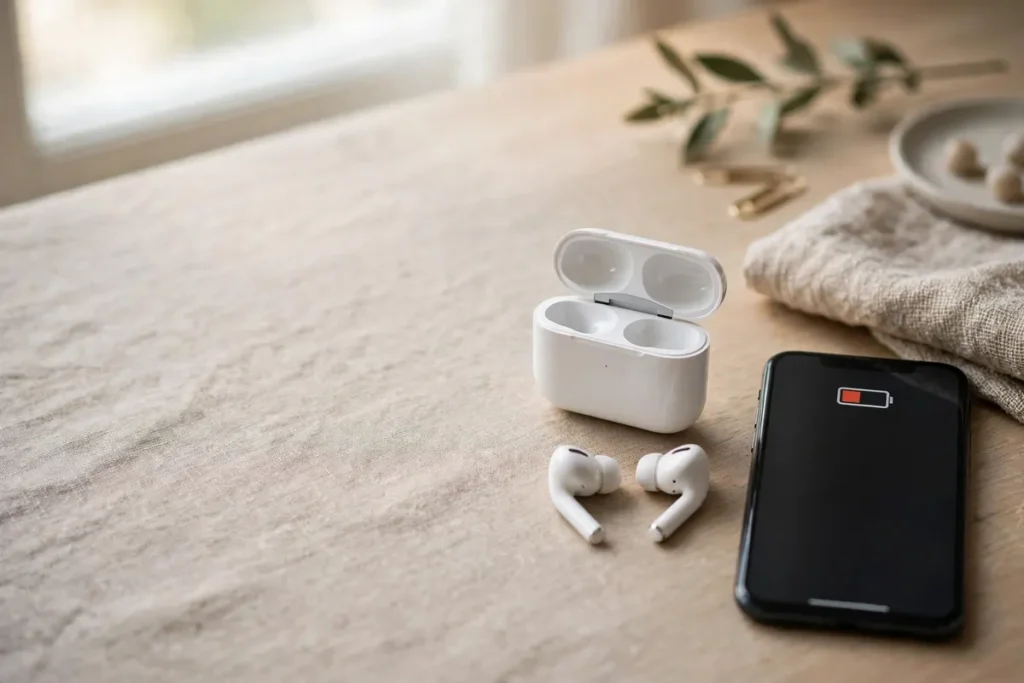
Battery wear announces itself gradually, and the pattern matters more than any single bad day. The reliable signs are these: a full charge that used to cover a workday now dies mid-afternoon; one earbud consistently gives up well before the other after both started full; the case needs charging far more often even on days you barely listen; and quick top-ups that once bought an hour now buy minutes. Crackling, dropouts or a dead microphone are faults, not wear, and they point to cleaning or service rather than age. A case or earbud that swells, separates or gets unusually hot is a safety issue: stop using it and contact Apple. Before you conclude anything, clean the charging contacts and run one timed session from a full charge, because a dirty contact imitates a dying battery almost perfectly.
The uneven-drain sign deserves one extra test before you blame the cells. Swap which earbud you take out of the case first for a few days: many people favour one side for calls and single-bud listening, so that side simply works more hours and ages faster, and the gap is usage, not a fault. If the same earbud still dies first after the swap, the wear is real and it is that earbud, which matters because Apple can service one side on its own.
When replacement beats repair
Apple’s battery service replaces a worn earbud or case individually, and under AppleCare+ it is free when capacity drops below 80 percent, so a single tired earbud is a service visit, not a new purchase. Replacement of the whole set makes sense when both earbuds are fading, the case is going with them, or the pair is old enough that a newer model’s noise cancelling and battery are a genuine step up. If you are at that point, the sensible default buy is the model our database scores highest for all-round use:

Apple AirPods Pro 2 (USB-C) 8.6/10
Why you: the all-round replacement for a worn pair: strong adaptive noise cancelling, six hours a charge and thirty with the case, and the deepest iPhone integration Apple makes.
Trade-off: most of the magic is Apple-only; on Android these are ordinary earbuds. And the same battery clock described above starts ticking on day one.
Adaptive ANC · 6-hour buds, 30 hours with case · IP54 · USB-C and wireless charging case
That card’s scores are our database’s canonical set for the AirPods Pro 2, the same ones used in our comparison of the AirPods Pro 3 vs AirPods Pro 2, which is the read that matters if your worn pair is a first-generation Pro and you are deciding whether the newer model earns the upgrade. Either way, judge your current pair by the timed-session test above before spending anything: plenty of supposedly dying AirPods are one contact clean away from another year of service.
How to make AirPods last longer
None of this stops the chemistry, but it slows it. Keep the case out of heat, especially cars. Use Optimized Battery Charging, which is on by default when AirPods are paired with an iPhone: it learns your routine and holds the charge below full until you are likely to need them, sparing the cells the most wearing state. Avoid running the earbuds to empty every day when a mid-day top-up in the case would do, since shallower cycles are gentler. Store a spare pair partly charged rather than flat, and give them a charge every few months. Finally, keep the earbuds and case contacts clean, because grime causes the failed charges that make owners cycle batteries harder than they need to. Readers weighing a fresh pair against these habits will find the current range compared in our best earbuds guide and our AirPods Pro 3 review.
Frequently asked questions
How long do AirPods last before the battery wears out?
For most daily users, two to three years before the decline becomes hard to ignore. The earbuds fade first: a pair rated for five or six hours when new commonly manages two to three hours by then. The charging case, with its larger battery and fewer deep cycles, usually stays useful for three to five years.
Can you replace the battery in AirPods?
Not yourself. The earbuds are sealed, and there is no user-replaceable battery. Apple offers a battery service that replaces the affected earbud or case for a fee, free under AppleCare+ when capacity falls below 80 percent. One worn earbud can be serviced on its own, which is much cheaper than a new set.
How do I check my AirPods battery health?
There is no battery-health percentage for AirPods as there is for iPhone, so judge by behaviour. Charge to full, then time a normal listening session and compare it with the model’s rated hours. If a six-hour model dies in three, the cells have lost roughly half their capacity. Uneven drain between the two earbuds is the other clear signal.
Do AirPods wear out if I do not use them?
Slowly, yes. Lithium-ion batteries age with time as well as use, and a case left empty in a drawer for months can drain low enough to damage itself. If you are storing AirPods, leave the case partly charged, keep it somewhere cool, and top it up every few months rather than leaving it flat.
How long should AirPods Pro last compared with regular AirPods?
About the same in years, and the Pro models often show wear sooner in hours, because noise cancelling draws more power per hour and racks up charge cycles faster. Expect two to three years of daily use from AirPods Pro before runtime drops sharply, matching the standard models. The case outlasts the buds in both lines.

I am the founder of Sound Mavericks, where I provide the polite truth about audio equipment. I started this site because consumer electronics reviews are often too technical. Instead of using a silent lab, I test headphones, earbuds, and Bluetooth speakers in the real world – like on a noisy subway or in a busy coffee shop.
To stay independent, I buy my own review units (mostly from the United States) rather than accepting free gifts from brands. Once I finish testing a product, I sell it locally to our community. My goal is to help you understand sound quality, active noise cancellation (ANC), and battery life without the marketing hype.