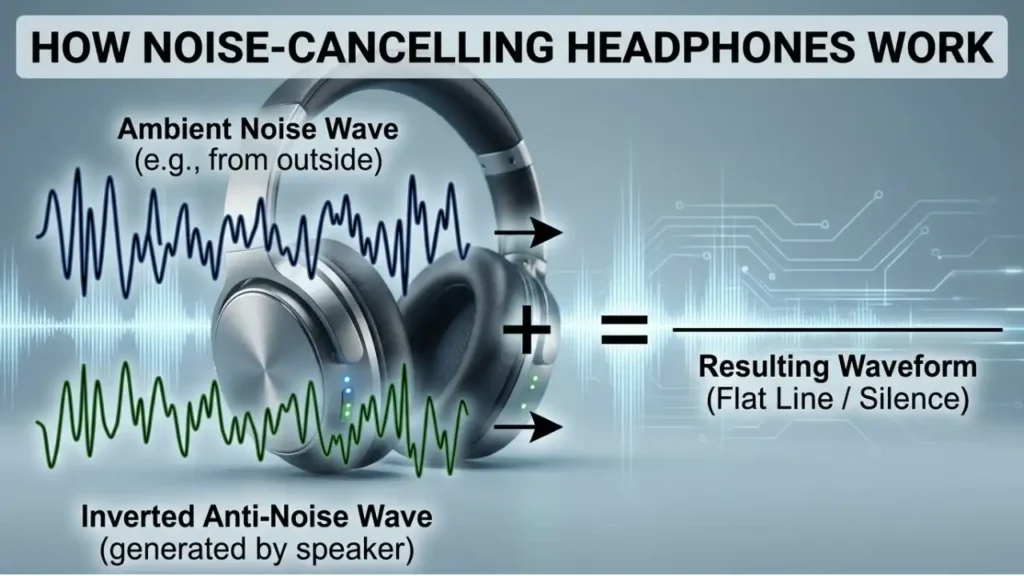
Getting headphone driver types explained properly starts with one idea: the driver is the motor. It is the part that turns an electrical signal into moving air, and its design sets the limits everything else works within. Tuning can flatter a driver or waste it, but it cannot change what the motor is good at. Four families cover almost everything you can buy: dynamic, planar magnetic, balanced armature and MEMS, plus hybrids that mix them. Here is what each one actually does, where it shows up, and what it means for the sound in your ears.
Dynamic drivers: the default for a reason
A dynamic driver is a small loudspeaker. A voice coil sits in the field of a fixed magnet, and a cone or dome diaphragm is attached to the coil. Current flows, the coil moves, the diaphragm pushes air. SoundGuys’ driver explainer describes the same three-part layout that Bose uses in its own guide: magnet, coil and diaphragm, a design shared with ordinary speakers and just as well understood.
That simplicity is why dynamic drivers are everywhere, from cheap earbuds to flagship over-ears. They move a lot of air for their size, so bass comes easily and sounds physical. They are cheap to build, easy to power from a phone, and tolerant of rough handling. Their weakness is control: a cone driven from its centre can flex and resonate, so cheap dynamic drivers smear detail, and even good ones need careful damping and tuning to stay clean at high volume.
The Sennheiser IE 200 shows what a single small dynamic driver does when the tuning is the priority: one 7mm driver per side, no crossover, no second driver to integrate, and a sound that stays coherent from bass to treble because nothing has to hand over to anything else.
Planar magnetic drivers: the whole surface moves
A planar driver replaces the cone with a flat, thin film. Conductive traces are printed across the film, and the film hangs between arrays of magnets. When the signal runs through the traces, the entire surface moves at once instead of being pushed from one point. Because the force is spread evenly, the diaphragm resists the flexing and breakup that limit dynamic drivers, and distortion stays low even as volume climbs.
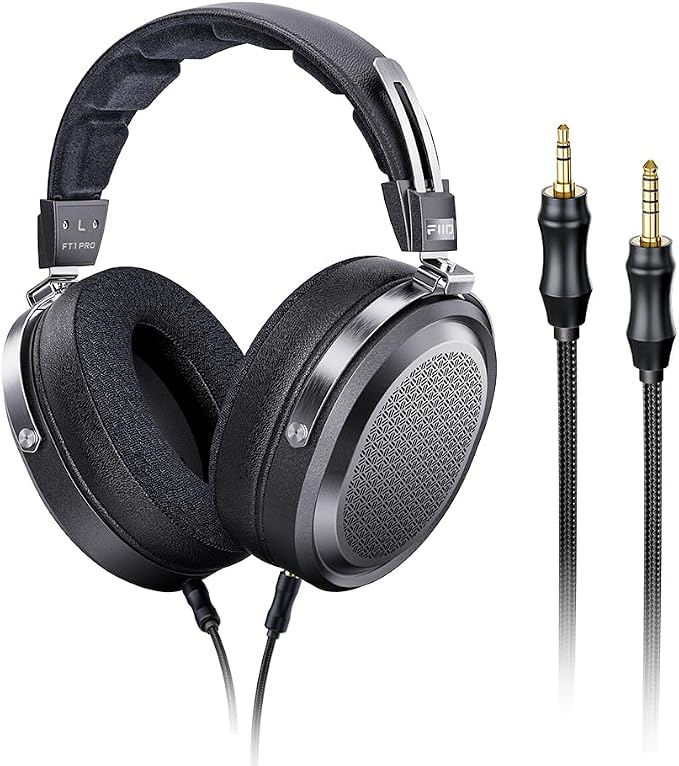
The costs are size, weight and appetite. The magnet arrays are big, so planar headphones tend to be large over-ears, and many want more power than a phone dongle gives happily. Most are open-back home headphones, which is why our dynamic vs planar magnetic drivers comparison treats them as a listening-at-home choice rather than a travel one. The FiiO FT1 Pro, covered in our FT1 Pro review, is the current value end of that world, and the wider field is rounded up in our guide to the best planar magnetic headphones.
Balanced armature drivers: small, precise, specialised
A balanced armature is a tiny sealed can. Inside, a small reed sits balanced between two magnets with a coil wrapped around it. The signal tips the reed, a drive rod carries the movement to a diaphragm, and sound comes out of a narrow spout. The design came from hearing aids, where small size and efficiency matter more than bass, and it still lives almost entirely inside in-ear monitors.
One armature covers a limited range well and the deep bass poorly, which is why you rarely see one working alone in a music earphone. Instead, makers stack them: two, four, eight or more per side, each assigned a slice of the range through a crossover. That gives very precise, fast treble and midrange, the house sound of stage monitors, at the cost of complexity. Every added driver is another crossover point that has to be tuned so the handovers stay invisible.
Hybrids: one driver per job
A hybrid earphone stops asking one driver to do everything. The common recipe is a dynamic driver for the low end, where moving air matters, and balanced armatures above it for detail. The 1MORE Penta Driver P50 takes the idea to five drivers a side: one dynamic driver under four armatures. Its low end has the weight a pure-armature set lacks, and its treble has the separation a single dynamic driver struggles to reach. The risk is the crossover region in the middle, where a clumsy handover makes vocals sound detached from the bass beneath them. Good hybrids are tuned as one system, not assembled as a parts list.
MEMS drivers: the chip in the earbud
MEMS stands for micro-electromechanical systems. A MEMS driver is built on silicon, like a chip, and moves its diaphragm through the piezoelectric effect rather than a coil and magnet. SoundGuys notes that MEMS speakers are sometimes called solid-state drivers for exactly that reason. Because they are manufactured like semiconductors, one unit matches the next with unusual precision, and the moving part is so light that it responds very fast, which flatters treble clarity.
MEMS drivers are still specialists. In the Creative Aurvana Ace 2, a MEMS driver handles the high frequencies while a conventional dynamic driver does the heavy lifting below, the same division of labour as a hybrid, with newer hardware. Expect the type to spread through wireless earbuds first, where its consistency helps mass production, rather than in big over-ear headphones.
One example of each family
Driver theory is easier to place with a real product attached to each type. These four cover the families above, and each one is a sensible buy for a listener who wants that family’s strengths.



Two types sit outside this article’s main four and deserve a sentence each. Electrostatic drivers charge a near-weightless film between perforated plates and sound superb, but they need a dedicated high-voltage amplifier, which keeps them in flagship home systems. Bone conduction drivers bypass the ear entirely and vibrate the cheekbone; they are an awareness tool for sport, not a fidelity rival to anything above.
So which type should you buy?
Match the family to the job. For wireless earbuds, over-ears and anything that has to survive a commute, dynamic drivers are the sensible default, and nearly every noise cancelling model uses one. For a quiet room and critical listening, planar magnetic earns its bulk. For stage work or very detailed in-ear listening, balanced armatures and hybrids built on them are the established tools. MEMS is worth hearing if treble clarity in a small earbud is your priority, and our Aurvana Ace 2 review covers the current example in full. In every case, treat driver type as a hint about character, then judge the specific model on its tuning, its fit and its measurements.
Frequently asked questions
What is a headphone driver?
It is the small transducer inside each earpiece that turns the electrical signal into sound: a magnet, a conductor and a diaphragm that moves air. Everything else in a headphone, the tuning, the housing and the electronics, exists to support or shape what that one part does.
Which driver type sounds best?
None of them, on its own. Driver type sets tendencies: dynamic drivers move air easily and suit bass, planar drivers keep distortion low, balanced armatures are small and precise, MEMS drivers are fast in the treble. Tuning decides the result, and a well-tuned dynamic driver beats a badly tuned planar every time.
Does a bigger driver mean better sound?
No. Size is just diaphragm diameter. A larger dynamic driver can move more air with less effort, which helps bass, but it says nothing about tuning, distortion or fit. Small balanced armatures in a good in-ear monitor resolve detail that plenty of large, cheap over-ear drivers smear.
Why do some earphones have several drivers?
So each driver only handles the part of the range it does best. A typical hybrid pairs a dynamic driver for the low end with balanced armatures for the mids and treble, joined by a crossover. Done well, it combines bass weight with treble precision. Done badly, the drivers fight at the crossover and the sound turns disjointed.
What is a MEMS driver?
A solid-state driver built like a computer chip, using the piezoelectric effect to move a tiny diaphragm. MEMS drivers are extremely consistent from unit to unit and very fast, which suits treble detail. They appear in earbuds such as the Creative Aurvana Ace 2, usually working alongside a conventional driver that handles the bass.

I am the founder of Sound Mavericks, where I provide the polite truth about audio equipment. I started this site because consumer electronics reviews are often too technical. Instead of using a silent lab, I test headphones, earbuds, and Bluetooth speakers in the real world – like on a noisy subway or in a busy coffee shop.
To stay independent, I buy my own review units (mostly from the United States) rather than accepting free gifts from brands. Once I finish testing a product, I sell it locally to our community. My goal is to help you understand sound quality, active noise cancellation (ANC), and battery life without the marketing hype.