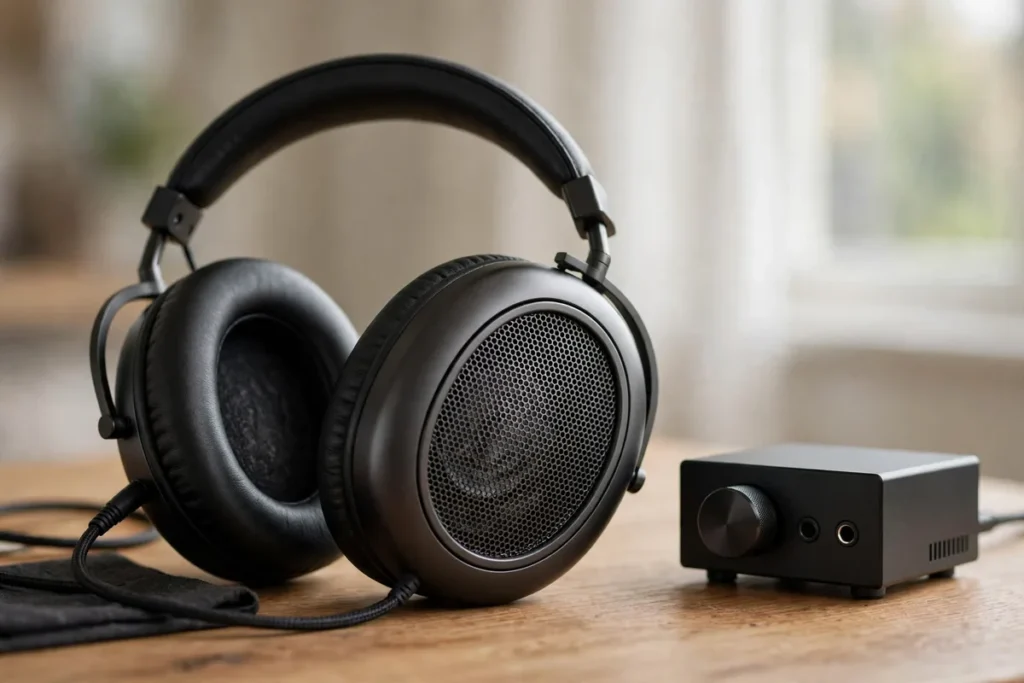
The best planar magnetic headphones share one trait: a flat diaphragm driven evenly across its surface, which keeps bass tight and detail intact where dynamic drivers start to smear. This list covers eight current models, from the entry-level HE400se to the Arya Stealth and the LCD-X, and it is honest about what the technology costs you: size, weight, and in most cases a wired connection at a desk.
Four of the eight picks carry scores from our published reviews and Finder listings. The rest are ranked on specifications, design and drive requirements until full scored reviews land. Every pick links to its exact Amazon listing.
| HiFiMan Sundara | Best overall | Check Price on Amazon |
| HiFiMan HE400se | Best budget pick | Check Price on Amazon |
| HiFiMan Edition XS | Best for soundstage | Check Price on Amazon |
| FiiO FT15 | Best build and finish | Check Price on Amazon |
| HiFiMan Ananda | Easiest flagship-grade drive | Check Price on Amazon |
| HiFiMan Arya Stealth | Best flagship open-back | Check Price on Amazon |
| Audeze LCD-X | Best for mixing and studio work | Check Price on Amazon |
| Audeze Maxwell | Best wireless and gaming planar | Check Price on Amazon |
How to read the scores: wired models take a neutral 5.0 placeholder for battery life and a 3.0 for calls when there is no microphone, which drags their overall number down even when the sound score is high. Judge the wired picks by the Sound bar first. Open-back models score low on noise cancelling by design: they block almost nothing.
1. HiFiMan Sundara: best overall

Why you: Planar speed and control at a price that undercuts most rivals. Bass stays flat and clean deep into the low end, imaging is precise, and the stage is wider than dynamic-driver headphones at this level manage.
Trade-off: Open-back, so it leaks sound both ways and belongs at a desk. Sensitivity is modest, so it sounds thin from a weak phone output and really wants a dongle DAC or small desktop amp.
ANC: None. Open-back, so it blocks almost nothing. Calls: No microphone. Battery: None, it is wired only. Scores are from our published review and Finder listing.
Check Price on AmazonThe Sundara is where most people should start. It has been the reference point for affordable planar sound for a long time because it gets the basics right: a near-flat low end, clean midrange and treble that resolves detail without turning harsh. Our full HiFiMan Sundara review covers the scoring in depth, including why the overall number sits lower than the sound score alone would suggest.
Drive requirements are the one catch. At 92 dB sensitivity it plays quietly from a laptop jack and opens up only with a dongle DAC or small desktop amp behind it.
2. HiFiMan HE400se: best budget pick

Why you: The cheapest route into genuine planar sound. It uses the same Stealth Magnet design as the bigger HiFiMan models, and the tuning is even enough that nothing jumps out or goes missing.
Trade-off: The stock cable is stiff and the headband padding is thin, so long sessions need a break. Build is mostly plastic and feels it.
We have not published a scored review of this model yet, so it earns its place here on specifications, design and drive requirements rather than a number.
Check Price on AmazonThe HE400se is the entry ticket. It shares the Stealth Magnet array with the Sundara but skips the supernano diaphragm, and the result is a slightly plainer, very honest sound that still shows the planar traits: tight bass, fast transients and separation that dynamic drivers at this level rarely match.
It is also easy to live with. The 25 ohm load runs from a phone dongle, and replacement pads and cables are cheap.
3. HiFiMan Edition XS: best for soundstage

Why you: Big oval cups and a very low 18 ohm load produce the widest, most layered stage in this price band, and it runs happily from a phone dongle. Detail retrieval is the stand-out here.
Trade-off: The fit is loose and the cups are large, so smaller heads may not get a stable seal. Open-back leakage rules it out for shared rooms.
We have not published a scored review of this model yet, so it earns its place here on specifications, design and drive requirements rather than a number.
Check Price on AmazonThe Edition XS is the step up for listeners who care most about space. The tall oval cups throw a stage that feels closer to speakers than headphones, and instruments sit in defined layers rather than a line between your ears. In our published coverage of wired headphones at this level, nothing resolves fine detail quite like it.
Check the fit before you commit. The cups are big and the clamp is gentle, which larger heads love and smaller heads sometimes cannot keep in place. It is desk equipment in every sense.
4. FiiO FT15: best build and finish

Why you: A 101 mm planar driver with a diamond-coated diaphragm thinner than a micron, set in walnut earcup frames. The presentation is warm and full, and at 24 ohms it is easy to drive well.
Trade-off: At 425 g it is a heavy headphone, and the open-back design leaks like every other pick here. The size rules it out for travel.
ANC: None. Open-back, so it blocks almost nothing. Calls: No microphone. Battery: None, it is wired only. Scores are from our published review and Finder listing.
Check Price on AmazonFiiO came late to full-size headphones and clearly studied the market first. The FT15 pairs its big planar driver with walnut frames and a carbon fibre headband, and it is tuned warmer than the HiFiMan picks, with more low-end body and a gentler top end. Our FiiO FT15 review has the full specification table and scoring.
The easy 24 ohm drive is part of the appeal. A capable dongle DAC runs it properly, so it suits listeners who want planar sound without building a desktop stack around it.
5. HiFiMan Ananda: easiest flagship-grade drive

Why you: The current Stealth Magnet version pairs a large window-shade grille with 103 dB sensitivity, so it plays loud and open from almost any source. The stage is tall as well as wide.
Trade-off: The suspension strap fit divides opinion and the cups do not fold, so it lives on a stand. Bass is lean compared with the Audeze picks.
We have not published a scored review of this model yet, so it earns its place here on specifications, design and drive requirements rather than a number.
Check Price on AmazonThe Ananda sits in a useful gap: flagship-style presentation, sensible drive requirements. The 103 dB sensitivity is the highest of the wired picks, so it reaches full volume from portable players and interfaces that leave the Arya sounding flat.
Tonally it leans bright and airy, with a stage that feels tall. Listeners who want weight in the low end should look at the LCD-X instead.
6. HiFiMan Arya Stealth: best flagship open-back

Why you: The nanometer-thickness diaphragm and Stealth Magnet array deliver the most complete open-back presentation in the HiFiMan line below the flagships: deep, controlled bass, fine detail and a stage that wraps around the head.
Trade-off: It needs a real amplifier to show what it can do, and the 430 g frame is a lot to wear. This is a considered purchase, not an impulse one.
We have not published a scored review of this model yet, so it earns its place here on specifications, design and drive requirements rather than a number.
Check Price on AmazonThe Arya Stealth is the connoisseur pick in this list. Its diaphragm is measured in nanometers, the magnet array is shaped so sound passes through with minimal diffraction, and the payoff is a stage that extends well outside the cups with bass that stays textured at low volume.
It is also the most demanding wired pick here. Feed it a weak output and it sounds polite and distant; feed it a proper desktop amplifier and it scales further than anything else here.
7. Audeze LCD-X: best for mixing and studio work

Why you: The studio reference of this group. The 106 mm drivers hold together at any volume, imaging is pinpoint, and the low 20 ohm load with high sensitivity means it runs from an audio interface without strain.
Trade-off: It weighs 612 g, which is the heaviest here by a wide margin, and long sessions test your neck. Wired only, with a price to match the build.
ANC: None. Open-back, so it blocks almost nothing. Calls: No microphone. Battery: None, it is wired only. Scores are from our published Finder listing for this model.
Check Price on AmazonThe LCD-X earns its place on accuracy. Engineers use it because what you hear is close to what is in the recording: no padded bass, no sweetened treble, and imaging stable enough to place individual parts in a mix. The metal and leather build is built for daily studio use.
Comfort is the tax. At 612 g it is close to double the Sundara, and for two-hour mixing sessions that matters more than the last degree of detail.
8. Audeze Maxwell: best wireless and gaming planar

Why you: The one closed-back, wireless pick: 90 mm planar drivers, a low-latency USB dongle, Bluetooth and a battery rated past 80 hours. Positional accuracy in games is excellent, and the detachable boom mic is the best in this list by a distance.
Trade-off: At 490 g it is heavy for long ranked sessions, and the closed-back stage is narrower than the open-back picks. It is a headset first, so it looks like one.
ANC: None, isolation is passive from the closed cups. Calls: Detachable broadcast-quality boom mic. Scores are from our published Finder listing for this model.
Check Price on AmazonEvery other pick here is a wired, open-back desk headphone. The Maxwell is the exception that proves how far planar drivers have spread: closed-back, wireless, and built for games, with planar speed behind the sound. Footsteps and directional cues are easy to place, and music holds up far better than most gaming headsets.
The microphone is the real gap over the rest of the list: the wired picks have no mic at all, while the Maxwell carries a proper broadcast boom for voice chat and calls.
All eight picks compared
| Model | Design | Impedance | Weight | Our score | Buy |
|---|---|---|---|---|---|
| HiFiMan Sundara | Open-back | 32 Ω | 342 g | 6.1 | Check Price on Amazon |
| HiFiMan HE400se | Open-back | 25 Ω | 390 g | Not scored yet | Check Price on Amazon |
| HiFiMan Edition XS | Open-back | 18 Ω | 405 g | Not scored yet | Check Price on Amazon |
| FiiO FT15 | Open-back | 24 Ω | 425 g | 6.0 | Check Price on Amazon |
| HiFiMan Ananda | Open-back | 25 Ω | 399 g | Not scored yet | Check Price on Amazon |
| HiFiMan Arya Stealth | Open-back | 32 Ω | 430 g | Not scored yet | Check Price on Amazon |
| Audeze LCD-X | Open-back | 20 Ω | 612 g | 5.6 | Check Price on Amazon |
| Audeze Maxwell | Closed-back, wireless | 32 Ω | 490 g | 8.0 | Check Price on Amazon |
Buying guide: what to know before you choose
What planar drivers actually do differently
A dynamic driver moves like a piston from one motor at its centre, and the cone can flex and break up at high output. A planar diaphragm is driven across its whole area at once, so it starts and stops faster and stays composed in busy passages. The trade is physical: the magnet arrays that make it work are wide and heavy. Our dynamic vs planar magnetic drivers explainer walks through the engineering in plain language.
Do you need an amp?
Impedance alone does not answer this. A low-impedance, low-sensitivity headphone like the Sundara can still starve on a laptop jack, while the high-sensitivity Ananda plays loudly from almost anything. As a rule, the picks here with sensitivity of 94 dB or lower deserve a desktop amp or a strong dongle DAC. Our guide to impedance and whether you need an amp explains how to match a source to a headphone.
Open-back is the default, and it sets the rules
Seven of these eight picks are open-back, which means they are for quiet rooms and private listening. They leak your music to the room and let the room in, and no amount of money changes that. If you listen near other people, the closed-back Maxwell or a sealed dynamic headphone is the practical answer. Our best open-back headphones roundup covers the wider field, planar and dynamic alike.
Frequently asked questions
What makes planar magnetic headphones different from dynamic headphones?
A planar magnetic driver moves a flat, ultra-thin diaphragm evenly across its whole surface, driven by magnets on one or both sides. A dynamic driver pushes a cone from a single voice coil at its centre. The planar approach usually brings tighter bass, lower distortion and faster transients, at the cost of size, weight and often a higher price.
Do planar magnetic headphones need an amplifier?
Some do, some do not. Sensitivity matters more than impedance on its own. The Ananda at 103 dB and the Edition XS at 18 ohms run well from a phone dongle, while the Sundara and Arya Stealth sound flat from weak outputs and need a dongle DAC with real power or a desktop amp. If a pick here lists sensitivity under 95 dB, plan on an amp.
Are planar magnetic headphones good for gaming?
Yes, with the right pick. The Audeze Maxwell was built for it, with a wireless dongle, a proper microphone and planar imaging for positional cues. The open-back wired picks also image very well for single-player games, but they leak sound and have no microphone, so you would need a separate mic for voice chat.
Should I choose open-back or closed-back planar headphones?
Open-back models sound wider and more natural, and nearly every respected planar is open-back. They leak sound in and out, so they suit quiet rooms. Closed-back models isolate you from the room and the room from you, which suits shared spaces, offices and travel. In this list only the Maxwell is closed-back.
What is the best budget planar magnetic headphone?
The HiFiMan HE400se. It carries the Stealth Magnet design of the bigger HiFiMan models, a balanced tuning and an easy 25 ohm drive, at the lowest price in this roundup. The Sundara is the better headphone, but the HE400se is where the value sits.

I am the founder of Sound Mavericks, where I provide the polite truth about audio equipment. I started this site because consumer electronics reviews are often too technical. Instead of using a silent lab, I test headphones, earbuds, and Bluetooth speakers in the real world – like on a noisy subway or in a busy coffee shop.
To stay independent, I buy my own review units (mostly from the United States) rather than accepting free gifts from brands. Once I finish testing a product, I sell it locally to our community. My goal is to help you understand sound quality, active noise cancellation (ANC), and battery life without the marketing hype.