
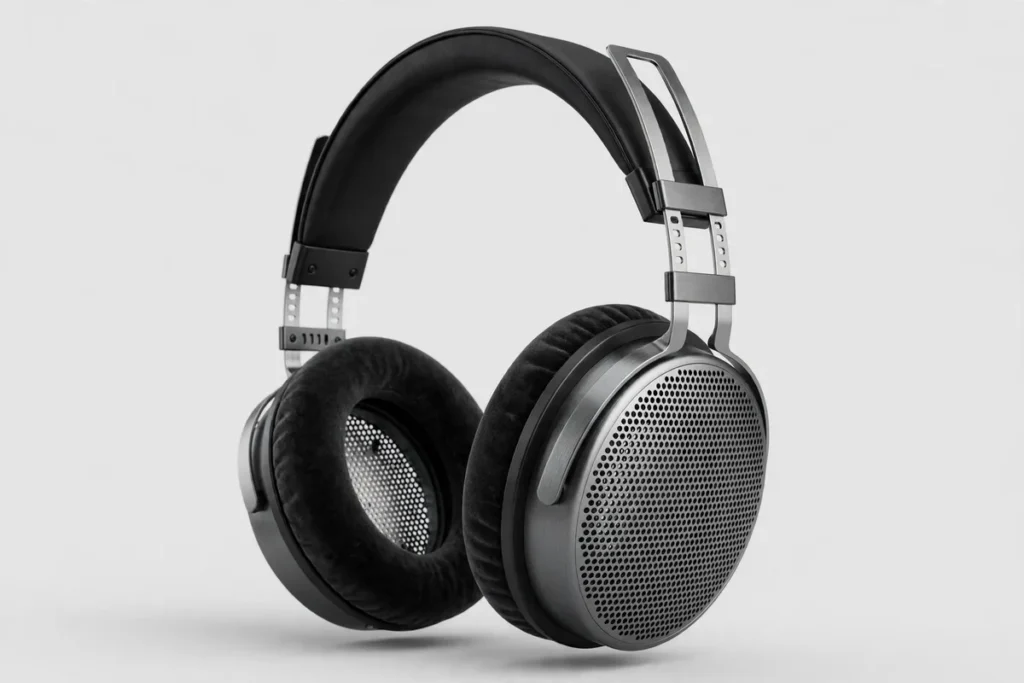
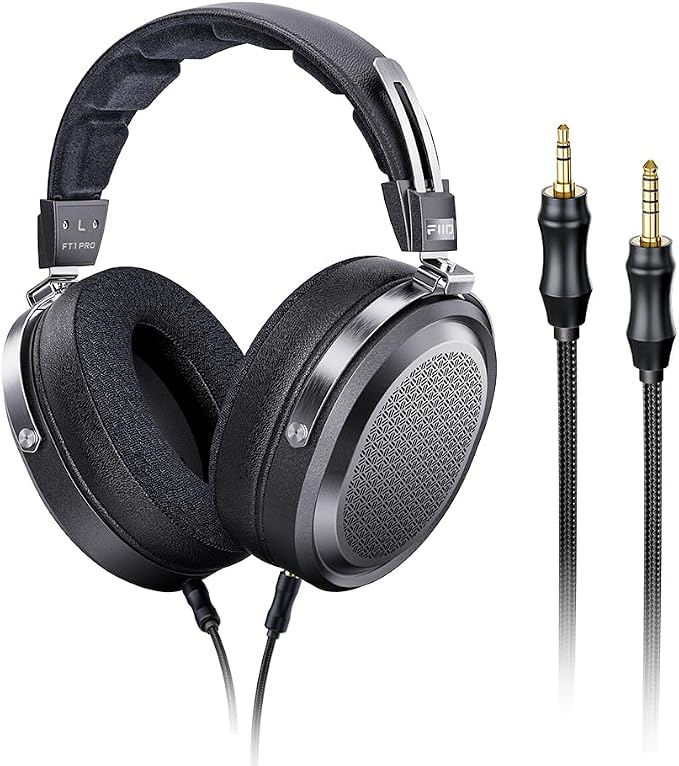
This FiiO FT1 Pro review covers FiiO’s open-back planar magnetic headphone: a large in-house driver, a near-neutral tuning and a box of accessories that embarrasses most rivals at its level. It is listed on Amazon US in black and blue. It also shares a name, a chassis and a cable set with the FT1, which is a different headphone: closed-back, with a dynamic driver and wooden cups. Keeping the two apart matters, because almost everything about how they sound and where they work follows from that split.
This is a research review. We have not tested the FT1 Pro on our own heads, so the verdict below is built from FiiO’s published specifications and published measurement data. The score is provisional.
FiiO FT1 Pro 6.1/10 provisional
Why you: you want planar speed and real sub-bass extension at a desk, from a headphone that a phone dongle can drive properly, with a balanced cable and a hard case already in the box.
Trade-off: it leaks sound in both directions by design, there is no microphone on either cable, and the top octave is polite, so listeners who want sparkle and air above the music should look at the Sundara instead.
Planar magnetic 95 × 86 mm driver · Open-back · 20 Ω · 374 g · 7 Hz to 40 kHz · Two detachable cables
The score, explained: 6.1 with three wired-model bars
Our overall score is 6.1, the mean of the six bars above, and three of those bars grade things a wired open-back only partly tries to do. Battery scores 5.0 because there is no battery. The FT1 Pro is wired, and 5.0 is the neutral placeholder we give wired models so they can sit in the same table as wireless ones. Calls & mic scores 3.0, and that one is a real limitation: neither included cable has a microphone, so calls and voice chat mean separate hardware. Noise cancelling scores 2.0 because an open-back has no cancelling system and no seal. Sound passes through the grilles in both directions, which is the design working as intended, not a fault.
The bars the FT1 Pro actually competes on tell the real story. Sound scores 8.8 on a tuning that published measurements consistently read as close to neutral, with sub-bass extension most open-backs at this level cannot match. Comfort scores 8.5 on deep velour pads and a well-spread weight, with the fit notes covered below. Value scores 9.1 because the box holds a large in-house planar driver, two cables including a balanced one, and a hard case, a package that used to mean spending far more. Read the 6.1 as a wired desk headphone graded on a wireless scorecard, then judge it on Sound, Comfort and Value.
Sound: near-neutral, with weight down low
The driver is the headline. FiiO builds its own planar magnetic driver for this headphone, a 95 × 86 mm unit with a diaphragm rated at 1 micron thin, coated with sapphire and aluminium to stiffen it and improve conductivity, and driven across a magnetic field FiiO designs to be uniform over the whole surface. A planar driver moves its full diaphragm at once instead of flexing from a central voice coil, and our explainer on dynamic vs planar magnetic drivers covers what that buys in speed and distortion.
The bass is where the FT1 Pro separates itself from the open-back field. Most open designs give up the lowest octave early. This one holds its level deep into the sub-bass and stays controlled doing it, so electronic lows and kick drums have genuine foundation rather than a hint of one. It is not a bass-head lift. The low end sits level with the midrange, tight rather than swollen, and that balance is what makes the tuning work across genres instead of suiting one playlist.
The midrange is full and natural, with voices and guitars carrying proper body. Published measurements show a shallow dip through the upper midrange, roughly between 1.5 and 2.5 kHz, and some listeners hear vocals set a half-step back because of it. Others never notice. A small EQ lift in that region is the standard fix, and the driver takes EQ cleanly. Above that, the treble is present and detailed but the top octave is restrained. Long sessions stay fatigue-free, and the cost is a little air and sparkle compared with the brightest rivals. If your taste runs to bite and shimmer up top, that restraint is the main reason to shop elsewhere.
Imaging is precise, with instruments placed at clear points, and the stage is wide for the class, which flatters orchestral and live recordings. Dense mixes stay separated instead of collapsing into a wall of sound. Taken together, the tuning reads warm-neutral: calm on top, honest in the middle, and unusually complete at the bottom for an open-back at this level.
Design, comfort and build
The FT1 Pro borrows its chassis from the FT1: a steel-railed headband with 12 levels of adjustment, round cups behind perforated aluminium grilles, and deep pads with a velour contact surface. It weighs 374 g, which is not light in absolute terms, but the weight spreads well and the clamp starts firm, then settles. Long-session comfort is one of the points outside reviewers agree on most, with multi-hour wear raising few complaints beyond ears warming inside the pads, as sealed pads tend to cause. A minority of owners report a pressure spot at the top of the headband, which is the usual fit lottery of a one-shape-fits-most band.
Two ownership notes are worth knowing before you buy. Some owners of early units reported loose screws at the cup hinges, and a small number report a buzz on very low bass notes. Both are the kind of fault a careful first-week check catches, and both argue for buying from a seller with straightforward returns. Neither changes what the headphone is when it is right. It comes in black or blue, and the finish and machining sit a clear step above the price class it plays in.
Power, cables and the missing microphone
Here is the FT1 Pro’s quiet advantage: it is genuinely easy to drive. The impedance is 20 Ω and sensitivity is 95 dB/mW (112 dB/Vrms), so a phone, a laptop socket or a basic dongle DAC gets it loud with headroom to spare, and the bass stays gripped at normal volumes. Plenty of planars punish weak sources; this one was designed not to. If impedance and sensitivity numbers are new to you, our explainer on impedance and when you need an amp walks through why the sensitivity figure matters more than the ohm rating. A better amp still scales it a little, and the balanced cable below will use one if you have it, but an amp is an upgrade here, not an entry fee.
The box holds two detachable cables: a 3.5 mm single-ended cable for everyday sources and a 4.4 mm balanced cable for amps and players with a balanced output. Both detach at the cups, so a damaged cable is a small replacement purchase rather than a repair. A hard storage case is included as well, which most rivals at this level sell separately or skip. What the box does not hold is a microphone. Neither cable has one, there is no wireless version of this headphone, and call-heavy users need a separate mic.
FiiO FT1 Pro specifications
| Product | FiiO FT1 Pro |
| Design | Open-back, over-ear |
| Driver | Planar magnetic, 95 × 86 mm, 1 µm diaphragm with sapphire and aluminium dual coating |
| Frequency response | 7 Hz to 40 kHz |
| Impedance | 20 Ω |
| Sensitivity | 95 dB/mW (112 dB/Vrms) |
| Weight | 374 g |
| Cables | Two detachable cables: 3.5 mm single-ended and 4.4 mm balanced |
| Case | Hard storage case included |
| Microphone | None on either included cable |
| Check Price | Check Price on Amazon |
FiiO FT1 Pro vs HiFiMan Sundara
The Sundara is the standing benchmark in this class, and our HiFiMan Sundara review covers it in full. Both are open-back planars aimed at desk listeners. They differ in tuning emphasis, in how much source they demand, and in what arrives in the box.
| FiiO FT1 Pro |  HiFiMan Sundara | |
|---|---|---|
| Design | Open-back, over-ear | Open-back, over-ear |
| Tuning | Warm-neutral, deep sub-bass, restrained top octave | Close to neutral, more air and sparkle up top |
| Drive | 20 Ω, 95 dB/mW: runs properly from a phone or dongle | 32 Ω, 92 dB: wants a small amp or a strong dongle |
| In the box | Two cables (3.5 mm and 4.4 mm balanced), hard case | One 1.5 m cable, no case |
| Weight | 374 g | 342 g |
| Microphone | None | None |
| Best for | Easy drive, long relaxed sessions, a complete bundle | Top-end detail and an established track record |
| Check Price | Check Price | Check Price |
Pick the FT1 Pro if your source is a phone, a laptop or a dongle and you want the headphone to just work at full quality, or if the balanced cable and hard case save you two extra purchases. Pick the Sundara if you already run a small amp and your taste runs to air and bite in the treble. Neither isolates, neither has a microphone, and neither belongs on a train. They are desk instruments, and both are good ones.
Who should buy the FiiO FT1 Pro
Buy it if this is your first planar magnetic headphone and you want the tuning the measurement crowd agrees on, without buying an amp first. Buy it if you listen for hours at a time and value a calm top end over a sparkling one. Buy it if you listen across genres and want sub-bass that most open-backs cannot produce.
Skip it if you share a room or an office, because the open back leaks your music out and the room in. Skip it if your listening runs on calls or voice chat, because there is no microphone and fixing that means extra hardware. And skip it if wooden cups and isolation are the point; that headphone exists, and it is the closed-back FT1, a different model entirely.
Frequently Asked Questions
Does the FiiO FT1 Pro need an amp?
No. At 20 Ω with 95 dB/mW sensitivity, phones, laptops and basic dongle DACs drive it to full volume with headroom. A better amp improves control slightly, and the included balanced cable will use one if you own one, but an amp is optional.
What is the difference between the FiiO FT1 and the FT1 Pro?
They are different headphones that share a chassis, a cable set and most of a name. The FT1 is closed-back with a dynamic driver and wooden cups, so it isolates and suits shared spaces. The FT1 Pro is open-back with a planar magnetic driver, leaks sound both ways, and is tuned nearer to neutral. This review covers the FT1 Pro only.
Does the FiiO FT1 Pro have a microphone?
No. Neither included cable has a microphone or remote. For calls and voice chat you need a separate microphone.
Is the FiiO FT1 Pro good for gaming?
For single-player games, yes. Its imaging is precise and its stage is wide, which places effects and footsteps well. For voice chat you need a separate microphone, and the open back leaks sound in shared rooms.
Does the FiiO FT1 Pro leak sound?
Yes, in both directions. The open-back grilles pass sound freely, so people nearby hear what you play and you hear the room. It is a quiet-room headphone.
What comes in the box with the FiiO FT1 Pro?
Two detachable cables, one 3.5 mm single-ended and one 4.4 mm balanced, plus a hard storage case. That bundle is unusually complete for this class, where a second cable and a case are normally extra purchases.
Final verdict
The FT1 Pro earns its place by removing the usual planar compromises one by one. It does not need an amp. It does not need a second cable purchase or a case. Its tuning is the one the measurement rigs keep agreeing on, extended at the bottom and calm at the top. The 6.1 headline undersells it, because three of the six bars grade a battery, a microphone and a cancelling system it never claimed to have. On the bars that describe the headphone itself (Sound 8.8, Comfort 8.5, Value 9.1) it is the easiest open-back planar to recommend to a first-time buyer, and a genuinely hard one for the Sundara to answer.

I am the founder of Sound Mavericks, where I provide the polite truth about audio equipment. I started this site because consumer electronics reviews are often too technical. Instead of using a silent lab, I test headphones, earbuds, and Bluetooth speakers in the real world – like on a noisy subway or in a busy coffee shop.
To stay independent, I buy my own review units (mostly from the United States) rather than accepting free gifts from brands. Once I finish testing a product, I sell it locally to our community. My goal is to help you understand sound quality, active noise cancellation (ANC), and battery life without the marketing hype.
