
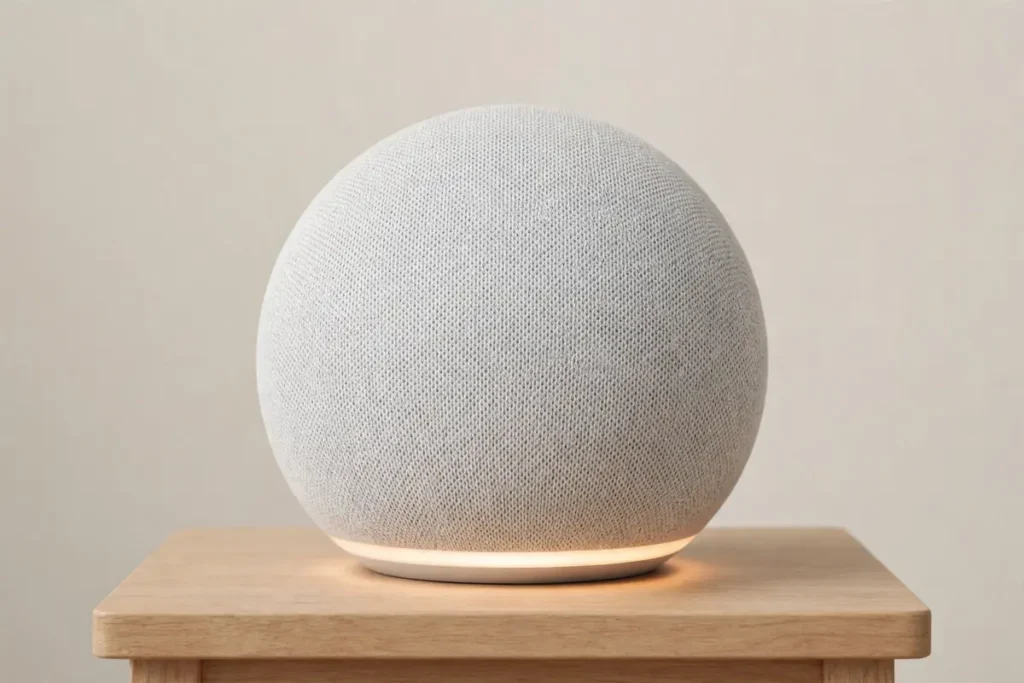
This Google Home Speaker review covers the new Google speaker built around Gemini for Home, the model that replaces both the Nest Mini and the Nest Audio in Google’s line. It is a compact fabric-covered ball with a single 58 mm driver, 360-degree sound, and a proper smart home hub inside: Wi-Fi 6, Bluetooth 5.4, a Thread border router and Matter control. This review is research-based. We have not tested the speaker hands-on; the verdict below is built from Google’s published specifications and the first wave of independent reviews, and we say plainly where reports disagree.
One buying note up front. Google sells this speaker through its own store and major electronics retailers. Amazon availability is inconsistent, and no verified Amazon product listing could be confirmed at the time of writing, so the buy buttons in this review point to tagged Amazon search results for the model rather than to a specific listing. Check that any result you land on is the Gemini model described here, in one of the four colours listed in the spec table, and not the older discontinued Google Home, which still circulates through import sellers.
Buy the Google Home Speaker if your home already runs on Google: lights, locks, cameras and routines in the Google Home app. Gemini for Home is the headline here. Conversations run longer and looser than the old assistant allowed, follow-up questions work, and the built-in Thread border router means this small speaker also becomes the hub that ties Matter devices together. Sound is the compromise. A single 58 mm driver fills a kitchen or bedroom with even, room-friendly audio, but it gives up the weight and stereo separation of the larger Nest Audio it replaces. Treat it as a smart speaker first and a music speaker second, and it makes sense. Check Price on Amazon
Why you: It is the first Google speaker designed for Gemini from the start, with a dedicated neural processor for faster on-device responses, natural follow-up conversation, and a full hub inside: Wi-Fi 6, Thread border routing and Matter control in a ball that fits on a shelf corner.
Trade-off: One small driver does the whole audio job, so bass depth and volume headroom sit below bigger smart speakers, and the richest Gemini features, including detailed camera history summaries, sit behind a Google Home Premium subscription after the included trial.
Google Home Speaker specifications
| Spec | Google Home Speaker |
|---|---|
| Driver | 58 mm full-range driver, omni-directional 360-degree sound |
| Voice assistant | Gemini for Home with Voice Match |
| Processor | Quad-core A55 at 2.0 GHz with dedicated NPU |
| Memory and storage | 1 GB LPDDR4 RAM, 4 GB eMMC storage |
| Wireless | Wi-Fi 6 (2.4 GHz and 5 GHz), Bluetooth 5.4, Google Cast |
| Smart home | Matter controller and hub, Thread 1.3 border router |
| Microphones | 3 far-field microphones, two-stage hardware mic off switch |
| Controls | Capacitive touch, three touch areas; light ring at the base |
| Dimensions | 106.7 mm diameter x 86.4 mm high (4.2 in x 3.4 in) |
| Weight | 408 g (about 0.9 lb), device only |
| Power | Mains only, no battery; 30W USB-C adapter; 1.5 m captive power cable |
| Colours and materials | Porcelain, Hazel, Jade, Berry; 3D-knit fabric made with recycled materials |
Specifications from Google’s published device specification page. Weight is Google’s US figure; some early retailer listings quoted a slightly lower weight.
Design: a small fabric ball that disappears into a room
The shape is a flattened sphere, closer to a wide pebble than a cylinder. At 106.7 mm across and 86.4 mm tall it takes up less shelf space than the tall Nest Audio, and the 3D-knit fabric wrap gives it a soft, furniture-like finish. Four colours cover most rooms: Porcelain is the pale neutral, Hazel the dark grey, and Jade and Berry add a muted green and a red for people who want the speaker visible. Google says the build uses a significant share of recycled material, including the knit, and the packaging is plastic-free.
There are no physical buttons on show. Playback and volume run through three capacitive touch areas on top, and a light ring around the base glows while Gemini listens and answers, which reads clearly from across a room. The one real hardware control is the microphone switch, a two-stage physical off switch. Flip it and the mics are electrically off, not just muted in software. That matters in a bedroom.
Two practical catches. The power cable is captive: a 1.5 m lead fixed to the speaker, feeding a 30W USB-C adapter. If the cable is too short for your shelf, there is no longer cable to swap in. And there is no battery and no audio input socket, so this speaker lives in one spot, plugged in, and plays only what arrives over Wi-Fi or Bluetooth.
Sound: even coverage, modest muscle
A single 58 mm full-range driver fires in every direction, and that shapes the whole listening experience. Put the speaker in the middle of a kitchen and the sound stays consistent as you move around it; there is no sweet spot to hunt for and no dead side. Google rates the driver at twice the size of the one in the Nest Mini, with noticeably stronger bass than that small speaker, and early reviews line up with that positioning: clear voices, tidy midrange, podcasts and radio that sound natural at breakfast volume.
The limits show up with music at volume. One small driver cannot move much air, so deep bass is suggested rather than felt, and busy tracks can harden at the top end when you push it. The older Nest Audio used separate woofer and tweeter units and still sounds bigger and more composed as a pure music speaker. If music quality is the main job, the honest advice is to look at a larger speaker, or at the powered and wireless options in our best budget wireless speakers guide, and treat this Google speaker as the voice and control point of the room.
For its actual brief, the tuning works. Spoken content is the daily workload in most kitchens and bedrooms: news briefings, timers with talkback, podcasts while cooking, video calls routed through the house. A forward, clear midrange serves all of that better than a bass-heavy curve would. Two speakers can also be paired for stereo and grouped for multi-room playback through the Google Home app, which is the sensible upgrade path if one room outgrows a single unit.
Gemini for Home: the actual reason this speaker exists
The old Google Assistant answered one command at a time and punished vague phrasing. Gemini for Home is built for normal speech. You can stack requests in one sentence, correct yourself halfway through, and ask a follow-up without repeating the context. Ask it to dim the kitchen, start a playlist and set a pasta timer, and it works through the list. Voice Match still separates the people in the house, so calendars, reminders and personal results stay attached to the right voice.
The hardware helps. A quad-core processor with a dedicated neural processing unit handles more of the listening work on the device itself, which trims the pause between a request and a response. Routine commands feel snappier than they did on the older speakers, and the speaker copes better when the internet connection stumbles, though anything that needs live information still needs the cloud.
Now the caveat, and it is a real one. The most advanced Gemini abilities sit behind Google Home Premium, Google’s subscription for the home. The speaker includes a trial of the standard plan, and once that ends, features such as Gemini Live’s open-ended conversation mode and detailed summaries of what your cameras recorded move behind the paywall. The core assistant, smart home control and media playback keep working without it. Go in expecting the free tier to be the product, and treat the trial as a test of whether the extras earn their keep in your house.
Smart home hub: Thread and Matter in a small box
This is where the speaker quietly outclasses the models it replaces. Inside is a Thread 1.3 border router and a Matter controller, so the speaker works as a hub for the Google Home app rather than just an endpoint. Matter lights, plugs, locks and sensors from different brands can join through it, and Thread devices get their low-power mesh connection without a separate hub box sitting by your router.
For a house starting its smart setup, that removes a purchase and a layer of setup friction. For a house that already runs Matter gear through another hub, the speaker still adds a second border router, which strengthens the mesh at the far end of a home. Wi-Fi 6 support is the other future-proofing step: the speaker will not be the device dragging an older wireless standard onto a modern network. Our guide to speaker brands covers how the big ecosystems compare if you are choosing a platform rather than a single product.
Everyday use: mics, calls and controls
Three far-field microphones handle voice pickup, and early reviews rate pickup as reliable across a room at normal speaking volume, including over moderate kitchen noise. The physical mute switch answers the privacy question cleanly, and the light ring makes the speaker’s listening state visible at a glance, which households with kids tend to appreciate.
Bluetooth 5.4 covers direct playback from a phone or laptop, and Google Cast handles streaming from Cast-enabled apps, which between them cover most listening that does not start with a voice command. There is no line-in, so a turntable or an older player cannot plug straight in; a setup built around wired sources belongs with the speakers in our best powered speakers guide instead.
Who should buy it, and who should skip it
Buy it if your home already lives in the Google Home app, you want an assistant that handles follow-up questions and multi-part requests, or you need a Thread border router and Matter hub without adding another box. It also suits anyone replacing a Nest Mini who wants the same footprint class with a bigger driver and a far better brain.
Skip it if music quality is the priority: a larger smart speaker or a proper powered pair will serve you better for the same shelf. Skip it if your home runs on Alexa or HomeKit as its main platform, since Gemini for Home is a Google-ecosystem product. And skip it if the subscription model bothers you on principle: the hardware is fairly priced as a hub and speaker, but the best software features are rented, not owned.
Frequently asked questions
Is the Google Home Speaker the same as the original Google Home?
No. The original Google Home is a discontinued taller speaker from an earlier generation, built for the old Google Assistant. This Google Home Speaker is a new, smaller fabric ball built for Gemini for Home, with Wi-Fi 6, a Thread border router and Matter support the original never had. Be careful on marketplaces: import listings for the old model still appear, and they are not this speaker.
Does the Google Home Speaker need a subscription?
No. Voice control, media playback, smart home control and hub duties work without one. A Google Home Premium subscription, with a trial included, adds the most advanced Gemini features, such as Gemini Live conversation and richer camera history summaries.
Can the Google Home Speaker work as a smart home hub?
Yes. It is a Matter controller and hub for the Google Home app and includes a Thread 1.3 border router, so compatible lights, plugs, locks and sensors can connect through it without a separate hub.
How does the Google Home Speaker sound for music?
Its single 58 mm driver produces clear, even 360-degree sound that suits podcasts, radio and casual listening in small to medium rooms. Bass depth and maximum volume are modest, so listeners who put music first should look at a larger speaker.
Does the Google Home Speaker have a battery or an aux input?
Neither. It is mains powered through a captive 1.5 m cable and a USB-C adapter, and audio arrives over Wi-Fi or Bluetooth 5.4. There is no battery for moving it between rooms and no socket for wired sources.

I am the founder of Sound Mavericks, where I provide the polite truth about audio equipment. I started this site because consumer electronics reviews are often too technical. Instead of using a silent lab, I test headphones, earbuds, and Bluetooth speakers in the real world – like on a noisy subway or in a busy coffee shop.
To stay independent, I buy my own review units (mostly from the United States) rather than accepting free gifts from brands. Once I finish testing a product, I sell it locally to our community. My goal is to help you understand sound quality, active noise cancellation (ANC), and battery life without the marketing hype.

